 Serpa
Serpa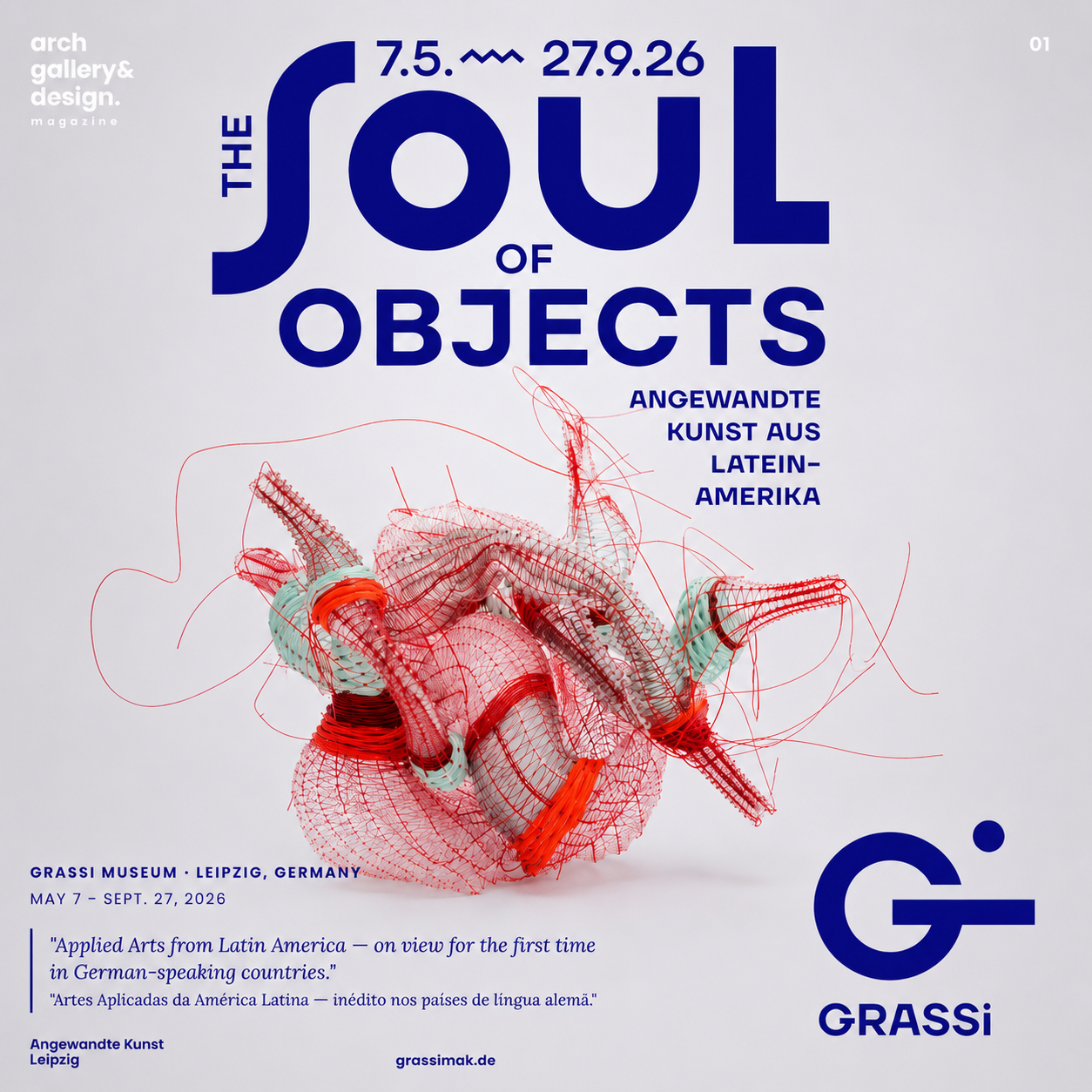
Official poster of The Soul of Objects exhibition, on view at the GRASSI Museum of Applied Arts in Leipzig, Germany, from May 7 through Sept.27, 2026.
Curated by Argentine journalist Lujan Cambariere, based in Berlin, the exhibition runs May 7 through Sept. 27, 2026, and marks the first time German-speaking countries have hosted a survey of this scope on Latin American applied arts — from ritual talismans to contemporary furniture.
By Samuel Serpa / Arch Gallery & Design | New York / São Paulo
LEIPZIG – The GRASSI Museum of Applied Arts in Leipzig, Germany, opened May 7, 2026, the exhibition “The Soul of Objects: Applied Arts from Latin America,” an unprecedented show bringing together more than 200 works by 56 artists, designers and craftspeople from 13 Latin American countries. It is the first time German-speaking countries have hosted a panorama of this scale on the applied arts of the continent, presented from a strictly Latin American perspective. The exhibition runs through Sept. 27, 2026.

Lujan Cambariere
Argentine journalist and curator specializing in Latin American craft and design. Based in Berlin, she is the author of two books and was named Craft Expert for Latin America at the Homo Faber Biennial in Venice in 2026.
The exhibition is curated by Lujan Cambariere, an Argentine journalist and curator specializing in Latin American craft and design, based in Berlin. Author of the books “El Alma de los Objetos: Una Mirada Antropologica del Diseno” and “Mastercraft: On the Importance of Working with Your Hands,” she has shaped a project that weaves together politics, cultural identity and materiality around a central axis: the making of objects by hand, as distinct from the industrial model dominant in the Global North. Cambariere was named Craft Expert for Latin America at the Homo Faber Biennial in Venice in 2026. Her exhibition record includes the Museum of Arts and Design and Wanted Design in New York, the Victoria and Albert Museum and London Design Fair in London, MALBA in Buenos Aires, and the Museu da Casa Brasileira and A Casa Museu do Objeto Brasileiro in Sao Paulo. She also directs the Saber Hacer craft and design project for the Argentine vice presidency and contributes to Experimenta magazine in Spain and AD Latinoamerica.
“In Latin America, the path of object-making does not run through large industries or technologies, but through a craft route. And it is precisely that gift of working with the hands that also gives soul to objects.”
Lujan Cambariere, exhibition curator
The show presents pieces of ritual significance — including talismans, masks and altars — alongside everyday objects, garments, historically charged textiles, light fixtures and furniture. Collections crafted from natural fibers, wood, clay, copper and other materials make up the exhibition route. The oldest pieces date from the 1940s; most were created from the 1970s to the present, by established names and emerging practitioners alike.
The curatorial concept draws on what Cambariere calls the “Global South design paradigm”: designers from diverse climates, latitudes and landscapes who co-created with artisan communities, recovering ancestral knowledge and turning scarcity into creative opportunity. The exhibition argues that this form of work — historically freighted with colonial shame — now offers urgent answers to the environmental and social crises facing the planet.
BRAZIL’S CONTRIBUTION
Brazil’s representation in the show is broad and varied. Artesol, the organization dedicated to preserving Brazilian craft heritage, joins the lineup alongside Fernanda Paes de Barros of the Yankatu brand and Francisco Graciano, a visual artist with a well-established international career. The duo Jailton e Jamile, a touchstone of Northeastern Brazilian folk art, appears alongside Heloisa Crocco, a designer from Rio Grande do Sul with internationally recognized work, and the Marco 500 project. Renato Imbroisi, founder of the institute that bears his name and one of Brazil’s leading advocates for artisan design, also joins the selection.
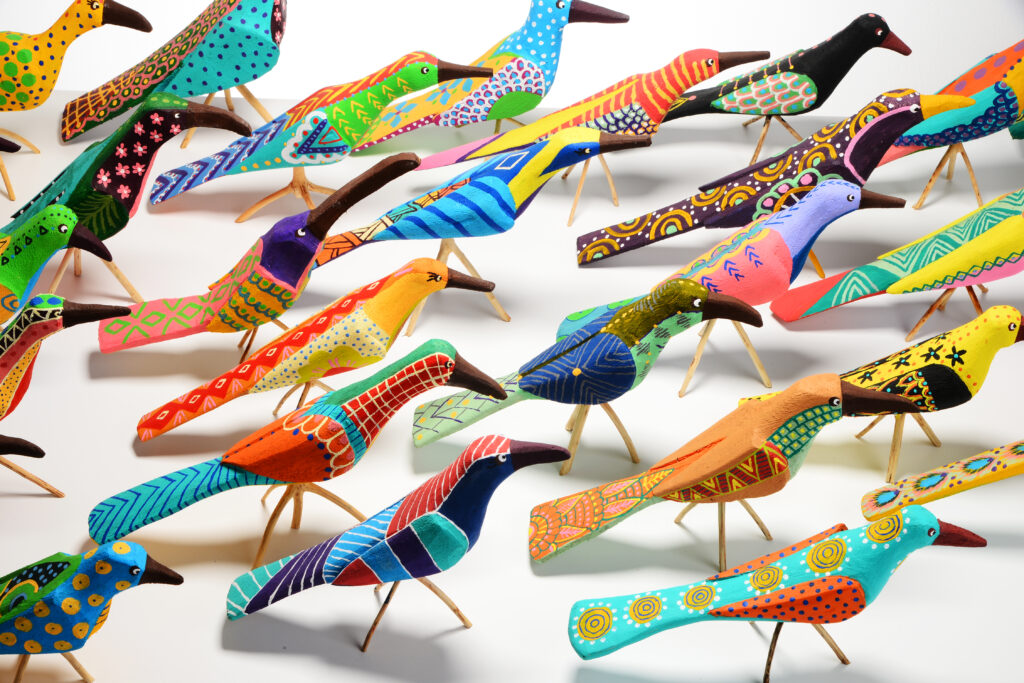
Jailton e Jamile | Brazil
Jailton e Jamile (Brazil) and their hand-painted wooden birds, icons of Northeastern Brazilian folk art.
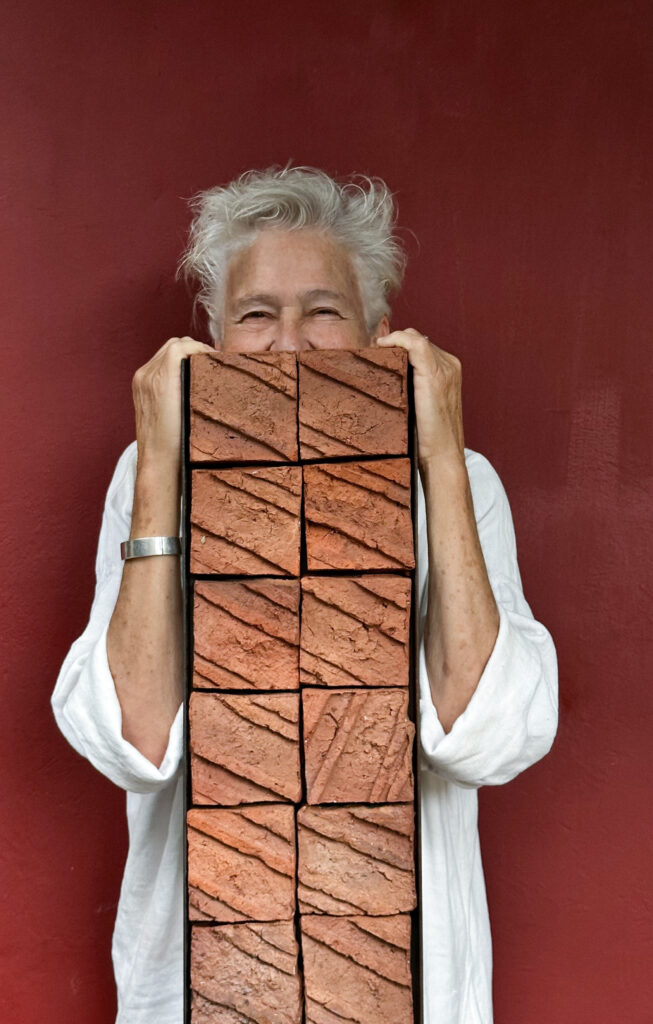
Heloisa Crocco | Brazil
Heloisa Crocco (Brazil) holding one of her clay works. The Rio Grande do Sul-based designer has built an internationally recognized body of work.
COLOMBIA AND CONTEMPORARY DESIGN
Colombia is the country with the largest number of participants in the show. Alta Estudio, Atlas Colombia, Caroyacu, Catalina Estrada, Claudia Gomez Mejia, Mauricio Vasquez Rendon, Danielle Lafaurie, Hechizoo — with works generously loaned by Galeria Cristina Grajales — Mongui and Xandra Uribe form an expressive ensemble that speaks to the vitality of contemporary Colombian design, particularly in its dialogue between Indigenous craft traditions and contemporary design language.
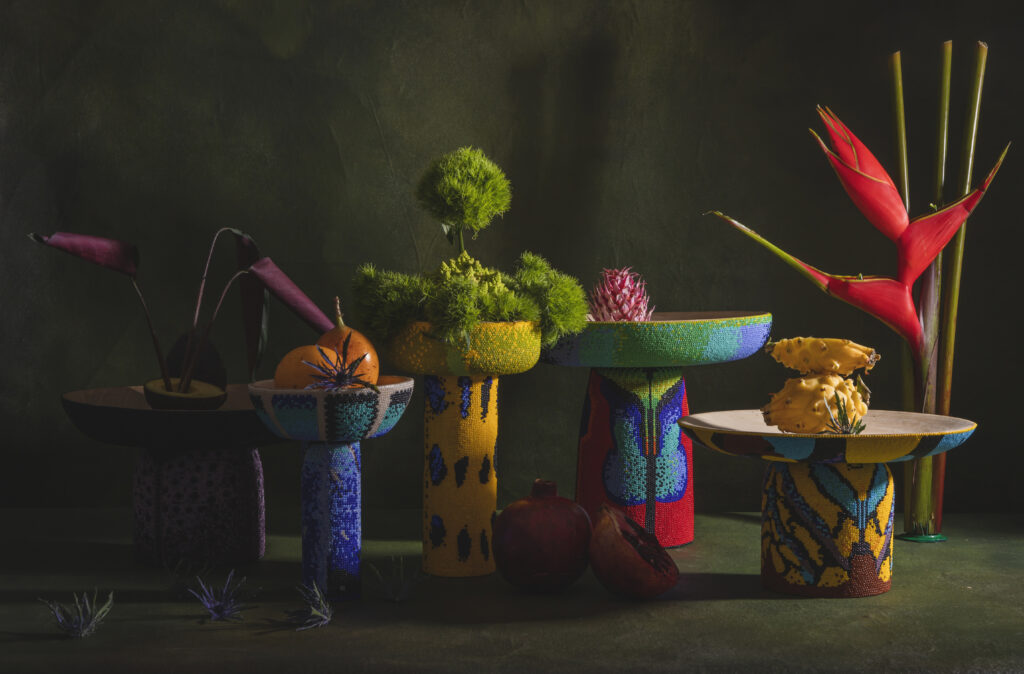
Alta Estudio | Colombia
Alta Estudio (Colombia) presents bead-encrusted tables that embody the curatorial concept: objects that are simultaneously useful, beautiful and ritually charged.
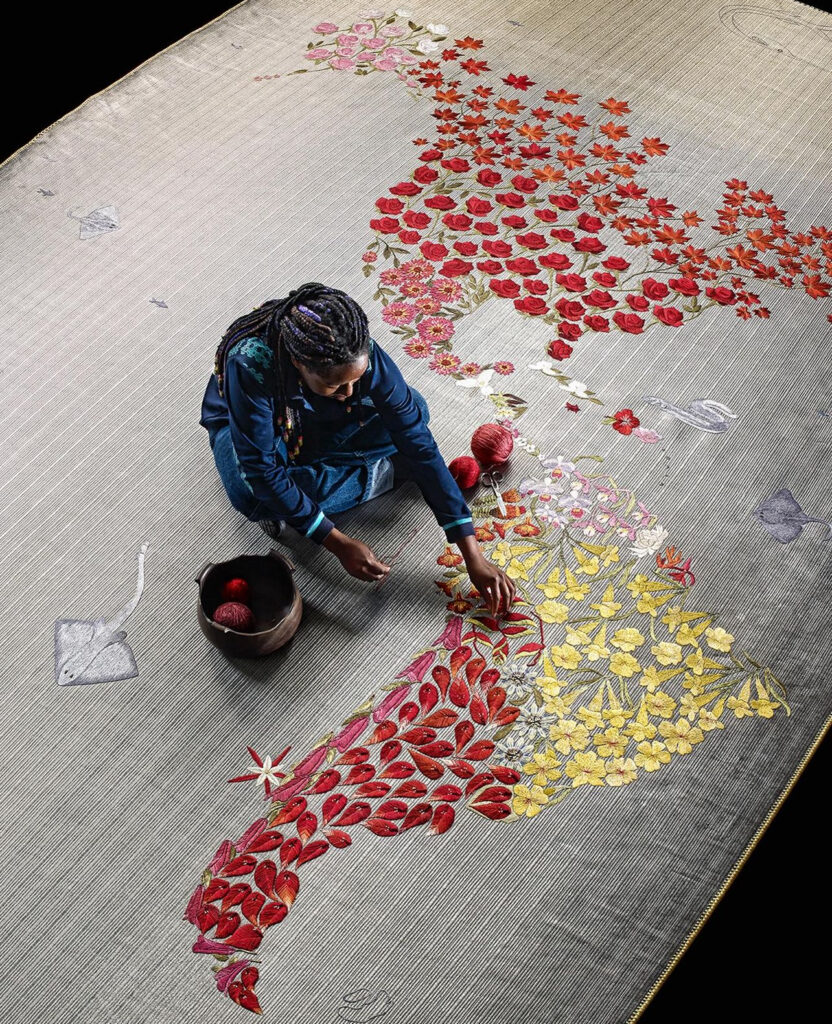
Hechizoo | Colombia
Hechizoo (Colombia), by designer Jorge Lizarazo: a natural-fiber mask that challenges the boundaries between craft, fashion and ritual art.
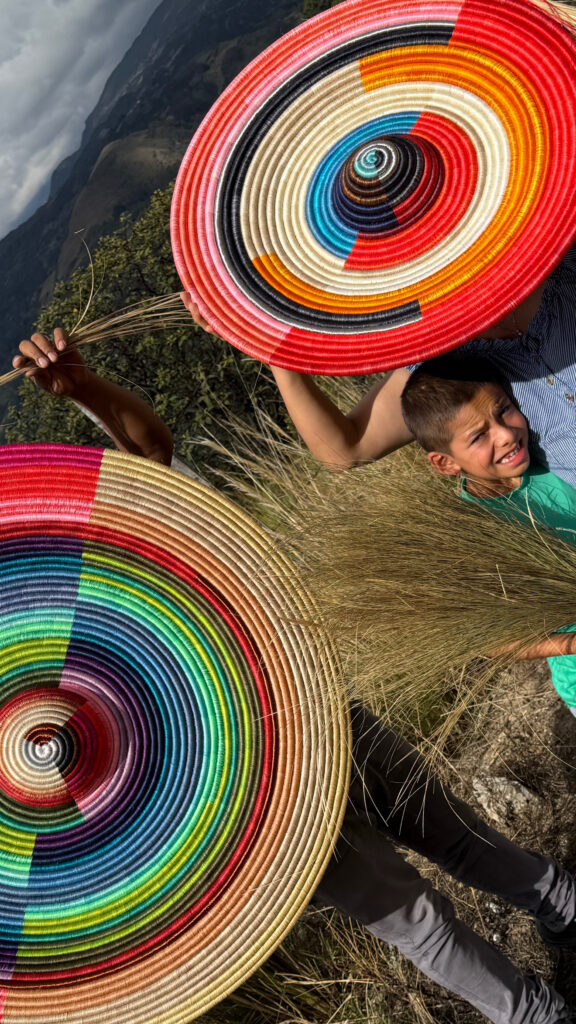
Mongui | Colombia
Mongui (Colombia): a multicolored circular textile disc that demonstrates the remarkable contemporaneity achieved by Colombian artisan design.
ARGENTINA, CHILE, PARAGUAY AND THE REGIONAL PANORAMA
Argentina is represented by 11 artists and designers. Claudia Santanera presents textile works of formal rigor; Carolina Giovagnoli and Caro Pepe, a duo working at the intersection of design and installation, join Constanza Martinez, a reference in contemporary textile work. The Finn brand, the Illaripuna collective and Karina Garrett, with her craft-based ceramics, broaden Argentina’s presence. Leo Battistelli, the natural-wool brand Maydi, the Rerere studio, artist Ricardo Paz — with works generously loaned by Galeria Herlitzka & Co. — and the organization Siwok complete the country’s contribution.
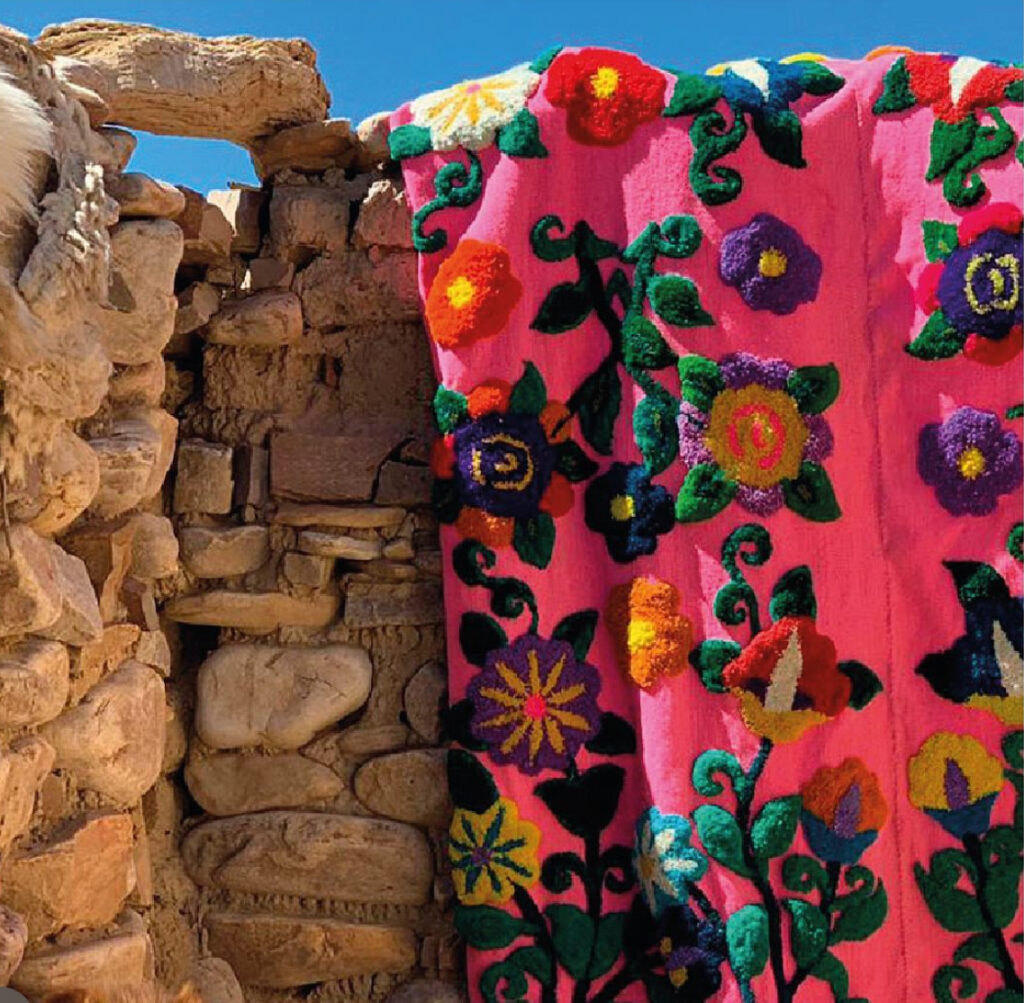
Illaripuna | Argentina
Illaripuna (Argentina): an embroidered textile in vibrant color set against a stone wall, capturing the tension between ancestral tradition and contemporary expression.
Chile sends to the GRASSI the work of Rita Soto, Simone Verdugo and Lamps from Chile, a studio specializing in handcrafted lighting. Paraguay makes a significant showing with the Instituto Paraguayo de Artesania, the country’s official craft promotion body, alongside Arte Kambai, ceramicist Julia Isidrez, the Popore studio, Pedro Barrail, Toba and Tonie Gie.

Simone Verdugo | Chile
Simone Verdugo (Chile): a curtain of rope and ceramic spheres combining minimalist elegance with artisan technique.
Peru is represented by Ani Alvarez Calderon, the Beneai Collective, Guadencia Yupari Quispe, the DNI studio and a work generously loaned by Galeria Herlitzka & Co. Mexico contributes Caralarga, Larisa Esparza and the Tributo project. Guatemala is represented by Nebula Handmade, by designer Claudia Menendez, and Estudio Fabrica. El Salvador sends the work of Quinta Esencia Studio.

Beneai Collective | Peru
Beneai Collective (Peru) in a working session with Indigenous communities in the Amazon. Co-creation with ancestral groups is the exhibition’s central political axis.
Bolivia brings Cynthya Villa Soto, an artist with a regionally significant textile practice. Ecuador participates with Olga Fisch, a historic figure in Latin American artisan design. Uruguay is represented by Manos del Uruguay, a textile cooperative founded in the 1960s and a world reference in handcrafted wool. Venezuela contributes Anabella Georgi and Madame Tepuy, two ateliers with strong visual identities rooted in the materials and color palettes of the region. The exhibition also includes Arte Popular Latino, a European platform dedicated to the promotion of Latin American craft.
MATERIALITY, RITUAL AND POLITICS
The exhibition’s curatorial framework is organized around three main axes. The first is materiality: natural fibers, ceramics, wood, copper, plant-dyed fabrics, seeds and mineral pigments appear as central language, not merely as support. The second is ritual: talismans, masks, altars and textile patterns that function as oracles reveal the symbolic and cosmological dimension of Latin American objects and their refusal to be reduced to pure function. The third is political: the show argues that collective artisan design — community-based and oriented toward social inclusion — constitutes an alternative and necessary model of development in the face of the mounting crises of industrial capitalism.
Project management was handled by Silvia Gaetti and Sabine Epple of the GRASSI Museum. Graphic design was produced by hey.brand & izoeasy of Leipzig; exhibition design by lfm2 of Leipzig and Berlin; and exhibition graphics by Anne Dietzsch. A special publication will be released parallel to the show, and an extensive program of public events will accompany the exhibition throughout its run.
Exhibition Information
Exhibition: El Alma de los Objetos: Applied Arts of Latin America
Venue: GRASSI Museum of Applied Arts, Johannisplatz 5-11, 04103 Leipzig, Germany
Dates: Through Sept. 27, 2026
Hours: 10 a.m. to 6 p.m. Tuesday, Thursday, Friday, Saturday and Sunday; 10 a.m. to 8 p.m. Wednesday
Information: www.grassimak.de
Arch Gallery & Design • archgallerydesign.art.br • @archgallerydesign • ISSN 3086-4267