 Serpa
Serpa
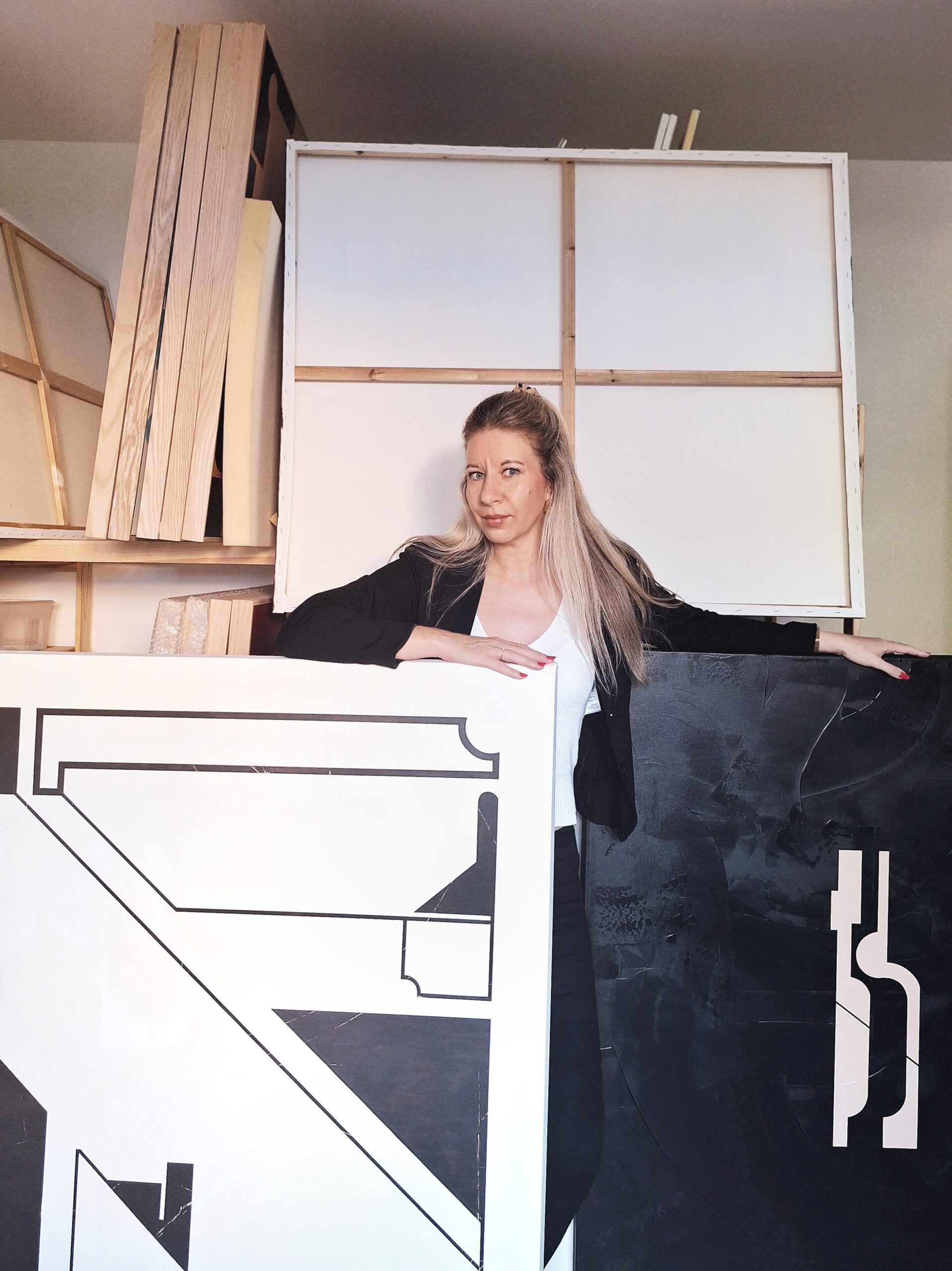
Annabelle Portz — ophthalmologist and artist, Hamburg, Germany.
German ophthalmologist Annabelle Portz transforms her clinical experience into abstract painting and questions where diagnosis ends and creation begins
By Samuel Serpa | Arch Gallery & Design | Hamburg, Germany
HAMBURG — There are two kinds of people who observe the human eye with near-obsessive attention: painters who seek to portray life on canvas and physicians who, with precision instruments, try to preserve it. Annabelle Portz belongs to both groups. A practicing ophthalmologist born and trained in Germany, she built a medical career dedicated to restoring and protecting her patients’ vision. In parallel, in the spaces medicine allows her, she paints. And it is precisely at that unlikely intersection — between the scalpel and the brush, between the clinical report and the gesture on canvas — that her work becomes singular.
The series “Relief” and “Dots,” which make up the current portfolio of Studio AP, her Hamburg-based gallery, are not merely exercises in formal abstraction. They are, above all, experiments in perception: how the human eye constructs meaning from minimal forms, how repetition generates rhythm, and how a flat surface can deceive, seduce and transform those who observe it. This is, in short, visual research conducted by someone who, in the room next door, examines corneas, evaluates refractions and prescribes lenses. In Portz, science and art do not merely coexist — they feed each other.
Portz’s trajectory is not that of an artist who chose medicine out of scientific vocation, nor that of a physician who found in painting a Sunday hobby. It is something more complex and more honest than that. Vision stands at the center of her professional and artistic life, and the responsibility of caring for her patients’ sight has profoundly shaped her creative perspective. That is not rhetorical — it is the axis around which her entire aesthetic project orbits.
In ophthalmology, the eye is not merely an organ. It is the system through which the brain receives, filters, interprets and decodes the external world. An experienced ophthalmologist knows, for example, that two patients can have the same visual acuity and still perceive the world in radically different ways, depending on how each one’s nervous system processes light signals. The ophthalmologist also knows that the perception of depth, contrast, movement and color is not a passive phenomenon: the eye does not photograph reality — it constructs it. That understanding, accumulated over years of clinical practice, is what fuels Portz’s work in her studio.
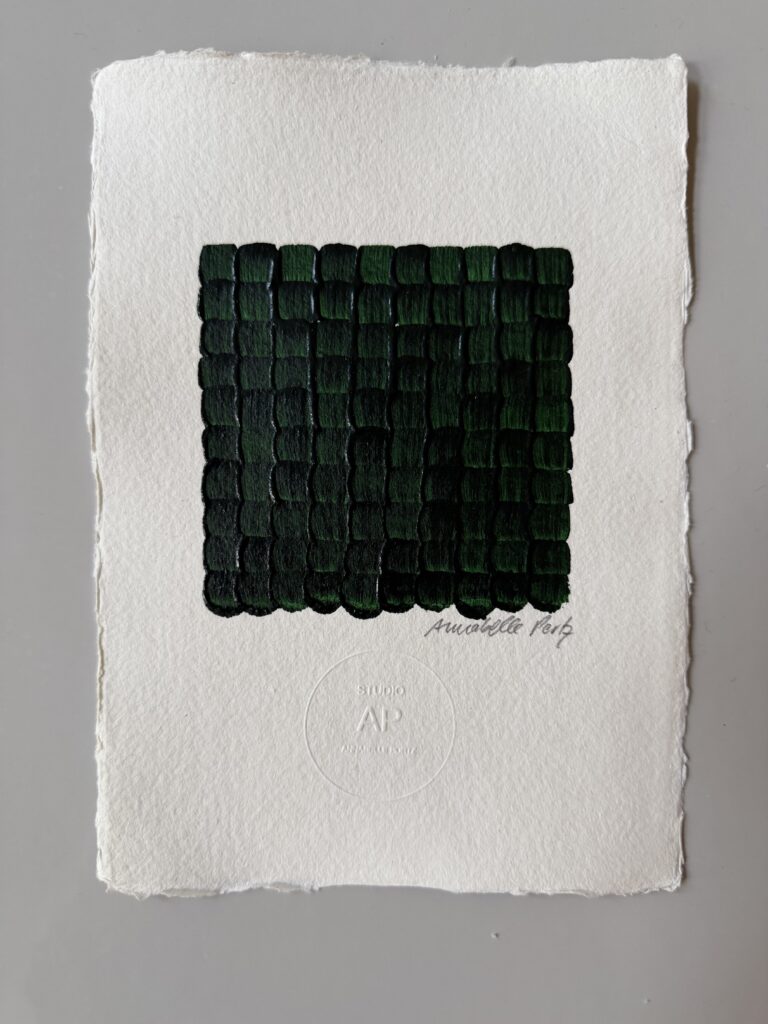
Relief III, 2026
Acryl on Handcrafted Paper
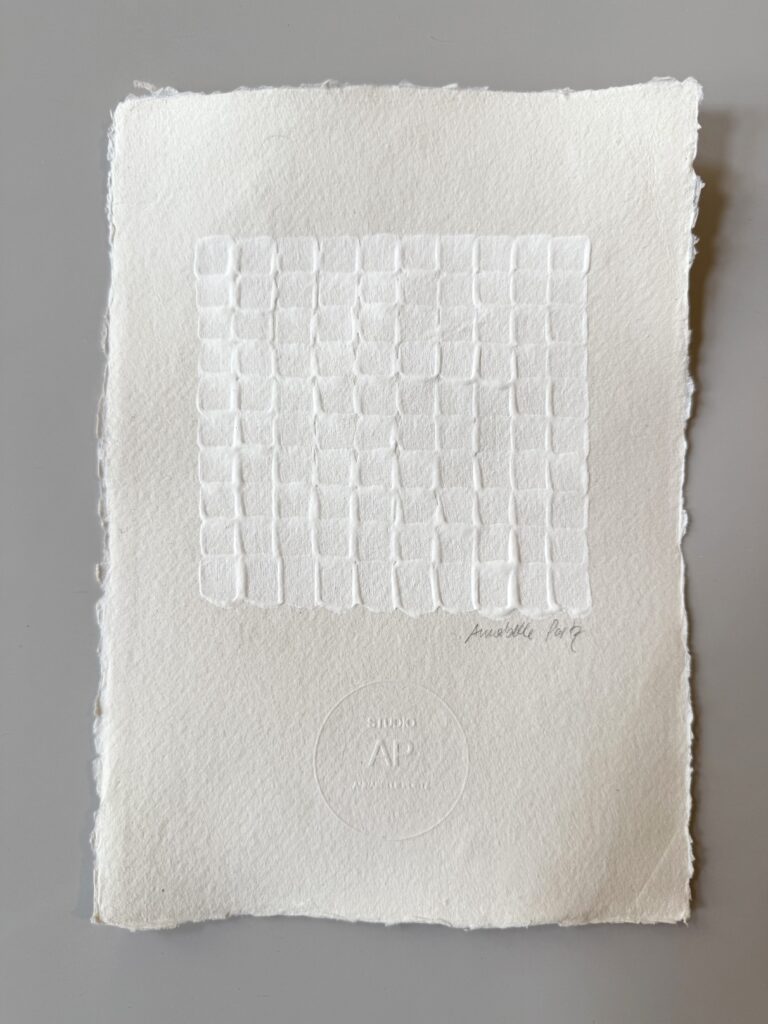
Relief II, 2026
Acryl on Handcrafted Paper
The dot as the minimal unit of perception
The “Dots” series begins with a simple, almost rudimentary premise and takes it to its ultimate consequences: the dot is the most basic visual element possible. It has no extension, no direction, no mass. And yet, when repeated, distributed, densified or scattered across a surface, it can generate rhythm, tension, depth and emotion. For someone who has spent years examining retinas with slit lamps and mapping visual fields, the idea is not metaphor — it is anatomy.
The human retina is composed of more than 120 million photoreceptors distributed unevenly across the surface of the fundus. The fovea, the central region responsible for sharp vision, concentrates most of the cones — cells sensitive to color and detail. As the gaze shifts toward the periphery, density drops and the predominant receptor type changes. What we perceive as a continuous, homogeneous image is, in reality, the result of a process in which the brain fills gaps, interpolates information and creates the illusion of completeness from fragmented data. Portz’s dots operate according to an analogous logic: they are fragments that the viewer’s eye joins, organizes and transforms into experience.
Small variations in the density and positioning of each dot completely alter the experience of a composition. A greater concentration of dots in a given area creates the impression of weight, gravity, presence. Wider spacing generates lightness, breath, emptiness. The eye does not register dots individually — it groups them into patterns, assigns relationships among them and extracts a narrative. Portz knows this process not only through aesthetic intuition but through precise technical knowledge of how the human visual system operates.
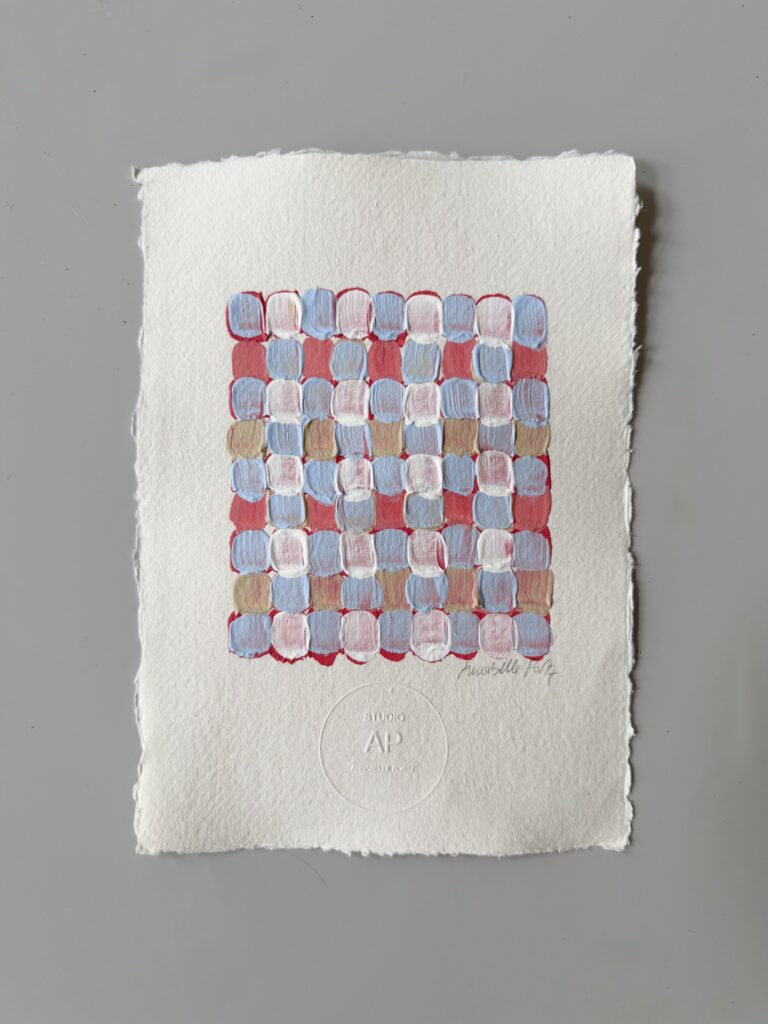
Dots I, 2026
Acryl on Handcrafted Paper
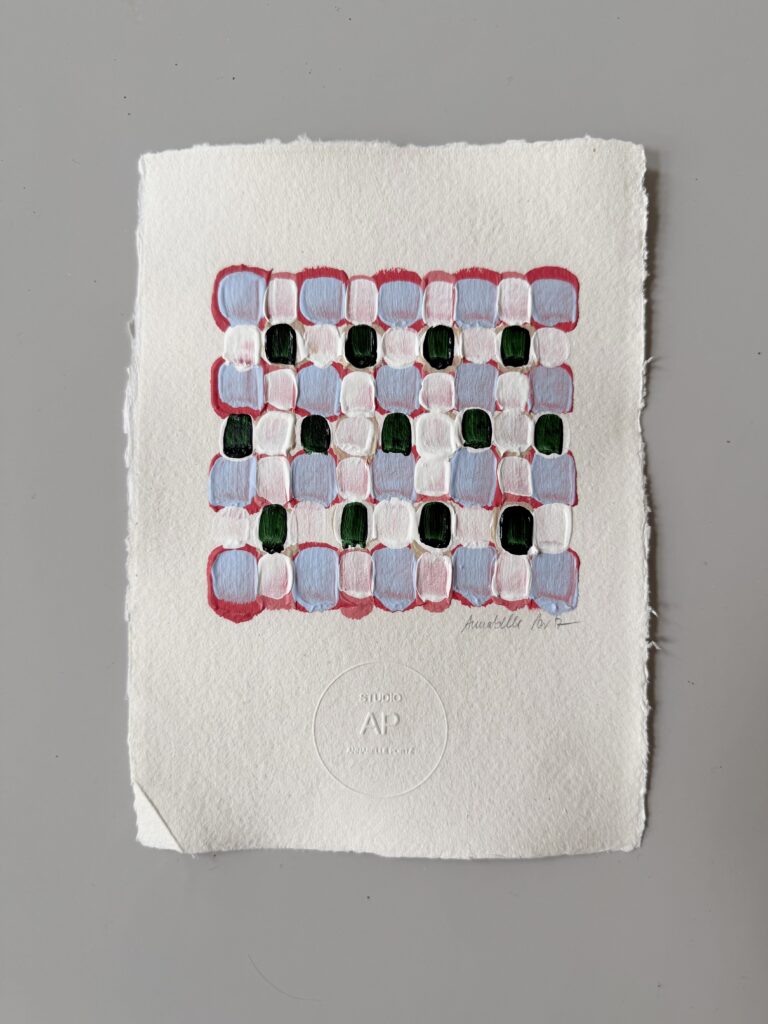
Dots II, 2026
Acryl on Handcrafted Paper
The illusion of depth and the flatness of the canvas
If “Dots” explores the temporal dimension of perception — the rhythm with which the eye scans and constructs an image — “Relief” addresses another equally central phenomenon in visual experience: the perception of depth. The question the series poses is almost philosophical: how does the eye, confronted with an absolutely flat surface such as a painted canvas, come to believe it is seeing volume, relief, three-dimensionality? Why is the brain systematically deceived by overlaps, suggested shadows and repetitions that create fictitious perspectives?
The answer lies in binocularity. Humans have two eyes positioned slightly apart, and the brain uses the difference between the two images captured — known as retinal disparity — to calculate distances and infer depth. It is an elegant, sophisticated system and, crucially, one susceptible to illusions. Renaissance painters knew this and used perspective to create depth where there was none. Portz knows it even more directly: she examines that system every day in her office, evaluates binocular fusion, tests her patients’ stereopsis and verifies whether each person’s brain can integrate two images into a single coherent perception.
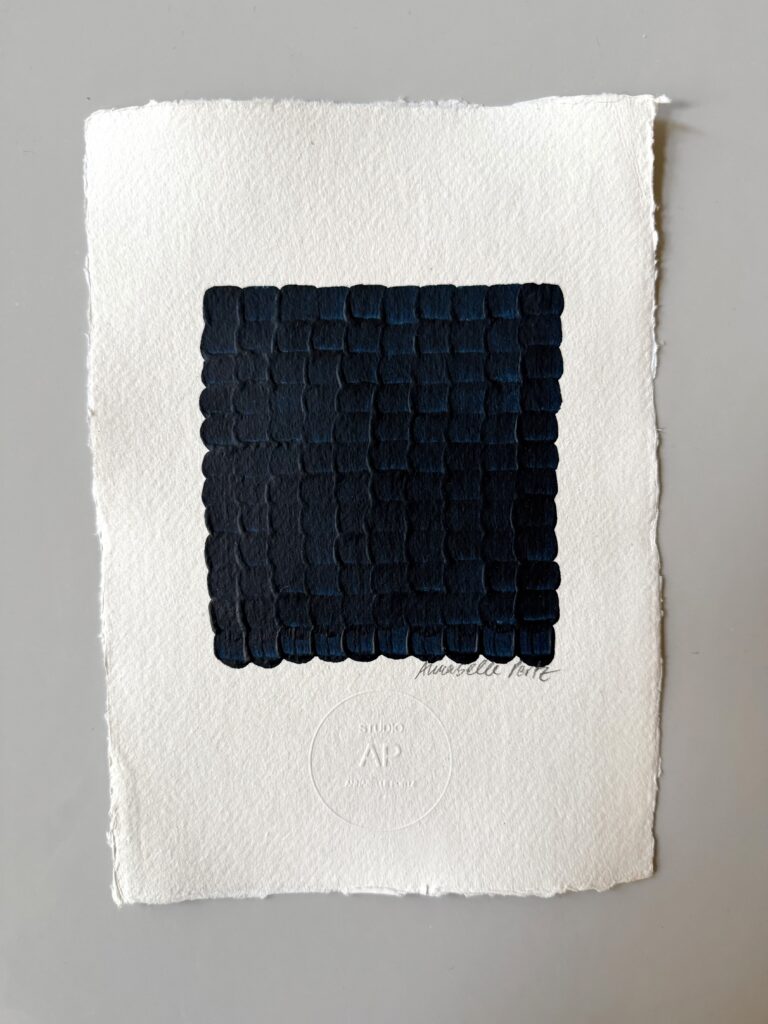
Relief III, 2026
Acryl on Handcrafted Paper
In “Relief,” that clinical understanding translates into artistic strategy. Through subtle overlaps, repetition and spatial arrangement, the works investigate how the eye constructs the perception of form and volume even within minimal compositions. There are no cheap tricks or spectacular optical illusions. What exists is a precise, almost scientific exploration of the thresholds of perception — the exact point at which a flat surface begins to fold in the viewer’s consciousness and becomes three-dimensional.
Art as an extension of medical ethics
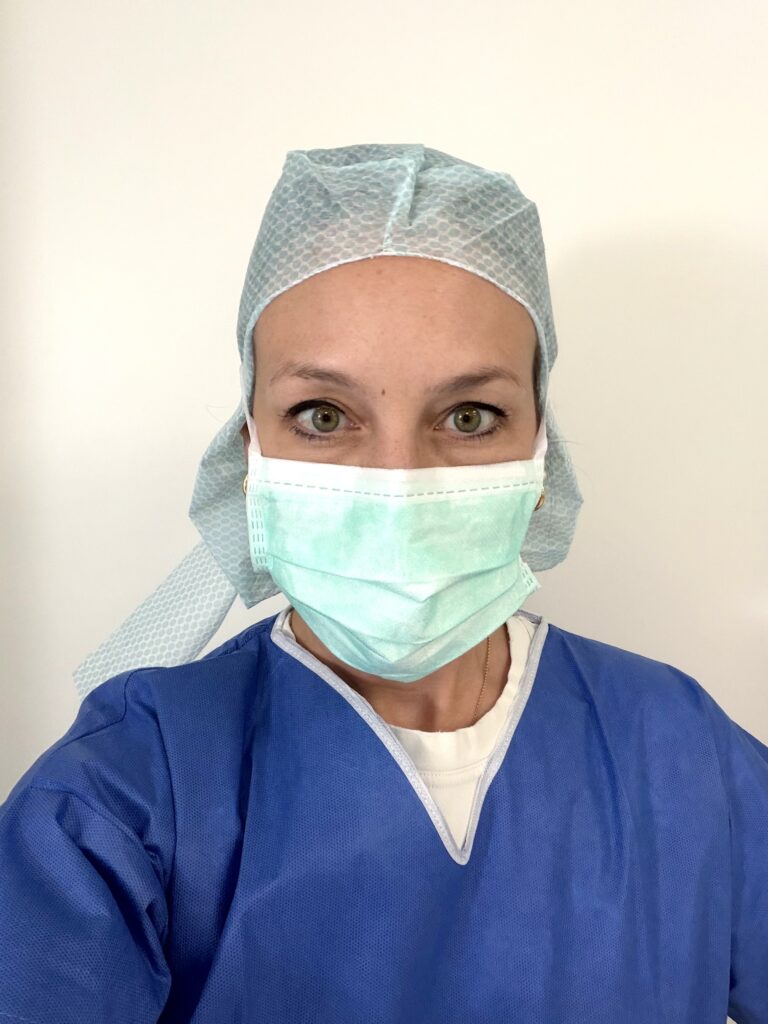
Portz in the operating room. Two identities, one inquiry
There is an ethical dimension in Portz’s work that deserves attention. The ability to see allows people to experience the richness and beauty of the world around them — from everyday moments to art itself — and that realization shapes her creative perspective profoundly. Read in isolation, the sentiment might sound like an artist’s rhetoric. Read in the context of someone who has dedicated her professional life to preserving that same sense in other human beings, it carries specific weight.
An ophthalmologist deals daily with the threat of vision loss. Glaucoma, macular degeneration, diabetic retinopathy, cataracts — these are conditions that, progressively or abruptly, strip patients of what may be the most central sense to the human experience of the world. Those who live alongside that clinical reality develop, almost inevitably, a heightened awareness of the fragility and value of the act of seeing. Portz channeled that awareness into her artistic practice. Her works do not celebrate vision in a triumphant way — they investigate its mechanisms, its limits, its susceptibility to deception, seduction and expansion.
In that sense, Portz’s work belongs to a tradition of artists who questioned the nature of visual perception as a cognitive act. Bridget Riley and British Op Art, Josef Albers and his studies on color interaction, the minimalism of Donald Judd and its perceptual ramifications — these are references that, though Portz does not cite them explicitly, emerge as natural interlocutors for her project. The difference is that, in Portz, this investigation carries an empirical foundation most of her predecessors did not possess: she sees the human eye from the inside.
The studio as laboratory
At Studio AP in Hamburg, Portz works primarily with acrylic on paper and canvas. The choice of medium is not incidental. Acrylic allows for quick layering, controlled drying and a precision in finish that aligns with her need for formal rigor. Paper, in turn, introduces a tactile variable that the eye eventually perceives as a difference in texture, adding a subtle layer to the illusion of three-dimensionality her works seek to create.
The working process is investigative. Portz does not start from a final image she wants to reproduce but from a question about perception she wants to test. How does this density of dots affect the sensation of movement? At what point does the layering of coats begin to create the illusion of depth? Where is the threshold between the structure the eye recognizes as pattern and the chaos it experiences as noise? These are questions a visual neuroscience researcher would pose with measuring instruments — she poses them with pigment and brush.
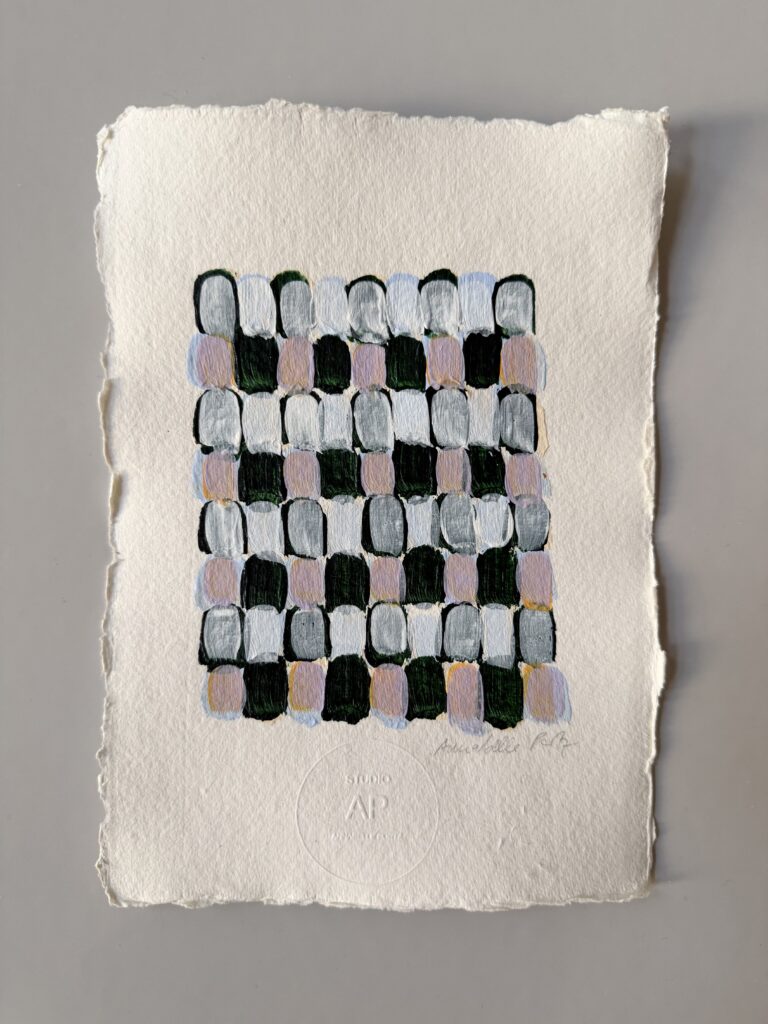
Dots IV, 2025
Acryl on Handcrafted Paper
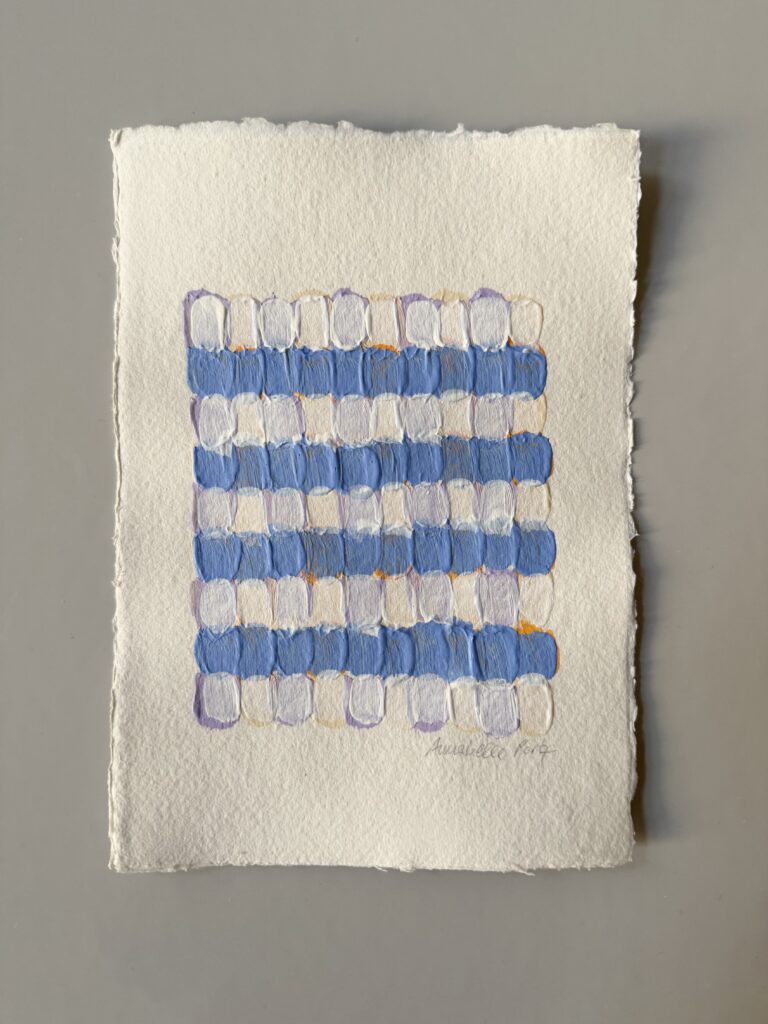
Dots V, 2025
Acryl on Handcrafted Paper
That investigative stance transforms viewers of her works into subjects of a near-clinical experience. Standing before a “Relief” or a “Dots,” visitors are not merely invited to aesthetically appreciate a composition — they are placed in a test situation. Their visual system is activated, asked to make choices about what they are seeing, to resolve ambiguities, to produce meaning where the artist has deliberately installed indeterminacy. The work is the experiment; the viewer’s gaze is the result.
A dual identity without contradiction
In interviews, artists with dual training frequently describe a tension between their two identities — as though the seriousness of science were always on the verge of swallowing the lightness of art, or as though the commitment to creative expression threatened the objectivity that medical practice demands. Portz appears to have resolved that equation differently: for her, there is no tension because there is no separation. Medicine and art, in her case, are two languages describing the same phenomenon — the human perception of the world — through distinct paths.
When she examines a patient’s retina and when she distributes dots across a canvas, Annabelle Portz is, at bottom, doing the same thing: trying to understand how human beings see. The difference is that in the office, the question carries therapeutic urgency; in the studio, it carries formal freedom. Together, the two practices produce an artist who is, simultaneously, more rigorous than most artists and more sensitive than most scientists.
Works from the “Relief” and “Dots” series are available for inquiry and acquisition through Studio AP in Hamburg. For those who observe them carefully, the visit has something of a consultation about it — they leave with their perception slightly altered, as though the eye had been recalibrated.
Studio AP | Hamburg, Germany | Series: Relief and Dots | Medium: Acrylic on paper and canvas
Arch Gallery & Design Magazine | archgallerydesign.art.br | ISSN 3086-4267