 Serpa
Serpa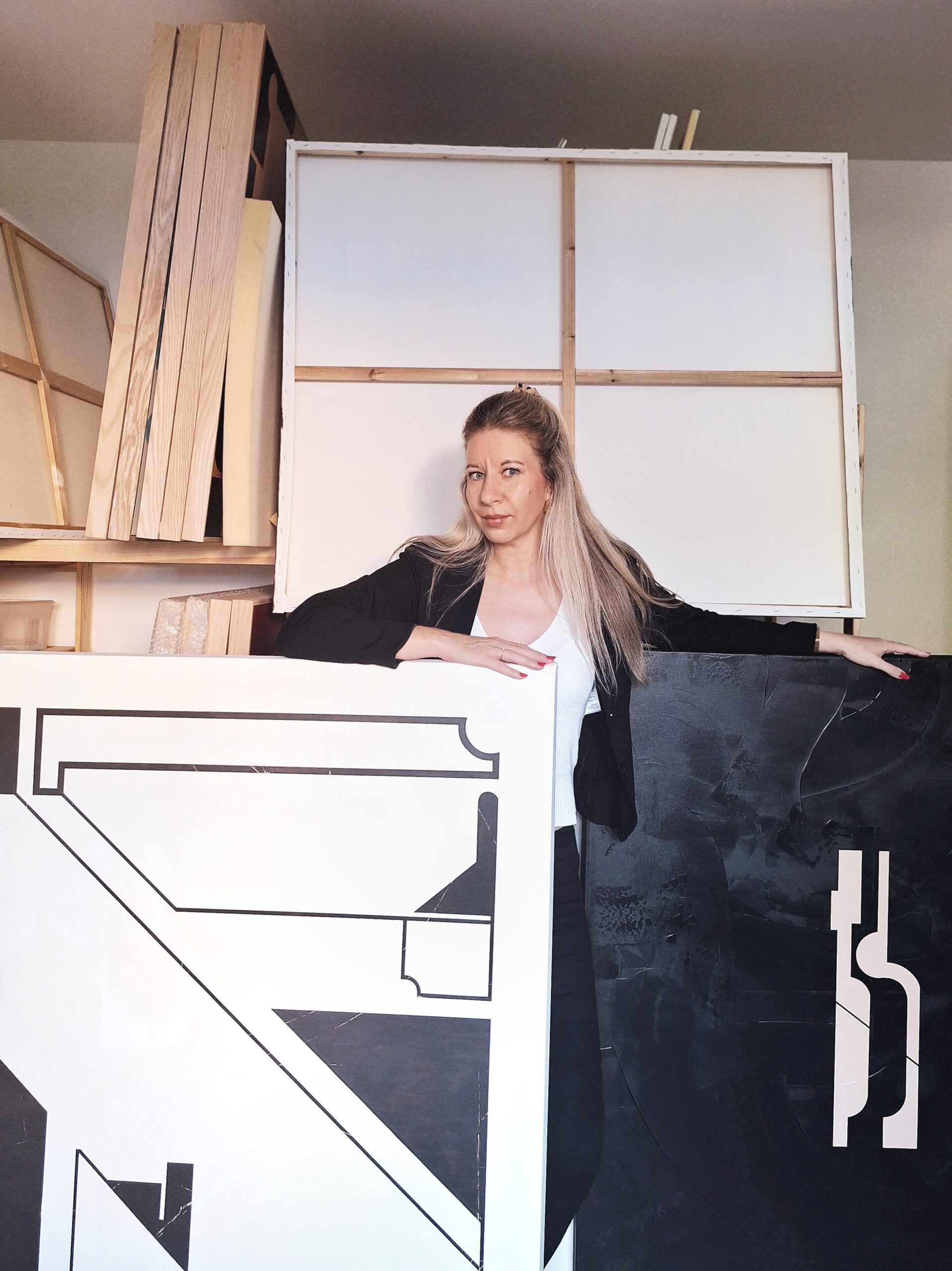
Nadine Hamann poses among wooden structures and white panels that inform her creative process in Berlin. Photo: Courtesy
By Samuel Navarro Serpa
Bauhaus principles inspire the German artist’s work, shown across Europe as she develops custom projects for architectural spaces
Berlin Roots
Born and still based in Berlin, Nadine Hamann builds geometric compositions rooted in straight lines, color fields and texture, aiming for balance similar to that found in architectural projects. Trained within the concrete art tradition, she has become part of the European gallery circuit.

The artist reviews a sketchbook of straight-line compositions, a step that precedes transferring forms to canvas. Photo: Courtesy
Multiple layers make up the surface of each canvas, always applied in a limited, nearly monochrome palette. Every geometric element occupies a specific place within the composition, while empty spaces receive treatment equal to filled forms, a principle that guides her entire body of work. Her approach traces back to Bauhaus, the German school of architecture and design founded in 1919, whose emphasis on structural clarity shapes much of today’s concrete art movement.
Exhibition History
Several exhibitions have featured Hamann’s work in recent years. In 2025, her solo show “Architecture of Stillness. Abstract Compositions” was held at Pałac Morawa in Strzegom, Poland. A year later, her canvases were included in the group exhibition “Periphery” at Galerie in der Südhalle, inside Reinickendorf’s district town hall in Berlin.
Fairs and festivals round out her exhibition record. Earlier appearances include Art Market, hosted by Berlin’s Notagallery in 2025, and Summer Art Festival, a virtual event organized by Virtual Artists Galleries in the United Kingdom in 2021. No extensive coverage from specialized art press exists outside this circuit so far.
Method and Visual Language
Geometry organizes each composition through forms that separate or connect across the canvas, creating what the artist calls visual constellations. Her aim is to convey balance without decorative elements, focusing instead on the emotional impact produced by proportion among volume, empty space and color.
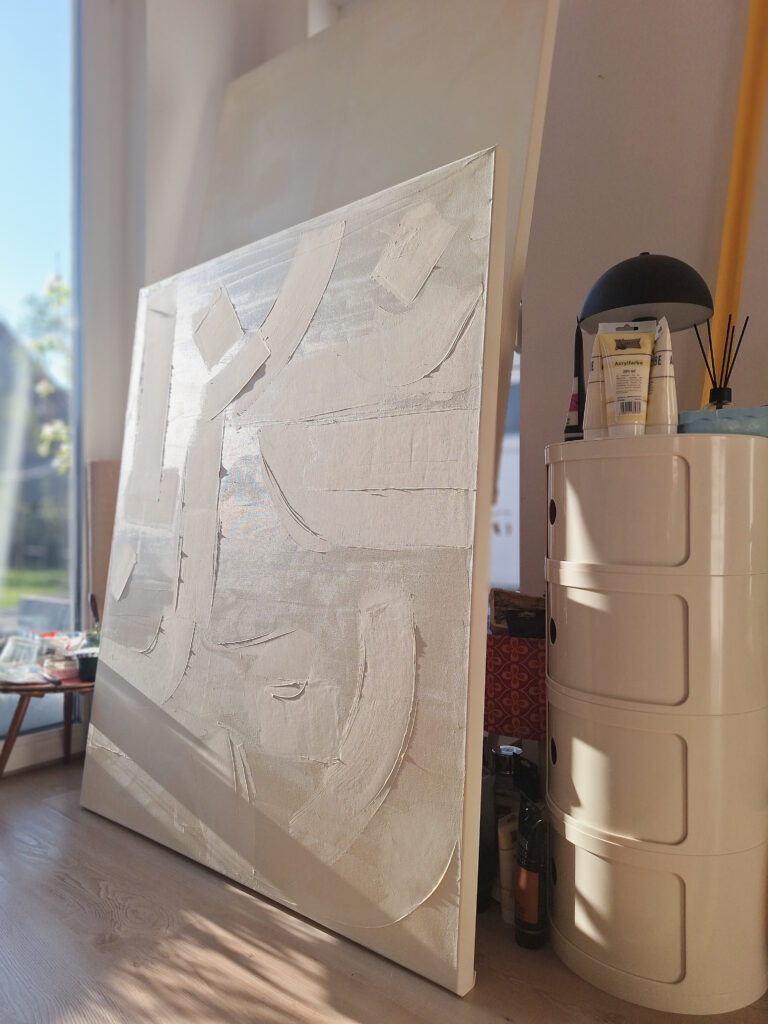
A light-toned canvas shows layers of paint applied with a cloth, a technique that lends spatial depth to the surface. Photo: Courtesy
Her process follows a consistent method across works: Paint layers are applied with cloth, built up and partially removed with water until the surface reaches the desired spatial depth. Transitional zones recur as a concept in how she describes her work, since surfaces shift in appearance as light changes throughout the day.
Series Identity
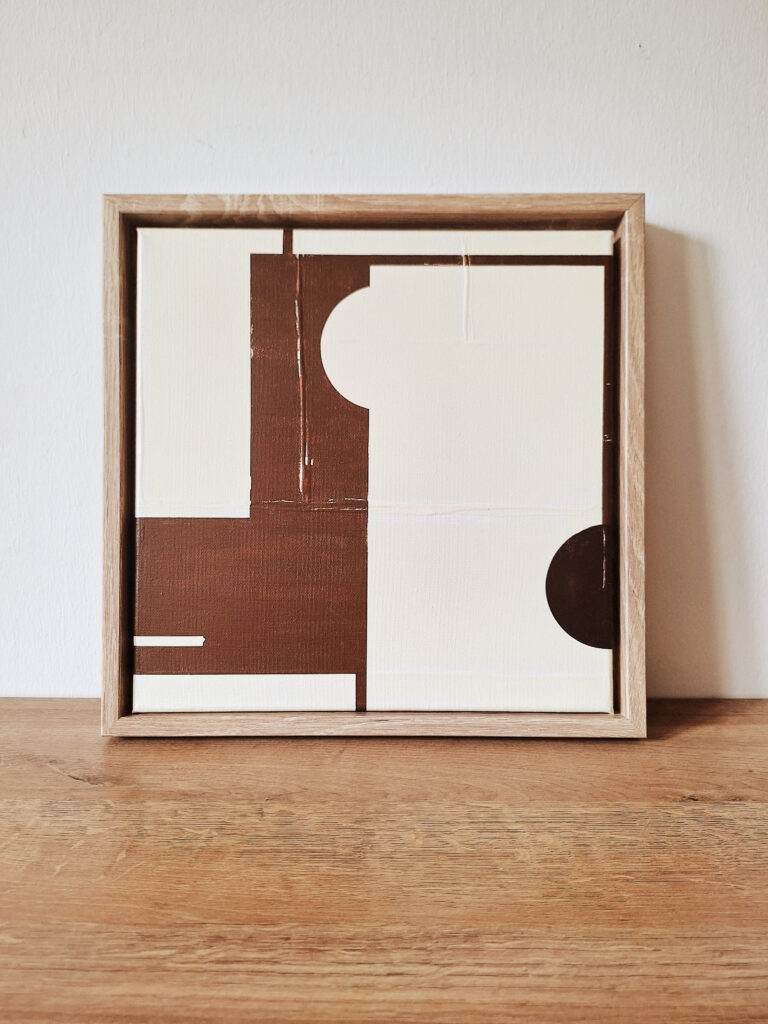
“Earth,” from the Fragments series. A fragment in earthy tones suggests a larger architectural structure without explicitly representing it. Photo: Courtesy
Already central to her recent output is the Fragments series, which explores the idea of incompleteness through pieces that suggest larger architectural structures without depicting them directly. Three thematic groups organize the series: Mineral, Earth and Shadow, each keeping the same base geometric language while varying palette and surface material.
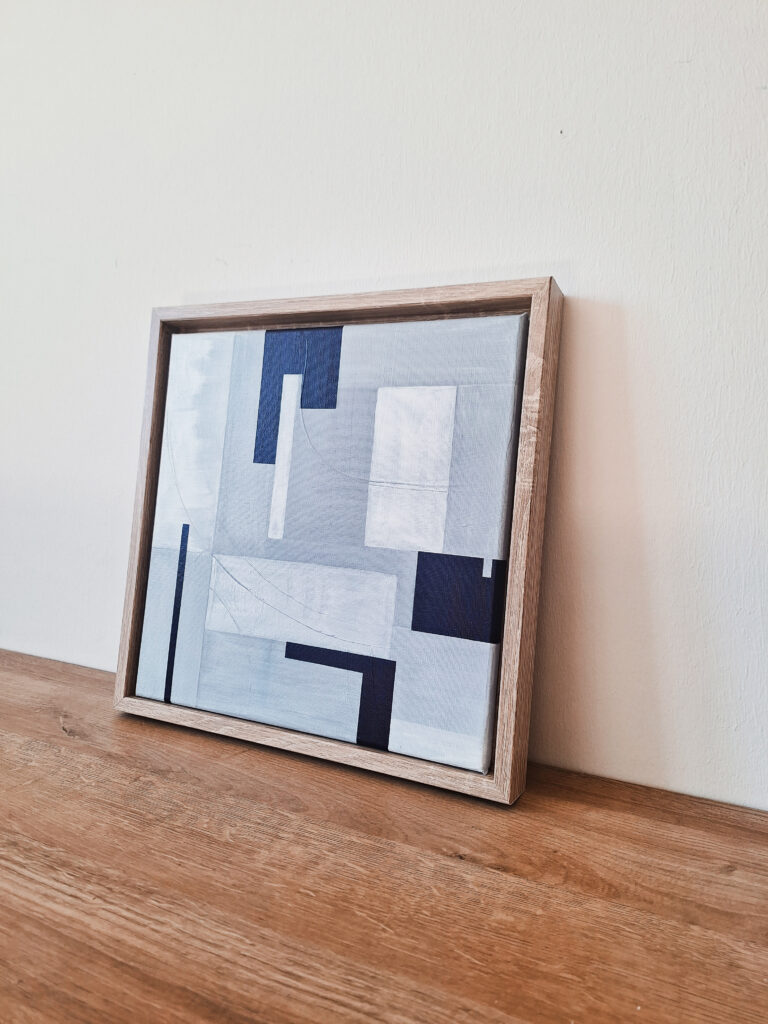
“Mineral,” from the Fragments series. A composition in navy blue and white combines clean geometry with a sculptural texture. Photo: Courtesy
Straight lines and planes take different forms across each group. Mineral combines clean geometry with a texture of almost sculptural quality. Earth favors opaque, ocher tones that give visual weight to reduced forms. Shadow relies on raw canvas surfaces that evoke architectural projections, shifting focus toward the spaces between figures.
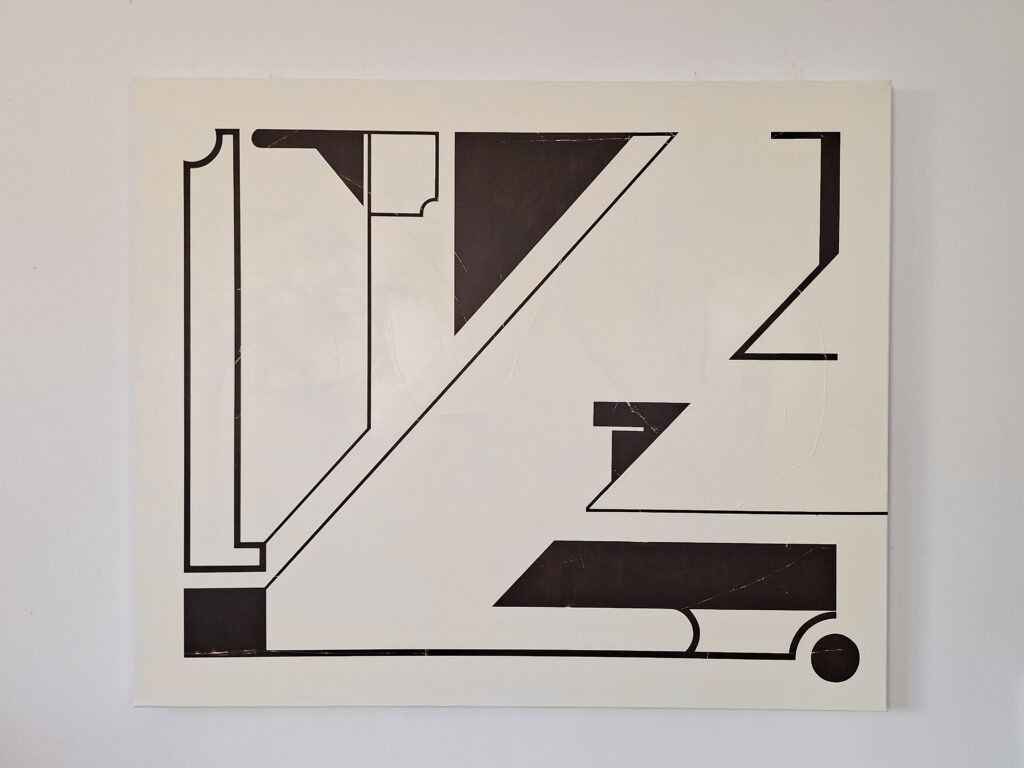
“Calma – Unlinked State”. Black diagonals against a light background evoke floor plans and building systems, detached from any specific architectural function. Photo: Courtesy
Order and emptiness share space within another strand of her work, called Calma, built from geometric formations that recall floor plans and construction systems despite having no specific architectural function. Diagonals introduce subtle movement across compositions, joining structural rigor with visual lightness.
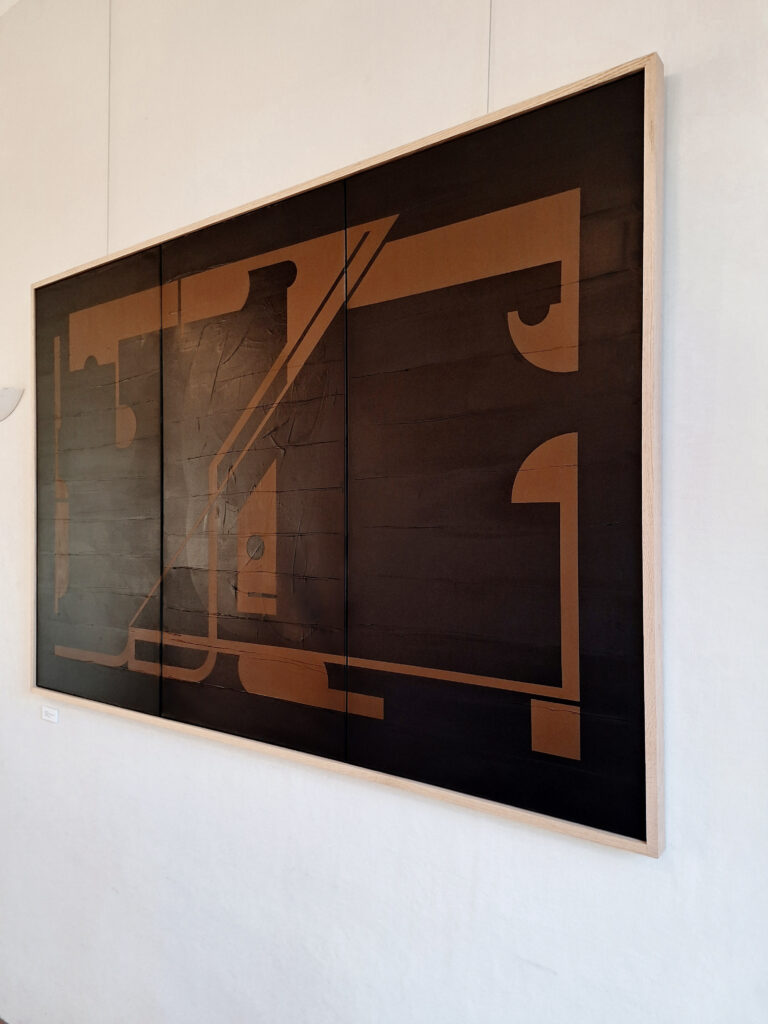
“Co-Regulation,” presented as a triptych. The three-panel work reveals its full balance only when all sections are viewed together.Photo: Courtesy
“Co-Regulation” grew out of a single pictorial system later divided into a triptych format. Each panel depends visually on the other two, and full balance only becomes apparent once all three sections are viewed together, according to the artist.
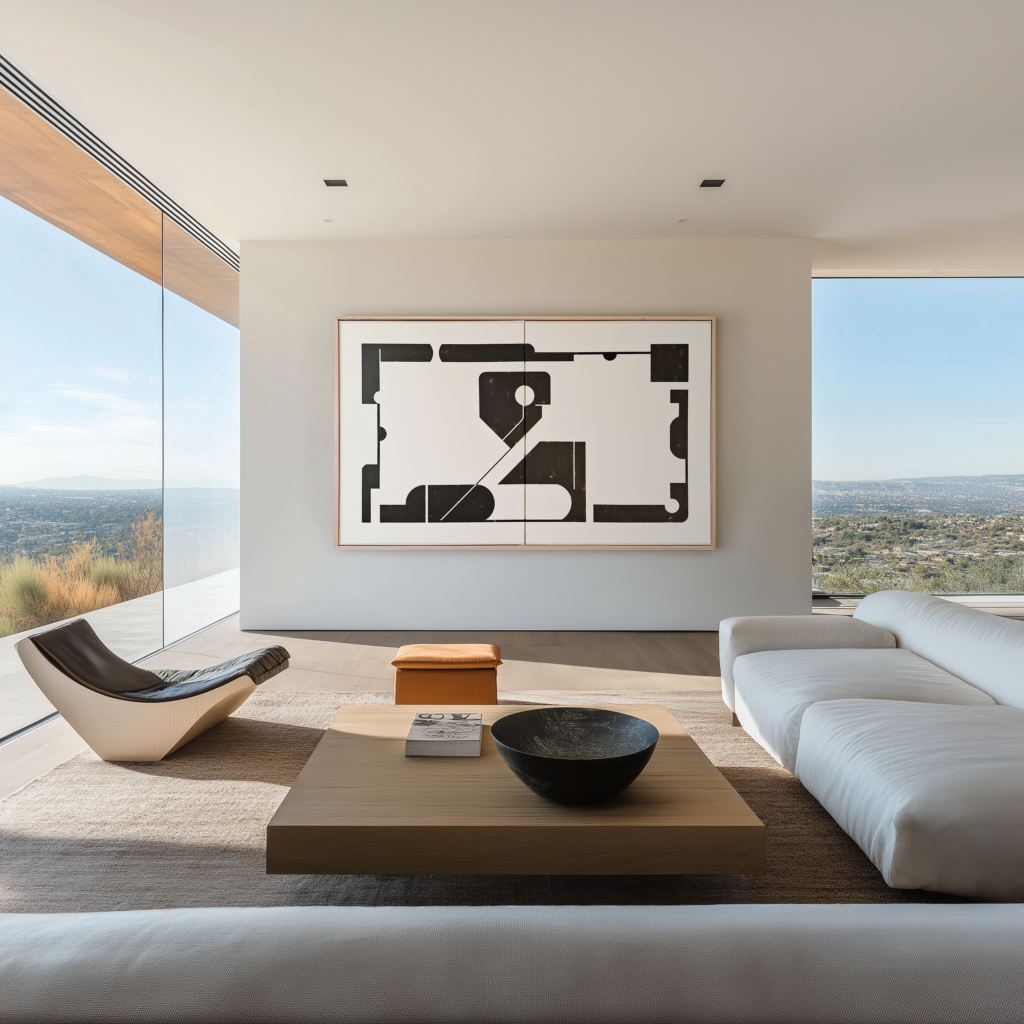
“Point of Connection” in a residential setting. The large-scale work interacts with a panoramic view, illustrating the artist’s custom designs for architectural spaces.Photo: Courtesy
“Point of Connection” stems from her search for a composition that stays cohesive despite the central division running through it. Rather than describing a specific link, the piece reflects a state of approach and tension, where structure and openness coexist.
“In Harmony” combines a textured surface, built with a palette knife, and precisely defined geometric forms arranged toward the center of the canvas. Contrast between dense texture and exact form produces the sense of stability behind the piece’s title.
Reducing order to its limits drives the Periphery series, which shifts between constructive clarity and subtle rupture, moving lines and planes until visual stability begins to give way. Treating painting as a dynamic structure, subject to constant transformation, guides this body of work, the artist said.
Shades names a subset of four monochromatic canvases within Periphery, each isolating a single color to examine how different tones alter perception of the same geometric language. Reduction, meanwhile, sets free painterly gesture against precise forms on a richly textured navy background, revealing what remains essential through successive layers of removal.
A more lyrical register appears in “With Sunset Light on Your Face. In My Rearview.,” which condenses light, space and memory into a sequence of color fields interrupted by abrupt painterly gestures. “You Promised Me a Bubble Gum” and “Pinky and the Pain” introduce, for the first time within the series, circular forms set against its predominantly orthogonal geometry.
Worth noting is “Happiness Awaits Around Every Corner. Best Wishes.,” a piece that reduces its composition to a single dominant architectural form covering nearly the entire canvas, with subtle textures animating a light-colored plane. Its focus sums up recurring traits across her recent work: concentration, absence of unnecessary elements and precision in every geometric choice.
Dialogue with Spaces
Preserving artistic identity even when a piece must respond to external spatial demands drives her custom projects, according to Hamann, which adapt format, scale and placement to their destination while avoiding visual competition with surrounding architecture. Such works typically emerge from direct dialogue with architects and interior designers, factoring in materiality and natural light within the chosen space, with new projects underway within the same conceptual framework tied to architecture and the concrete art movement.
Website : https://www.nadinehamann-art.com/
Instagram : https://www.instagram.com/nadinehamann_art/