 Serpa
Serpa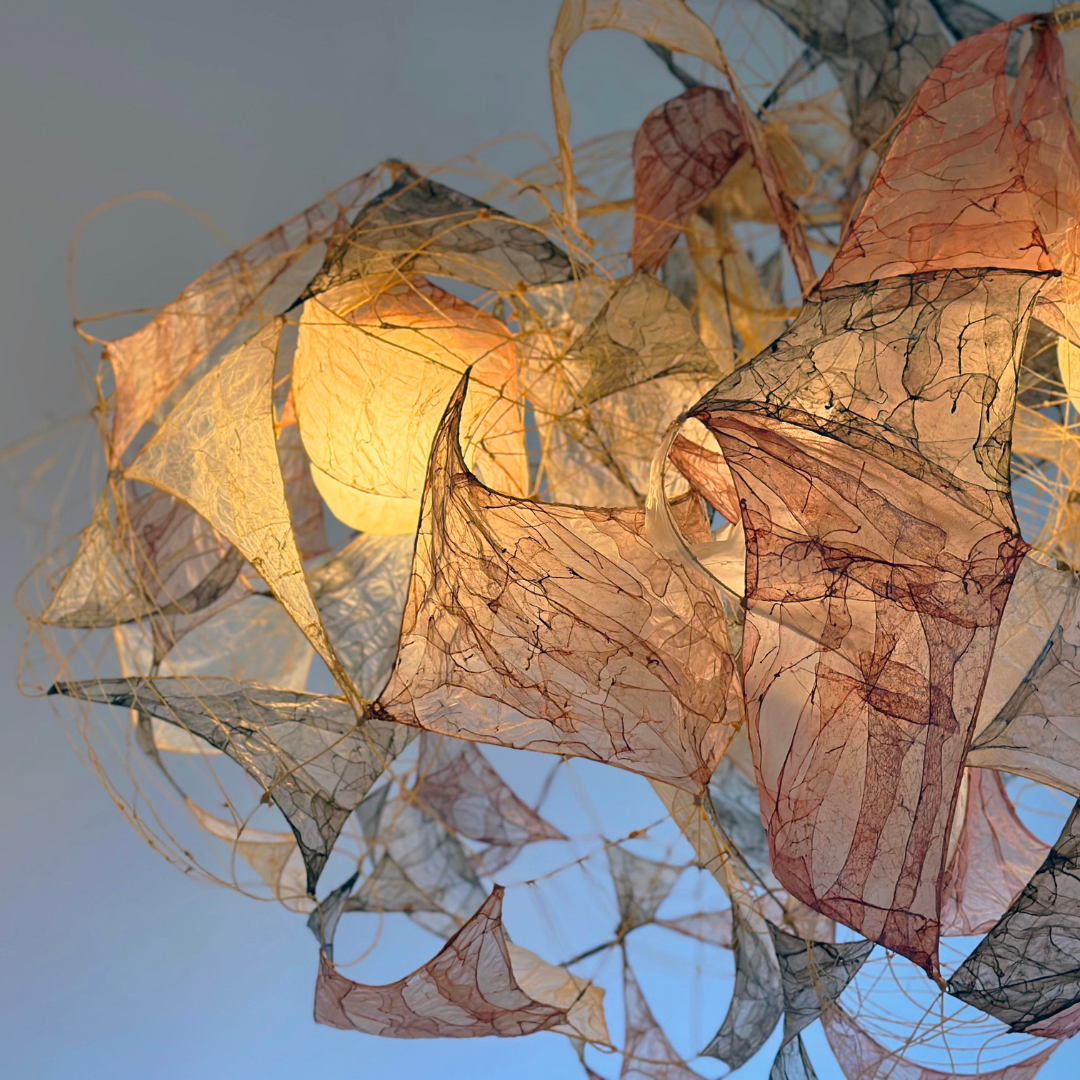
French designer Thibault Philip presented at Kazerne gallery, during Dutch Design Week 2025, the luminaire Louvanes, a piece made from woven and dyed intestines, waste discarded by the food industry. The work explores the boundary between art and design by transforming organic material into a functional and aesthetic object.

Photo: Inès Gicquel
The luminaire uses threads and leaves of animal intestine woven by hand. The creation process is slow and meticulous, according to Philip, who seeks to expand the possibilities of using this material. The piece was dyed with cuttlefish ink and madder, a plant traditionally used in natural dyeing.
The concept references traditional stained glass and the structure of biological nests, creating an interplay between the familiar and the unusual. The light emitted by Louvanes varies as it passes through the different layers of intestinal membranes, producing a soft, diffused effect.
Radical approach to biological materials
Thibault Philip is an experimental designer whose practice includes everyday objects, functional sculptures and contemporary art. He graduated with a master’s degree in design from the École Européenne Supérieur d’Art de Bretagne in Rennes, where he developed a radical approach to biological materials, based on valorising waste from the agri-food industry.

Strongly influenced by Dutch design, particularly after working with Nacho Carbonell, the designer invites the public to explore misunderstood materials to question humanity’s relationship with the living in its purest form. Philip demonstrates that what appears repugnant by connotation can have both aesthetic and technical value.
In an exploratory approach, the designer uses intestine down to its chemical composition. His work is free from any petrochemical elements, following the cradle-to-cradle principle.
New generation of sustainable design
Philip’s work is characterised by specialisation in developing materials of biological origin and radical sustainability, with projects completely free from petroleum derivatives. The designer transforms discards from the food industry into design objects and art, maintaining a strong connection with the experimental design school of the Netherlands.

His works transition between functional sculpture and contemporary art, representing a new generation of designers who question the limits between beauty, functionality and sustainability, proposing a transformative perspective on traditionally discarded materials.
Kazerne, based in the Netherlands, is known for hosting experimental projects that challenge conventions of contemporary design. Dutch Design Week is one of Europe’s leading design events, bringing together creators who explore the limits of the discipline.
Photo: Inès Gicquel / Thibault Philip