 Samuel Navarro Serpa
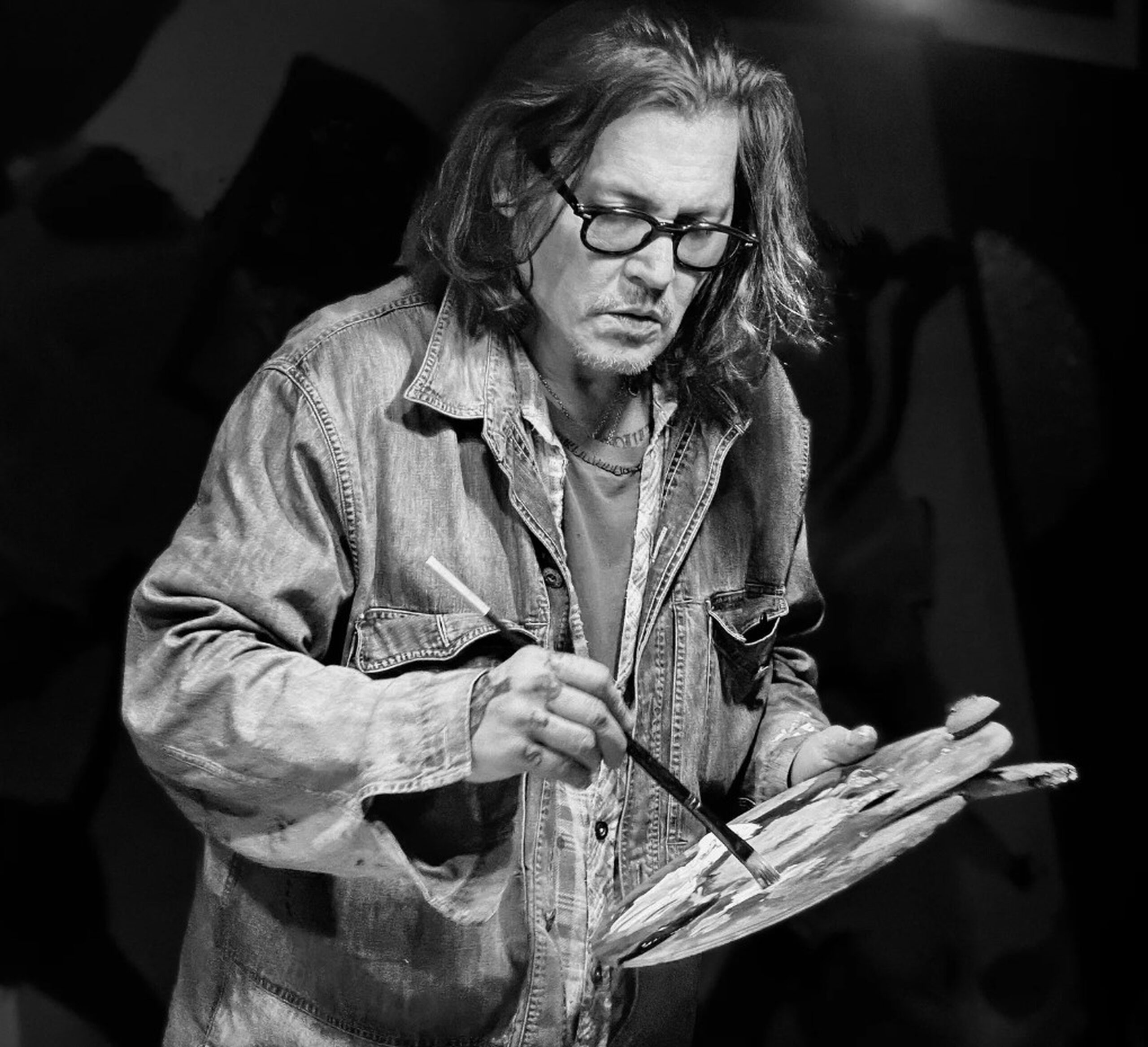
Johnny Depp, with a paintbrush and palette in hand. Photo: Courtesy of Halcyon
Open until Nov. 15, the exhibition at 148 New Bond Street presents anonymous faces, tributes to outsiders and floral series
By Samuel Navarro Serpa
Halcyon opened the first major exhibition of Johnny Depp’s originals in the United Kingdom on Oct. 13. The show runs through Nov. 15, 2026, at 148 New Bond Street in London. A director and musician as well as an actor, Depp presents new pieces and examples decades old, seen until now only by family and friends.
Faces of nobody and everybody
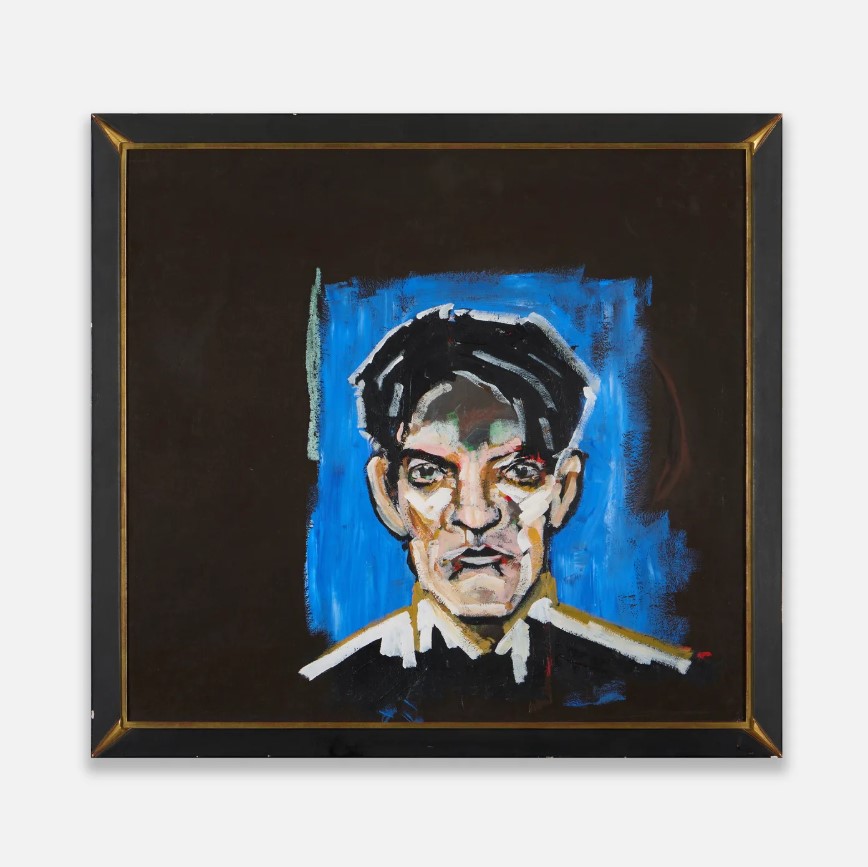
Everyman, mixed media on panel, 71 x 77 cm. Photo: Courtesy of Halcyon
Guided by light and shadow, the route runs from tangled bouquet to psychological study, with stops in nostalgia and imaginary figures. One recurring motif is the Everyman: an anonymous persona, at times bald and of ambiguous gender, stripped of the markers that identify an individual. The face becomes a surface where visitors project their own emotions and experiences. Claude Cahun, who investigated doubles and disguises with the camera, echoes in the series.
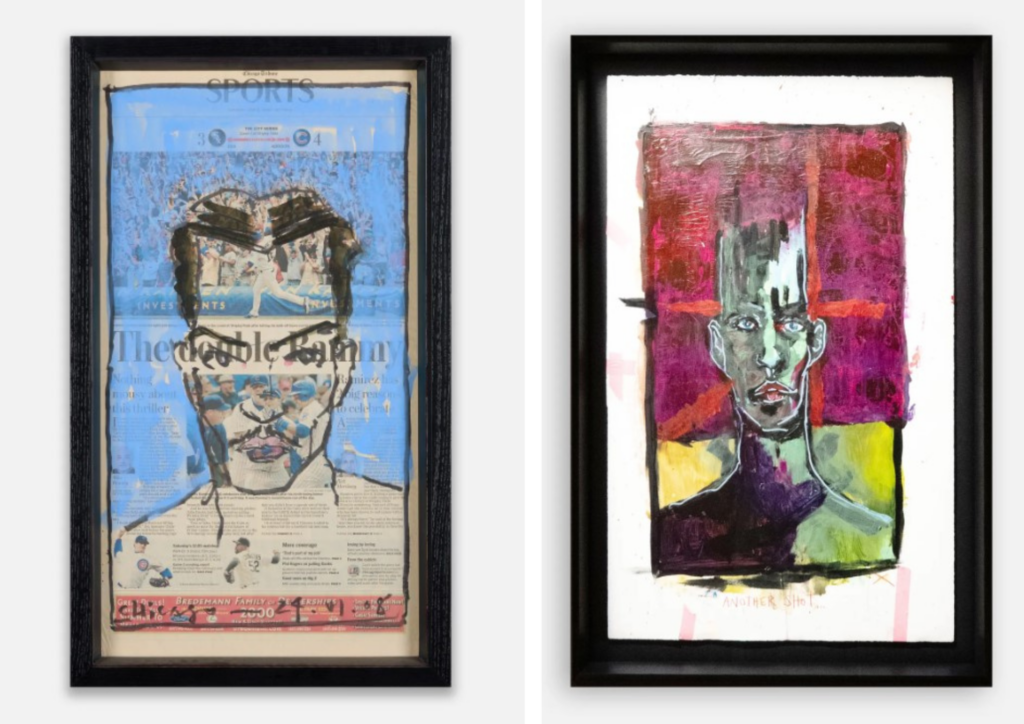
Dillinger II (2008), acrylic and pen on newspaper, 58 x 32 cm, and Rum, Part 1: Reflections, mixed media on paper, 90 x 60 cm. Photo: Courtesy of Halcyon
Among the compositions, “Dillinger II” (2008) layers acrylic and pen over a page from a sports periodical, and “Rum, Part 1: Reflections,” at 90 by 60 centimeters, crosses an abstract face with red strokes. Raoul Duke, John Dillinger, Jack Sparrow, Ed Wood, Edward Scissorhands and the Mad Hatter reappear as drawers of a single body, open at any moment. The paintings do not illustrate what he performed; they address the relationship between the person and the identities he inhabits.
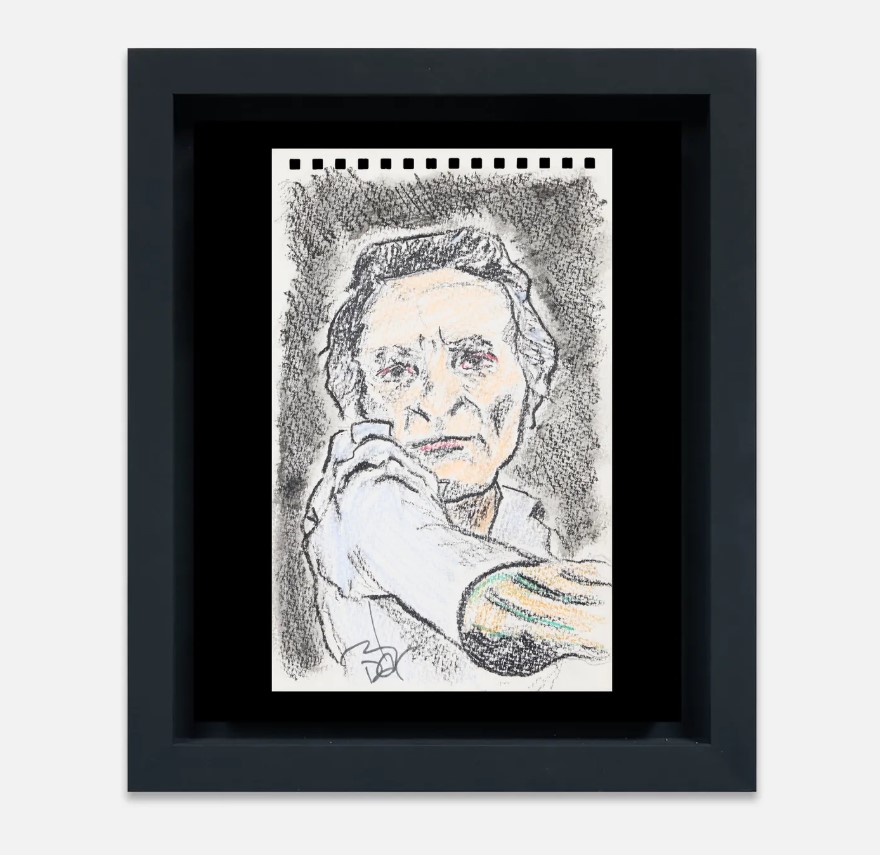
Larry Rivers (2003), crayon on paper, 20.2 x 12.5 cm. Photo: Courtesy of Halcyon
Johnny Depp’s heroes get a space of their own: Jack Kerouac, Bob Dylan, Hunter S. Thompson, F. Scott Fitzgerald, Larry Rivers and Antonin Artaud, whom he identifies as outsiders. In “Larry Rivers” (2003), wax crayon fixes the man with his hand near his chin. The character profiles capture originality and a refusal of conventional boundaries. Elongated forms recall Modigliani and Munch; simplification brings pop art to mind.
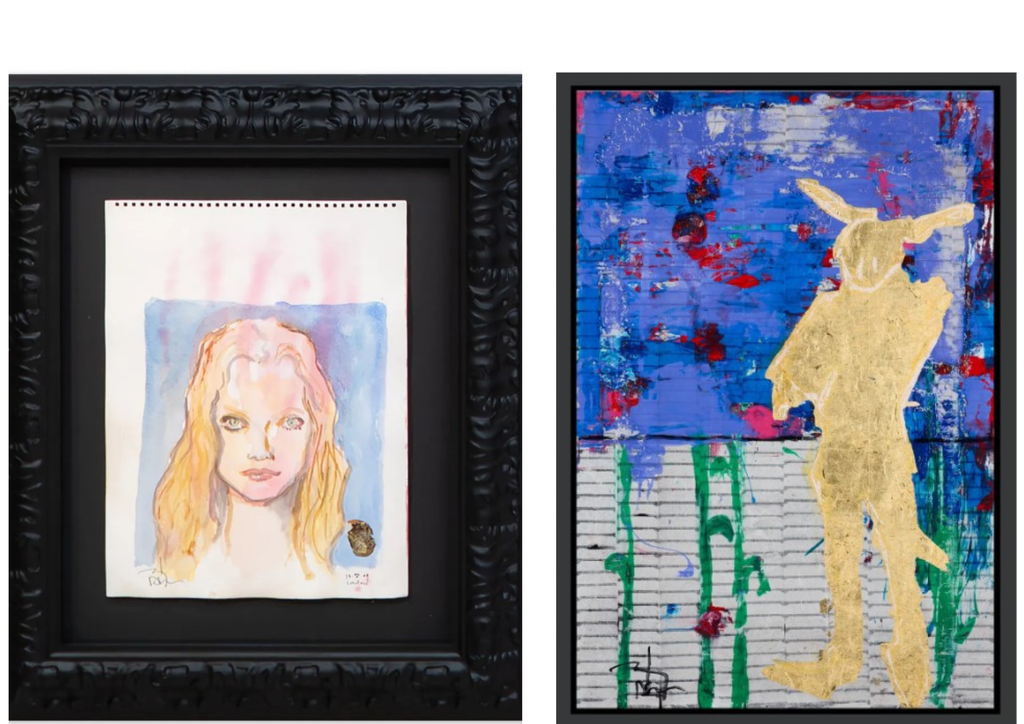
Untitled (2004), watercolor and wax on paper, 40.3 x 30.3 cm, and Bunnyman (2022), mixed media on panel, 100.5 x 68 cm. Photo: Courtesy of Halcyon
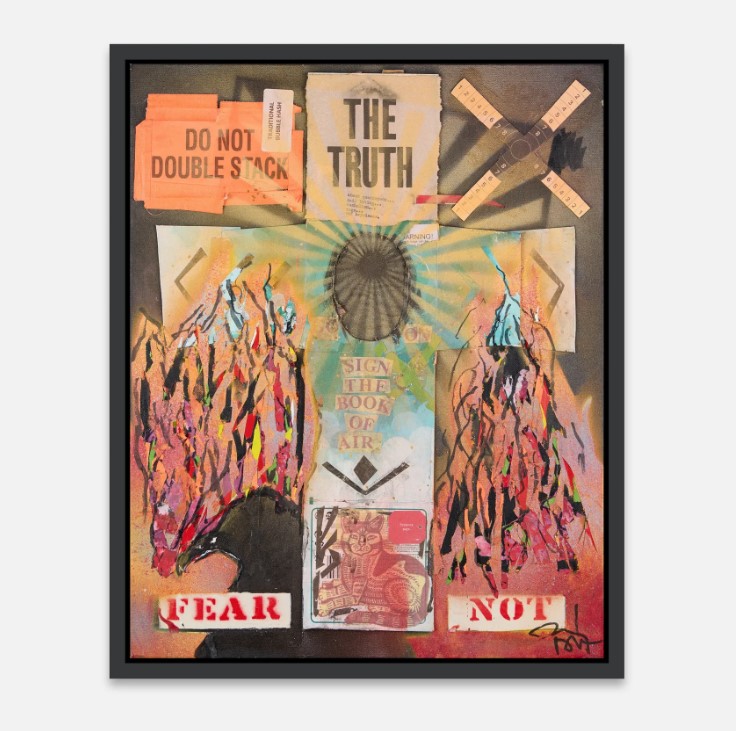
Untitled: Yorkshire Tea (2024), acrylic, spray paint, and collage on canvas, 50 x 40 cm. Photo: Courtesy of Halcyonn
Materials set the rhythm. Hotel notebooks, Rizla papers, tea boxes and newspaper clippings serve as supports and attest to a routine that makes use of whatever is at hand. “Untitled: Yorkshire Tea” (2024) brings together acrylic, spray paint and collage on canvas, at 50 by 40 centimeters. “Untitled” (2004) pairs watercolor and wax on paper. “Bunnyman” (2022), at 100.5 by 68 centimeters, uses mixed media on panel.
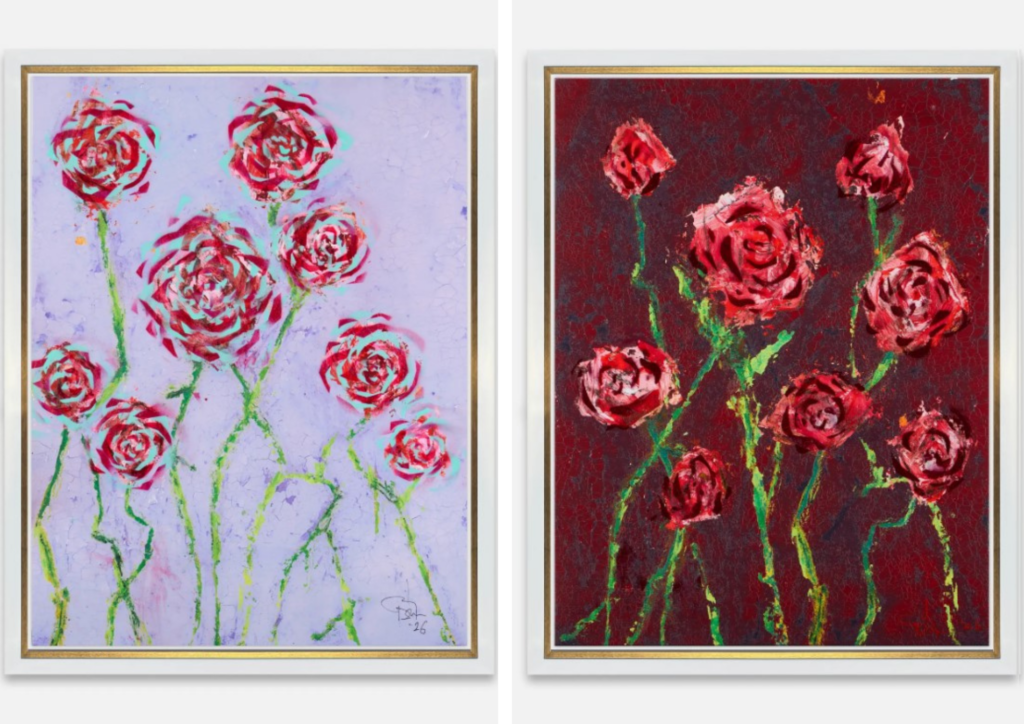
Yesterday’s Flowers (2026), mixed media on canvas, 105 x 80.5 cm. Photo: Courtesy of Halcyon
In the floral series, the rose works as a tangential portrait of Lily-Rose, Johnny Depp’s daughter, daughter, and hides her identity under a symbol. “Yesterday’s Flowers” (2026), at 105 by 80.5 centimeters, stands in dialogue with faded frescoes, cracked marble and sun-weathered facades, memories of journeys through Italy. Muses, among them Vanessa Paradis, appear marked by tenderness and longing.
Describing his method, Johnny Depp said: “The process of painting evolves like a film. Over time, it starts to say what it wants to be and then shows who it wants to be.” Art, he said, came before music and cinema.
Influences range from American literature to the Parisian avant-garde of the 1920s and the neo-expressionists of 1980s New York. Acting, composition and painting feed one another, and the crossover results in a language of its own.
Related: Atong Atem presents Passage, her first major solo show in Australia