
 Serpa
Serpa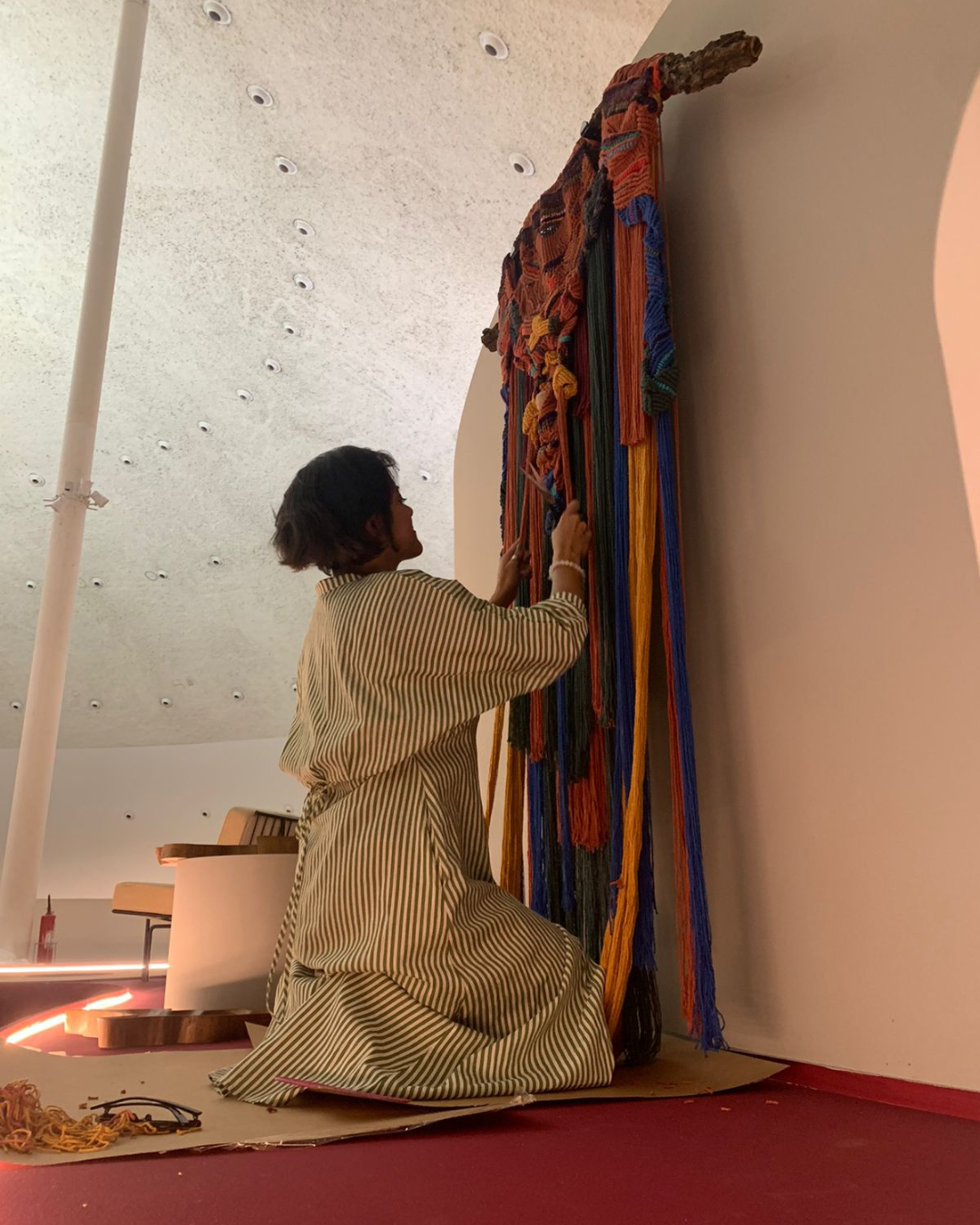
CAMILA MONTURIL
From studio to museums: sculptural embroidery dialogues with body, material, and environment in group shows
BRASÍLIA, BRAZIL – Designer and artist Camilla Monturil, from Candonba studio, who has worked for 12 years with experience in interior design, set design, and furniture, has consolidated over the past five years an original body of work that combines embroidery techniques with wooden structures, metalwork, fibers, fabrics, and repurposed materials. Her works inhabit the boundary between art and design, focusing on textile materiality and three-dimensional compositions that dialogue with the body and space.
Her embroidery practice emerged self-taught, through a process of discovery and experimentation that expanded to integrate with the environment. The embroidery transcends the surface and becomes a sculptural gesture, investigating the tension between order and chance, using asymmetry as a method that finds balance in the making itself.
Camilla Monturil has participated in exhibitions at the National Museum of Brasília and Mané Garrincha Stadium, in shows that celebrate the intersection of art, design, and sensory experience. Her creations reveal themselves in multiple stages and perspectives, always in dialogue with body, material, and environment.

CAMILLA MONTURIL
Exhibitions in 2024 and 2025
In 2024, the Candomba studio artist participated in two significant group exhibitions. At Casa Cor Brasília, she presented the work “Entrelaços do Cerrado” (Interlacing of the Cerrado) at the Arco Pavilion, designed by Três Arquitetura. The space was awarded best use of artwork by the technical jury of Correio Braziliense. Also in 2024, she joined the exhibition “Onde o Plano Encontra a Margem” (Where the Plane Meets the Margin), held at the National Museum during Brasília Design Week, curated by Nina Coimbra.

“Entrelaços do Cerrado” (Interlacing of the Cerrado)
In 2025, the exhibition schedule intensified. Camilla Monturil participated in Brasília Fashion Design at Metrópole, exhibiting the Copaíba lamp. At Brasília Design Week, she joined the exhibition “Horizonte em Risco” (Horizon at Risk), with the Uirá chair and the piece Berço das Águas (Cradle of Waters), curated by Nina Coimbra and Cris Velhotes. At the National Museum Annex, she presented the works Visagem and Fogo (Fire) in the show promoted by ADEPRO during BDW25.

Uirá chair partnership with designer Raquel Chaves
Brasília Design Week and the “Horizonte em Risco” Exhibition
Brasília Design Week 2025, held from June 17-24, occupied the National Museum of the Republic and various points throughout the federal capital with over 40 free activities, including exhibitions, fashion shows, lectures, urban circuits, workshops, and experiences integrating tradition and innovation. Under the theme “Memory, Design, and Future,” the event transformed Brasília into an open-air gallery, with participation from designers, artists, and creators from across the country.
The creator of Brasília Design Week, Caetana Franarin, emphasized that the event represented an affective encounter between memory, past, and future, helping to understand the growth of design, art, and culture in the Federal District. The 2025 edition was organized by Desponta Brasil and the Brazilian Institute of Creative Economy, with support from the Federal District Government.
The exhibition “Horizonte em Risco,” curated by Nina Coimbra and Cris Velhotes, proposed reflections on the directions of design through original objects, artworks, and furniture with strong aesthetic and critical presence. The show presented objects and furniture of original design from throughout Brazil that translate Brazilian identity and dialogue with themes that permeate and construct horizons. Nina Coimbra, a Brasília-based artist and designer with a degree in Visual Arts from the State University of New York, works across different languages and techniques, having exhibited in spaces such as MASP, the Museum of the Republic, and the Cultural Center of Banco do Brasil.
Influences and Methods
Throughout her journey, the Candomba studio designer has recognized affinities with artists whose investigations in materiality, patterns, and layers resonate with her own aesthetic and sensory experiences. Among her references is New Zealand textile artist Toni Brogan, based in New York, who creates free-form textile sculptures and explores the tactile nature of fibers, developing unique weaving techniques. Brogan works with textures, everyday objects, and intricate patterns that incorporate vibrant colors and earthy tones, inspired by the seasonal changes of the Catskill Mountains.

Coleção Elementais / Elementals Collection
Another fundamental influence is Arthur Bispo do Rosário, a Brazilian artist who lived for nearly 50 years in psychiatric institutions, where he created about a thousand pieces using everyday objects, embroidery, and found materials. Born in Sergipe in 1911, Bispo do Rosário produced works with sewing and embroidery techniques on fabric, creating ceremonial robes and banners that represented his mission to record the world to present it on judgment day. His production, which includes the iconic work “Manto da Apresentação” (Presentation Mantle), uses threads pulled from inmates’ uniforms and collected objects such as mugs, wood, wire, and bottles. He represented Brazil at the Venice Biennale in 1995 and became a fundamental reference for contemporary Brazilian art, with his work designated as heritage by the State Institute of Cultural Heritage of Rio de Janeiro.

Coleção Elementais / Elementals Collection
Camilla Monturil’s research starts from manual gesture and textile materiality, with interest in ancestral techniques of braiding and weaving, the logic of patterns and organic geometries, and the relationship of the body with space. Her visual repertoire emerges from natural elements, spirals, and layers, uniting artisanal tradition and contemporary language. The works involve touch, scale, and the breathing of the environment, in a process that values sensory experience and spatial integration developed at Candomba studio.

Berço das águas / Cradle of Waters
Instagram: https://www.instagram.com/ateliecandomba/

Amazing and impressive work!
Camilla, artista têxtil dotada de muitos detalhes e beleza nas suas obras, parabéns!
Camilla, artista têxtil dotada de muitos detalhes e beleza nas suas obras, parabéns!