 Samuel Navarro Serpa
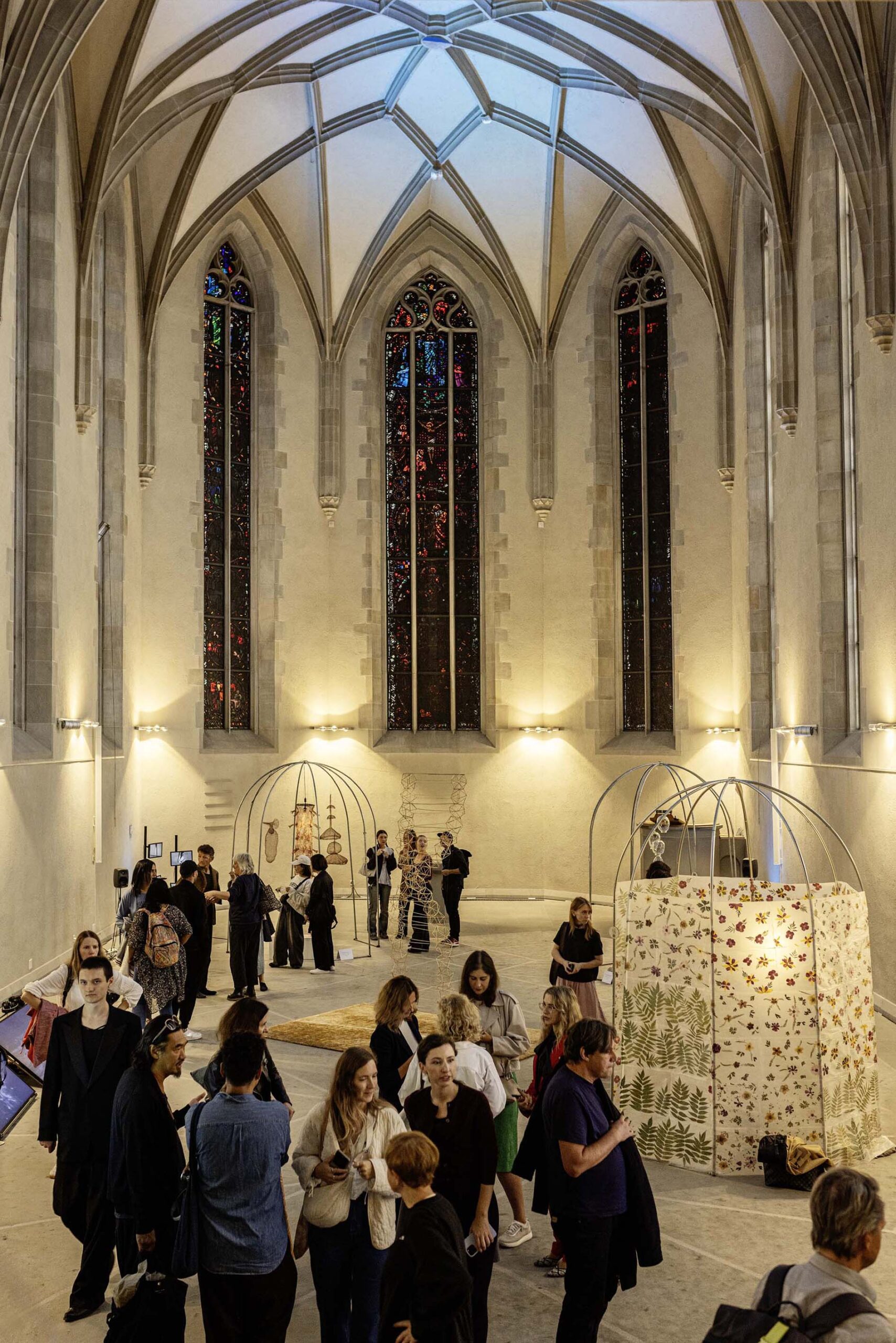
Visitors gather inside the historic Wasserkirche in Zurich for the opening of “Presence.” (Photo: Nora Dal Cero)
By Samuel Navarro Serpa
Exhibition ‘Presence’ occupies the historic Wasserkirche through Sunday and gathers 12 Ukrainian artists around the relationship between body, nature and memory
ZURICH, Switzerland — Kyiv Design Week has opened the exhibition “Presence” as part of the Zurich Design Weeks 2026 program. Ukrainian designers and multimedia artists come together around a central question: what it means to be present. The show occupies the Wasserkirche in Zurich and runs through Sunday.
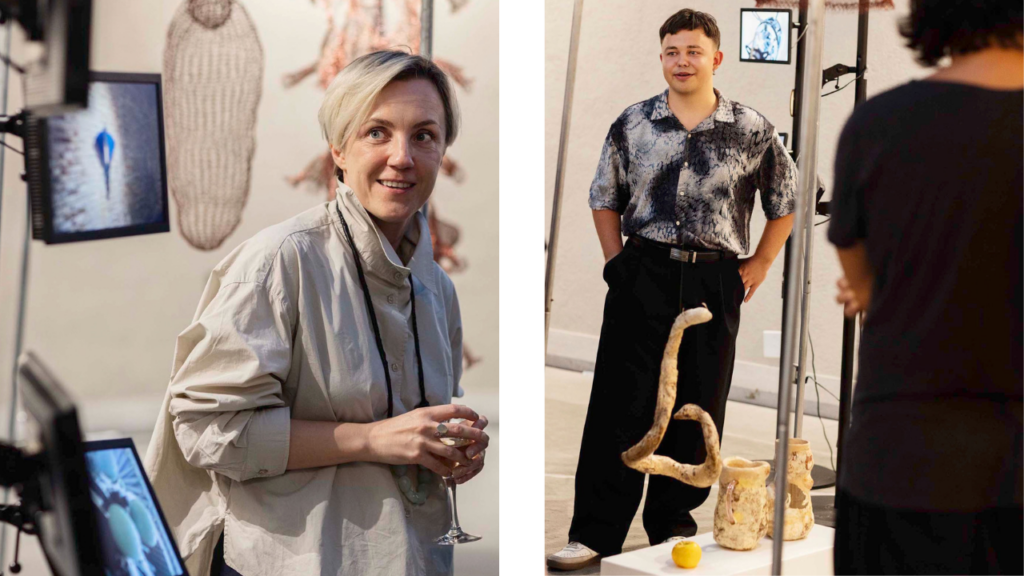
Curators Anastasiia Biletska and Andrii Kapalb attend the exhibition’s opening. (Photo: Nora Dal Cero)
Curators Anastasiia Biletska and Andrii Kapalb are in charge of the show, with spatial architecture and graphic design by Katerina Leontidou. Wasserkirche Zürich, SüdKulturFonds and Studio Leon support the production, which marks the Ukrainian event’s fourth consecutive participation in Zurich Design Weeks.
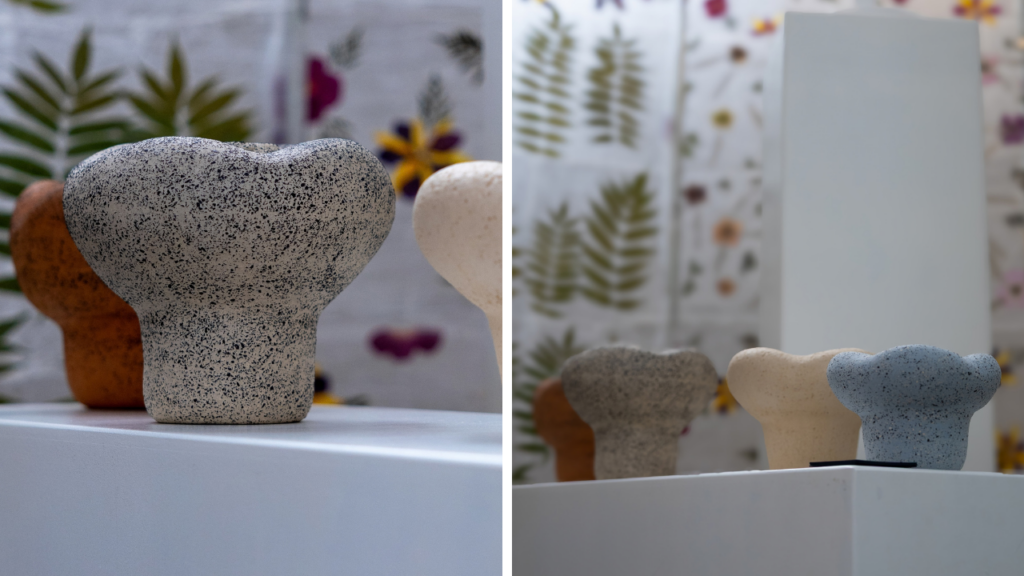
Ceramic vases from Olha Denysova’s “Les Fleurs” series appear in the Childhood Garden section. (Photo: Courtesy)
Making up the lineup are 12 studios and artists from Ukraine: Joseph Virts, Decorkuznetsov, Atelier Dasha Tsapenko, Smyth & Winken, Tetiana Shaleva (Rugsandrugs), Alyona Shybunova, Tetyana Kulminska (Tanski / Verdandi Lab), Ksenia and Yuriy Ryntovt (Ryntovt Design), Yelyzaveta Rudenok, Olha Denysova, Polina Moroz and Lidia Kolchenko. The works explore wood, metal, ceramics, textiles, earth, straw and scent, as well as sound, light and video.
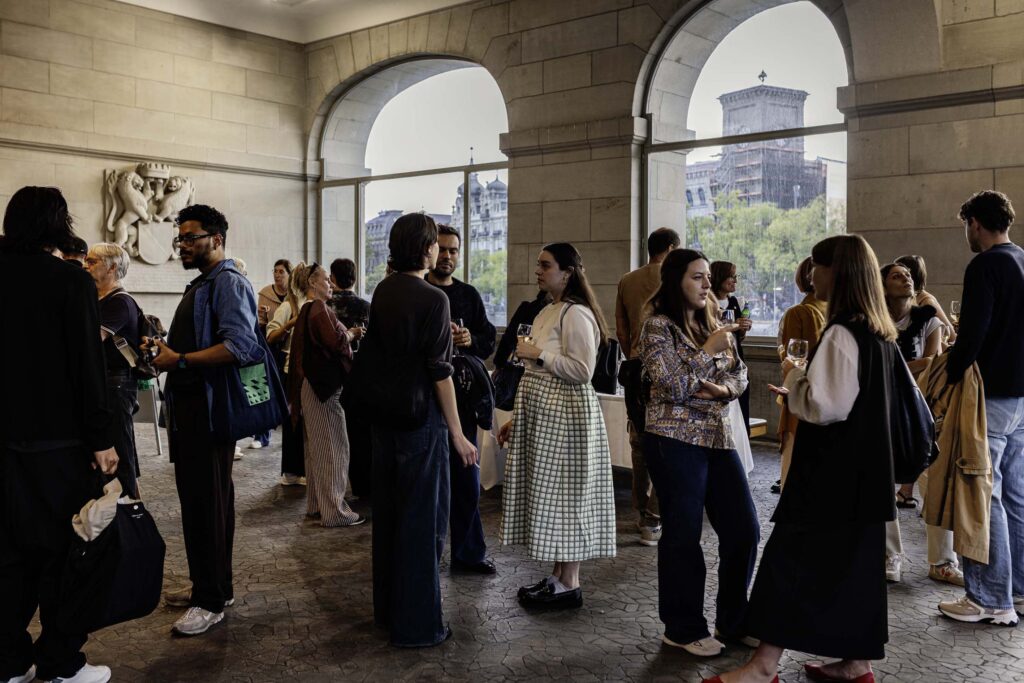
Guests mingle beneath the arched windows during the exhibition’s opening reception. (Photo: Nora Dal Cero)
Admission is free. Visiting hours run daily from noon to 6 p.m., except Mondays. A parallel program of talks and meetings with curators accompanies the exhibition period.
Built on an island in the Limmat
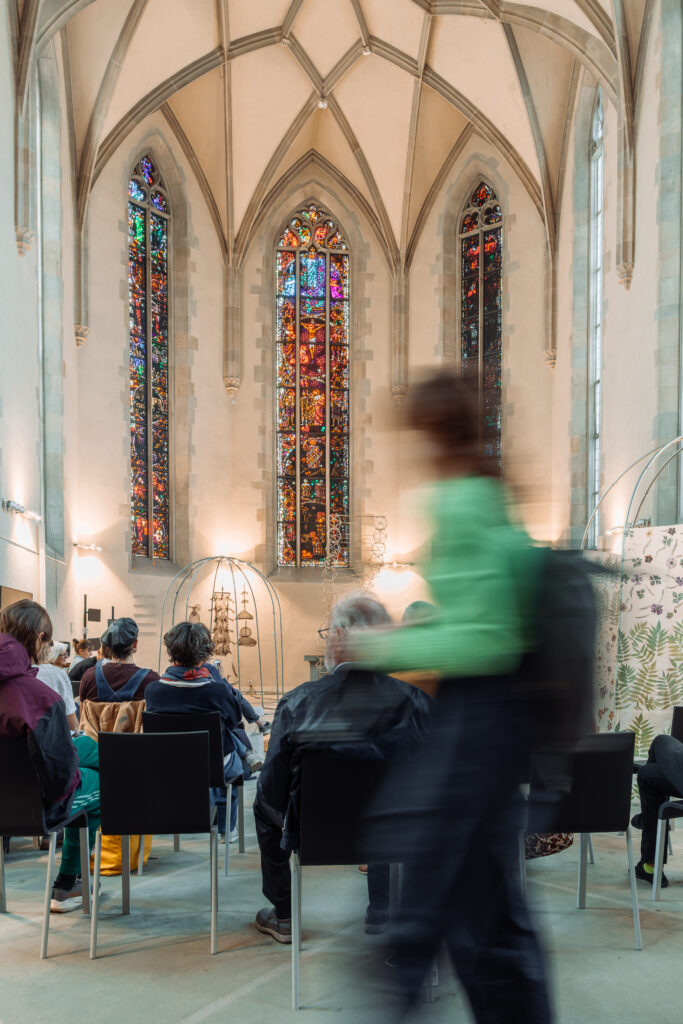
Stained-glass windows by artist Augusto Giacometti frame the Wasserkirche’s choir. (Photo: Anetta Damm)
Located at Limmatquai 31 in Zurich’s historic center, the Wasserkirche, whose name means “water church,” was originally erected on a small island in the Limmat River, between the two main churches of the medieval city, the Grossmünster and the Fraumünster. Documents from the 13th century already record the location under the Latin name ecclesia Aquatica Turicensi. According to local tradition, the island was where the city’s patron saints, Felix and Regula, were executed.
Around 1486, the current late Gothic building was finished. During the Protestant Reformation, the church was labeled a temple of idolatry and lost its religious function. In 1634 it became Zurich’s first public library, a role it held for centuries and that helped lay the groundwork for the future University of Zurich, founded in the 19th century. The island disappeared in 1839, when landfill along the Limmatquai joined the land to the river’s right bank.
Renovation in 1942 brought religious and cultural activities back to the Wasserkirche, and today it is recognized as a heritage site of national significance by the Swiss inventory of cultural property. Among its attractions are the choir’s stained-glass windows by artist Augusto Giacometti, which contrast scenes from the life of Christ with images of modern everyday life. It is in this age-old setting, marked by layers of faith, knowledge and reconstruction, that Kyiv Design Week installs the contemporary works of “Presence.”
Three gardens organize the route
Greenhouses converted into exhibition rooms form three environments, dubbed “Gardens of Memory” by the curatorial team. Each space represents a dimension of human experience: forgetting, enchantment and personal remembrance.
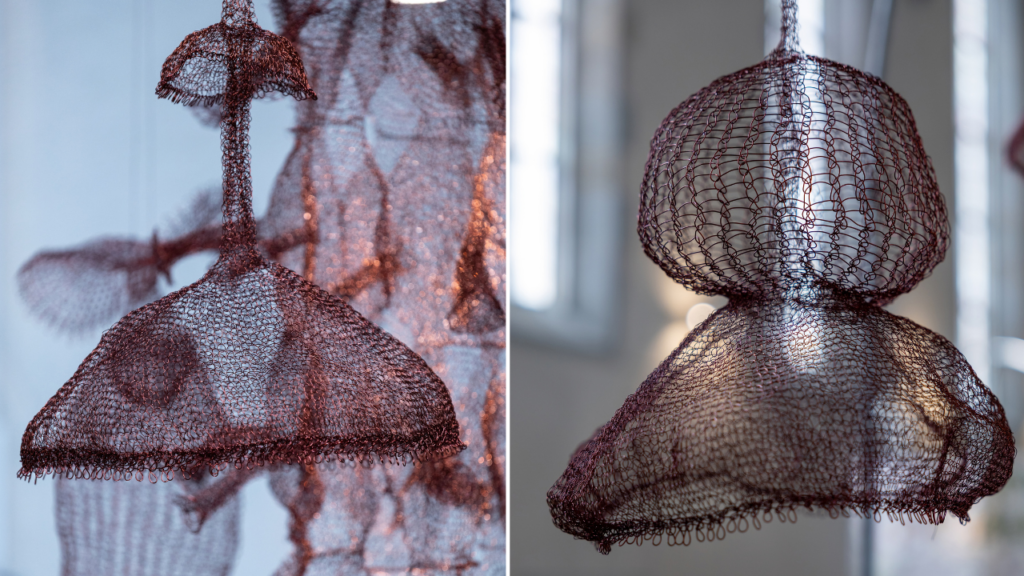
Aerial sculptures from “Aeria Garden,” by Kateryna and Valerii Kuznetsov of Decorkuznetsov, hang in the Forgotten Garden. (Photo: Courtesy)
In the first environment, called Forgotten Garden, are the aerial sculptures and light installations of the Aeria Garden project, created by Kateryna and Valerii Kuznetsov of the collective Decorkuznetsov.
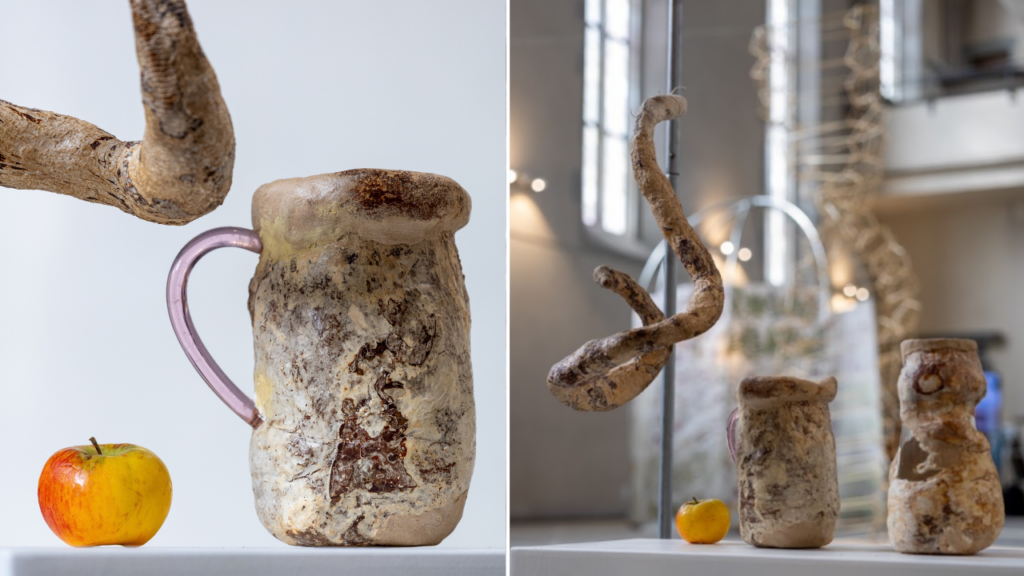
Mycelium-based objects by Atelier Dasha Tsapenko sit near an apple used for scale. (Photo: Courtesy)
Objects made of mycelium, produced by Atelier Dasha Tsapenko, share the space with the video installation “Endless Movement Project,” by the duo Smyth & Winken, which compiles recordings of kinetic sculptures made between 2020 and 2026.
Magical Garden, in turn, is home to pieces from the new collection Living Structure by Yelyzaveta Rudenok, known as Doinshapes, including a chair and a bench. A perfume called “Petrichor,” created by Tetyana Kulminska, reproduces the smell of wet earth after rain and completes the room’s sensory setting.
Dedicated to personal memory, the Childhood Garden features the “Pollen” lamp by Polina Moroz, the flower coat “Blumenmantel,” made by Lidia Kolchenko with petals she gathered herself in the European summer of 2026, and the ceramic vases of the Les Fleurs series by Olha Denysova.
Ukrainian soil becomes symbol of identity
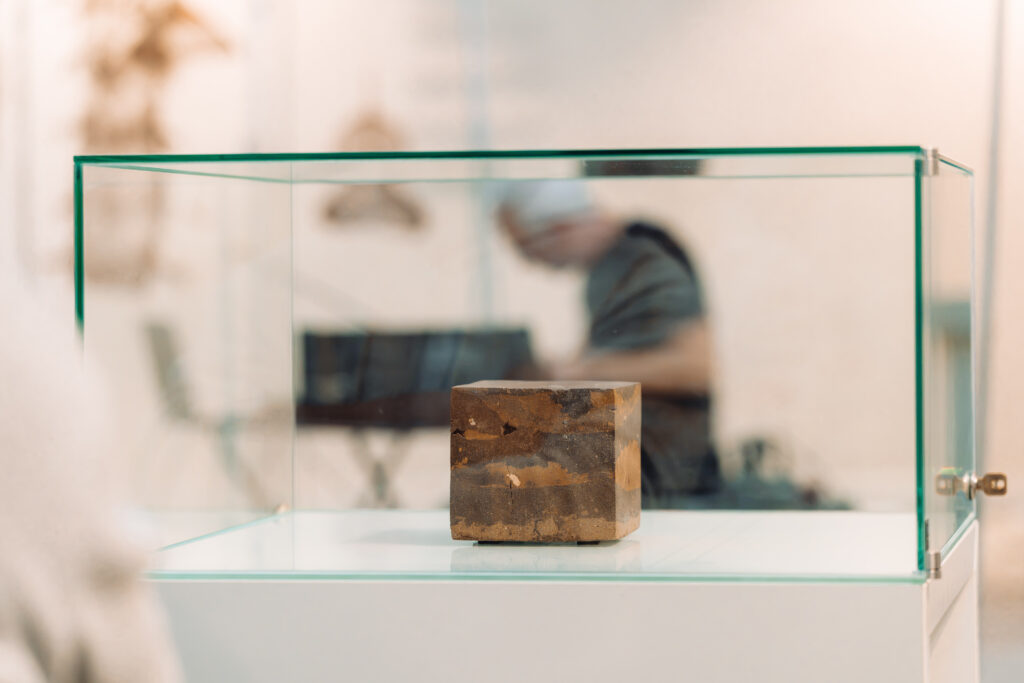
Ksenia and Yuriy Ryntovt’s sculpture “Terra,” made from Ukrainian black soil and clay, sits in a glass case. (Photo: Anetta Damm)
Sculpted from black soil and clay from Ukraine, “Terra” holds a central place in the exhibition. Ksenia and Yuriy Ryntovt of Ryntovt Design created the work in 2016 and display it in a glass case. A phrase sums up the duo’s working principle: “Walk on the Earth as if whispering.”
With the horizontal plane of the earth turned into a vertical structure, the designers reinforce, according to the curators, the symbolic value of soil as an element of identity and belonging in Ukrainian culture, beyond its territorial dimension.
Visually, a Ukrainian wheat field is rebuilt in “Terra 006,” a textile piece by Tetiana Shaleva of Rugsandrugs and the first work in the Terra Ukraina collection.
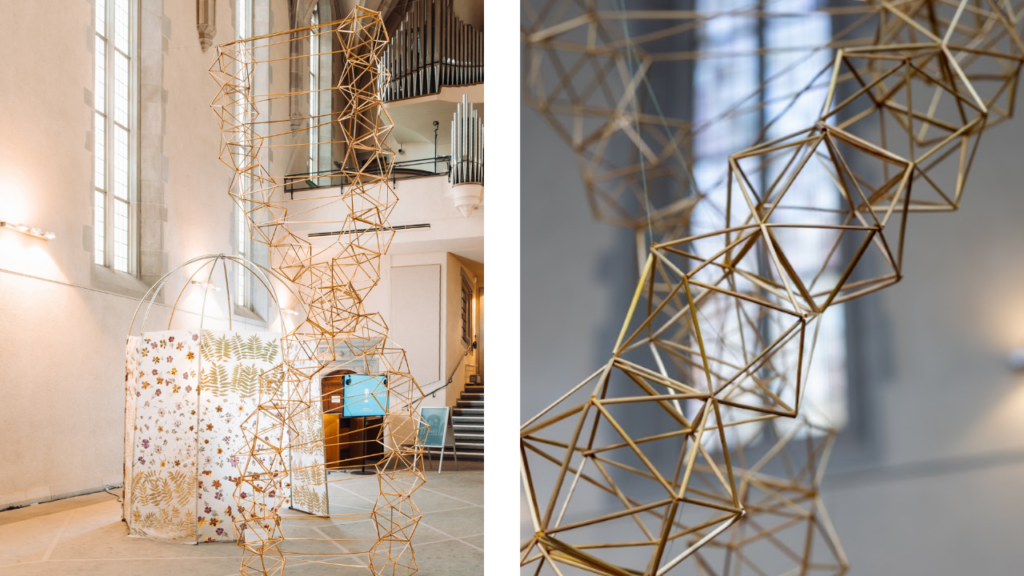
Alyona Shybunova’s aerial sculpture “Spiral” draws on a traditional Ukrainian weaving technique. (Photo: Courtesy)
Named “Spiral,” the aerial sculpture by Alyona Shybunova grew out of a traditional technique from Ukraine associated with making pavuky, Christmas ornaments woven in the shape of spiders. Created especially for the exhibition, the sculpture suggests a movement of transition between earth and sky.
Water recalls building’s history
Joseph Virts signs the piece dedicated to water, presented on two screens. The audiovisual work alludes to the history of the building itself. The screens were positioned exactly on the side of the church where water once ran, the curators explain. One sentence closes the piece and serves as a message to the public: “Whatever happens, everything will be fine.”
Hardly for the first time has Anastasiia Biletska turned to preexisting structures as a scenographic device. In 2024, during an edition of Kyiv Design Week held at the Mystetskyi Arsenal in Kyiv, the curator used a military tent to house the exhibition “Design of Freedom,” which gathered more than 40 objects by creators from Ukraine under the theme “Design to Unite.”
Regular guest at Zurich Design Weeks
“Out of” is the theme of this year’s Zurich Design Weeks, tied to ideas of transition and breaking with familiar forms. Before any exit, however, the organizers of “Presence” propose a pause: to observe where and how each person is present, in the body and in the surrounding environment.
Ukraine’s presence at the event reinforces the dialogue between the country’s contemporary output and the international design scene.
Details
“Presence,” Kyiv Design Week at Zurich Design Weeks 2026
Where: Wasserkirche, Limmatquai 31, Zurich
Schedule: Through Sunday, daily, noon to 6 p.m., except Mondays
Price: Free admission
Instagram: @kyivdesignweek @wasserkirchezurich @zurichdesignweeks
Website: 2026.designweeks.ch