 Samuel Navarro Serpa
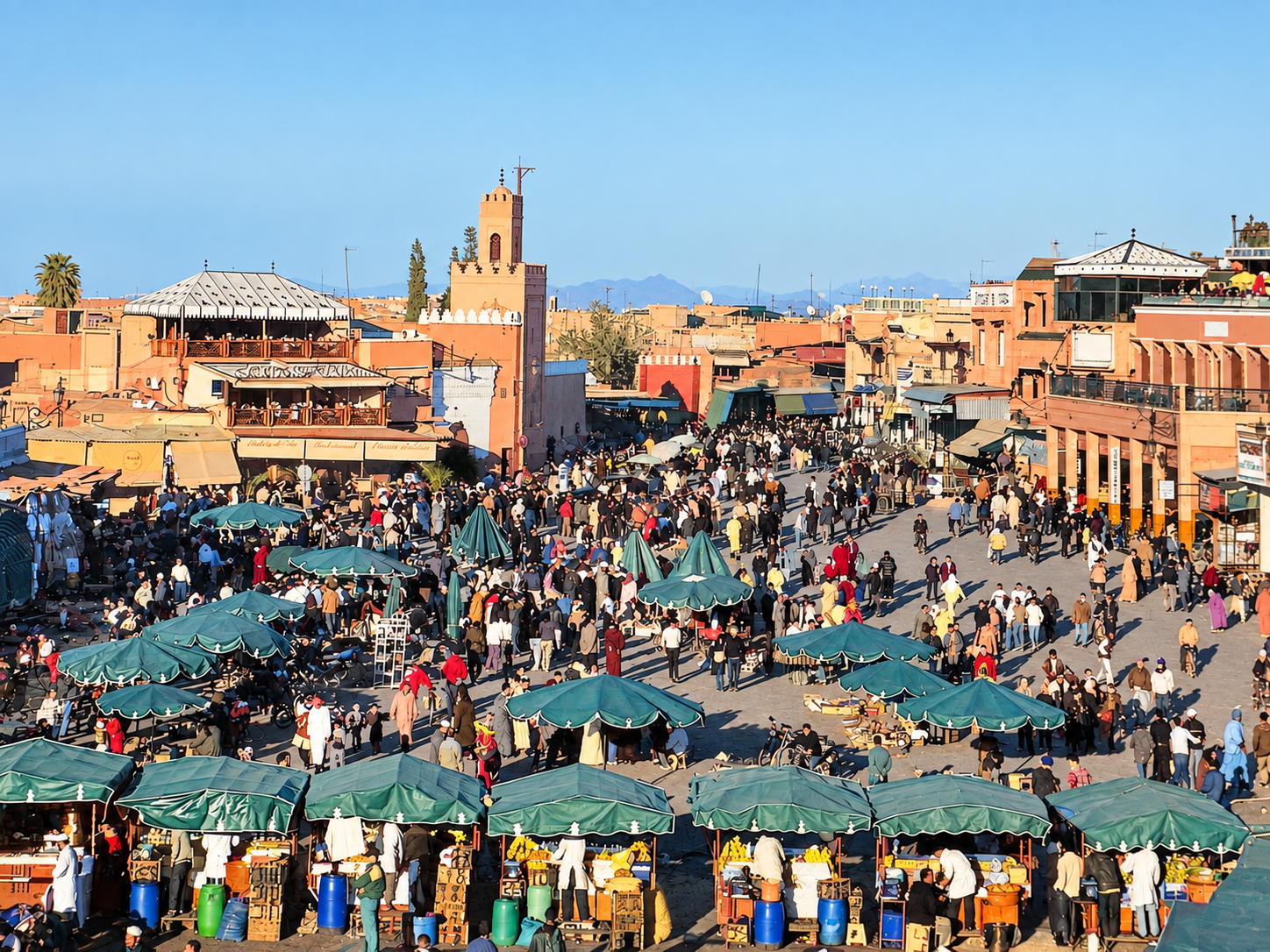
Amid terracotta tones, colorful mosaics and the tea ritual, Marrakech reveals that its greatest beauty stems from its contradictions. (Photo by Fernanda Artibani)
By Fernanda Artibani
Lifestyle & Travel
A few years ago, not to say many and give away my age, I visited Morocco.
Even today, when someone asks me which is the most different place I have ever been, the answer comes quickly: Marrakech.
In short, it was the most contradictory city I have visited.
Perhaps that is because few cities anywhere manage to bring together so many contrasts in a single place. Marrakech is, at once, ancient and contemporary, intense and contemplative, chaotic and welcoming. It is a city where the past remains alive without giving up on the present.
Founded around the 11th century, Marrakech became one of Morocco’s key imperial cities. For centuries, it served as a meeting point between Africa, the Middle East and Europe. Merchants, scholars, artisans, travelers and explorers from many corners of the globe passed through its streets, which may explain why its identity is so rich and complex.
Known as the “Red City” (Al-Hamra, in Arabic), Marrakech earned the nickname not by aesthetic choice but through a combination of geography, tradition and legislation. Historically, its buildings were constructed with the region’s clay-rich, iron-heavy soil, which naturally shows shades of pink, ocher and red. The ancient rammed-earth building technique, which uses local soil to raise walls and structures, helped consolidate this visual identity.
Urban regulation still preserves that characteristic, requiring facades to keep the palette that turned the city into one of the most recognizable urban landscapes in the world.
From the outside, Marrakech looks almost monochromatic.
Yet all it takes is walking through the door of a mosque, a cafe or a hotel, or simply wandering the paths of the medina (the city’s old quarter), and that impression disappears completely.
It is like crossing an invisible border.
Earthy tones dominate the exterior. Inside, a universe of colors, textures and details bursts forth, defying any expectation.
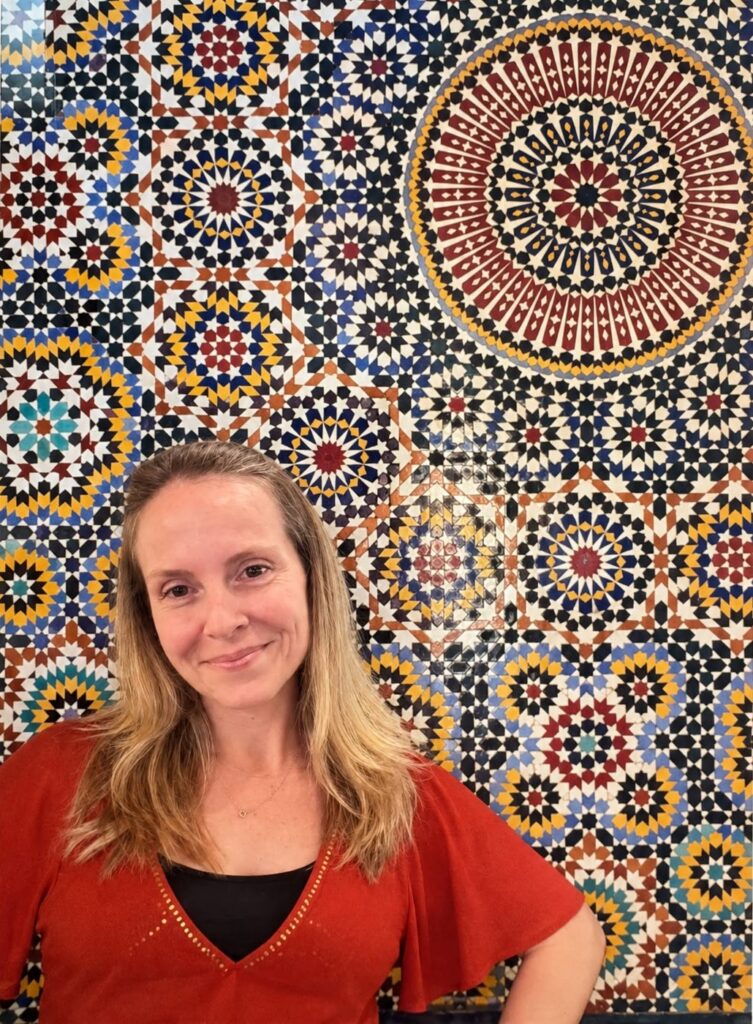
A panel of zellige captures one of the greatest symbols of Moroccan art and architecture. (Photo by Fernanda Artibani)
Zellige, the famous Moroccan mosaics, are one of the best examples of this. Beyond simple decorative tiles, they represent an ancestral art executed by hand. Small pieces of glazed ceramic are cut one by one and assembled like an intricate puzzle, forming geometric patterns inspired by Islamic art.
To the onlooker, they are just designs. To those who understand their origin, they represent much larger concepts: balance, harmony, spirituality and the infinity of the universe.
Centuries later, this technique would influence the development of the encaustic cement tiles that spread across Europe and, later, throughout several Latin American countries.
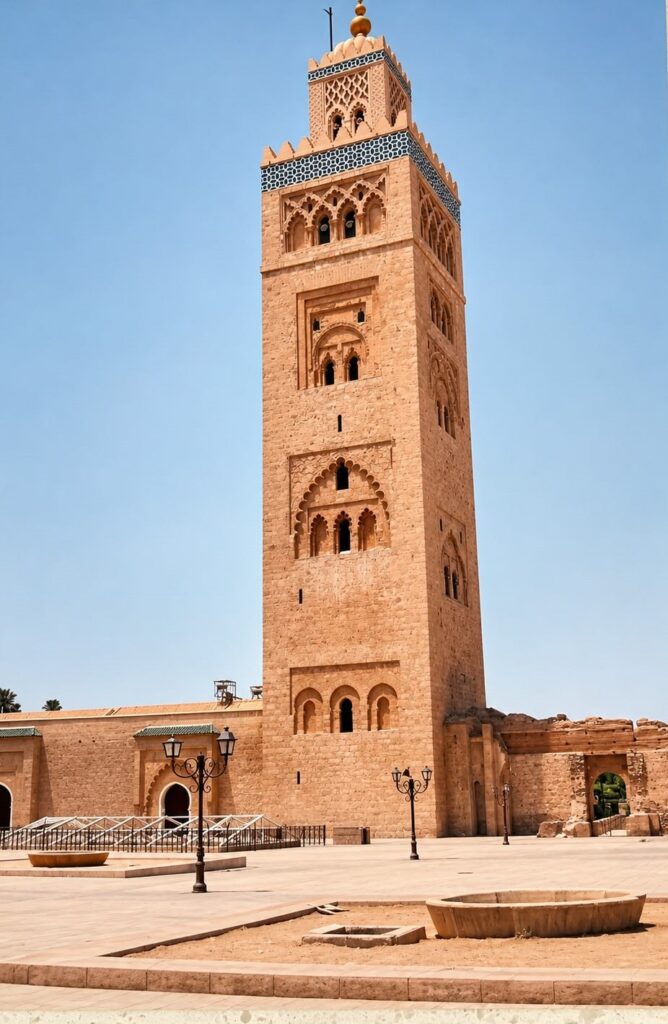
Marrakech’s compass is not a monument in the ordinary sense, but the Koutoubia Mosque itself. Its minaret, visible from many points across the city, has guided residents and visitors for more than eight centuries, connecting history, faith and Moroccan identity. (Photo by Fernanda Artibani)
Among the monuments that best reveal this architectural richness is the Koutoubia Mosque, considered the city’s main symbol. Its minaret dominates the skyline and can be seen from practically anywhere in the historic center. Its height also served as a reference for later constructions in other parts of the Islamic world, even influencing the architecture of Spain’s Andalusia.
Contemplating the grandeur of the building at dusk is a striking experience, even for those who cannot visit its interior.
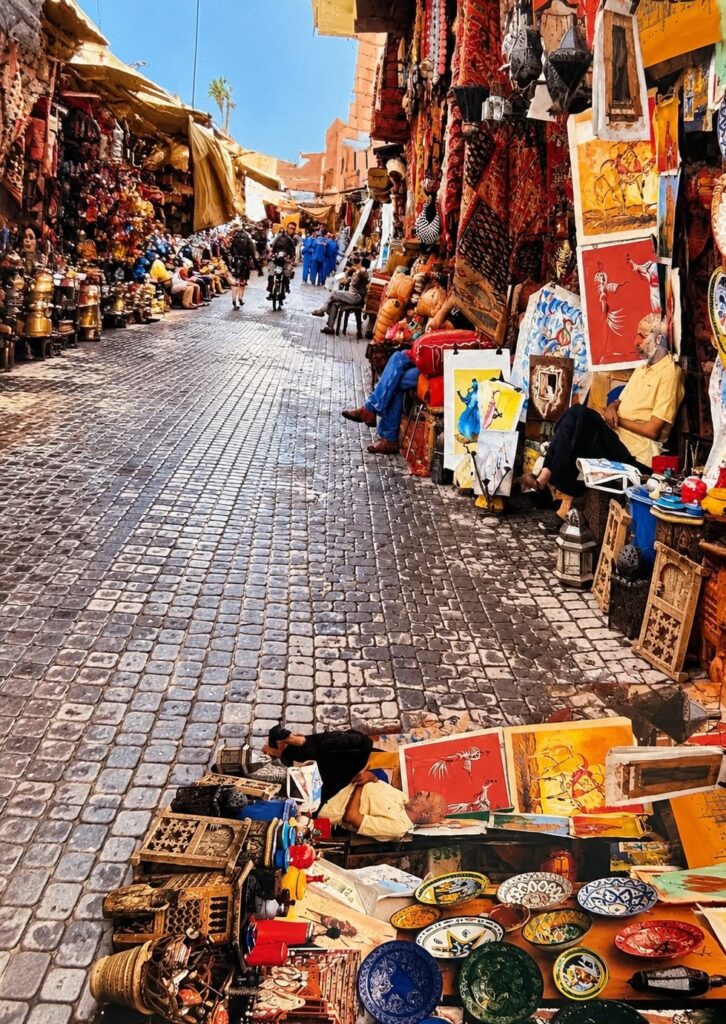
Daily life in the heart of the medina becomes spectacle. Textures, scents, colors and sounds blend into a setting that seems carefully shaped by time. (Photo by Fernanda Artibani)
But the medina is where Marrakech shows its soul.
Recognized as a UNESCO World Heritage Site, it is a labyrinth of more than 9,000 narrow alleys surrounded by centuries-old walls. Walking through it requires more surrender than planning.
Maps help little.
Apps help even less.
Eventually there comes a moment when the best decision is to accept that you are going to get lost.
And that may be the best way to get to know Marrakech.
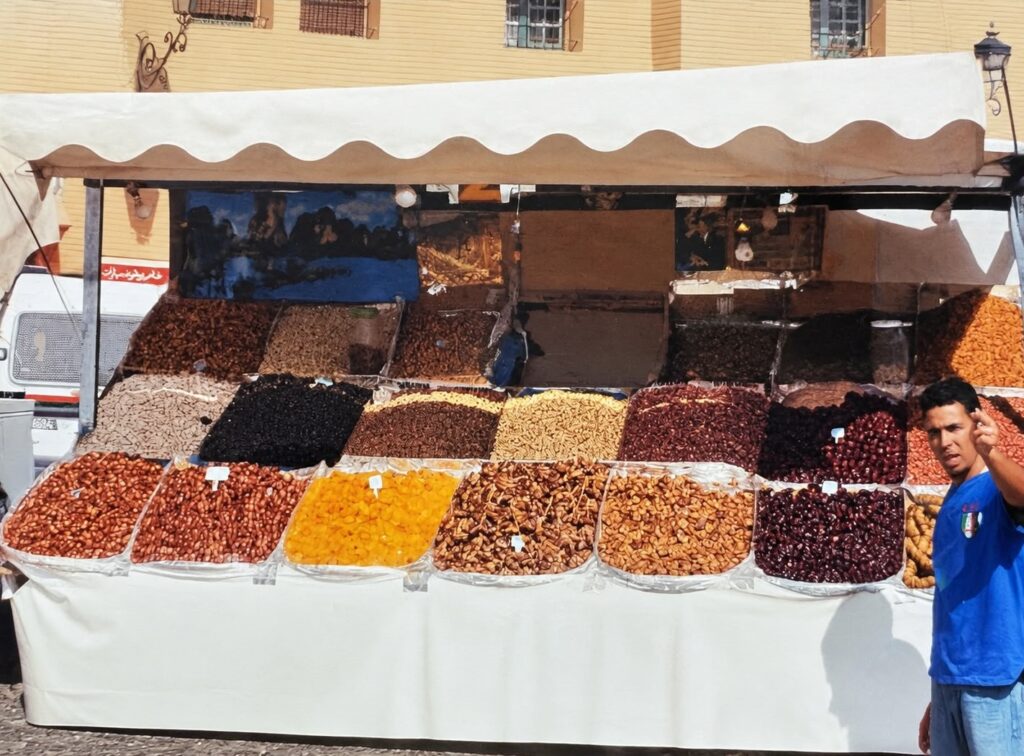
Souk stalls across Marrakech each look like a work of art. Amid spices, dried fruits and dates of different varieties, the markets turn colors, scents and flavors into a singular sensory experience. (Photo by Fernanda Artibani)
In the souks, the city’s bustling markets, you can find practically everything: spices, dates, rugs, fabrics, lanterns, jewelry, ceramics, perfumes and handmade decorative objects.
Saffron, cinnamon, cumin and fresh mint perfume the air.
Right there, I realized Marrakech is a city discovered far more through the senses than through tourist itineraries.
Another contradiction fascinates me: the cultural one.
Camels, motorcycles, bicycles, pedestrians, cars and merchants share the same streets in an apparently organized chaos, and yet there is one of the most elegant rituals I have ever witnessed: Moroccan tea.
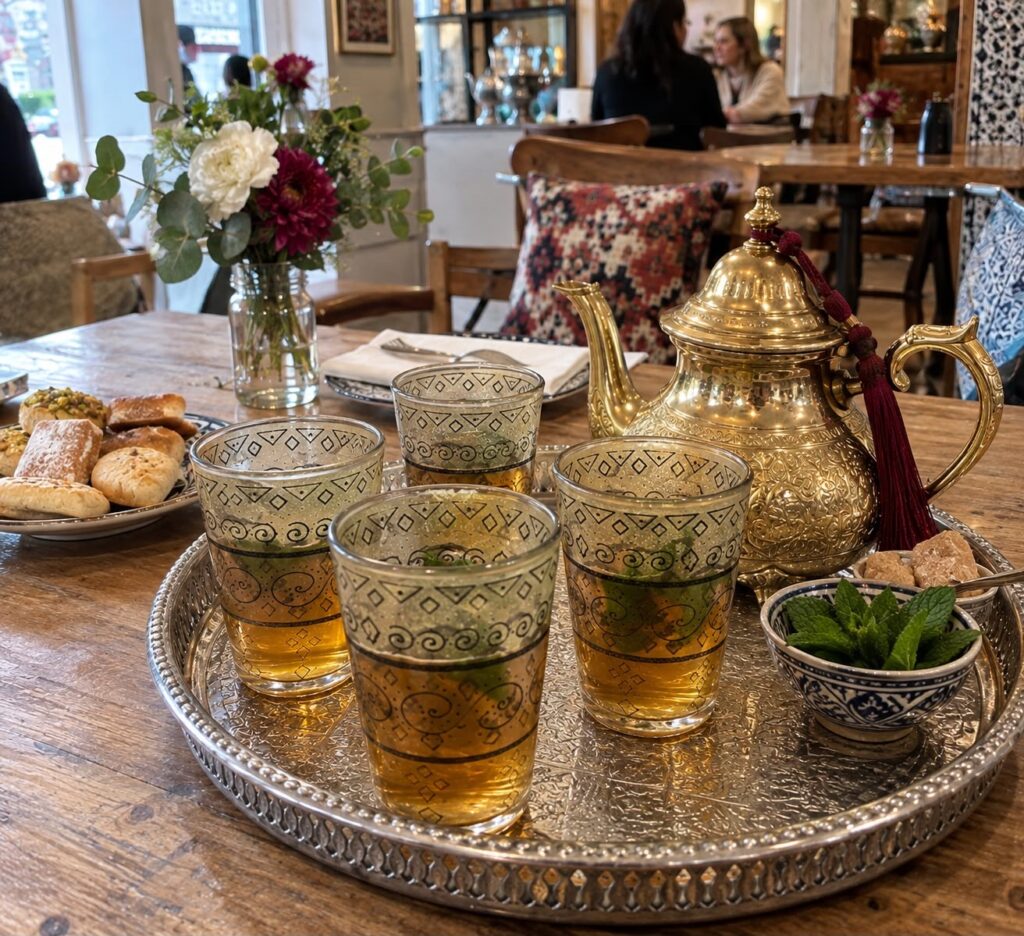
Made with green tea, mint and sugar, attay holds a special place in Moroccan culture. Offering it is a gesture of welcome; sharing it is a way to celebrate togetherness. (Photo by Fernanda Artibani)
Called attay, it is much more than a beverage.
Hospitality, friendship and welcome are what it symbolizes.
Offering tea is a gesture of respect, and refusing it can be seen as discourteous.
Many family gatherings, business negotiations and meetings between friends begin around a carefully prepared tray.
Height matters too. Tea is poured from high above the glass to create foam and aerate the drink, a display that combines technique, tradition and ceremony.
Some families still follow the custom of three glasses of tea, each carrying its own symbolism related to life, love and the human experience.
Amid the city’s incessant movement, the tea ritual works as a pause.
Guests are invited to slow down, be present, listen and build connections.
Because in Morocco, tea does not mark the time of day.
Instead, it marks the importance of the moment and of the people who share it.
Maybe that is exactly why Marrakech remains so vivid in my memory.
Not only because of its palaces, markets or historic monuments.
Above all, because there I learned that opposites can coexist in perfect harmony.
There, tradition and modernity walk side by side. Silence and movement meet on the same corner. Simplicity and exuberance share the same space.
Within this collection of contrasts lies its most authentic beauty.
A beauty that cannot be completely explained. Only lived.

Lifestyle and Travel by Fernanda Artibani