 Serpa
Serpa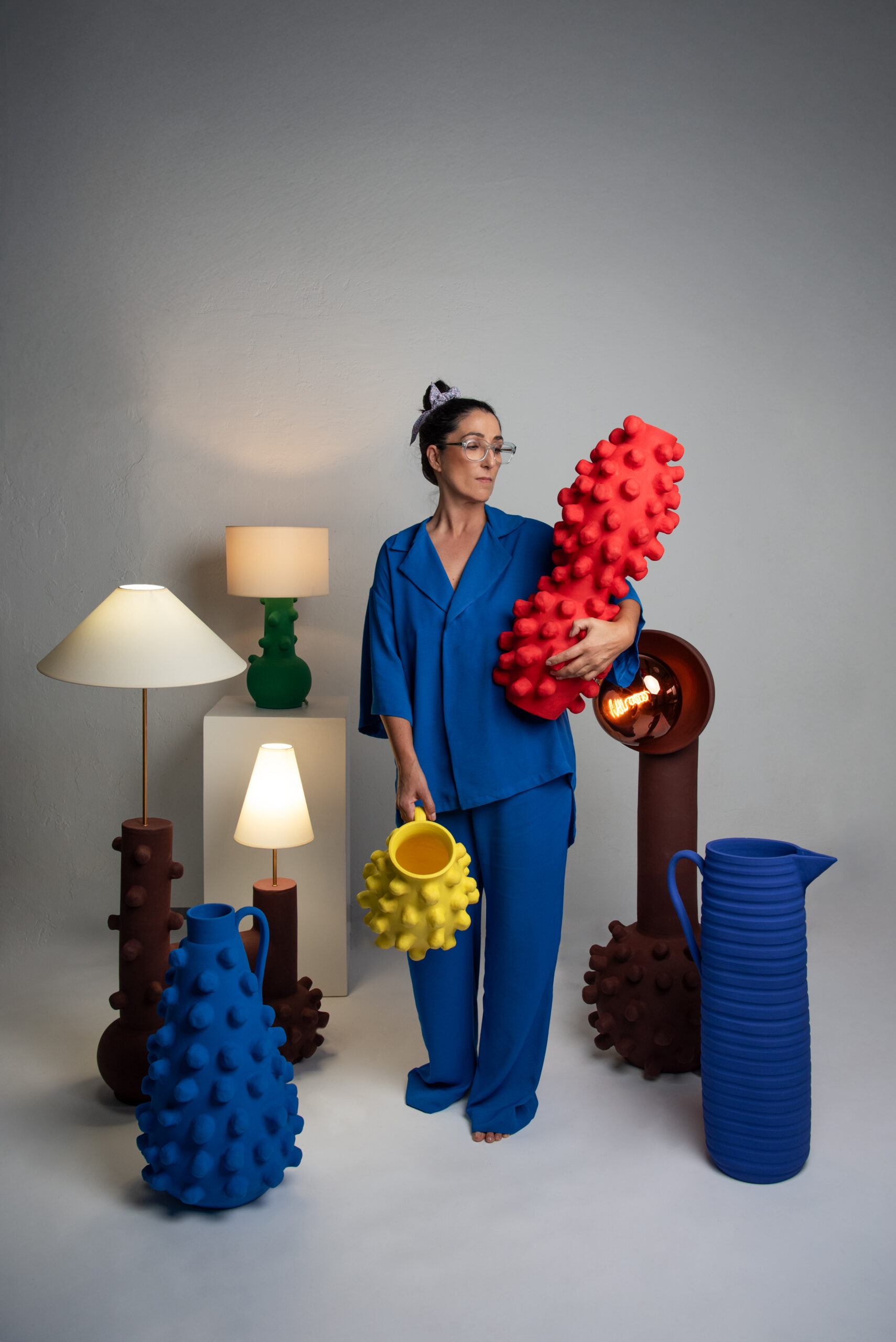
Liliana Silva takes artisanal ceramics from Barcelos to galleries and concept stores worldwide
Ceramicist Liliana Silva, founded the Terrakota brand in 2020, reinterpreting Portuguese ceramic tradition with contemporary language. Born in Barcelos, northern Portugal, she is the granddaughter and daughter of potters and now works from her own studio in Esposende. Her pieces are sold in international galleries and concept stores.

Each creation is handmade on the potter’s wheel, with vibrant colours and forms that transform utilitarian objects into functional sculptures. Production rejects mass manufacturing and values imperfections as part of the work. The clay used comes from the northern region, from Alvarães.
The brand’s main project is the DisFunction collection, presented at Lisbon Design Week in 2025. There are six pieces ranging from 1 metre to 2.10 metres in height. The collection questions the relationship between function and expression in ceramics: recognisable objects are deformed and distorted until they become sculptures that challenge the observer.

From Fashion Design to Ceramics
Liliana Silva spent five years in London, where she studied Fashion and Footwear Design. She explored museums and galleries before returning to Portugal to work with ceramics. She initially joined the family business and developed her own style. The Terrakota brand was born from this fusion between the potters’ heritage and design training.
“My greatest tool is my heart and my hands”, the artist states. The emotional connection with clay guides her work. The potter’s wheel, manual form and slow rhythms of artisanal work are fundamental to her process.
Design training brought a contemporary perspective to traditional ceramics. The pieces have larger formats and strong presence. They go beyond function and transform into art objects. Colour and form are used as expressive means, not merely utilitarian.

Process and Philosophy
Production is manual. Each piece is unique, with intentional imperfections. The focus is on singularity and the value of time. The creations invite contemplation and care. They are made to last, not to discard

The texture of the ceramics, the touch, the curve and the volume are part of the artistic expression. Simple yet expressive forms inhabit space and dialogue with it.
Each piece is born from a personal place: a memory, a gesture, a restlessness. When work is designed for someone, the process becomes even more sensitive. It is necessary to understand who that person is, what they feel, what they seek. The material gains form and also gains history. This history remains between the creator and the client.
DisFunction Collection
The DisFunction collection took two months to produce, with no margin for error. All pieces are made on the wheel. Drying is natural. In an almost dry phase, they go into the kiln at low heat. They are then taken to the 4-metre oven and fired at 900 degrees for 9 hours. Subsequently they are hand-painted.
In DisFunction, each piece starts from a utilitarian object. Recognisable forms, almost familiar. Then they are manipulated to the limit: the artist deforms, distorts and suspends function to give way to estrangement. What was useful becomes sculptural. What was an everyday object transforms into art.
The collection establishes direct dialogue with the Barcelos Rooster tradition. The six pieces are painted with the same vibrant colours as the Portuguese symbol: blue, red, orange, yellow and green. Uselessness comes in matte blue. Terramorpha appears in red. Unmeasured emerges in orange. Disforme is yellow. Subverse gains green. Funcídio is also blue.
The choice of colours is not casual. Liliana Silva establishes a bridge between Barcelos’ ceramic heritage and contemporary rupture. The traditional colours of the rooster, symbol of justice and hope, are applied to pieces that precisely question function and tradition. What was a symbol of utility and luck transforms into a manifesto of uselessness and freedom of form.
The artist intended to show beauty in the imperfect and in what deviates from norms. These are intentional pieces in their flaws. They invite the observer to reconsider the emotional relationship with objects and with the very act of using. The ceramicist continues to develop the series in sculptural scale and with new surface and colour techniques.

Trajectory and Recognition
Portuguese ceramics, especially from Minho and the Barcelos area, serve as a constant reference. Memory, local culture and traditional clay textures appear stylised in Liliana Silva’s contemporary language. Barcelos is a city with deep ceramic tradition, birthplace of the famous Barcelos Rooster.
The artist participated in Lisbon Design Week in 2025 and presented the DisFunction collection at Hotel Mélia Braga. The Palma Project was exhibited in Chiado, Lisbon. She also took part in the Lisbon International Contemporary Exhibition, at Galeria Natália Gromicho.
Barcelos and the Ceramic Tradition
Barcelos is a city in Alto Minho, Braga district, with deep ceramic tradition. Barcelos pottery gained international recognition when the Barcelos Rooster was exhibited for the first time at the Portuguese Popular Art Exhibition in Geneva in 1935. The city still maintains the largest traditional fair in northern Portugal, held every Thursday.
The Barcelos Rooster is the most famous Portuguese souvenir. The legend dates back to mediaeval times and tells the story of a Galician pilgrim travelling to Santiago de Compostela who was unjustly accused of a crime in Barcelos. Sentenced to the gallows, the man pointed to a roasted rooster on the judge’s table and declared that the animal would sing to prove his innocence. The roasted rooster rose and sang, saving the pilgrim.
From the 1930s onwards, the Barcelos Rooster became a constant presence at promotional events and appeared as the main image on tourism posters promoting Portugal. The colourful ceramic rooster, traditionally hand-painted with vibrant colours such as red, yellow, green and blue, transformed into a national symbol.
The rooster is traditionally associated with mythological virtues and is a symbol of the people through its domestic proximity. Due to its song, it is also associated with victory, light and the warding off of negative forces. In Portuguese popular culture, it represents justice, luck, honesty and hope.
The Barcelos Pottery Museum documents the history of the region’s potters and preserves the memory of this ancestral art. The Cruzeiro do Senhor do Galo, a seventeenth-century monument that is part of the collection of the Archaeological Museum of Barcelos, is associated with the pilgrim’s legend.
Liliana Silva, through Terrakota, projects this millennial tradition into the future with contemporary language. The artist keeps alive the heritage of Barcelos potters and takes Portuguese ceramics to the international market with modern artistic vision.
Site: www.https://www.terrakota.pt/
Instagram: @terrakota_ceramic