 Serpa
Serpa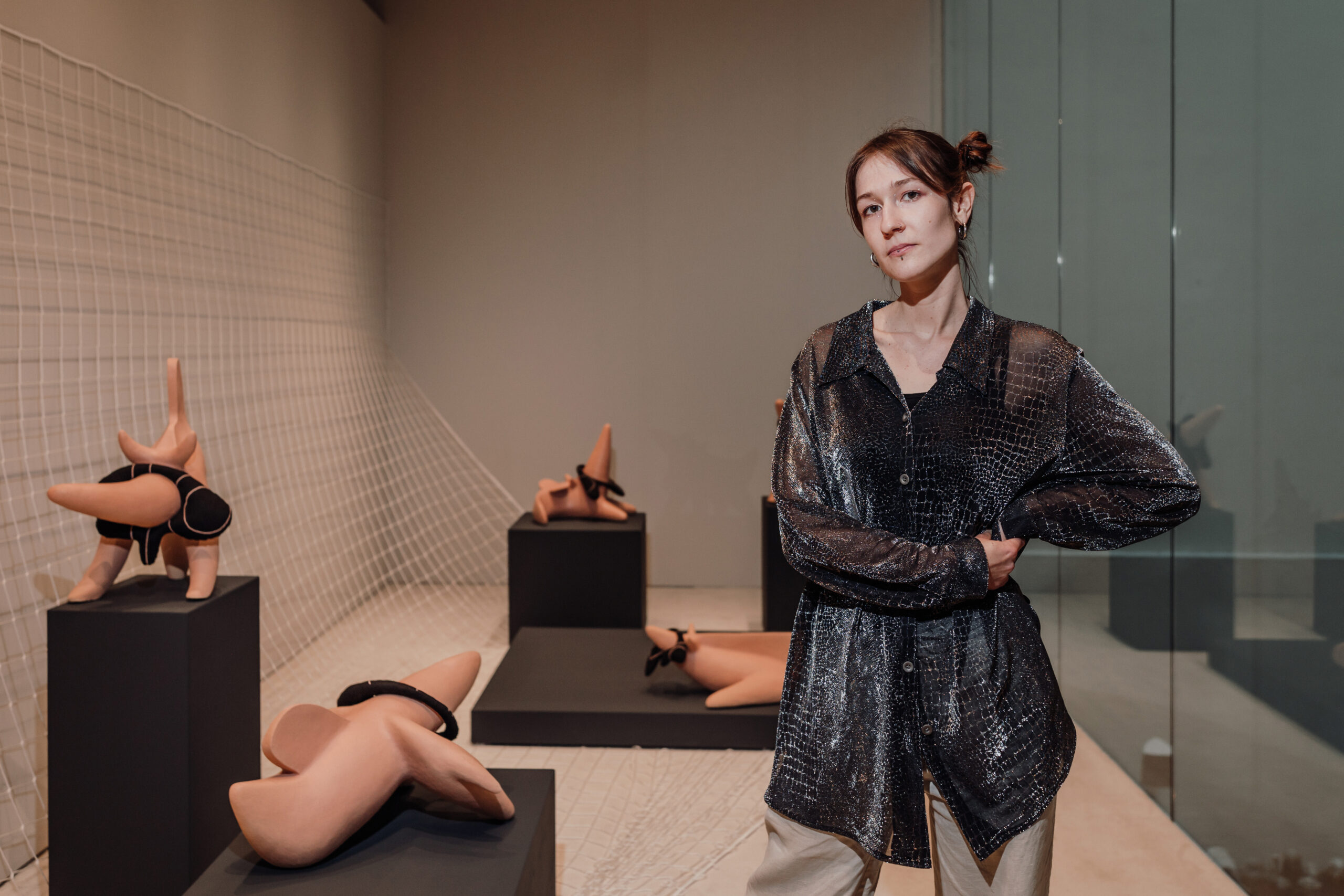
Angelika Stefaniak
Angelika Stefaniak explores tactile and sensitive forms that oscillate between sculpture and functional object
NEW YORK – Angelika Stefaniak, a Polish visual artist born in 1997 in the city of Jawor, was selected as one of the 10 laureates of the Art Prize 2026 at ceramic brussels, one of Europe’s leading ceramic art fairs. The award guarantees the young artist a solo exhibition during the 2027 edition of the fair, in addition to participation in artistic residencies and other shows yet to be announced. The achievement represents an important milestone in Stefaniak’s career, who completed her master’s degree in sculpture at the Academy of Fine Arts in Wrocław only in 2024.
Stefaniak’s work stands out for its unusual combination of ceramics and textiles, materials that the artist manipulates through an intuitive process that dialogues with childlike perception and dreamlike distortion. Her works explore the concept of beauty found in the grotesque, creating sensitive and tactile forms that oscillate between sculpture and functional object. The artist draws inspiration from fields such as psychology, anthropology, and biomorphism, resulting in pieces that invite sensory interaction while maintaining conceptual density.

Photo: Courtesy of Sophie Carree
In the 2026 edition of ceramic brussels, Stefaniak participates in a group exhibition curated especially for the laureates, with scenography developed in partnership with MAD Brussels (Museum of Art and Design of Brussels) and Action et Service. The prizes will be awarded during the opening of the event, consolidating the international recognition of an emerging generation of contemporary ceramicists.
Training in the Polish tradition
The Academy of Fine Arts in Wrocław, where Stefaniak obtained her training, is one of the most prestigious art education institutions in Poland and Central Europe. Founded in 1946, shortly after the end of World War II, the academy was born in a context of cultural reconstruction of the country and the city of Wrocław, which had been severely damaged during the conflict.
The institution, officially known as Akademia Sztuk Pięknych im. Eugeniusza Gepperta we Wrocławiu (Eugeniusz Geppert Academy of Fine Arts in Wrocław), was named after the Polish painter and pedagogue Eugeniusz Geppert, who was fundamental to its foundation and early years of operation. Geppert established the pedagogical principles of the school, emphasizing the connection between artistic tradition and contemporary experimentation.

Photo: Courtesy of Sophie Carree
Throughout its nearly eight decades of existence, the academy has consolidated itself as a center of excellence in various artistic disciplines, including painting, sculpture, graphic design, interior design, ceramics, and textile arts. The sculpture course, in which Stefaniak graduated, has particular relevance in the institution’s history, having trained some of the most important Polish sculptors of the post-war period.
The academy’s curricular structure combines technical rigor with creative freedom, allowing students to develop authorial languages while mastering the fundamentals of their disciplines. The studios are organized under the guidance of recognized artist-professors, in a system that privileges individualized mentorship and the development of long-term projects.
Wrocław, the city where the academy is based, offers a rich cultural context for artistic training. Poland’s fourth-largest city is known for its historic architecture, vibrant cultural life, and role as a university center. The presence of various cultural institutions, galleries, and alternative spaces provides academy students with constant opportunities for exhibition and dialogue with the local and international art circuit.
Contemporary art circuit in Poland
Before the international prize at ceramic brussels, Stefaniak had already accumulated important recognition in the Polish art circuit. In 2024, she won the OP_YOUNG program, an initiative aimed at emerging artists, and received a grant from the Polish Ministry of Culture, a fundamental resource for the development of her artistic research.

Photo: Courtesy of Sophie Carree
Her work was exhibited in important Polish cultural spaces that represent different models of operation in the country’s contemporary art scene. OP ENHEIM, a cultural space located in Wrocław, is known for its program focused on contemporary art and experimentation. The institution functions as an incubator for new talents, offering not only exhibition space but also artistic residencies and support programs for project development. The space stands out for its adapted industrial architecture, a common characteristic of contemporary cultural centers that occupy repurposed historic buildings.

Photo: Courtesy of Sophie Carree
Galeria Miejska (Municipal Gallery) in Wrocław is one of the most important public cultural institutions in Lower Silesia, the region where the city is located. Founded in 1995, the gallery occupies a historic building in the city center and maintains an exhibition program that balances shows by established artists with projects by young creators. The institution also develops an important collection of Polish contemporary art and promotes publications, conferences, and educational programs. For emerging artists like Stefaniak, exhibiting at Galeria Miejska represents significant institutional recognition, as the space is a regional reference in critical and curatorial validation.
Apteka Sztuki (Art Pharmacy), in Warsaw, represents a different model of cultural space. Located in the Polish capital, the institution has operated since the 1990s as an independent gallery and space for artistic experimentation. The name refers to the historic address it occupies, a former pharmacy, and has become synonymous with avant-garde and curatorial risk. Apteka Sztuki is known for presenting works by artists who challenge conventions and explore contemporary languages, including installation, performance, video, and new media, in addition to traditional visual arts.
Stefaniak’s presence in these three distinct spaces demonstrates the versatility of her work and her ability to dialogue with both public institutions and independent circuits. This circulation through different institutional contexts is fundamental for consolidating an artistic career in contemporary Poland, where the cultural ecosystem combines state support, municipal initiatives, and self-managed spaces.
The artist also participated in international events in the cities of Łódź and Olomouc, the latter in the Czech Republic, gradually expanding her presence beyond Polish borders. Łódź, Poland’s third-largest city, is known for its role as a hub for contemporary art and alternative culture, hosting important events such as the Textile Art Biennial and various art festivals.
Artistic language and contemporary context
Stefaniak’s approach, which finds beauty in the grotesque and works with the tension between the familiar and the strange, is part of a tradition of Polish contemporary art that frequently dialogues with questions of materiality, body, and memory. Her pieces, at once delicate and disturbing, invite the observer to rethink the boundaries between the beautiful and the monstrous, the comfortable and the uncomfortable.

Photo: Courtesy of Sophie Carree
The artist’s interest in biomorphism and the distortion of organic forms connects her work to international contemporary trends, while the use of textiles and ceramics maintains dialogue with craft traditions deeply rooted in Polish culture. This combination of local elements and global language is characteristic of a generation of artists who emerged after Poland’s integration into the European Union, with expanded access to international art circuits.

Photo: Courtesy of Sophie Carree
At only 27 years old and with a rising career, Stefaniak represents a new generation of Polish artists who are gaining space in the international circuit while maintaining deep ties with their country’s cultural tradition and with the institutions that form the fabric of Polish contemporary art.