 Samuel Navarro Serpa
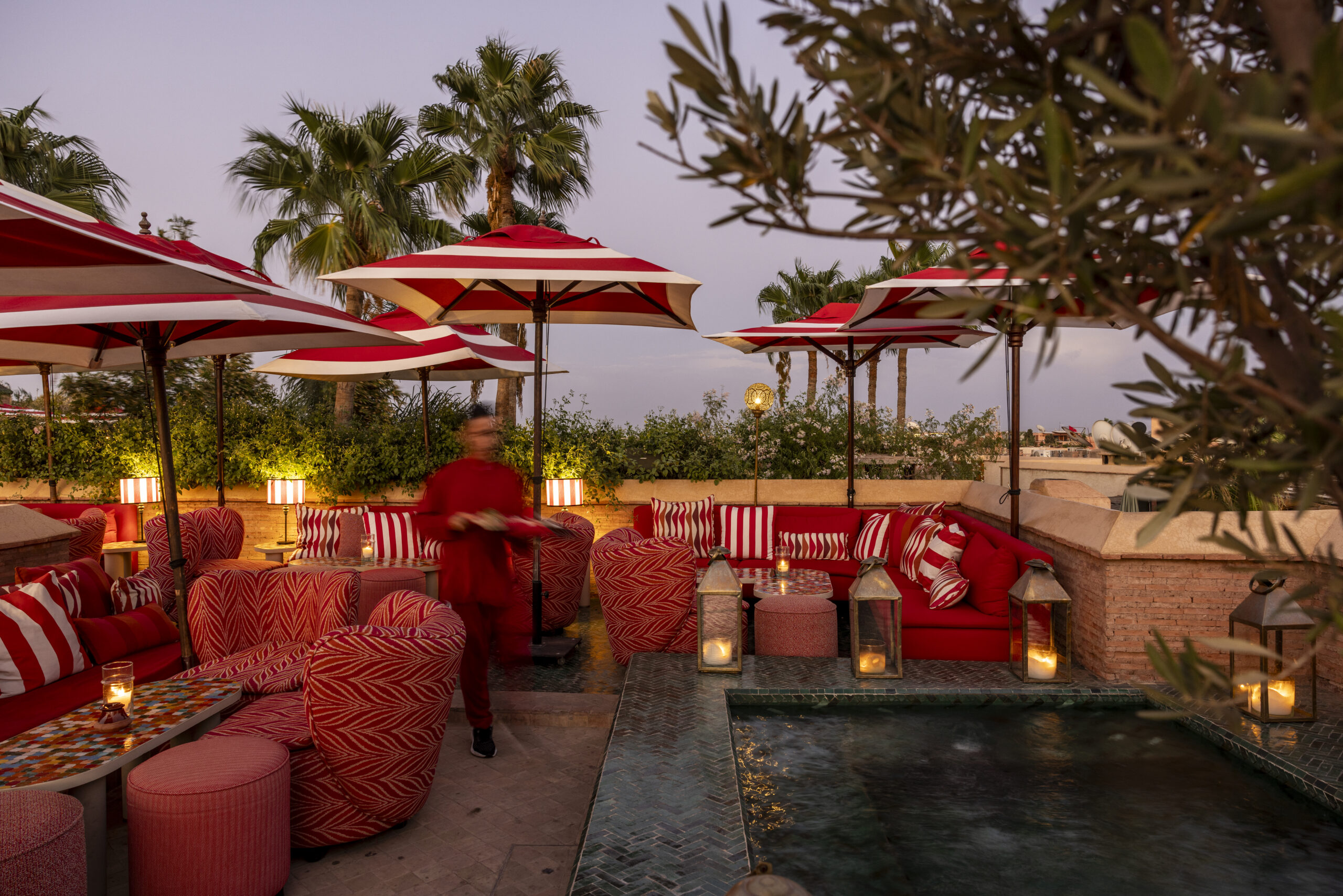
Red-and-white striped umbrellas shade the rooftop cocktail bar at El Fenn, which looks out on the Koutoubia Mosque and the Atlas Mountains. Photo: Moggy Photography
Lifestyle & Travel
By Samuel Navarro Serpa
On a 1,300-square-meter terrace facing the Atlas, the hotel offers three pools and more than 300 days of sun
A tortoise slowly crosses the central courtyard, accompanied by the low sound of a fountain. It is the kind of scene that appears in no brochure and that defines, better than any technical description, the spirit of El Fenn: 41 rooms and 13 interconnected riads built behind pink walls, where earth, light and mountain are arranged according to a logic Marrakech has perfected over centuries. Part of the Moroccan AKAN hotel collection since November 2025, the property brings together local craftsmanship, a significant contemporary art collection and a 1,300-square-meter (about 14,000-square-foot) terrace facing the Atlas Mountains. The result is a case study in how hospitality in the Red City reinterprets the landscape around it.
Courtyards and climate response
Passing through the first courtyard after the narrow medina street means feeling the temperature drop several degrees before any architectural explanation. Born in 2004 and developed over two decades, the property took its current form after an expansion completed in 2022, which added 10 rooms and joined the hotel to its annex on the same street under a single roof. The 13 interconnected riads now occupy about two acres, generous by the standards of a medina where plots tend to be narrow and vertical.
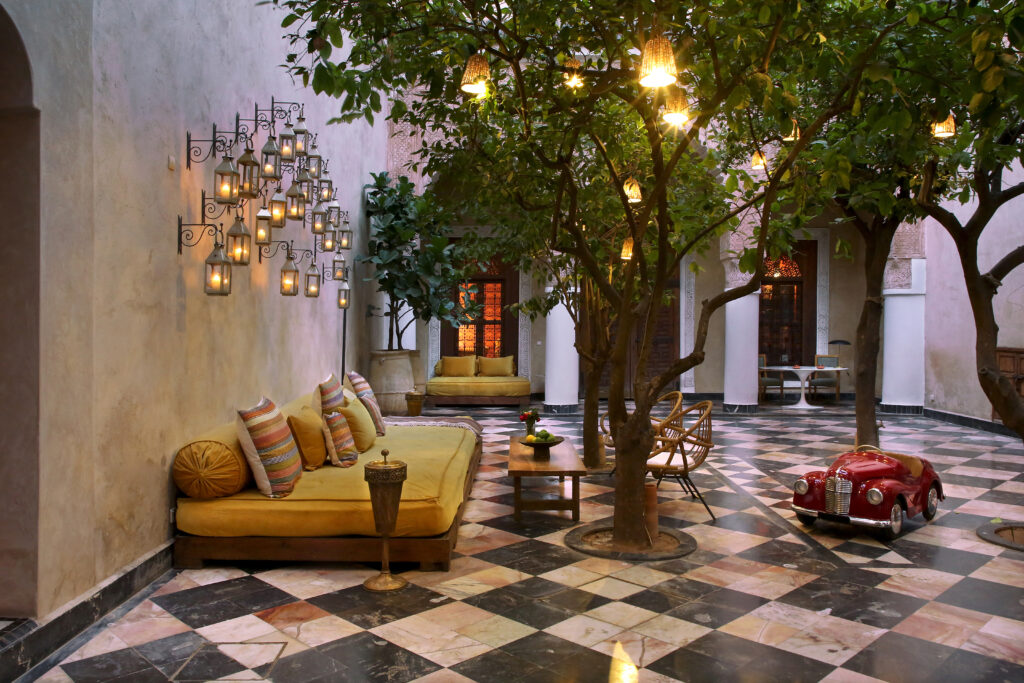
Thick walls, few exterior openings and greenery create natural microclimates in El Fenn’s central courtyard, a solution inherited from traditional medina architecture. Photo: Cécile Treal
Thick walls, reduced exterior openings and courtyards with greenery and water create efficient microclimates without relying on any contemporary technology, an environmental intelligence that predates today’s vocabulary of sustainability by centuries.
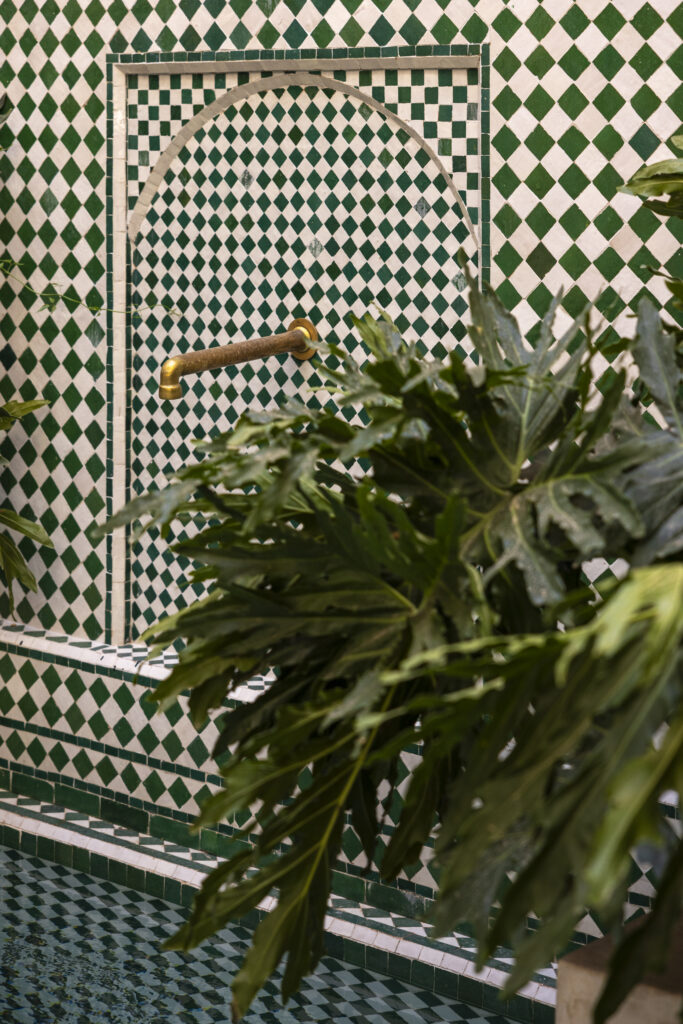
Clad in zellige, one of El Fenn’s three pools echoes the jewel-toned palette that runs through the hotel’s interiors. Photo: Moggy Photography
Zellige, tadelakt and the artisanal soul
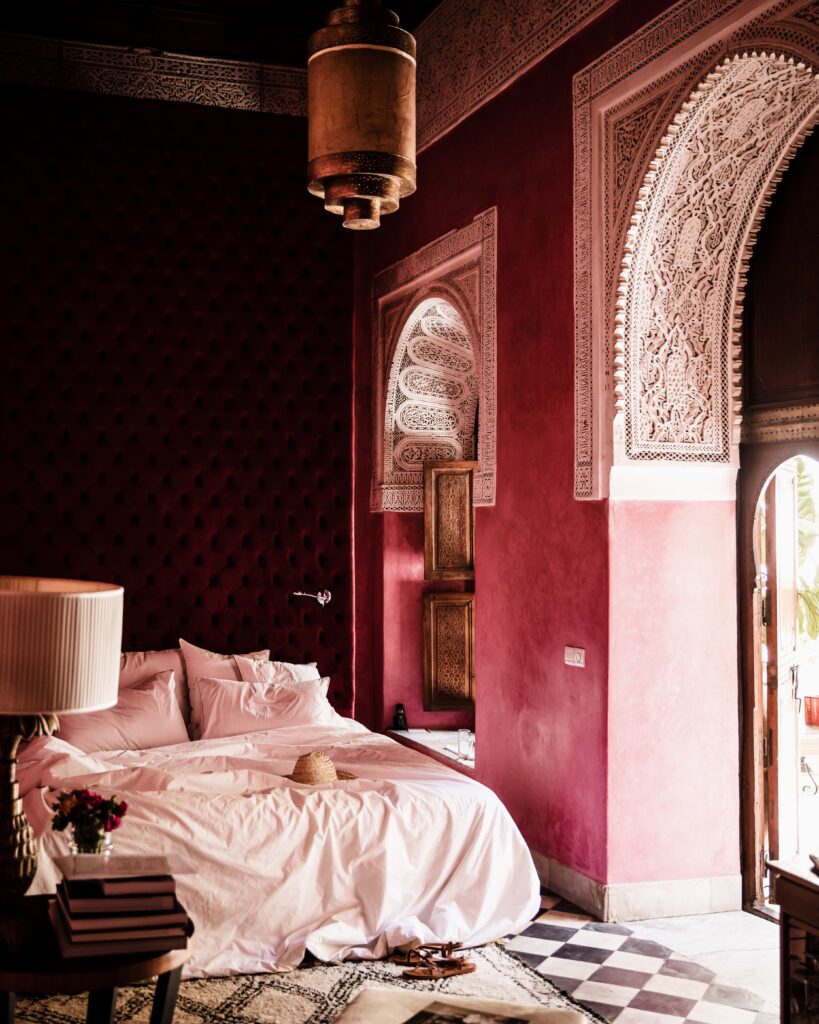
No two suites at El Fenn share the same design: Antique furniture and one-of-a-kind pieces move between rooms in a continual process of reinvention. Photo: Signe Bay Billede
No room at El Fenn resembles another, and that is, according to the hotel’s own team, a deliberate choice.
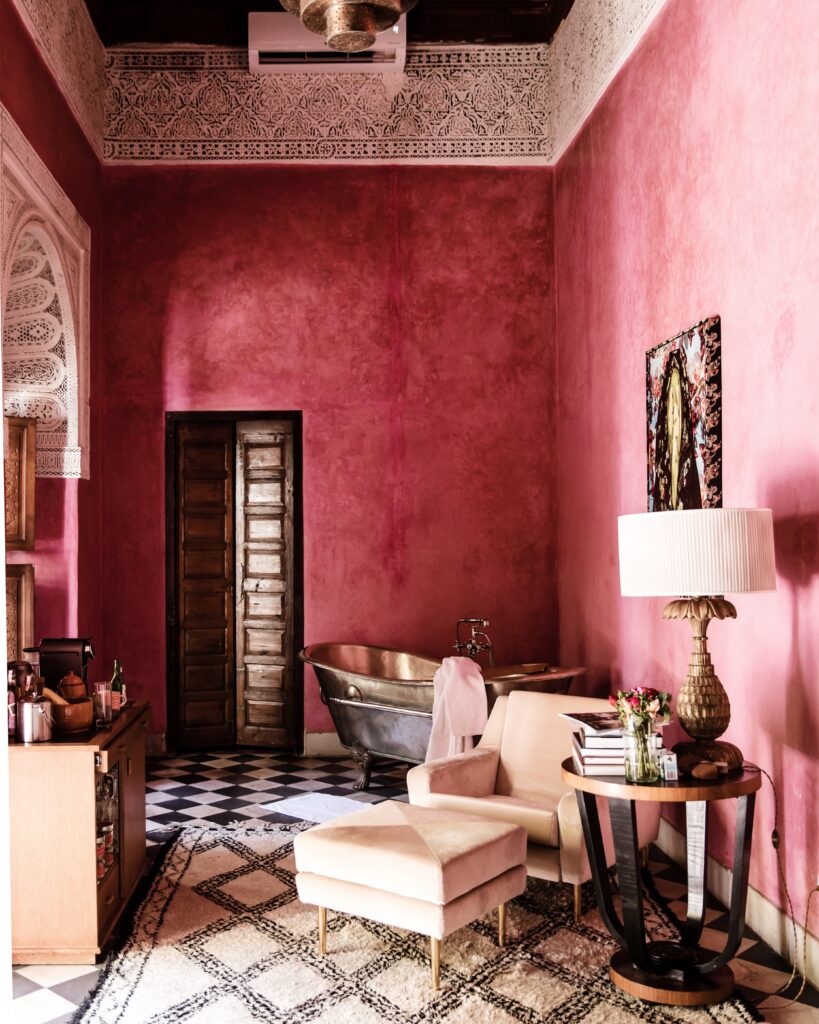
Photo: Signe Bay Billede
Zellige, sculpted stucco and hand-carved cedar ceilings share space with tadelakt, the lime plaster traditionally applied in hammams, and with hand-stitched camel leather floors.
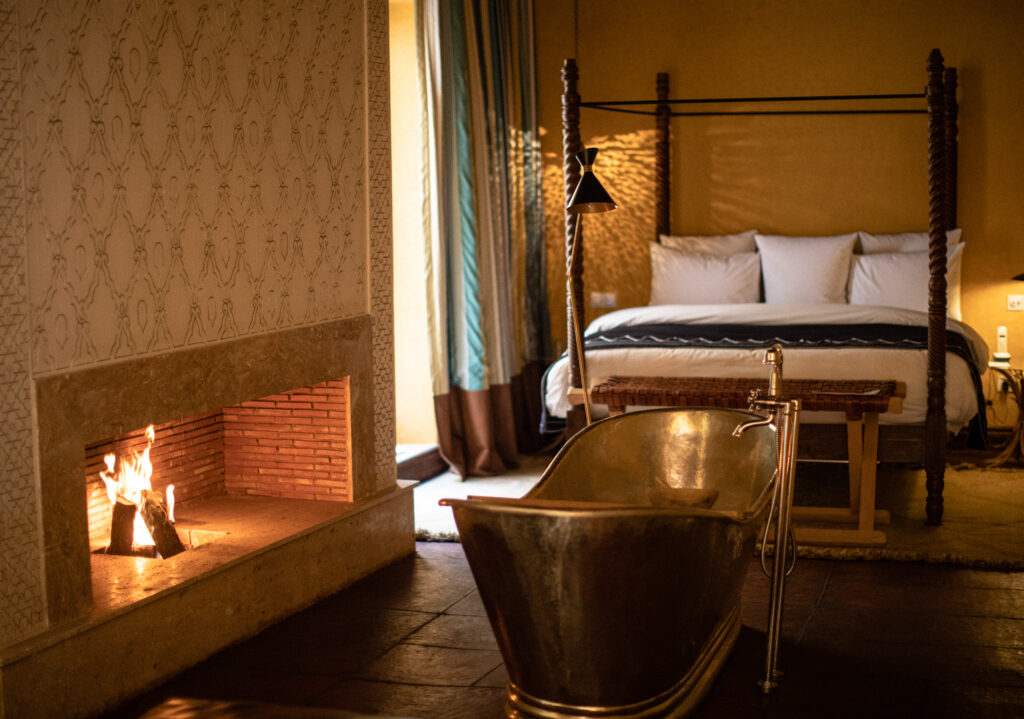
Open fireplaces, freestanding tubs and outdoor showers round out the suites at El Fenn, where repetition is not part of the design. Photo: Pink Palm Studio
Antique furniture and one-of-a-kind pieces circulate among the spaces, repositioned regularly in a continuous process of reinvention that the brand treats as central to its identity. Freestanding bathtubs, outdoor showers and open fireplaces complete suites where repetition is simply not part of the design.
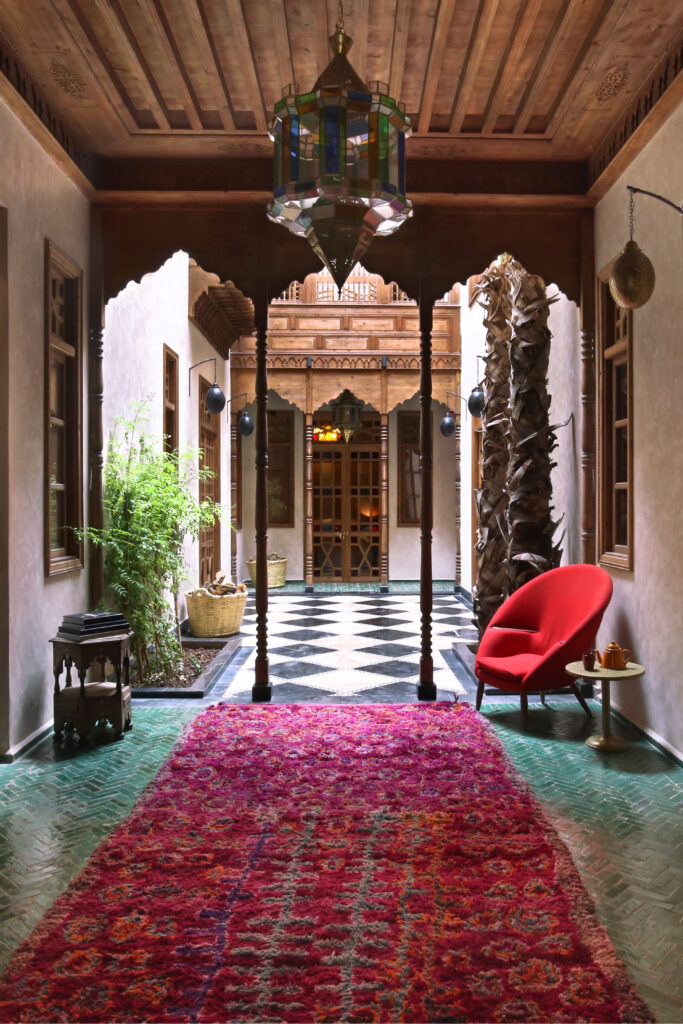
Colonnades framed by billowing curtains define El Fenn’s verandas, while lantern-lit paths echo the palette of the interiors. Photo: Cécile Treal
Colonnades framed by billowing curtains create photogenic verandas, while lantern-lit paths reinforce the jewel-tone palette that defines the interiors. Among returning guests, the family of resident tortoises has become almost an informal symbol of the house.
Three pools and a landmark terrace
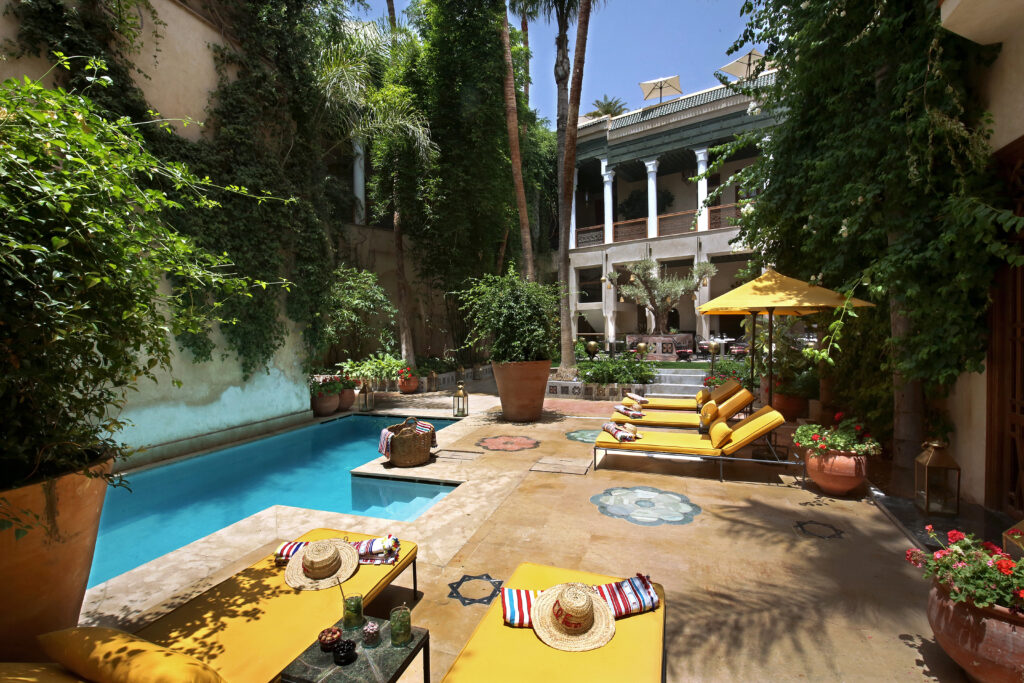
On the ground floor at El Fenn, a lap pool nearly 12 meters long is surrounded by hanging gardens. Photo: Cécile Treal
Rare in a historically dense and vertical medina, El Fenn operates three pools at once. On the ground floor, a lap pool of nearly 12 meters (about 39 feet) is surrounded by hanging gardens; next to it, children wade in a shallow pool, protected by the shade of the vegetation.
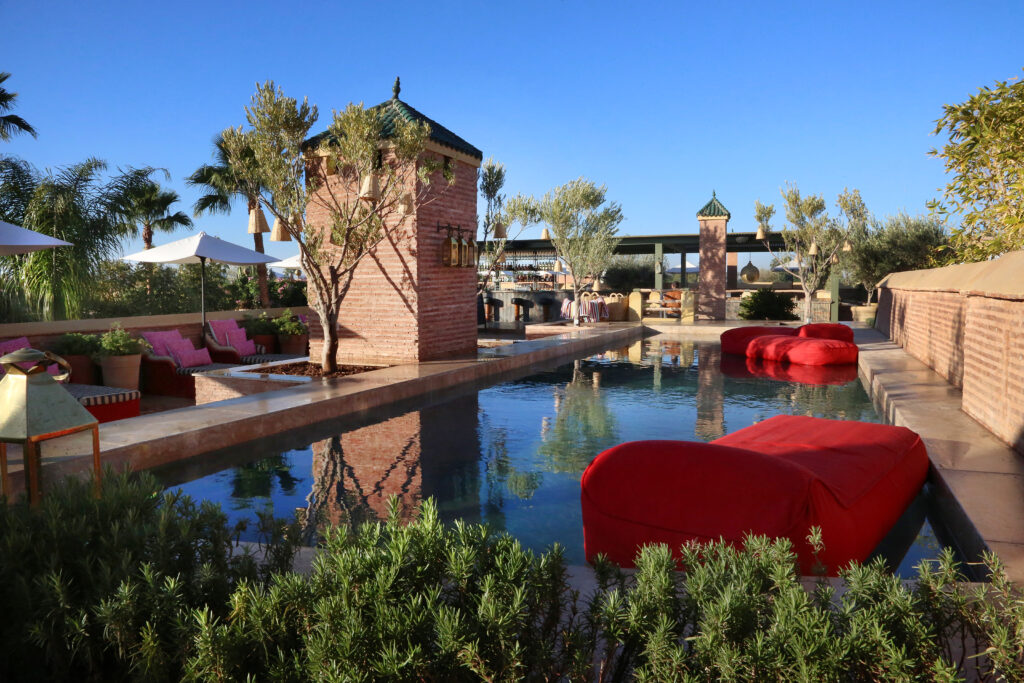
A 12-meter heated pool on the rooftop opens onto the Koutoubia Mosque and the Atlas Mountains beyond. Photo: Cécile Treal
On the rooftop, a heated 12-meter (about 39-foot) pool opens onto the Koutoubia Mosque and the Atlas Mountains in the background, visually reinforcing the dialogue between city and mountain range that runs through the whole Marrakech landscape. All three pools are for guests’ exclusive use.
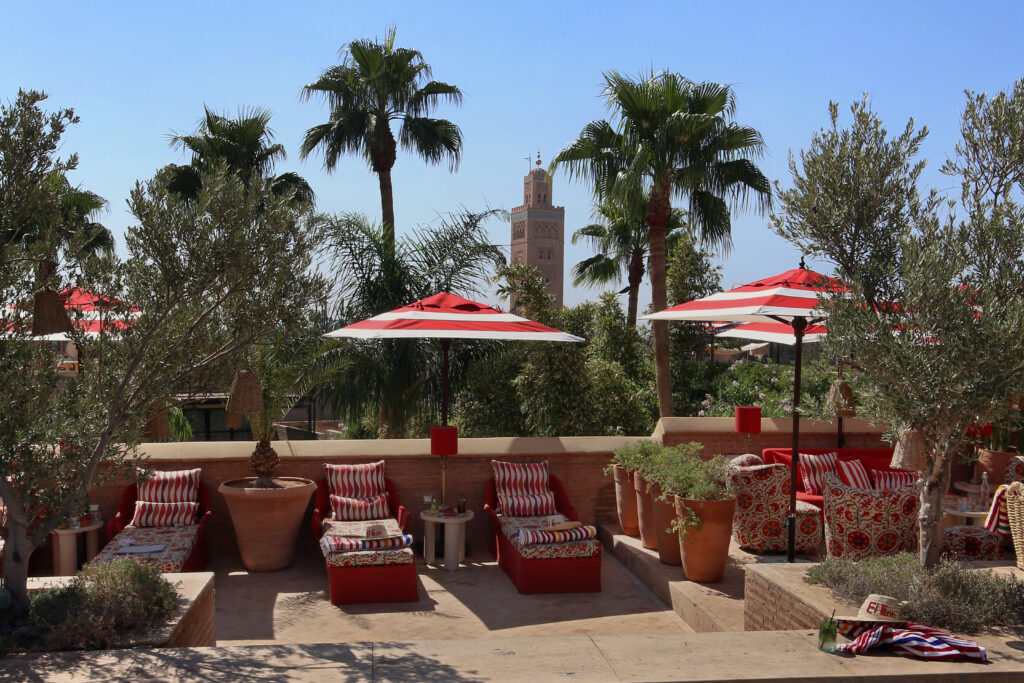
Lounge chairs with embroidered towels fill El Fenn’s 1,300-square-meter terrace, the property’s main architectural distinction. Photo: Cécile Treal
Loungers with embroidered towels and straw hats fill the terrace, the property’s main architectural distinction compared with other Moroccan addresses.
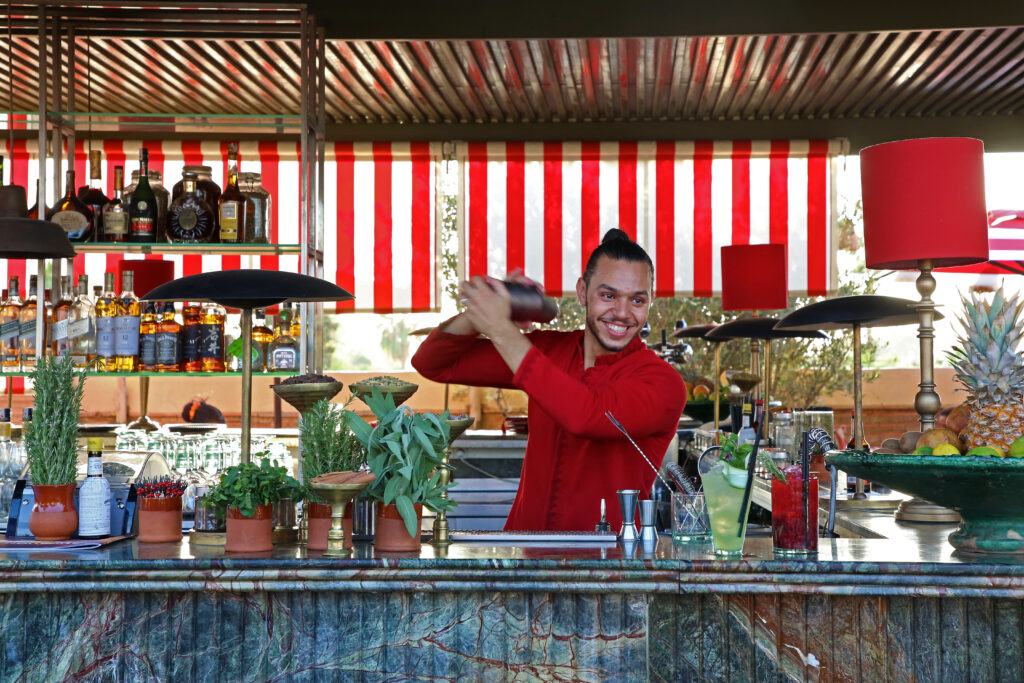
Lit by candlelight in summer and warmed by fire pits in winter, El Fenn’s rooftop is home to the restaurant and cocktail bar. Photo: Courtesy of El Fenn
Also on the terrace are the restaurant and rooftop cocktail bar, lit by candlelight in summer and warmed by fire pits in winter, beneath red-and-white-striped umbrellas. No other corner of the hotel draws as many breakfast orders at sunrise and toasts at sunset.
Wines, cocktails and a plant-based kitchen
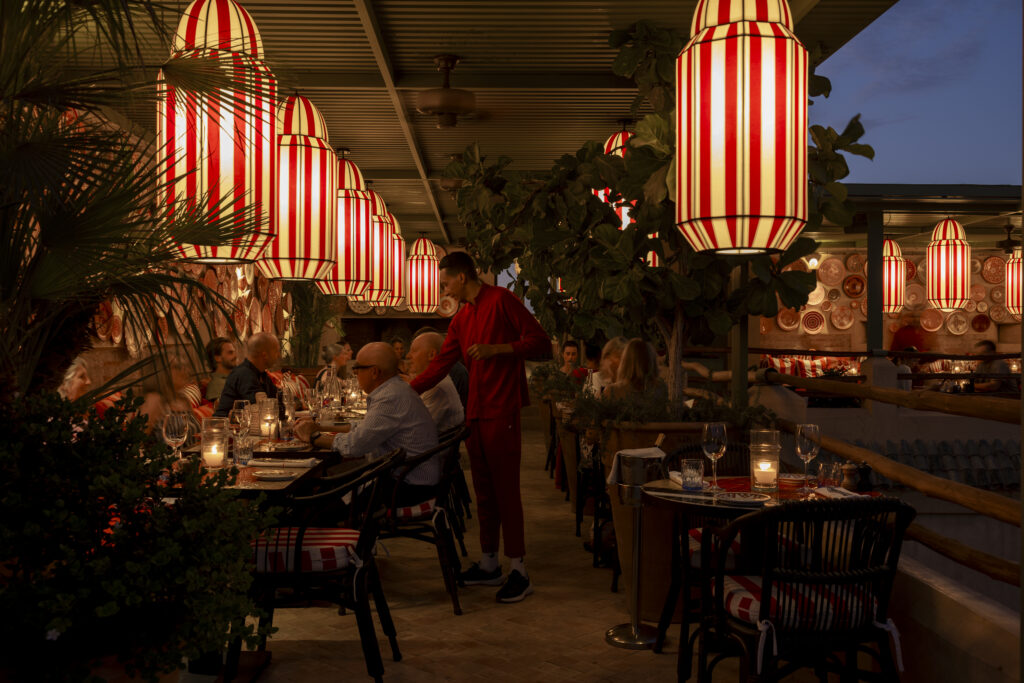
Mostly plant-based and built on seasonal local produce, El Fenn’s rooftop kitchen serves meat and fish on request. Photo: Moggy Photography
Mostly plant-based, the rooftop kitchen works with seasonal local produce in signature salads, with meat and fish available on request. Slow-cooked lamb shank with zucchini, turmeric and toasted almonds shares the evening menu with an onion and pearl barley stew with dried fruit, both designed to pair with wines from Moroccan producers or signature cocktails such as the house’s Hibiscus Ginger Margarita, the El Fenn Mule and the Marrakech Negroni.
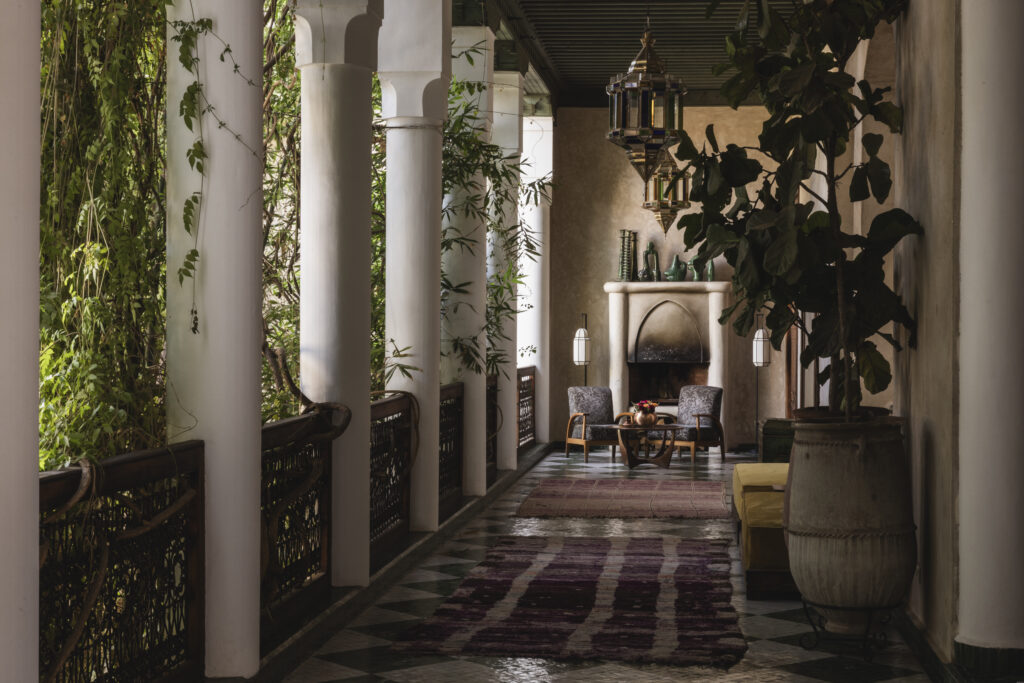
Reserved for guests, Colonnade Café serves à la carte meals in a courtyard framed by climbing vines and a marble-clad pool. Photo: Moggy Photography
Reserved for guests, Colonnade Café serves breakfast, lunch and dinner a la carte in a courtyard framed by climbing vines and a marble-lined pool. Two private terraces, named Toubkal and Pasha, host events for up to 20 and 40 guests, respectively, reinforcing a reading of Moroccan hospitality as a spatial experience before any list of room services.
Hammams, argan oils and the spa ritual
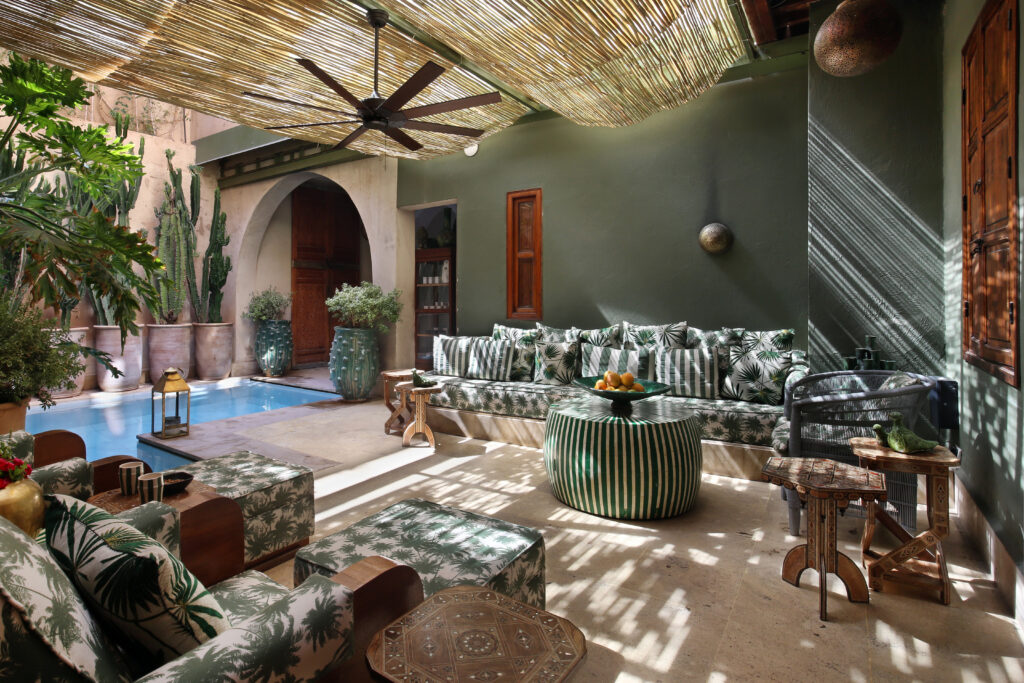
Covered in tadelakt, El Fenn’s hammams use products from the Moroccan brand Maison D’Asa, made with orange blossom, lavender and argan oil. Photo: Cécile Treal
Traditional hammams lined with tadelakt and fireside massages lead guests to a slower rhythm, supported by products from the Moroccan brand Maison D’Asa, formulated with orange blossom, lavender, verbena and argan and prickly pear oils. A spa pool, heated year-round, measures nearly 8 meters (about 26 feet) and works as a direct extension of the treatments.
Contemporary art between centuries-old walls
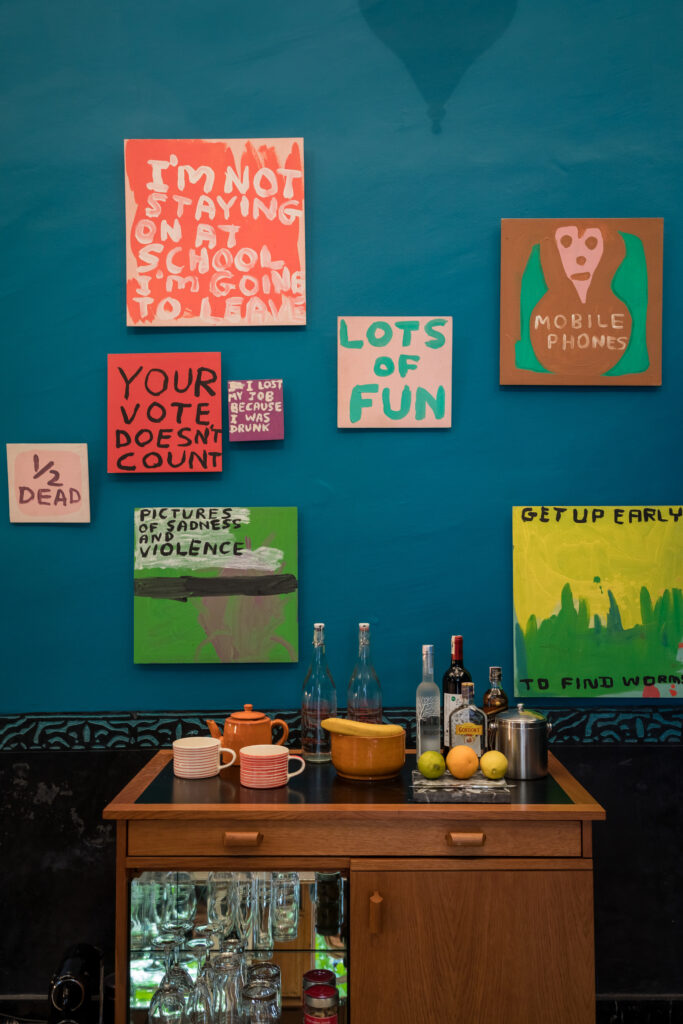
Work by British artist David Shrigley is part of El Fenn’s contemporary art collection. The hotel was one of the pioneers of the “art hotel” concept. Photo: Cécile Treal
A pioneer of the international “art hotel” concept, El Fenn houses one of Morocco’s most significant contemporary art collections. David Shrigley contributes his handwritten humor and childlike images, a language the Briton also extends to sculptures and installations. Hassan Hajjaj, born in Larache and based in London, crosses Western pop art with Moroccan aesthetics in colorful portraits inspired by West African studio photography.
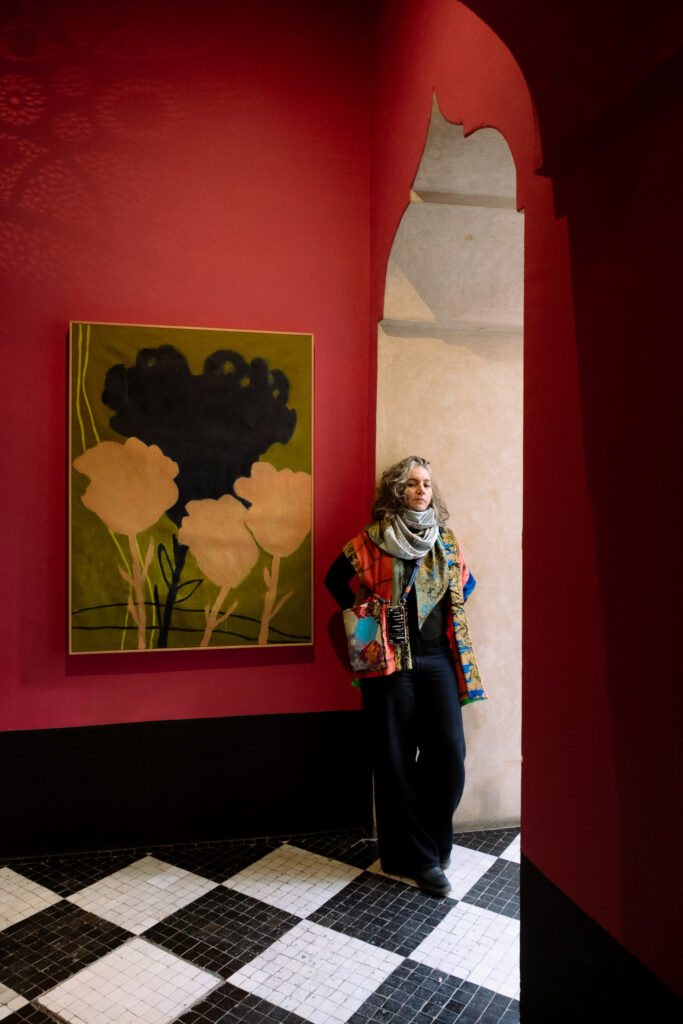
French-Moroccan artist Rita Alaoui, who was born in Rabat, creates work that delves into a dreamlike, sacred imaginary. Photo: Alfie Fisher
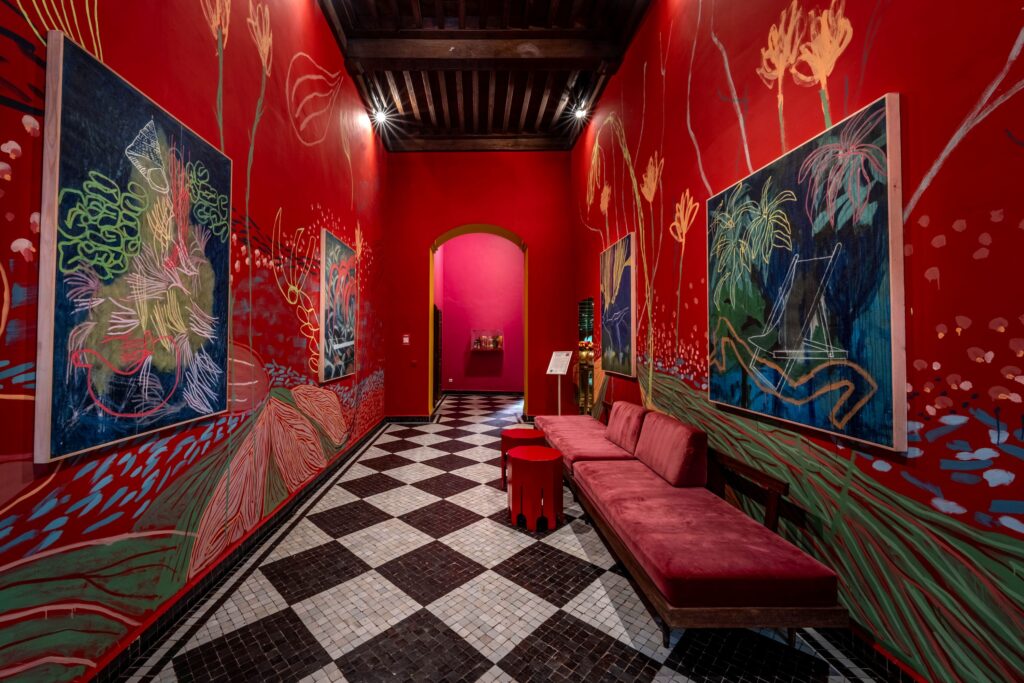
Work by Alaoui delves into a dreamlike, sacred imaginary. Photo: Alfie Fisher
Rita Alaoui, a French-Moroccan artist born in Rabat, delves into a dreamlike and sacred imaginary across painting, photography, installation and video performance.
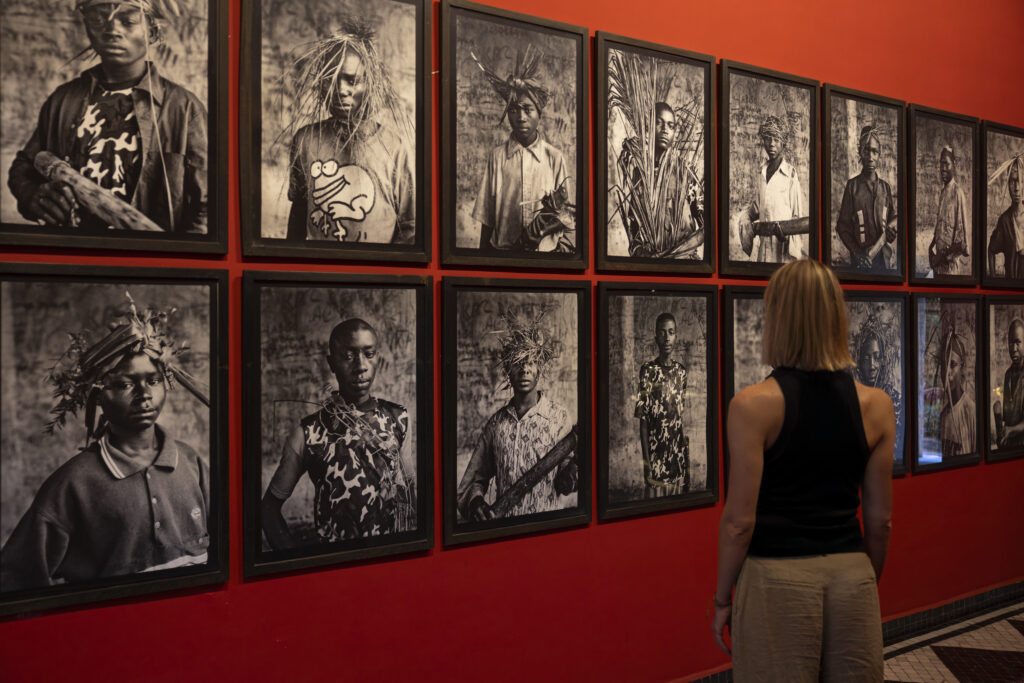
Work by South African photographer Guy Tillim, who has documented contemporary African cities since 1986, is part of El Fenn’s art collection. Photo: Moggy Photography
William Kentridge, a South African known for charcoal drawings that revisit the history of apartheid, and Sir Antony Gormley, a Briton who investigates the relationship between body and space, share the collection with Batoul S’Himi, a Moroccan sculptor who turns pressure cookers into commentary on global environmental tensions. Guy Tillim, a South African photographer, has documented contemporary African cities since 1986, when he joined the Afrapix collective. A 2026 artist-in-residence program expands this commitment to contemporary African artistic production.
Shopping signed by Moroccan hands
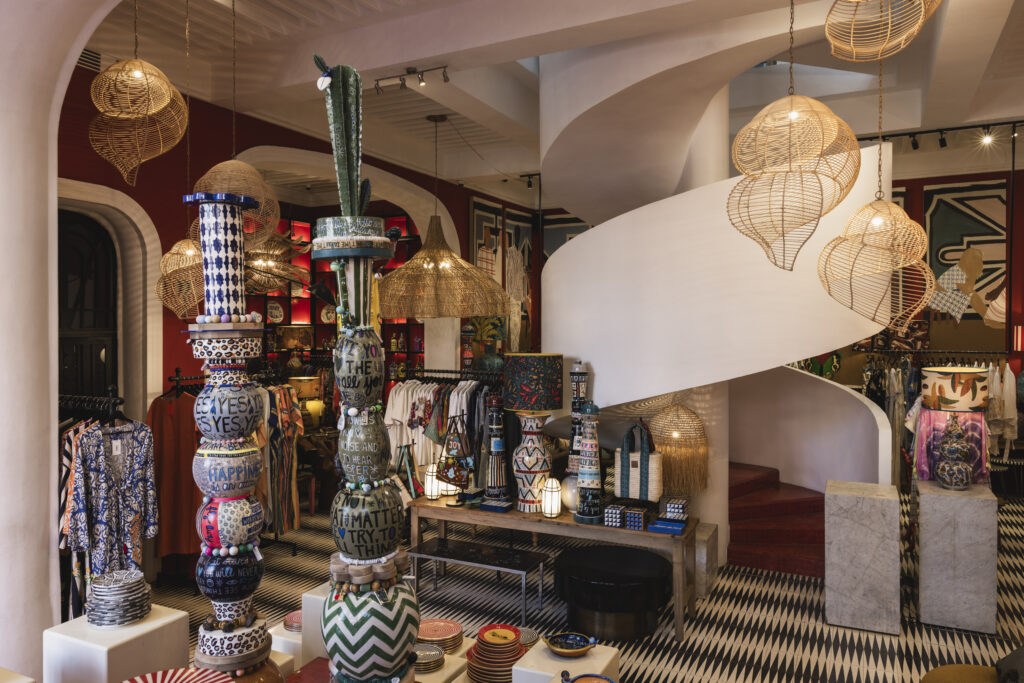
A spiral staircase in El Fenn’s boutique leads straight up to the hotel’s rooftop. Photo: Moggy Photography
Contemporary and vintage jewelry, ceramics, cushions and design books fill showcases signed by Moroccan and international designers in the hotel’s in-house boutique, whose spiral staircase climbs straight to the rooftop.
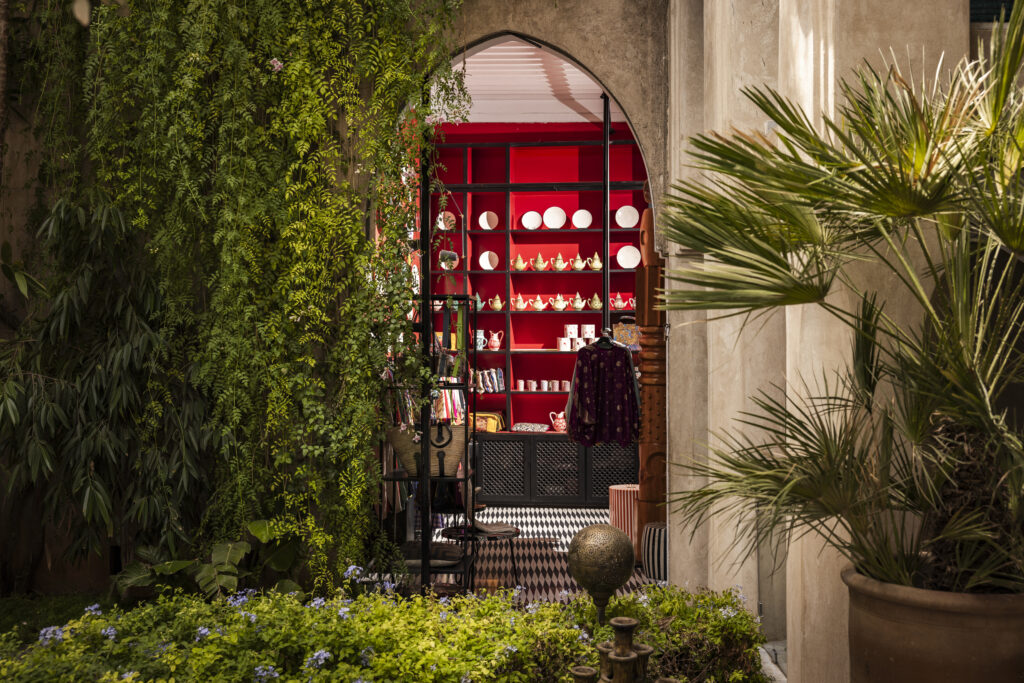
Fitting rooms framed by Moroccan arches heighten the theatricality of El Fenn’s in-house boutique. Photo: Moggy Photography
Fitting rooms framed by Moroccan arches heighten the theatricality of the shopping experience, under the ongoing curation of Yann Dobry, the property’s creative director, for whom no space at El Fenn should be treated as definitive.
Restored riads, preserved tradition
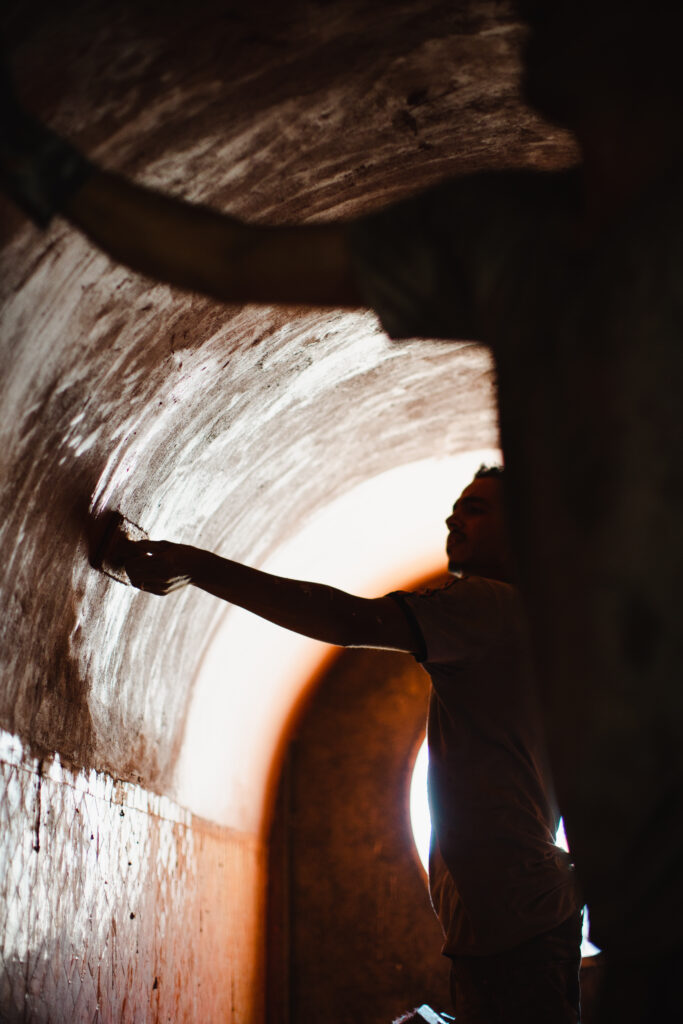
Local artisans restored, one by one, the 13 traditional riads that became El Fenn, applying zellige and tadelakt. Photo: Courtesy of El Fenn
Local artisans painstakingly restored every inch of the 13 traditional riads that form the property’s heritage, applying zellige to the colonnades and brightly colored tadelakt to the walls, and supplying organic bath products.
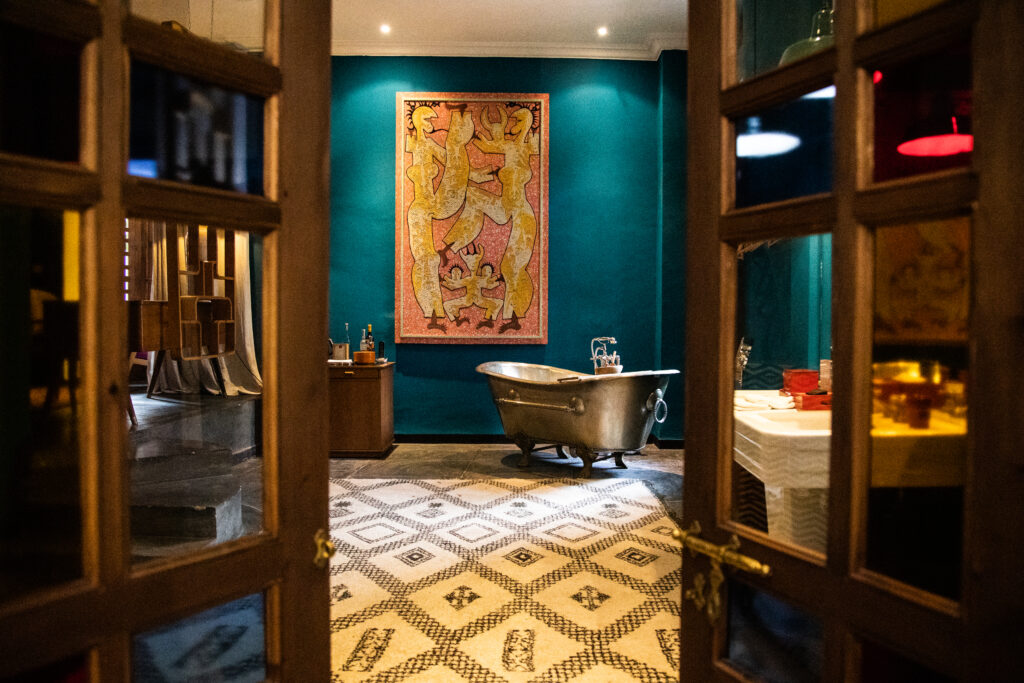
Brightly colored tadelakt walls and organic bath products reflect El Fenn’s commitment to the Moroccan economy and community. Photo: Pink Palm Studio
El Fenn’s wider commitment to Morocco’s economy, community and environment is a message present since its founding, one that over time became part of the brand’s commercial positioning.
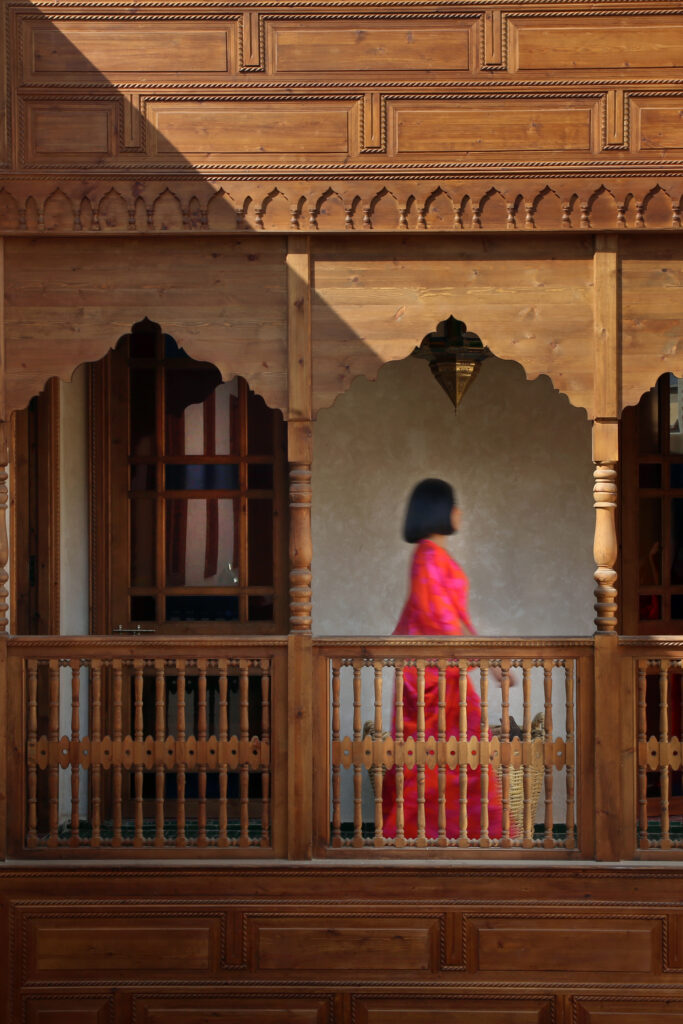
Hand-carved wood is one of the artisanal techniques that define the material identity of El Fenn and Marrakech. Photo: Cécile Treal
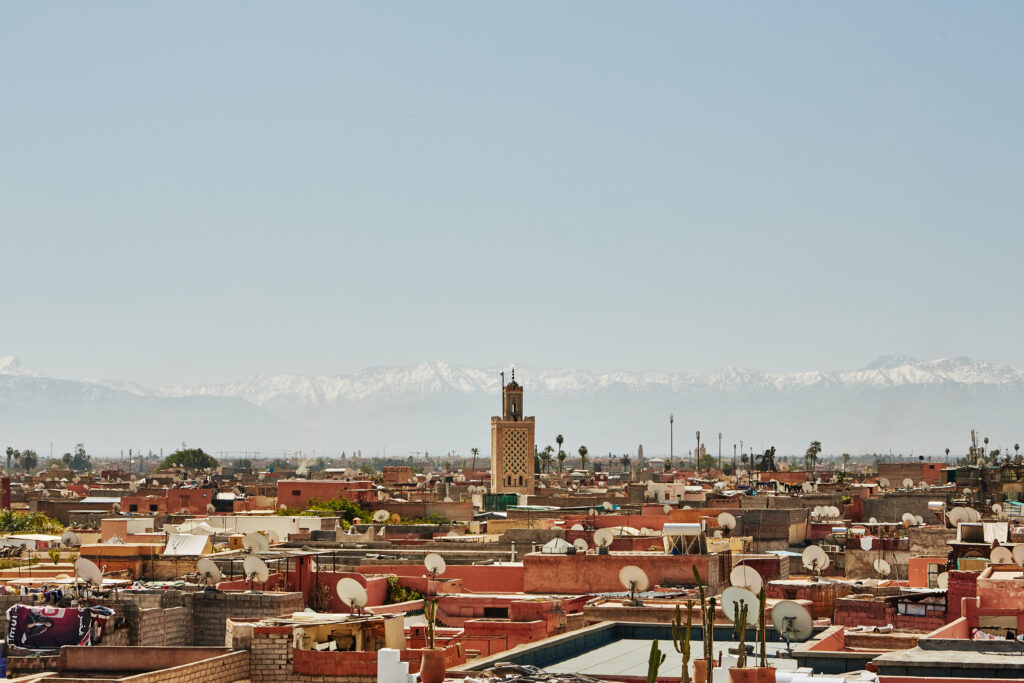
Marrakech as a whole shares a reverence for craftsmanship as a structural trait of its material culture. The ocher of the ramparts, the texture of the finishes and the geometry of the interior courtyards point to a direct relationship between territory and construction, in which materials and techniques come from the earth and pass through the hands of skilled artisans. Carved wood, sculpted stucco, rugs, ceramics, basketry, metalwork and zellige function as built memory, passed down across generations.
Atlas as a territory of matter
Vernacular techniques in earth, stone, wood and natural pigments define the architecture of Morocco’s Atlas Mountains region. Photo: Mitchell Van Voorbergen
In the mountainous regions of the Atlas, vernacular techniques in earth, stone, wood and natural pigments result in buildings that seem to be born directly from the terrain. Echoes of this materiality reappear in Marrakech in the predominance of earthy tones and the appreciation of tactile surfaces, in both historic buildings and contemporary hospitality projects such as El Fenn.
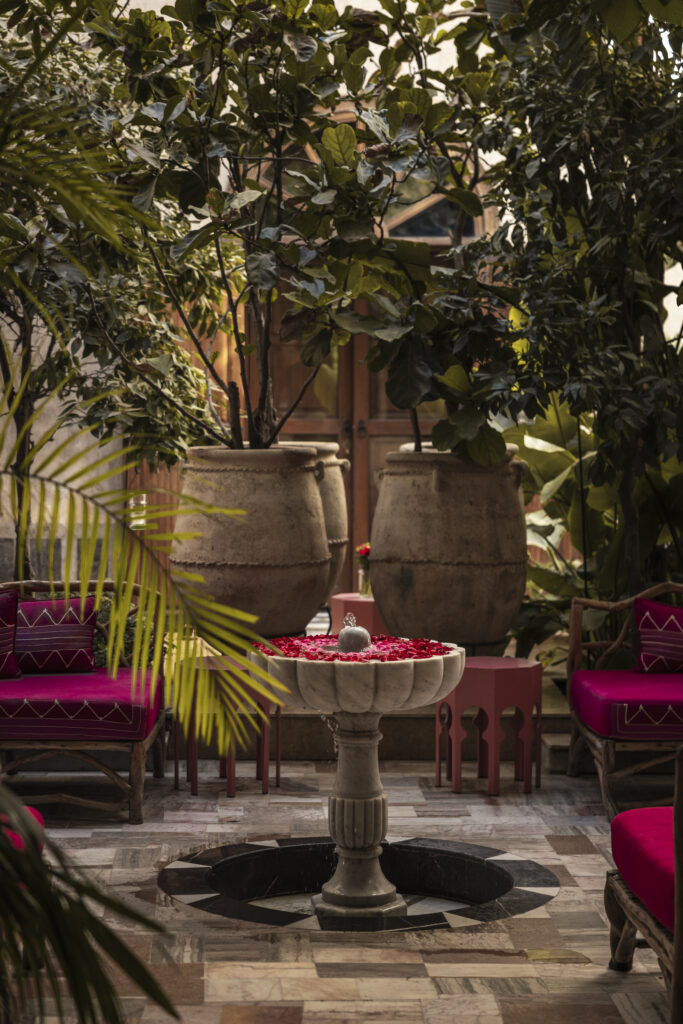
Central courtyards in riads offer refuge from harsh weather and establish a relationship among shade, water, vegetation and light. Photo: Moggy Photography
Belonging to the landscape, not dominating it, is the central idea behind the riad tradition. Central courtyards create refuges from climatic intensity and establish a delicate relationship among shade, water, vegetation and light, elements recurring in both traditional residential architecture and new-generation boutique hotels.
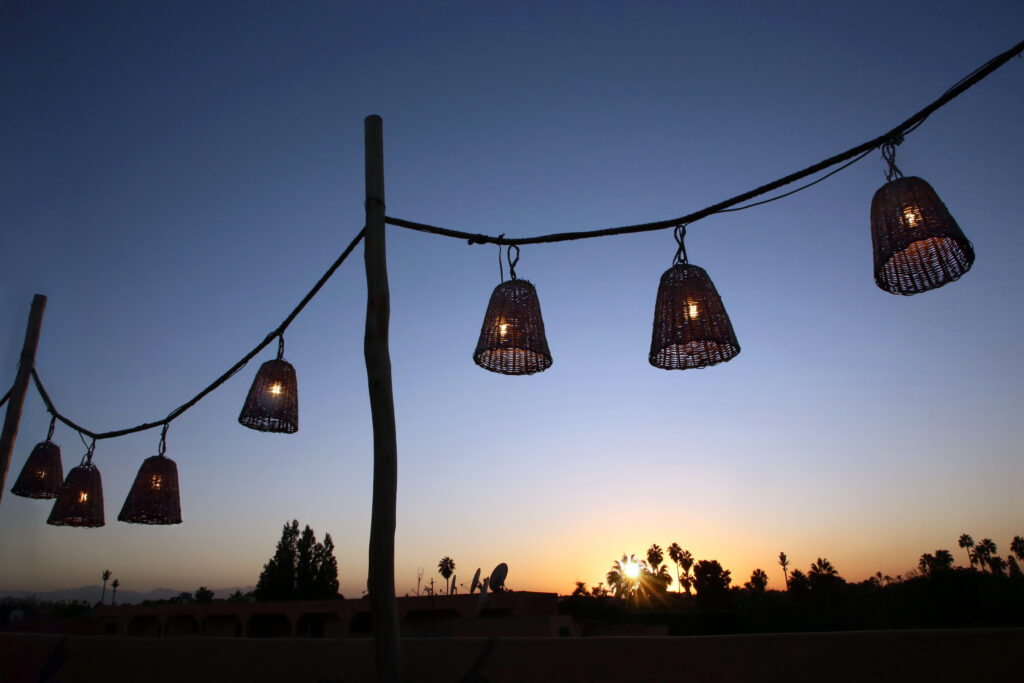
View from El Fenn’s terrace, where spaces, scents and temperatures combine to shape the experience of a stay. Photo: Courtesy of El Fenn
Much of the city’s contemporary hospitality avoids reproducing traditional symbols literally, preferring to reinterpret courtyards, gardens, water and local materials in a current language, turning a stay into a sequence of environments, scents, temperatures and views, and not just an isolated room.
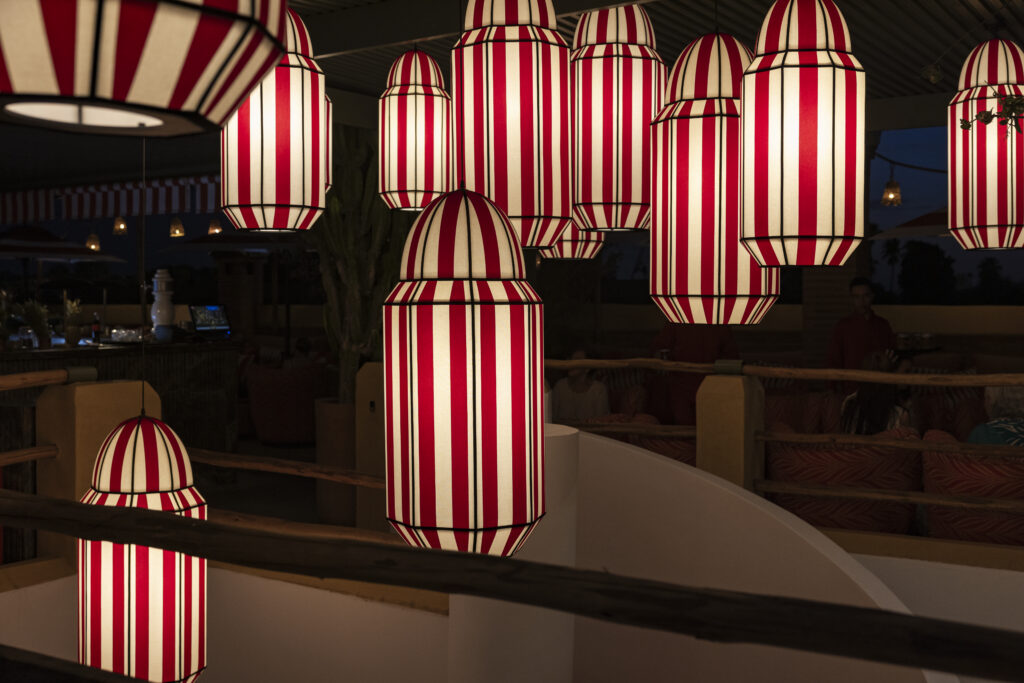
Lanterns light up El Fenn at dusk, reinforcing the atmosphere that made Marrakech a benchmark for hospitality aimed at creative audiences. Photo: Moggy Photography
Such conceptual depth explains, in part, why Marrakech has established itself as an international reference for hospitality aimed at creative audiences, architects, designers and art collectors among them, who find in this type of project a way to experience Moroccan cultural identity without depending exclusively on obvious symbols.
Under the AKAN banner, an intimate future
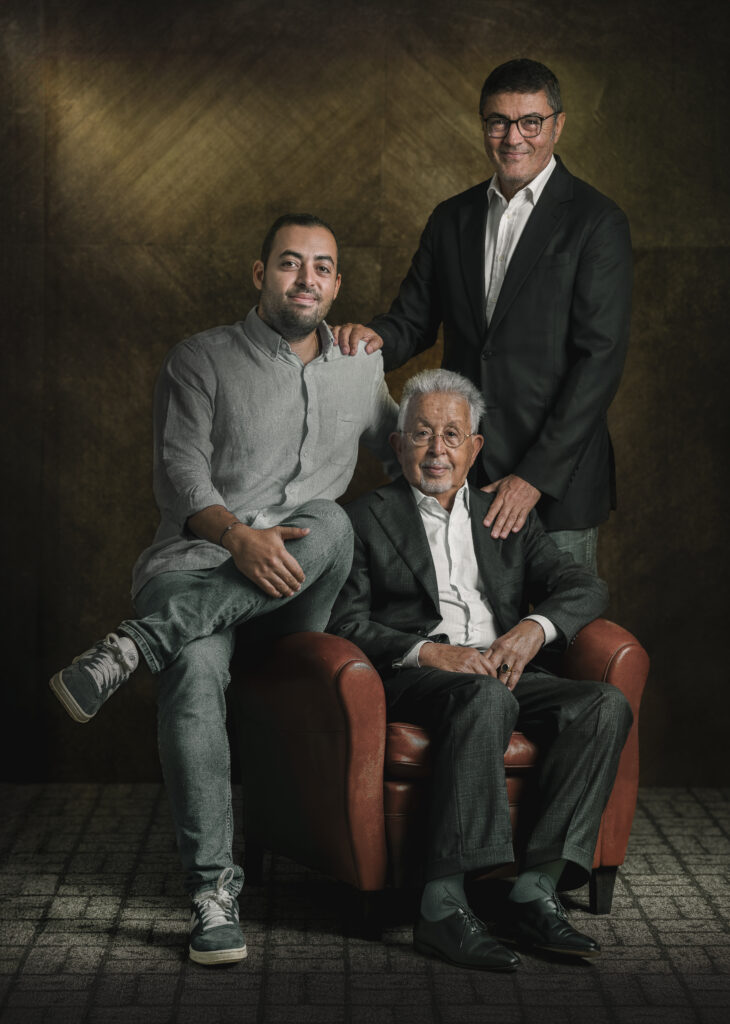
From left, Ahmed, Jalil and Youssef Benabbés-Taarji, of the family behind the holding company Dar Tarjii, which created the AKAN hotel collection. Photo: Courtesy of El Fenn
El Fenn belongs to the AKAN collection, created by the Benabbés-Taarji family through the holding company Dar Taarji. The group also includes La Villa des Orangers, a Michelin-starred Relais & Châteaux property at the medina gates, and Les Deux Tours, set in the Palmeraie. Each address preserves its own identity and specific cultural roots.
Consolidating boutique properties into family collections, rather than submitting them to large international chains, has become a recent trend in historic cities like Marrakech. It preserves specific architectural characteristics, avoids the standardization of global operators and allows greater flexibility to constantly revise spaces, artworks and curation, exactly as has happened at El Fenn since 2004.
Guided by a principle similar to that of the original restoration, the continuous expansion of the property, including the work completed in 2022, reused existing structures in the medina instead of erecting isolated buildings, gradually incorporating adjacent riads and preserving the scale and traditional urban fabric of the area.
Marrakech beyond the walls of El Fenn
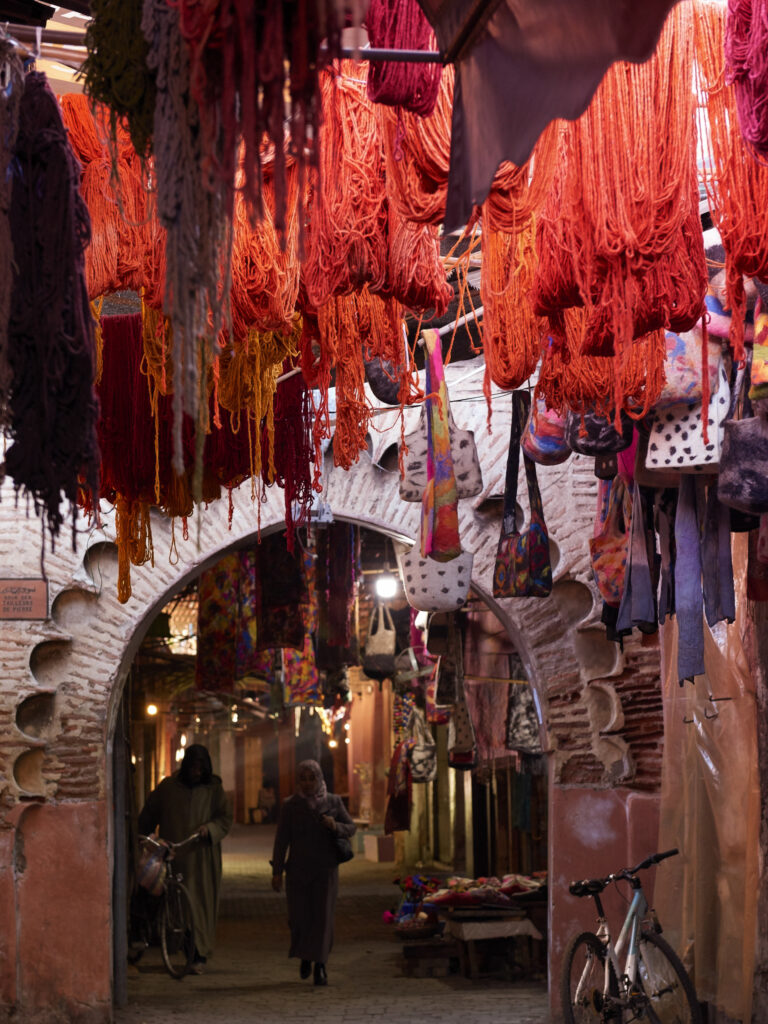
View of Marrakech, a city where craft has become a structural trait of its material culture. Photo: Kasia Gatkowska
Far more than a hotel, El Fenn works as a showcase of Moroccan craftsmanship, bringing together in a single space zellige, tadelakt, carved wood and a contemporary art collection in direct dialogue with these traditions. Such an intersection helps explain how contemporary hospitality can operate within protected historic contexts without stripping them of character, and it accounts for the growing interest among design- and architecture-minded travelers in this type of narrative.
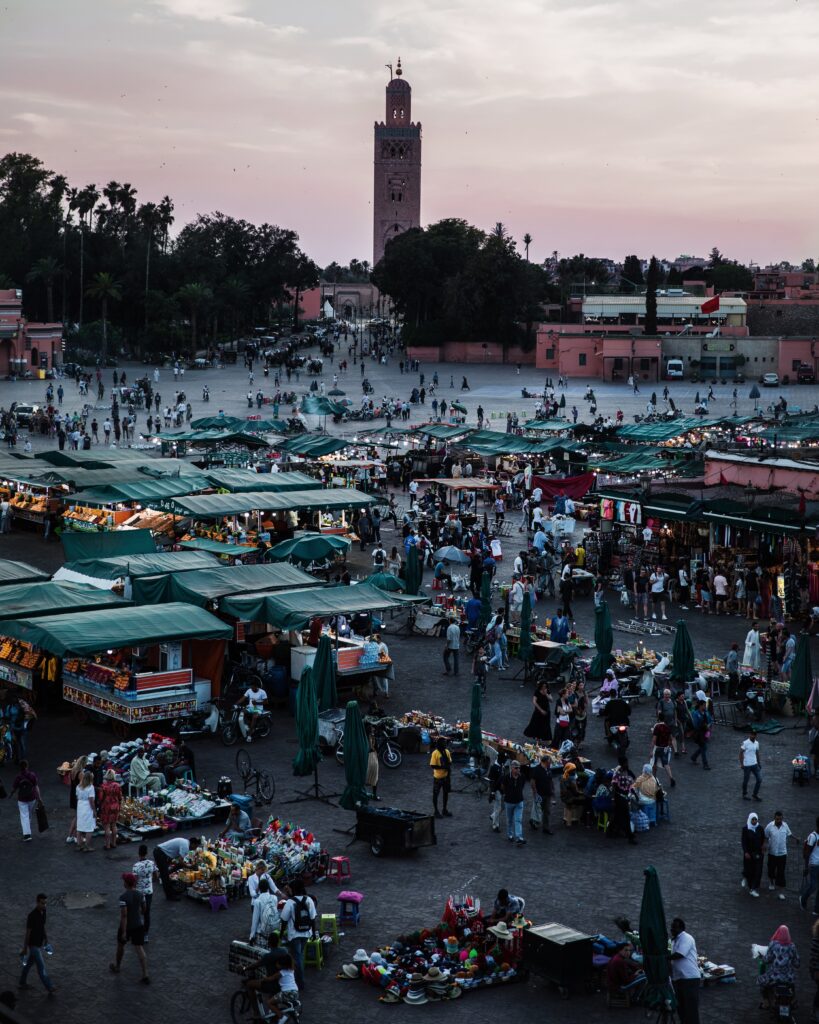
Jemaa el-Fna, in Marrakech’s medina, is the city’s main square and a starting point for exploring the area around El Fenn. Photo: Signe Bay Billede
Daily life at the property centers on maintaining the terrace, the three pools and the dining spaces, which benefit from an average of more than 300 days of sun a year in the region. In the surrounding mountains, the same techniques and materials that supplied Marrakech’s building culture for centuries remain available, a reminder that the experience offered by El Fenn belongs to a territory that extends far beyond the property’s physical limits.
Website : https://el-fenn.com/
Instagram : https://www.instagram.com/elfennmarrakech/