 Serpa
Serpa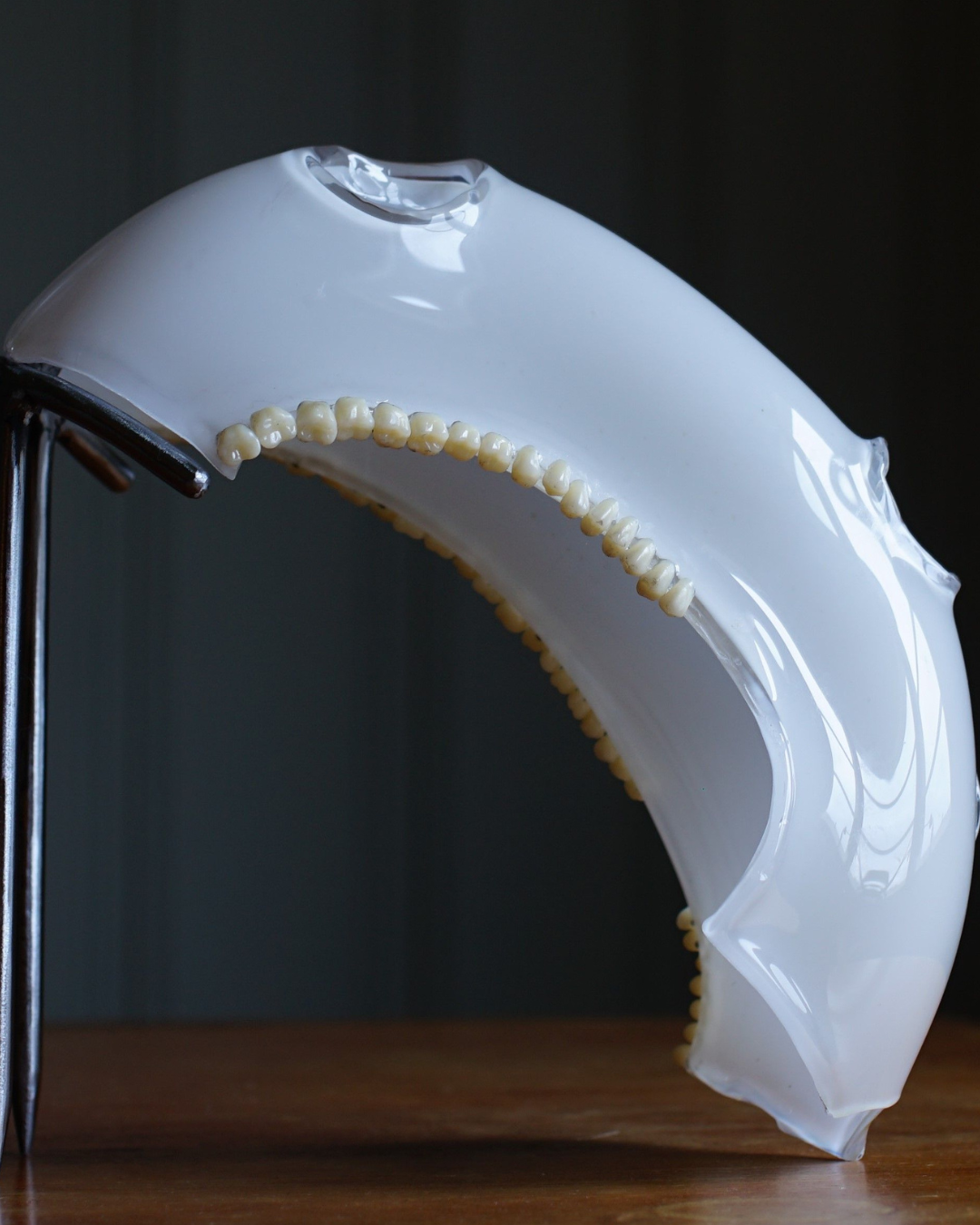
Trained in Sweden and with artist residencies in five countries, the Norwegian artist’s work is part of museum collections in Europe and the United States
At 3 years old, Ida Siebke already knew what she wanted to be: a glassblower. Today, the Norwegian artist has works in the collections of the National Museum of Norway, the Nordenfjeldske Kunstindustrimuseum, and institutions in the Czech Republic and the United States. Her work stems from personal issues—emotions, traumas, and human taboos—and materializes into tactile sculptures that, according to her, “form their own beings.”
“Glass is the material of my dreams,” says the artist, who maintains the focus and discipline required by the craft while allowing creativity to flow. “There’s always something to reach for, something to improve, test, or redo. Over and over until it’s good enough.”

Ida Siebke
Graduating in 2011 from the three-year Nordic program at Kosta Glascenter in Sweden, Siebke deepened her studies at the Gerrit Rietveld Academie in the Netherlands and at Einar Granum Kunstfagskole in Norway, where she studied three-dimensional art between 2015 and 2016. Her academic trajectory was complemented by artist residencies in five countries and workshops with glass masters such as Martin Janecky, Dan Mirer, and Debora Czeresko.
Institutional recognition and grants
The consistency of Siebke’s work is reflected in the support received from Norwegian cultural institutions. In 2024, she obtained a two-year work grant from Kulturrådet (the Cultural Council of Norway), in addition to two travel grants from Norske Kunsthåndverkere (Norwegian Crafts). Since 2020, she has accumulated ten grants, including work stipends, travel assistance, and funding for participation in international programs such as the Haystack Mountain School of Crafts and Pilchuck Glass School.
Recognition extends beyond funding. Five museums maintain her pieces in public collections: in addition to the aforementioned National Museum of Norway and Nordenfjeldske Kunstindustrimuseum, these include KODE, the Městské Muzeum v Železném Brodě (Municipal Museum of Zelezny Brod in the Czech Republic), and the Islip Art Museum in New York.

Monster
Solo exhibitions and group shows
Since 2011, Siebke has held 13 solo exhibitions in galleries and museums in Norway, Sweden, and the United States. Among the most recent are “Somatoforme Tendenser” at Galleri Format in Oslo (2024) and “Haustutstilling” at Vang Folkebibliotek in Valdres (2024). In 2023, she presented “Solnedgang på Løkka” at the BRUDD space, also in Oslo.
Group exhibitions total more than 40 participations since 2011. In 2024, she was part of the exhibition “Talente – Masters of the Future” in Munich, Germany, and “Kopp og Skål!” at the Kunstbanken contemporary art center in Hamar. The previous year, she participated in “Ein Herz für Glas” at Galerie Handwerk in Germany and the traveling exhibition “Generation WHY,” which toured Risør (Norway), Copenhagen (Denmark), and Falkenberg (Sweden) between 2023 and 2025.

Division
Creative process between the personal and the universal
The artist’s starting point is always personal. Siebke uses her own emotions and psyche as raw material to address difficult issues and taboos related to the human condition. This subjective material is brought into the glass studio, where it transforms into concrete and tactile sculptures.
“I create independent beings,” she explains. Inspiration comes from her surroundings—from nature, travels, encounters with people—and above all, from the sensorial. The process involves continuous repetition and refinement: “I redo it repeatedly until it’s good enough,” she states.
Glass, according to Siebke, demands focus and precision but at the same time allows her to dream and grow. “There’s always something to reach for,” she says. This tension between technical control and creative freedom characterizes both her sculptural production and her functional pieces.

Somatoforme Tendenser
Artist residencies and international training
Artist residencies have played a fundamental role in Siebke’s trajectory. In 2022, she participated in the “LSD, Connected By Glass” program in Zelezny Brod, Czech Republic. In 2018, she was in Kairagarh, India; in 2017, in Voitsberg, Austria. In the United States, she attended the New York Center for Art and Social Studies (NYCAS) on Long Island and the Diablo Glass School in Boston, both in 2015.
Workshops complement her training. In 2022, she studied the pâte de verre technique with Saman Kalantari at S12 Gallery and participated in the “#Reality” course with Debora Czeresko at Haystack Mountain School of Crafts. At Pilchuck Glass School, she attended the workshops “Brainstorming Forming” with Dan Mirer and Peter Drobny (2016) and “Printmaking with Glass as the Matrix” with Charlie Cohan (2015). In 2010, she participated in the “Sculpting from Inside the Bubble” course with Martin Janecky at AYA Glass Studio.

Gjennomslag
Institutional involvement and cultural management
Beyond artistic production, Siebke works in sector organization. Between 2023 and 2025, she served on the board of Norske Glasskunstnere (Norwegian Glass Artists). From 2022 to 2024, she was a board member of NK Viken. In 2022, she curated the “MOCA Lights” exhibition.

Conditions for Breathing
Professional experience includes studio management and piece production. Since 2019, she has worked as studio manager and glassblower at Klart Glass. Between 2017 and 2019, she held the same position at Glasets Hus Limmared in Sweden, where she also organized an artist residency program in 2018. From 2012 to 2014, she was part of the Egenart Glassmakerne collective.
The origin of her calling remains a mystery to the artist herself. “Where it came from, I cannot answer,” she admits. What is known is that, more than two decades later, glass continues to be the material of her dreams—and of her established body of work.