 Serpa
Serpa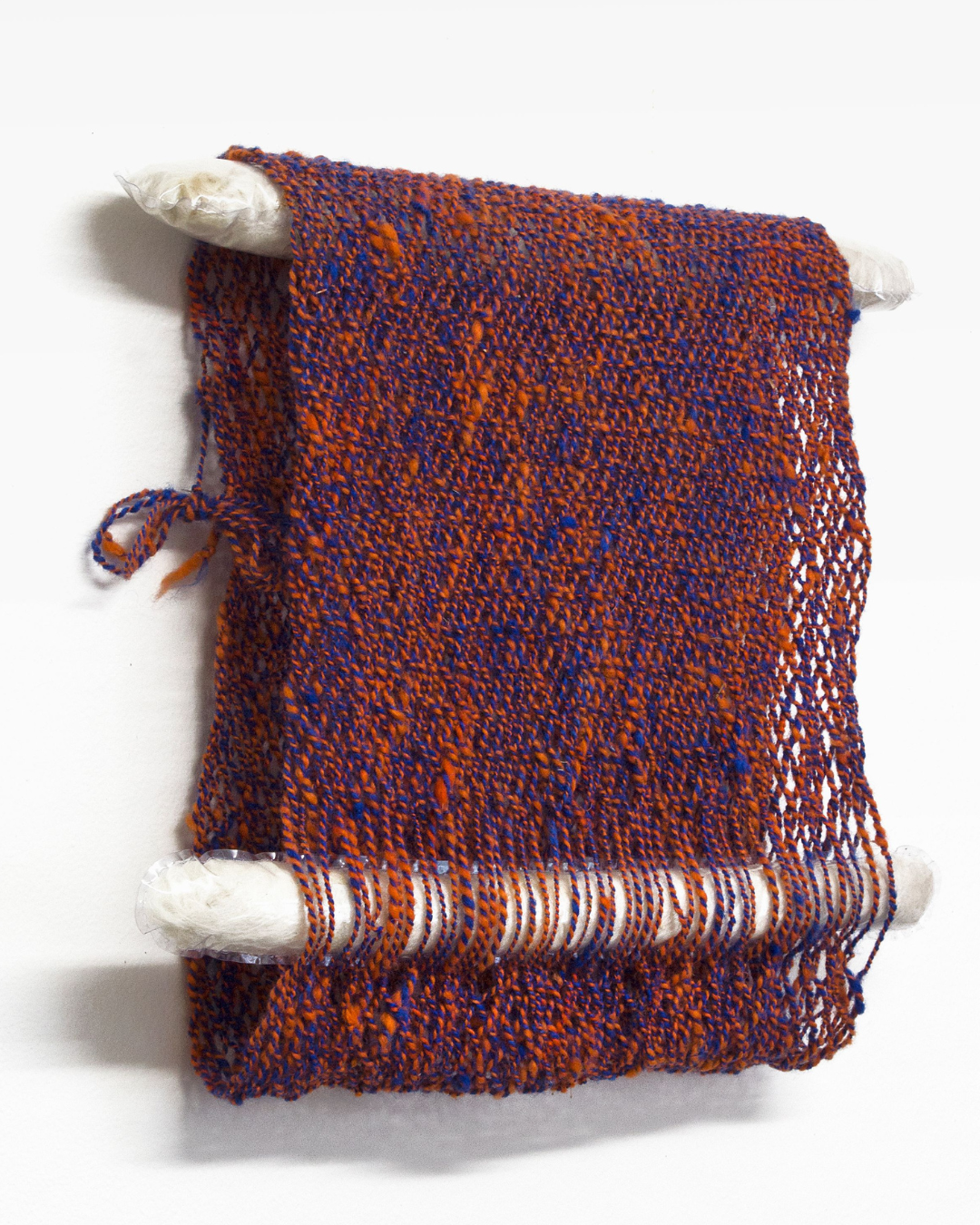
Hand-spinning and Sprang braiding techniques used for over a thousand years in Norway gain contemporary dimension in Liilian Saksi’s works
Textile artist Liilian Saksi, 36, has developed a creative process that unites contemporary art and sustainable agriculture. Born in Sweden and based in rural Skotterud, southeastern Norway, she produces works exclusively with wool from her own flock of sheep, managing the entire cycle — from shearing to final creation. The work, recognized by European museums and galleries, raises questions about lifestyle, animal value, and interspecies coexistence in an era when we rarely track the origin of materials.
With a Master of Fine Arts from the Oslo National Academy of the Arts, Saksi primarily uses the Sprang technique, an ancestral braiding method that allows her to construct textile surfaces displayed on walls or installed in environments. The pieces are fixed with plastic structures in various formats, creating stretched weaves that explore the interaction between vibrant colors and natural tones. The color palette is inspired by four specific sheep from her flock — Alli, Majlis, Lea, and Salme — complemented by white wool dyed with synthetic colorants from her parents’ flock in Sweden.
“By working with my own wool in art, I can manage the small farm. Art finances the expenses associated with the farm,” explains the artist, who has established a circular economic model: the sale of works sustains the costs of the rural property, allowing the continuation of both artistic creation and agricultural activity.

The FLOCK
Saksi’s creative process encompasses hand-spinning, dyeing, and weaving. “From the moment the wool is sheared, it is my hands that shape it, touching every millimeter along the way,” she states. This proximity allows her to control the character of the wool, preserve its natural properties, and incorporate irregularities as part of the artistic expression. The result is chromatic variations that contrast strong colors with earthy tones, creating visual energy while the presence of wool brings coziness to exhibition spaces.

Photo Thomas Tveter
The relationship between art, wool, and Scandinavian cultural identity dates back more than a thousand years. In the Viking Age (793-1066 AD), wool was Norway’s most important textile material, used both for clothing and ship sails. Nordic women mastered sophisticated spinning and weaving techniques, producing everything from simple garments to complex tapestries. Archaeological excavations have revealed textile fragments with intricate geometric patterns, dyed with local plants such as lichen and tree bark, demonstrating a high degree of aesthetic refinement.
During the Middle Ages, Norwegian textile production achieved international recognition. Embroidered wool mantles and narrative tapestries, such as the famous Baldishol pieces (dated to the 12th century), combined utilitarian function and artistic expression. These works, many preserved in medieval wooden churches, depicted biblical and mythological scenes with weaving techniques that required years of learning. Wool was spun on hand spindles, dyed with natural ingredients, and woven on vertical looms in a process that involved the entire community.
In subsequent centuries, Norwegian textile tradition remained alive, especially in rural areas, where each region developed characteristic patterns and colors. The famous Norwegian wool sweaters, with their snowflake and reindeer motifs, originated from these local traditions. Hand-spinning remained essential until the 19th-century industrialization, when machines gradually replaced artisanal work. However, traditional knowledge never completely disappeared, being transmitted between generations as cultural heritage.

Kasuri 2025 – Solo exhibition at the Oplandia Contemporary Art Center – Photo Thomas Tveter
Through ancestral techniques such as hand-spinning and Sprang, Saksi consciously inserts herself into this historical lineage. “Through hand-spinning, I feel a sense of belonging, as this craft has been absolutely essential to our existence,” reflects the artist. By working with her own sheep, she rescues the direct link between creator, animal, and material that characterized pre-industrial textile production. The difference lies in the purpose: while her ancestors produced for survival and protection against the harsh Scandinavian winter, Saksi transforms wool into contemporary artistic objects that question our consumption patterns.
The Oslo National Academy of the Arts (Kunsthøgskolen i Oslo), one of Scandinavia’s leading artistic education institutions, provided the foundation for Saksi’s academic training. Founded in 1909, the Norwegian academy is recognized for excellence in visual arts and design, offering specialized programs that combine tradition and contemporary experimentation. Between 2011 and 2014, Saksi completed her bachelor’s degree in Visual Arts, focusing on textiles. Subsequently, between 2015 and 2017, she completed her Master of Fine Arts in the Visual Arts and Materials program, specifically in the institution’s textiles department.
Before university education, the artist attended preparatory courses in textile design. Between 2009 and 2010, she studied textile craft design at Väddö Folk High School in Sweden. The following year (2010-2011), she deepened technical knowledge at the Steneby School Foundation, also focused on textiles. This formative trajectory combined learning traditional Scandinavian techniques with contemporary artistic experimentation, the basis of the method she would later develop in her professional practice.

Remains 2019
Since completing her master’s degree, Saksi has held nine solo exhibitions in cities such as Oslo, Bergen, and Lillehammer, in addition to participating in group shows in Norway, Sweden, Portugal, Greece, and Iceland. Of note is her participation in Contextile, a contemporary textile art biennial held in Guimarães, Portugal, in 2022. Her master’s degree graduation exhibition, titled “Agreement Between the Seasons,” presented in 2017 in Oslo, marked the beginning of her consolidated professional trajectory.
Saksi’s institutional recognition gained national dimension with the entry of her works into three of Norway’s most important public art collections. In 2021, the National Museum of Norway in Oslo acquired the artist’s works for its permanent collection. Inaugurated in 2022 after the merger of four cultural institutions — including the National Gallery and the Museum of Contemporary Art — the National Museum is the Scandinavian country’s largest artistic institution, with a collection ranging from medieval art to contemporary productions. The acquisition positions Saksi alongside central names in Norwegian art, such as Edvard Munch and works by international masters.
In 2025, the Nordenfjeldske Museum of Applied Arts in Trondheim also incorporated Saksi’s pieces into its collection. Founded in 1893, the Nordenfjeldske is one of Scandinavia’s oldest design and decorative arts museums, specializing in textiles, ceramics, furniture, and historical and contemporary crafts. The institution preserves one of the most relevant collections of Nordic applied art, including traditional Norwegian textiles and innovative productions. Saksi’s entry into this collection reaffirms the importance of her work in the context of contemporary applied arts.

Kasuri 2025 – Solo exhibition at the Oplandia Contemporary Art Center – Photo Thomas Tveter
Also in 2025, the KODE Bergen collection, a Bergen city hall initiative focused on public art and municipal collections, acquired works by the artist. Bergen, Norway’s second-largest city, maintains an active cultural policy of valorizing visual arts, focusing on emerging and established Scandinavian artists.
Institutional consecration was crowned with the inclusion of Saksi’s works in the group exhibition “Art. Craft,” held in 2025 at the National Museum of Art in Oslo. The show, of retrospective and curatorial character, investigated the boundaries between art and craft in contemporary Scandinavian production, bringing together artists who transit between these historically separated categories. Saksi’s participation in this high-visibility public exhibition reaffirmed the relevance of her production in the regional artistic scene and consolidated her name among the leading textile artists active in Norway.
The financial sustainability of Saksi’s artistic practice was made possible by a significant set of grants and subsidies. Between 2022 and 2024, she received annual grants from the Visual Arts Compensation Fund, in addition to a two-year work grant awarded by the Norwegian Arts Council (2020). She also obtained support from the Danish Artist Remuneration Fund and regional subsidies for specific projects.

The FLOCK
In addition to exhibitions, Saksi executes public art commissions. In 2023, she completed a work for the Ila Prison and Detention Center in Oslo, commissioned by Koro (public art program). In 2024, she carried out a one-year commission titled “A Poet’s House” for Hans Børlis plass in Skotterud. For 2025, an installation is planned at the Høyset Health and Wellness Center in Trondheim
The artist also contributes to the formation and articulation of the textile art field. She was coordinator of the SOFT gallery/Norwegian Textile Artists (2019-2020), member of the Norwegian Textile Artists Nominations Committee (2018-2020), and consultant to her alma mater, the Oslo National Academy of the Arts, in the Visual Arts and Crafts (Textile) course between 2020 and 2021. She currently belongs to the Norwegian Visual Artists Association (NBK) and the Norwegian Textile Artists Association (NTK).
For Saksi, manual work creates a reflection on a world that was, the present, and above all, the future—a questioning that runs through her production and proposes alternatives to the contemporary consumption model, reconnecting with ancestral knowledge that kept entire civilizations warm and protected throughout centuries.

Prominent Retrospective 2020 Photo: Thomas Tveter
Website: https://www.liiliansaksi.com/
Instagram: https://www.instagram.com/liiliansaksi/