 Serpa
Serpa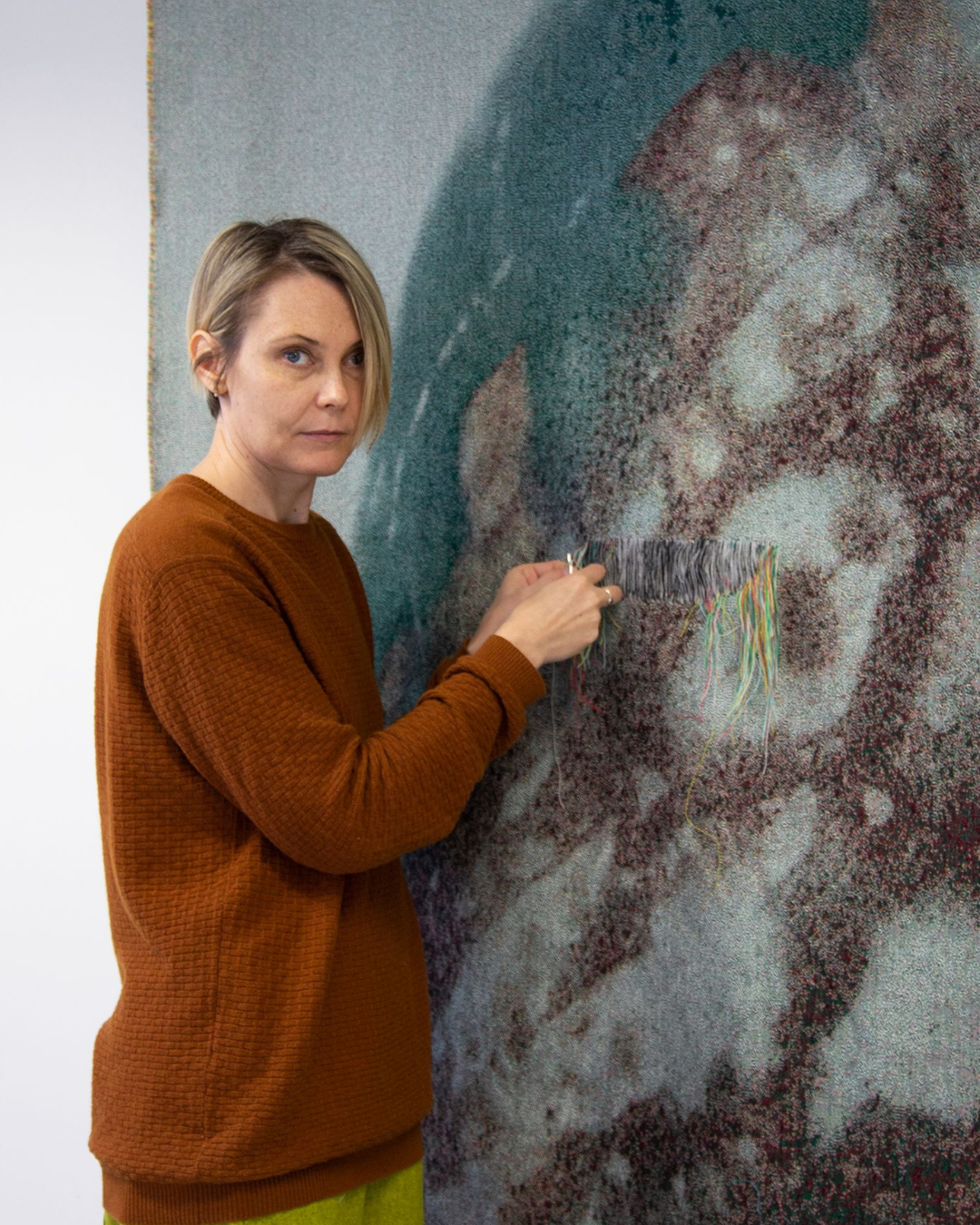
Kristina Austi
The Lithuanian-Norwegian artist who trains algorithms with real textures
Kristina Austi, a textile artist born in Lithuania and based in Bergen, Norway, has developed a unique method for working with artificial intelligence: instead of typing instructions, she feeds algorithms exclusively with images of fabrics and patterns that she weaves herself.
The results of these experiments are on display through February 2026 at the Munch Museum in Oslo, as part of the 2nd Munch Triennial. The institution holds the largest collection of works by Norwegian artist Edvard Munch in the world. It is housed in a building designed by the Herreros studio in the Bjørvika neighborhood, on the shores of the Oslo Fjord, with more than 26,000 works in its collection.
Austi’s approach to AI subverts the conventional logic of generative tools. She never uses verbal commands. Instead, the artist trains systems using real textile surfaces, textures, weaves, and patterns from her own works, obtaining visual results that she then translates back into woven pieces on the digital loom. The process creates a continuous cycle between the analog and the digital, between the handcrafted and the algorithmic.
That same year, works by Austi were acquired by Equinor’s art program, the Norwegian energy giant and one of the largest corporate art collectors in the country, further consolidating her international recognition.

Hybrid I – Photo Oystein Thorvaldsen
The Exhibition
The Triennial, held every three years, is part of the museum’s contemporary art program and brings into dialogue artists based in Norway and international artists. Austi’s work is featured in the exhibition “Almost Unreal.”
The second edition of the Triennial explores the spaces between the real and the virtual, old and new technologies, and dystopian and hopeful visions of the future. The show brings together works by 26 artists that open portals to other realities, including parallel universes, mystical realms, and alternative ways of seeing the world. The exhibition is curated by Tominga O’Donnell, senior curator and head of contemporary art at the Munch, and Mariam Elnozahy, artistic director of Konsthall C in Stockholm.

Hybrid I – Photo Oystein Thorvaldsen
Digital Weaving as Artistic Language
Austi holds a Fine Arts degree from the Bergen Academy of Art and Design, where she completed both her undergraduate studies, from 2006 to 2009, and her master’s degree, from 2009 to 2011, in the textiles department. She has dedicated her practice to digital Jacquard weaving, a technique that allows for the creation of complex images on the loom through computer programming. Her curiosity about the woven surface is, by her own account, the driving force behind her entire body of work.
Beyond her artistic practice, Austi serves as a professor of textile disciplines at the University of Bergen, the second oldest university in Norway. The institution was established by an act of parliament in 1946, although its academic roots date back to 1825, when the Bergen Museum was founded as a research institution. Today, one of the country’s most internationally recognized public universities, it brings together approximately 20,000 students and more than 4,000 staff and faculty members across seven faculties and 90 departments and research centers.
The Faculty of Fine Art, Music, and Design, to which the textiles department belongs, was established in 2017 through the incorporation of the Bergen Academy of Art and Design, the same school where Austi trained, and the Grieg Academy of Music. The university maintains partnerships with industry in western Norway.
Alongside her academic work, Austi founded VEVFT, a company aimed at building a professional environment for digital weaving in the country. Her market-building efforts have already yielded concrete results: several young Norwegian artists have begun incorporating the technique into their work in recent years, directly influenced by her efforts.

Hybrid I – Photo Oystein Thorvaldsen
A Career Marked by Awards and International Exhibitions
Austi’s track record in the international textile arts circuit is extensive. She has participated in the Textile Triennials of Riga, in Latvia, and Lodz, in Poland, both landmark events in the field, as well as biennials in Rijswijk in the Netherlands, Vilnius in Lithuania, and Guimarães in Portugal. Her works have also been featured in exhibitions in the United States, Denmark, Belgium, Sweden, China, and Germany. In 2024, she represented Norway at BeCraft, the European Prize for Applied Arts, in Mons, Belgium.
Among her notable awards are first place in a juried exhibition in Seattle in 2018, a special prize at the Portrait Now exhibition at the National History Museum at Frederiksborg Castle in Denmark in 2021, and an honorable mention at the 9th Cheongju International Craft Competition in South Korea in 2015. That same year, she received the jury diploma for “sense of materiality” at the International Biennial of Textile Miniatures in Vilnius.
Her works are held in the permanent collections of museums and public institutions in Norway and abroad, including the Norwegian Museum of Decorative Arts and Design in Trondheim, known as NKIM, the Sogn og Fjordane Art Museum, and the Muskegon Museum of Art in the United States. Public recognition also includes commissions for healthcare facilities and Norwegian municipalities.

Hybrid I – Photo Oystein Thorvaldsen
A Ten-Year Grant Ensures the Continuity of Her Work
In 2025, Austi received a ten-year working grant for established artists awarded by Arts Council Norway, a government body founded in 1965 and the primary operator of Norwegian cultural policy under the Ministry of Culture and Equality. The institution administers the Norwegian Cultural Fund and, in 2023 alone, managed approximately 190 million euros in public funds allocated to the arts, equivalent to 9% of the country’s entire cultural budget. Each year, the council receives more than 20,000 funding applications across the fields of visual arts, music, literature, performing arts, museums, and cultural heritage.
The ten-year grant for established artists represents the top tier of individual support offered by the institution. It is awarded to a very limited number of artists with a proven and recognized body of work, providing long-term financial stability and signaling to both the national and international art world that the recipient’s work carries lasting relevance.
For Austi, the distinction is the culmination of more than a decade of consecutive annual grants and support from various levels of government, including municipal, regional, and national, a trajectory that attests to the consistency of her practice in the eyes of Norway’s leading cultural institutions.

Hybrid I – Photo Oystein Thorvaldsen
Kristina Austi’s studio is located at C. Sundts gate 55, Studio 302, Bergen, Norway.
Website: https://austikristina.com/
Instagram: https://www.instagram.com/austikristina/