 Serpa
Serpa
A arch marks the entrance to “O Banho da Saudade,” the installation by architect Bruno Borges at CASACOR São Paulo 2026. (Photo: MCA Estúdio)
Named “O Banho da Saudade” (“The Bath of Longing”), the 33-square-meter space designed by BSB Arquitetura is part of the 39th edition of the show, running through Aug. 9 at Parque da Água Branca.
SÃO PAULO – Bruno Borges has spent his career building spaces that ask something of the people who move through them, and his first appearance at CASACOR São Paulo does not deviate from that instinct. Named “O Banho da Saudade” (“The Bath of Longing”), the 33 sq m installation from his firm BSB Arquitetura forms part of the show’s 39th edition, running at Parque da Água Branca through 9 August. Where much of the exhibition trades in decoration, Borges has built something closer to a ritual: a bathroom reconceived as a sequence of emotional stations, each one calibrated to slow a visitor down rather than move them along.
Everything begins with a definition. For Borges, saudade is not simple nostalgia but a rift in time, the sensation of a present tense still haunted by a past that has never quite left. Borges says the idea shaped every decision on the project, from the materials chosen for each surface to the precise sequence in which the artworks unfold along the route. Overall, it reads less like a showroom vignette than a short, wordless film, structured in acts and paced by light, sound and texture.
An Entrance Built on Fragility
A stone arch announces the beginning of the journey, framing two works by artist Bruno Passos, “A Descoberta” and “Pachamama.” Their distorted, fragmented figures set the emotional register for everything that follows, suspended somewhere between vulnerability and protection. Rather than functioning as a decorative overture, the pieces operate as a kind of thesis statement, telling visitors before they have gone any further that this space intends to unsettle as much as it soothes.
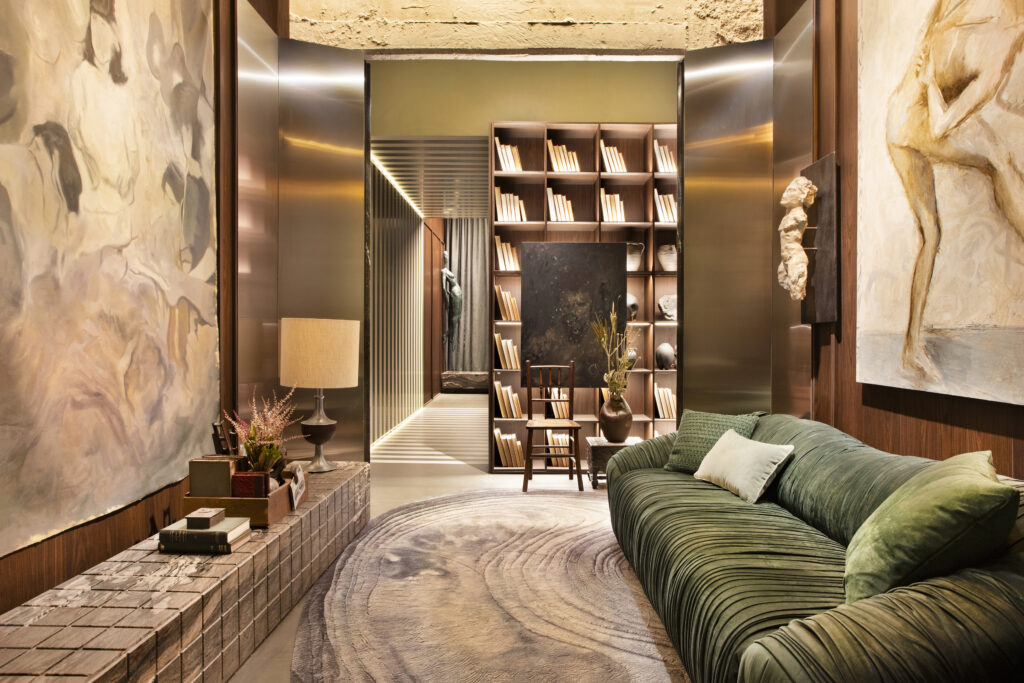
A general view of “O Banho da Saudade,” with paintings of fragmented figures lining the entrance walls. (Photo: MCA Estúdio)
Comfort follows close behind that unease. At the centre of the room sits the Bacio sofa, designed by Karol Suguikawa, its soft velvet upholstery evoking the memory of a first kiss and the other formative, tactile moments that never fully fade. Paired with the in-house Profundezas rug, the sofa becomes the installation’s resting core, a deliberate pause built into the choreography. Borges has said the texture itself was chosen to draw visitors into surrender, to make the introspective work of the piece feel less like an ask and more like an invitation.
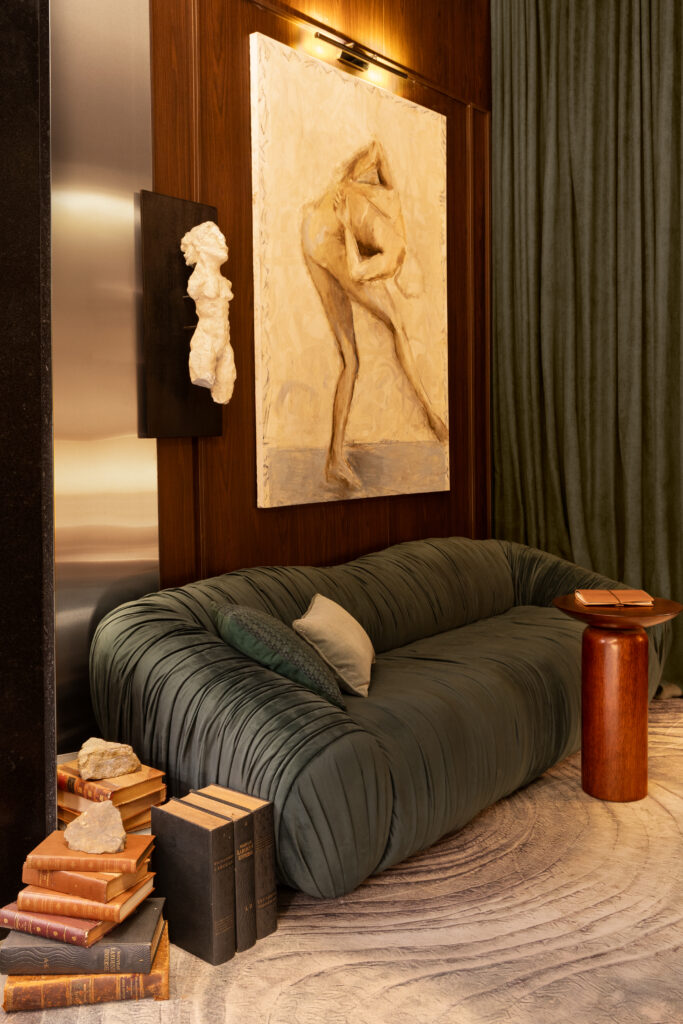
Detail of one of the artworks displayed in the installation’s entrance area. (Photo: Daniela Magario)
Facing the sofa, Caio Cruz’s “Santo Lar de Vertigem” hangs like a hazy recollection of childhood, adding a layer of psychological weight to what is already the installation’s most contemplative stretch. Nearby, the Jogada bench, another BSB design, references the logic of board games, reframing the choices embedded in a game as a stand-in for the choices that structure a life. Visitors are also handed an open journal at this stage, an invitation to record their own memories and, in doing so, become co-authors of an installation that was never meant to stay static.
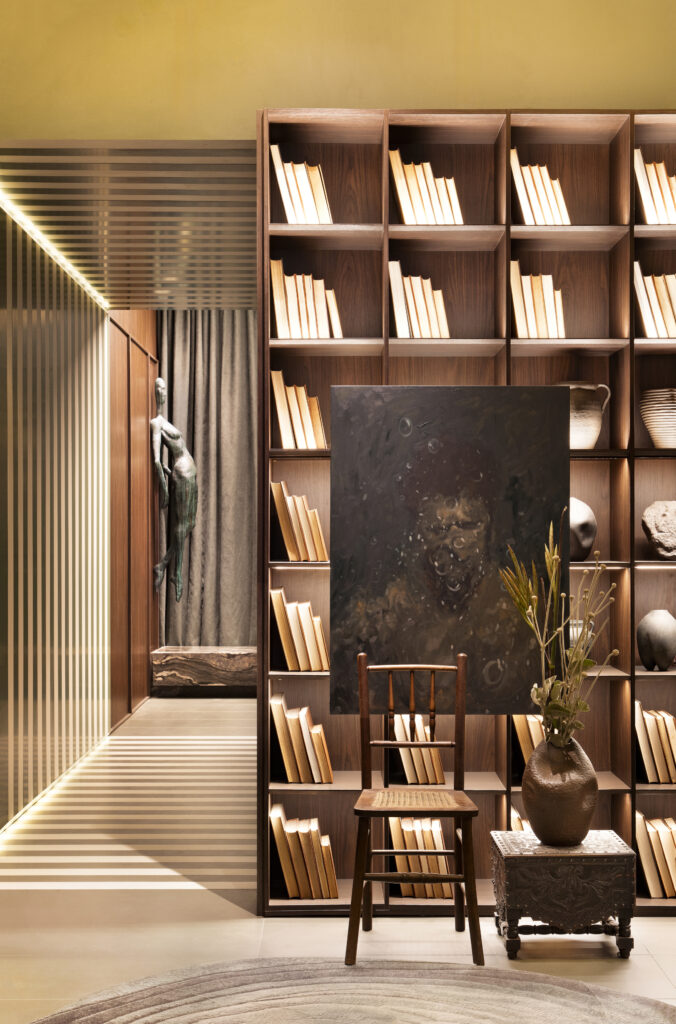
A painting is displayed facing the Bacio sofa, in the installation’s most contemplative area. (Photo: MCA Estúdio)
A Threshold, a Tunnel and a Question
Journaling precedes a Laminox portal, finished in stone and stainless steel, engineered to support the building’s original beam without disturbing the architecture already in place. Fragments of preserved stories surface here, alongside a second work by Caio Cruz, “O Interior das Coisas Macias,” which extends the symbolic language introduced at the entrance and keeps the narrative from fracturing.
Just before the installation’s final stretch comes its most monumental gesture: “108 Vezes Agora,” a sculptural japa mala created by Borges in collaboration with artist Patrícia Cavalli. Dozens of beads, arranged in the sequence of a contemplative meditation strand, each hold a fragment of someone’s past, among them wedding flowers, the keys to a long-dreamed-of house and a first daughter’s earring. Assembled as a gesture of gratitude, the work pulls visitors back into the present after pages of looking backward.
Past that point, a striped tunnel induces a mild, deliberate vertigo, a visual stand-in for the mind’s continuous churn, and guides visitors toward the bathroom’s stalls.
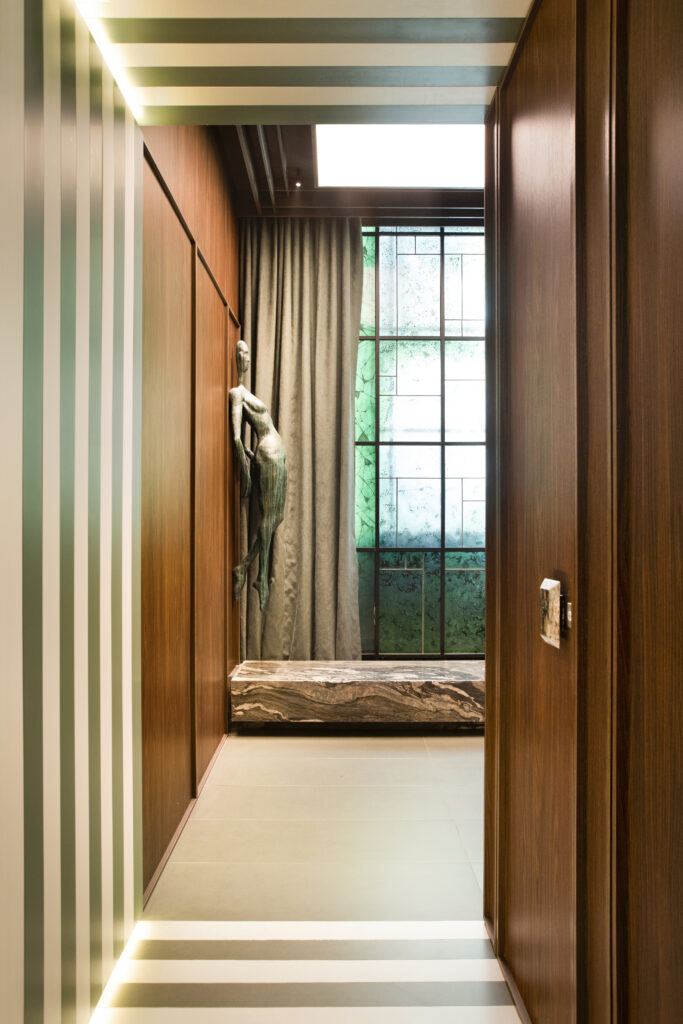
A striped tunnel leads visitors toward the mirrored stalls, inducing a mild vertigo. (Photo: MCA Estúdio)
Inside, strategically placed mirrors expand the compact space and pose the question that anchors the installation’s second half: who are you when no one is watching? Unlike the collective memory built across the earlier stations, this question turns the lens inward, confronting visitors with their own magnified reflection.
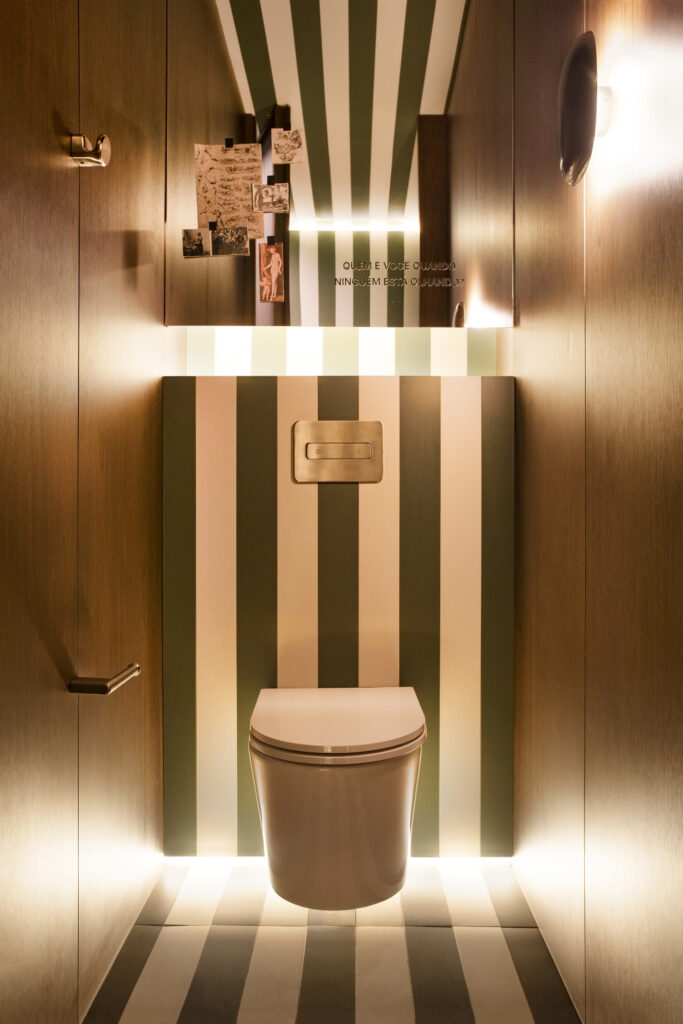
Strategically placed mirrors expand the compact stalls, which display handwritten notes and memory fragments on the wall. (Photo: MCA Estúdio)
Masks, Mirrors and a Final Light
Next comes a surgical-grade stainless steel counter, built for the ordinary act of washing hands, positioned opposite a work by artist Felipe Lanzas. Rendered in translucent metal mesh, the piece takes the form of masks, each one a stand-in for the different social versions of the self that people present to the world. Directly across from the masks, a convex mirror physically embodies the word saudade, its curve warping the reflection just enough to reinforce the tension between presence and absence that has driven the project since its opening arch.
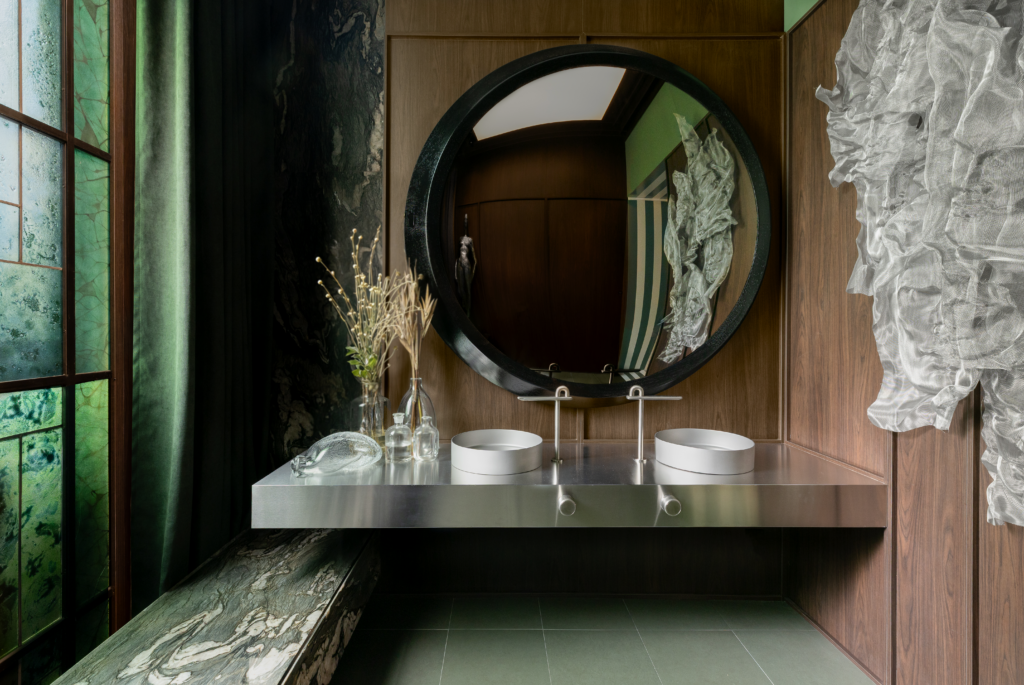
A stainless steel countertop faces a translucent metal mesh installation. (Photo: Daniela Magario)
Light closes the sequence. A handcrafted stained-glass window, standing nearly 4m tall, filters natural light into this final stage, acting as a hinge between the symbolic density built up over the route and the calm of its resolution. Just before the exit, “Levitação,” a sculpture by Leopoldo Martins, rests on a bench of Tempest Green quartzite chosen specifically for a durability that stands in deliberate contrast to the emotional fragility explored throughout the piece. Its bench nods to kintsugi, the Japanese practice of repairing ceramics with gold, and by extension to the idea that what breaks can still acquire new value once it has been mended.
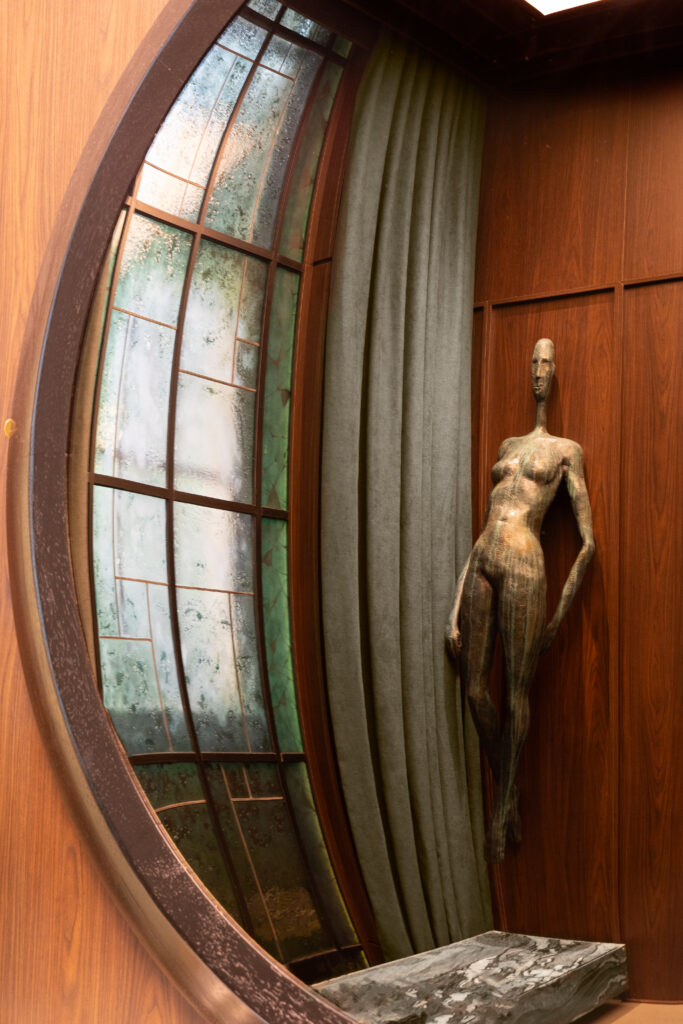
A convex mirror distorts the reflection, giving physical form to the word saudade and reinforcing the tension between presence and absence. (Photo: Daniela Magario)
Threading through every station is a soundscape composed at 528 hertz, punctuated at intervals by the sound of breaking glass. It is a small, sharp device, but according to the firm, an effective one, designed to keep visitors’ minds anchored in the present even as the installation asks them to sit with the past. Taken together, Borges says, the artworks, materials and score form a space built for pause, memory and reconnection, a dive into the mind capable of surfacing fragments that time has already quietly turned into memory. As he put it, “O Banho da Saudade” invites visitors to look inward and recognise that even what is broken can remain, in its own way, whole.
Detail of the Tempest Green quartzite bench beneath the stained-glass window that filters natural light at the close of the route. (Photo: Daniela Magario)
Meet the Architect Behind the Room
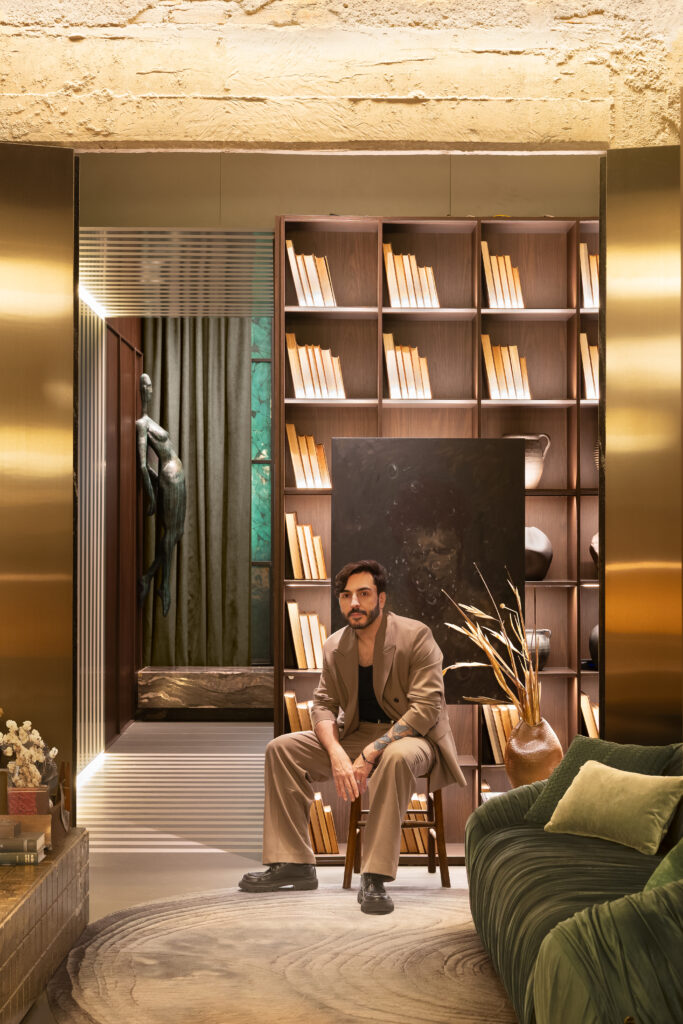
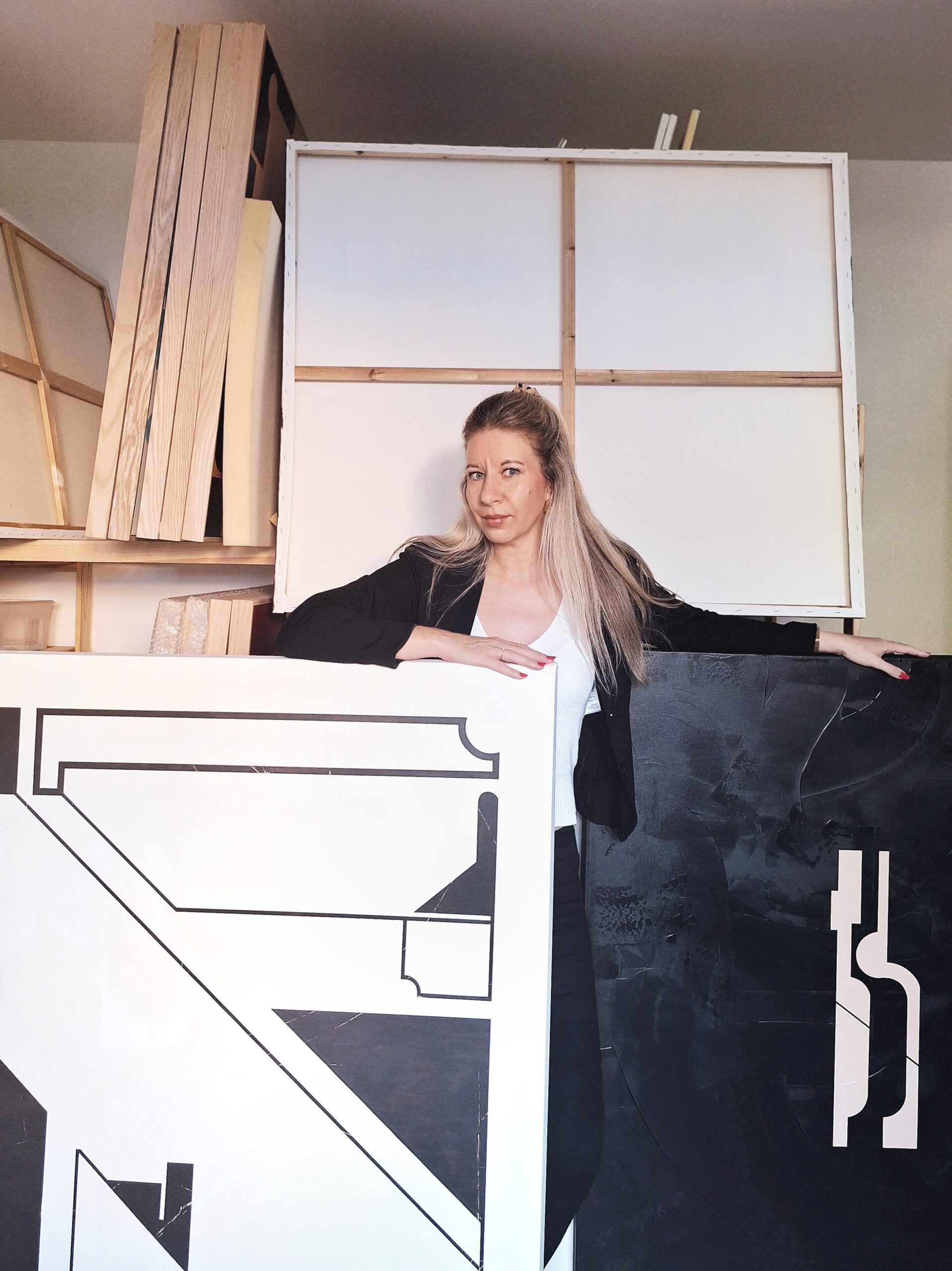
Architect Bruno Borges, founder of BSB Arquitetura, makes his CASACOR São Paulo 2026 debut with an installation dedicated to emotional memory. (Photo: Daniela Magario)
Born in Santa Catarina, Borges built his career in São Paulo, the city where his architectural language found its fullest expression. BSB Arquitetura has built a reputation for uniting art and experience, placing emotion rather than function at the centre of its projects. Borges describes his own approach as deeply personal, more curious about what a space might provoke in the people who inhabit it than in the practical demands of the room itself. Memory, perception and presence are not incidental to his process but structural to it, woven into form until the two become inseparable. Seen in that light, his CASACOR São Paulo debut reads less like a departure than a continuation, a natural extension of ideas Borges has been developing across his practice for years.
About CASACOR São Paulo
Billed by its organisers as the most comprehensive cultural platform for architecture, landscaping and interior design in the Americas, CASACOR São Paulo gathers leading architects, decorators and landscapers each year within a single exhibition. Now in its 39th edition, the 2026 show returns to Parque da Água Branca, one of the city’s principal green spaces and a regular host to major cultural events.
Visitor Information
Parque da Água Branca, Rua Dona Ana Pimentel (no street number), Gate G4
Through 9 August 2026
Tuesday through Sunday, 11am to 10pm