 Serpa
Serpa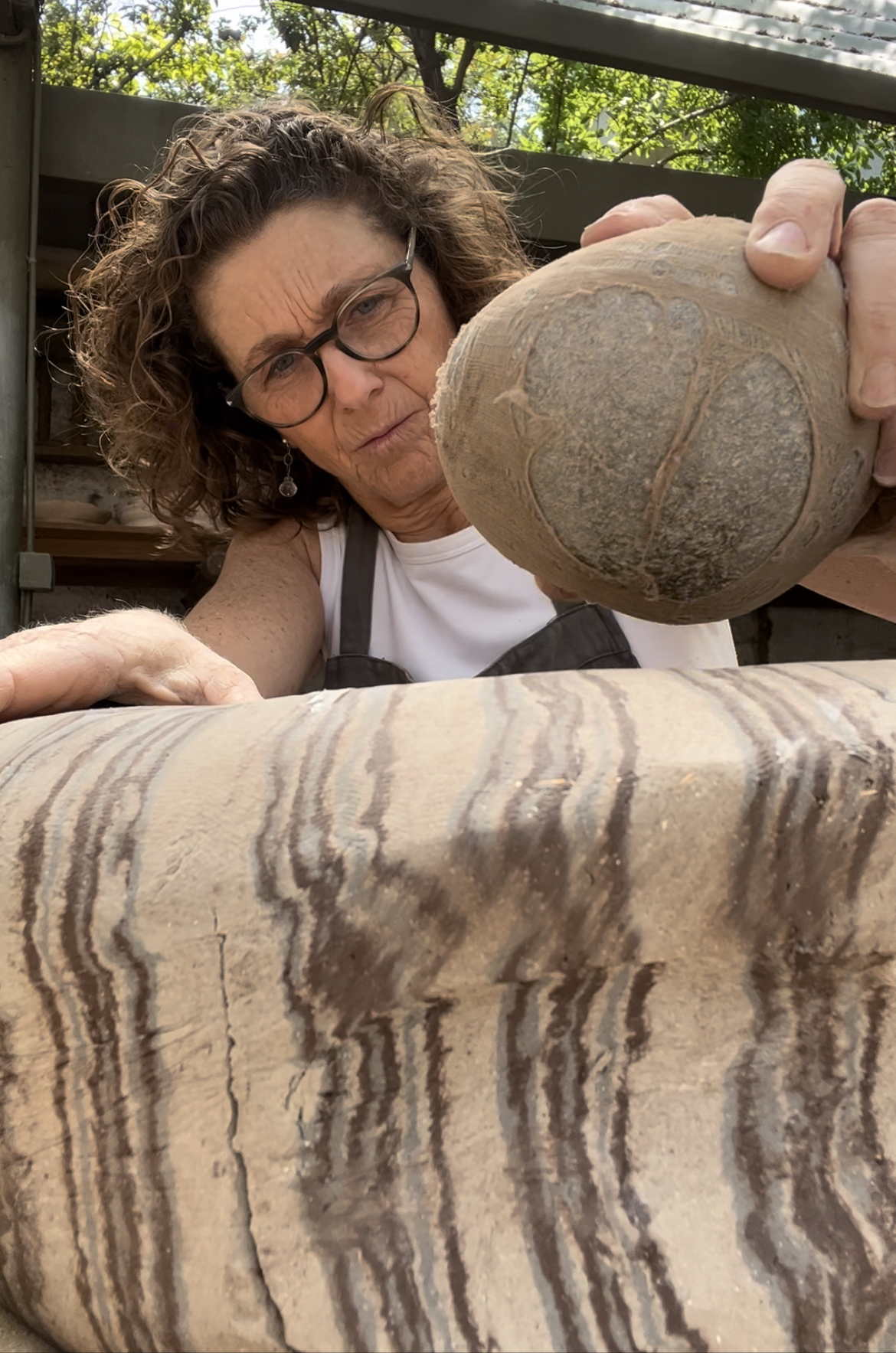
Jacqueline Schapiro
Clay, porcelain, and lava from Chile in the hands of Jacqueline Schapiro, member of the AIC/IAC and the Homo Faber Guide, become sculptures that evoke ten thousand years of Indigenous memory and the slow passage of geological time
Chilean ceramist and sculptor Jacqueline Schapiro has built over the past decades a singular artistic language that bridges the Indigenous memory of Chilean territory with contemporary sculpture. Working with clay, porcelain, and volcanic sand (materials humanity has used for more than ten thousand years), she creates volumes with intentionally irregular surfaces where the traces of the making process remain visible as an essential part of the work. A member of the International Academy of Ceramics (AIC/IAC) since 2021 and listed in the Homo Faber Guide of the Michelangelo Foundation since 2023, Schapiro has works in the Chilean government’s public collection and in international collections.
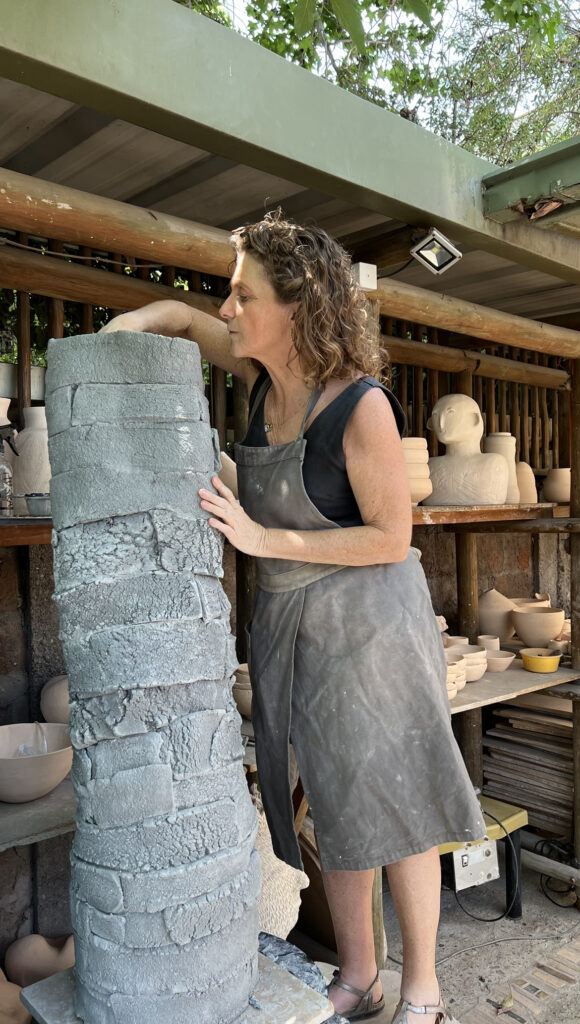
Jacqueline Schapiro
The AIC/IAC, founded in 1952 and based in Geneva, is the foremost international organization dedicated to ceramic art, bringing together the most influential creators, researchers, and institutions in the field worldwide. Membership is by invitation and peer review, making it one of the most selective distinctions available to a ceramist. The Homo Faber Guide, an initiative of the Michelangelo Foundation based in Venice, is a platform dedicated to mapping and preserving masters of excellence in craftsmanship across Europe and Latin America. To be listed in its guide is to be recognized among the artisans and artists whose practice represents the highest level of technical mastery and creative originality working today. For Schapiro, both distinctions place her work in direct dialogue with the international contemporary ceramics scene.
In 2024, the artist held her most recent solo exhibition, “Sedimentos: Sculptures 2017-2024,” at the Comunidad Israelita de Santiago, bringing together works that synthesize her research on geological time and the Chilean landscape. That same year, she participated in “Barro 6,” a group exhibition of contemporary ceramics at the Museo Ralli in Santiago, and was invited to serve on the jury of the CIS Art Competition.
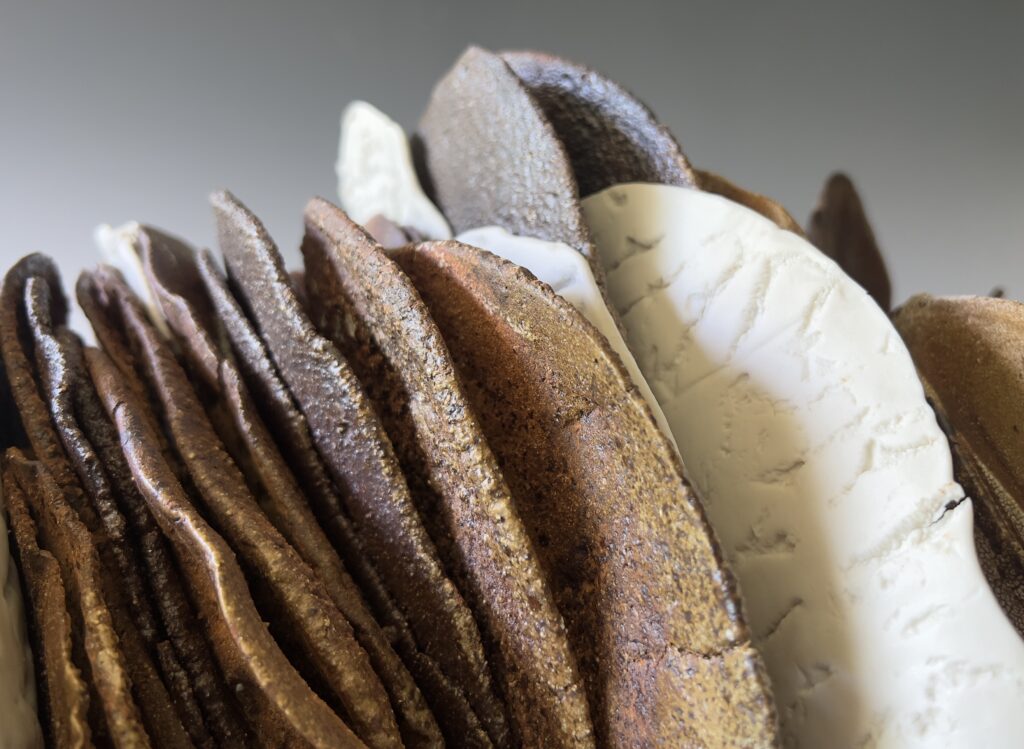
Algaes
Territory as Material
What sets Schapiro’s work apart from other currents in contemporary ceramics is its direct, physical relationship with the land. The artist travels across Chile in search of materials she collects herself: volcanic sand, lava, and soils from different regions. Back in her studio, she also incorporates residues from her own process, such as fragments of dry clay, dust, and pigments accumulated in her workspace, transforming what would otherwise be discarded into aesthetic elements.
“I recycle matter; I transform it,” the artist writes in her statement. “My relationship with the work exists between the passage of time and the knowledge of our country, both its territory and its culture.”
This approach situates Schapiro in dialogue with the international “breakaway ceramics” movement, a contemporary current that values matter and unconventional methods above finished form. But her work goes beyond aesthetics: there is a dimension of living archaeology, a recovery of techniques and materiality rooted in Chile’s pre-Columbian civilizations.
Her most openly declared inspiration is the Chinchorro culture of northern Chile, whose funerary rituals involved wrapping bodies in clay and other materials that have survived for more than ten thousand years. The constructive techniques and materiality of that culture run directly through her series “Cuerpos Vendados” (Bandaged Bodies), one of her most recognized bodies of work, whose fourth piece was acquired by the Chilean government in 2020.
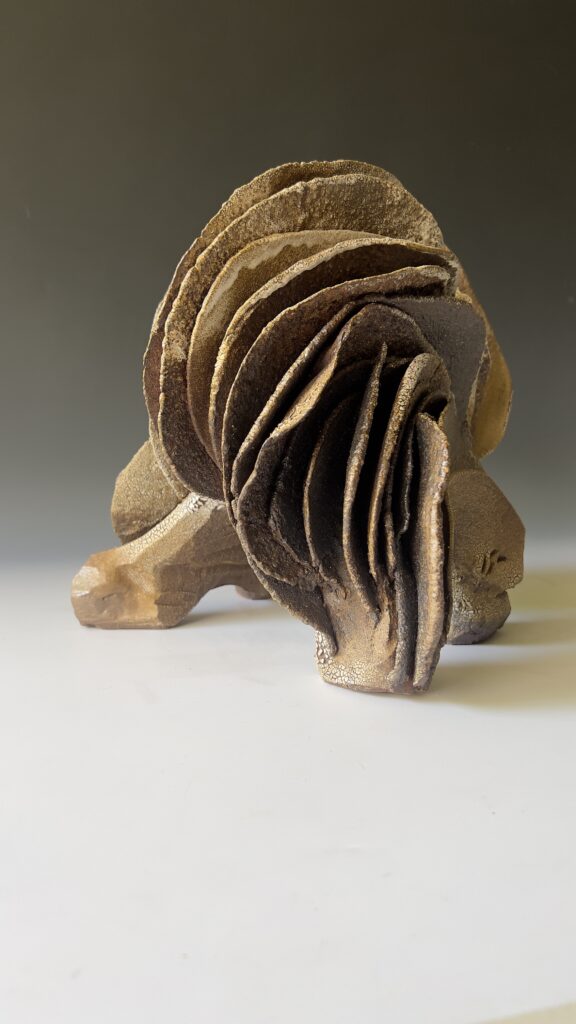
Desert Animal Soul
Surfaces That Hold Time
Schapiro’s pieces are built from slabs of varying thicknesses or solid forms that give volume to the sculptures. The surface is never smooth or uniform: the artist intentionally preserves the marks of gesture, pressure, and chance. The kiln’s fire is treated as a co-author: the flame passing unpredictably over the pieces leaves traces the artist values as “scars” of the process.
“I am passionate about highlighting the origin of the material, which is why I make a point of leaving much of the clay in its original, visible state,” she explains. “The forms, colors, and textures that nature offers us, with their perfect asymmetry, are a constant source of attraction for my imagination.”
This sensitivity to the irregular and the residual finds its echo in Chile’s geological landscape. Igneous formations, erosion, sedimentation, and the marks of volcanic activity all inform Schapiro’s visual vocabulary. Her works do not represent nature: they incorporate its materials and replicate its processes.
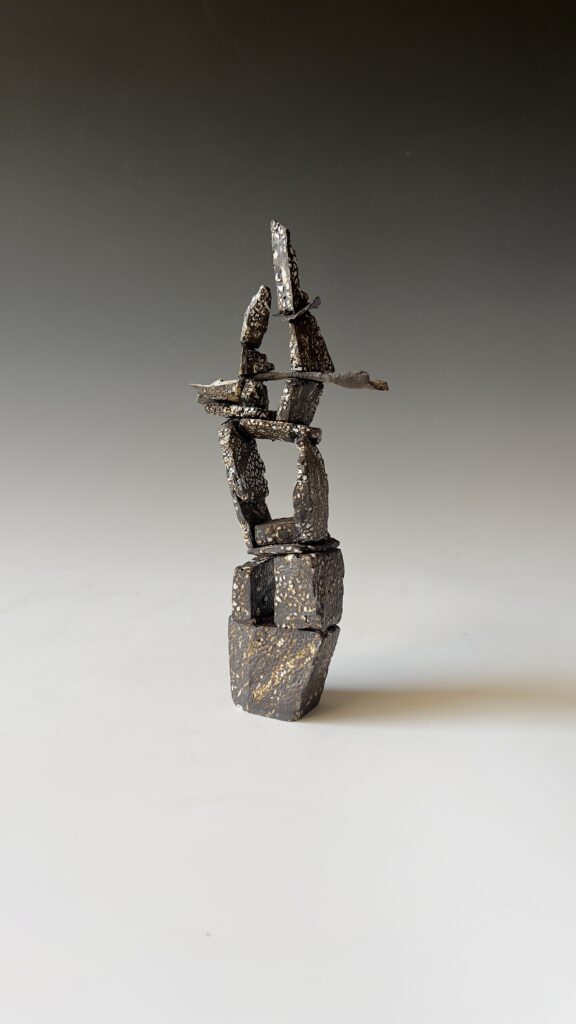
Precarious balance
A Career Built on Discipline and Observation
Born in 1969, the granddaughter of immigrants, and raised with rigor and sobriety, Schapiro was diagnosed with severe hearing loss at age three, a condition that, as she herself reflects in retrospect, sharpened her other senses, especially her visual acuity. “Hearing less gave me a heightened development of other senses, above all the visual,” she says.
That refined sensitivity to materiality, visual art, and nature guided her early training in painting, from mimesis to abstraction, through the study of color and composition. The pictorial foundations built at the Pedro Bernal Troncoso painting academy (1982-1985) and Berta Orrego’s school (1980-1982) laid the groundwork for the freedom she would find in ceramic sculpture.
Her definitive transition to ceramics took place throughout the 2010s, when Schapiro pursued training with internationally recognized artists: Cuban-American Cristina Córdova (human figure in slabs, 2017), Spanish sculptor Rafa Pérez (sculpture techniques, 2018), and Argentine Andrea Lallana (casting and paper porcelain, 2016), among others. Since 2017, she has been a member of the Taller Huara Huara studio collective in Santiago.
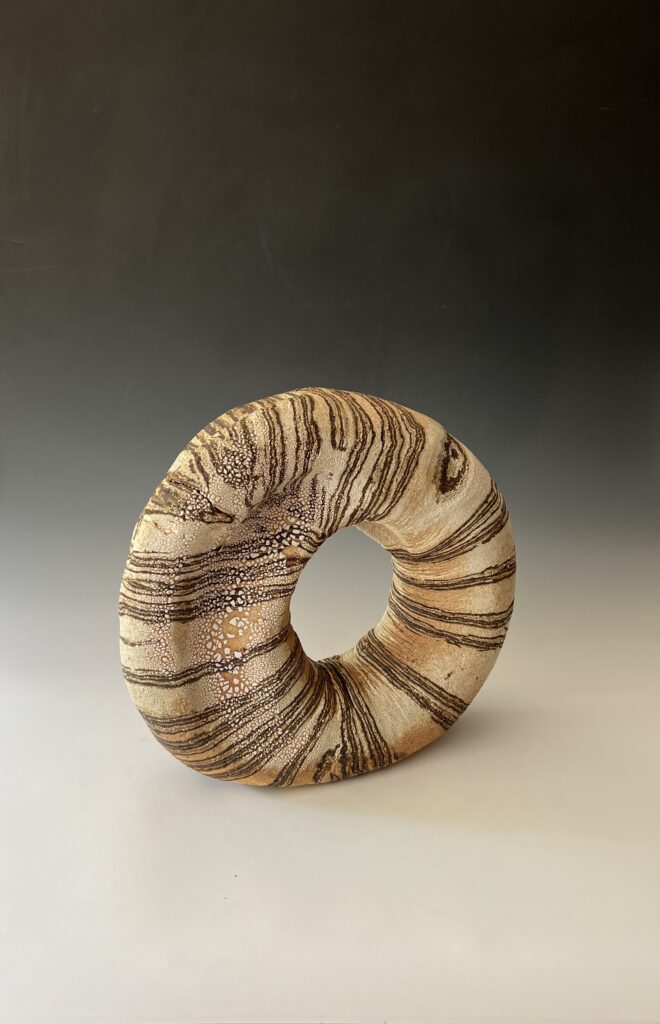
Circle III
International Reach
Schapiro’s international profile solidified in 2019, when she participated in the Revelations 4 Biennial at the Grand Palais in Paris and in an exhibition at UNESCO’s Miró Hall during Latin American Week. The following year, her work was included in “Asimetría del Cubo” at the Porcelain Museum in Riga, Latvia.
Her presence at high-profile international events brought her work into direct contact with collectors and institutions across several countries, resulting in her pieces entering private and public collections outside Chile.
At home, in addition to the 2020 government acquisition, Schapiro has exhibited at venues including the Parque de Las Esculturas in Providencia and the Instituto Cultural de Las Condes in Santiago.
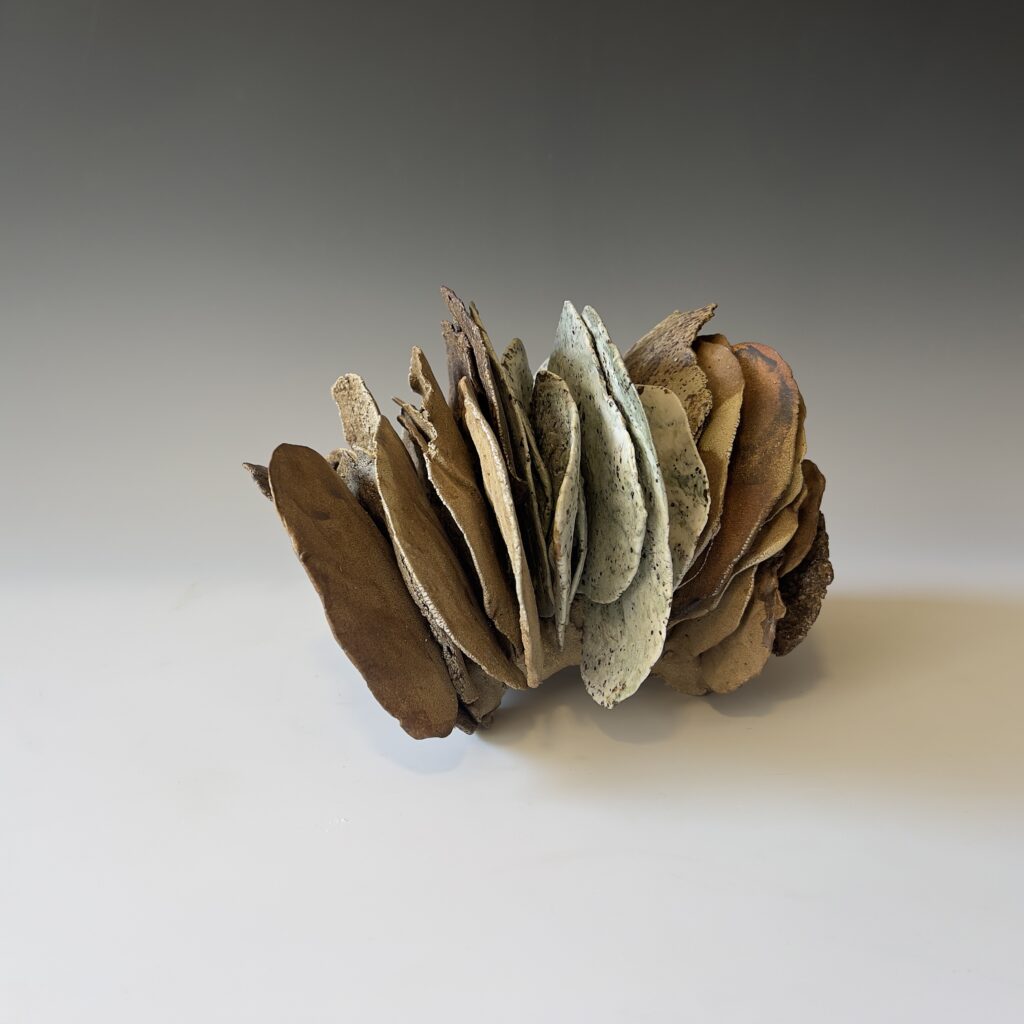
Rainbow Valley
Art as the Dignity of the Observed
For Schapiro, ceramics is more than an expressive medium: it is a way of dignifying what exists. “I seek to replicate nature, to dignify what I observe, and to create beauty,” she writes. That ethical stance toward material, a respect for the residual, the fragment, and the raw state, gives her work a dimension that goes beyond the aesthetic.
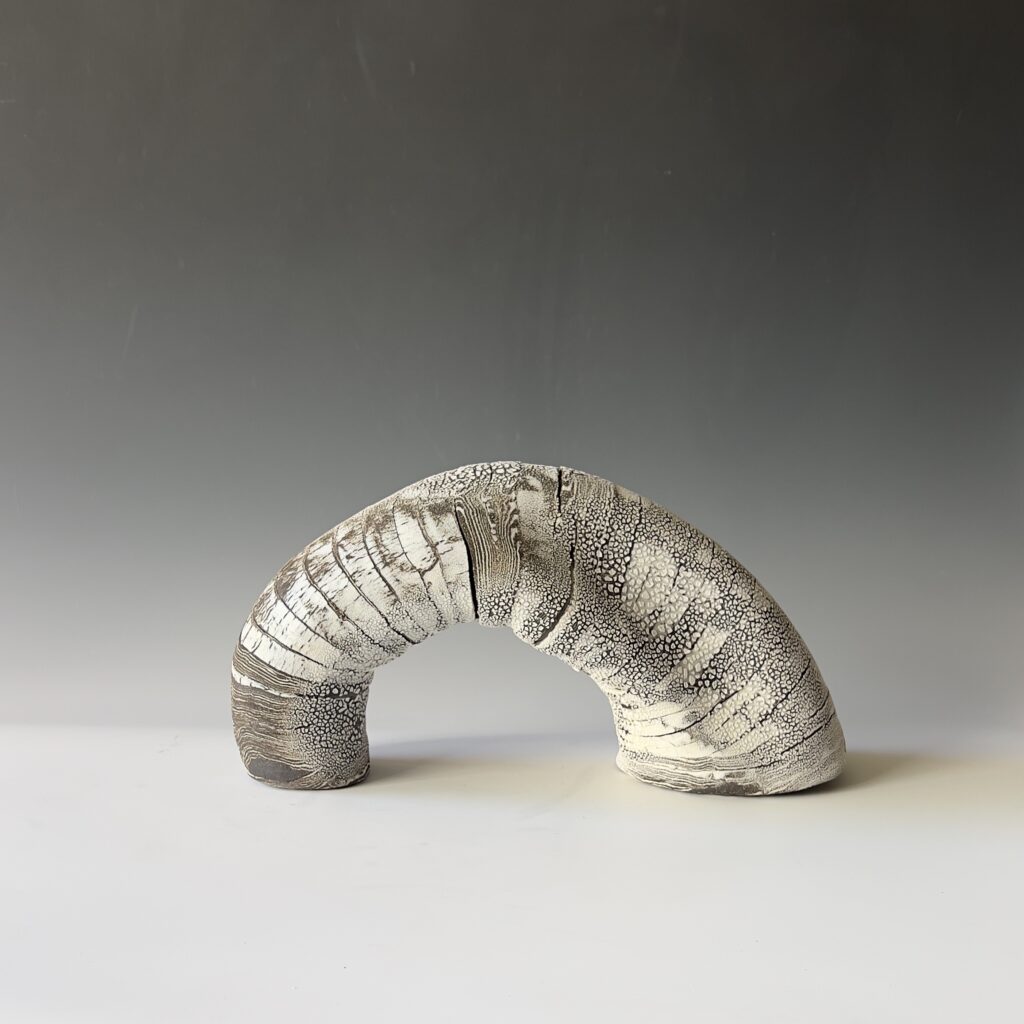
Arch XV
By preserving portions of clay in their original state and integrating studio debris into finished surfaces, the artist practices a kind of circular economy of creation: nothing is lost, everything is transformed. The result is sculptures that carry time within them: the geological time of lava, the historical time of the Chinchorro culture, and the lived time of the working process, like sedimentary layers visible to anyone willing to look.
Jacqueline Schapiro lives and works in Santiago.
Website: https://www.jschapiro.com/
Instagram: https://www.instagram.com/jschapiro/