 Serpa
Serpa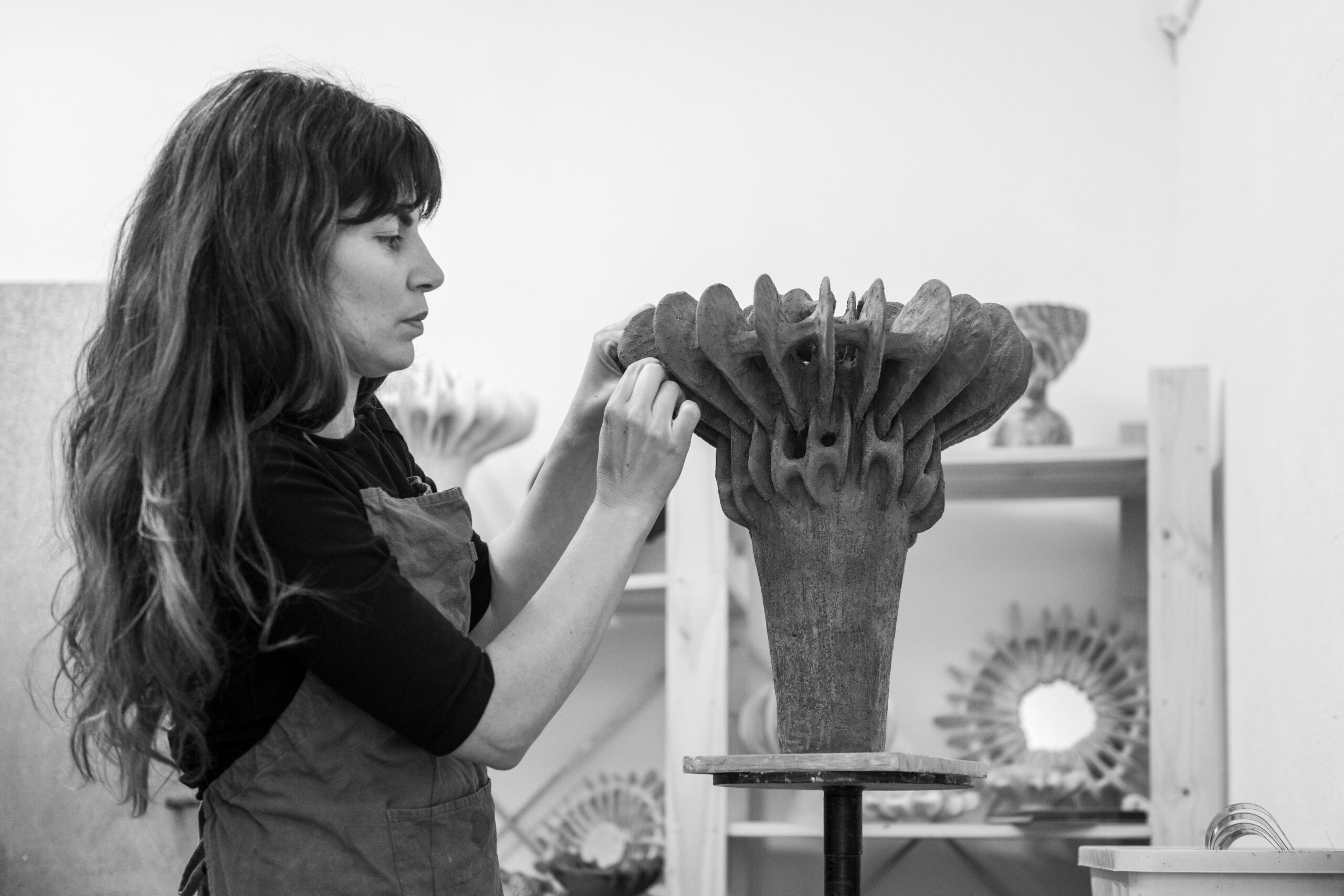
Kallia Panopoulou
Kallia Panopoulou weaves Greek mythology, personal memory, and environmental urgency into sculptures found in luxury hotels, international galleries, and the collection of the Benaki Museum
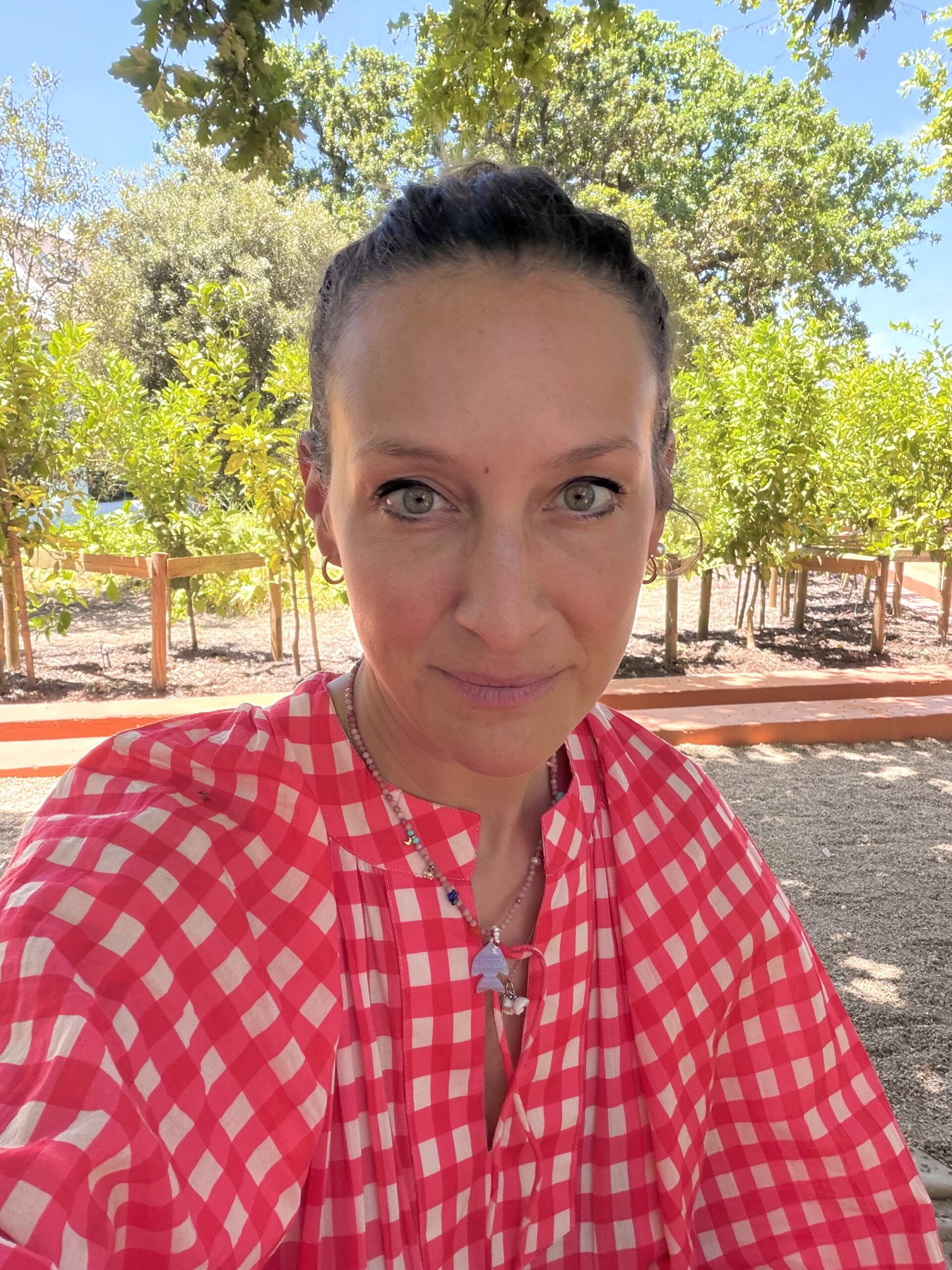
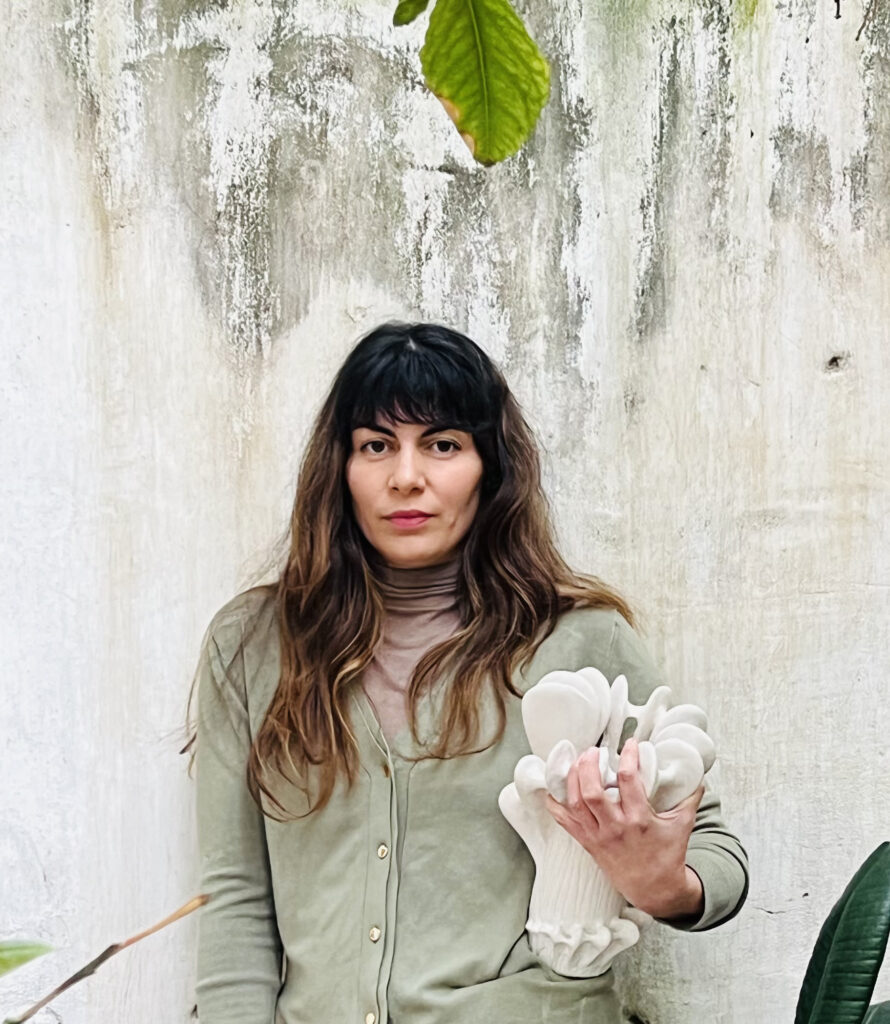
A cornucopia that no longer yields abundance, but thorns and bone fragments. That is the image Greek ceramicist Kallia Panopoulou, uses to capture the breakdown of humanity’s relationship with nature. Trained in product design at Central Saint Martins in London, she walked away from the rationality of industrial design to devote herself to clay and, in fewer than five years of running her own studio, has placed her work in galleries in Milan, Paris, London, and Brussels, while collaborating with architects on projects for luxury resorts across the Greek islands.
Kallia Panopoulou
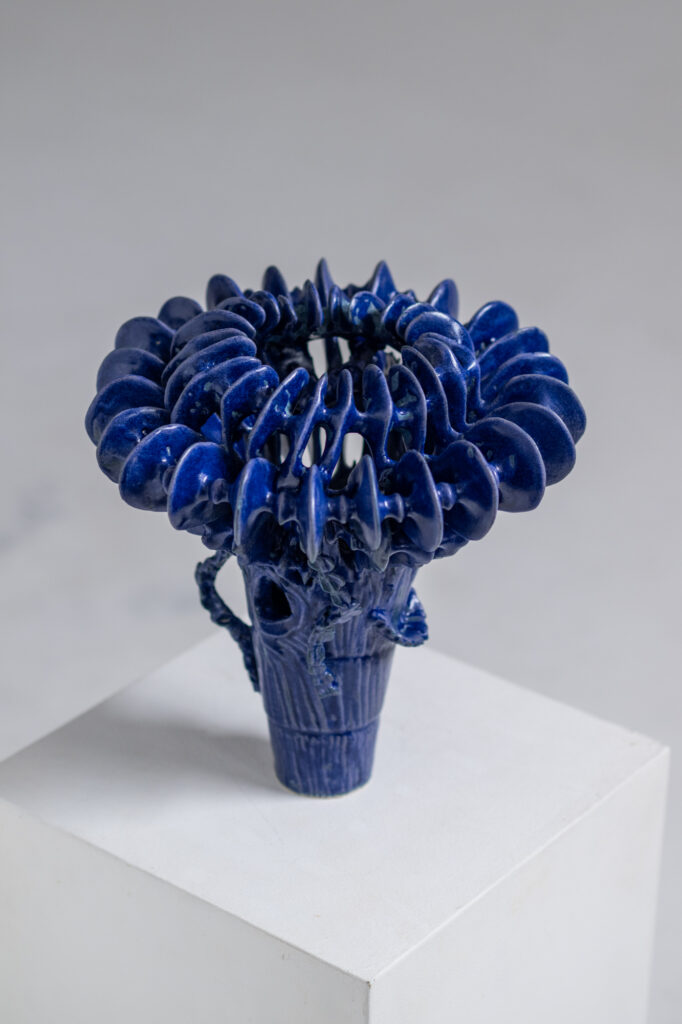
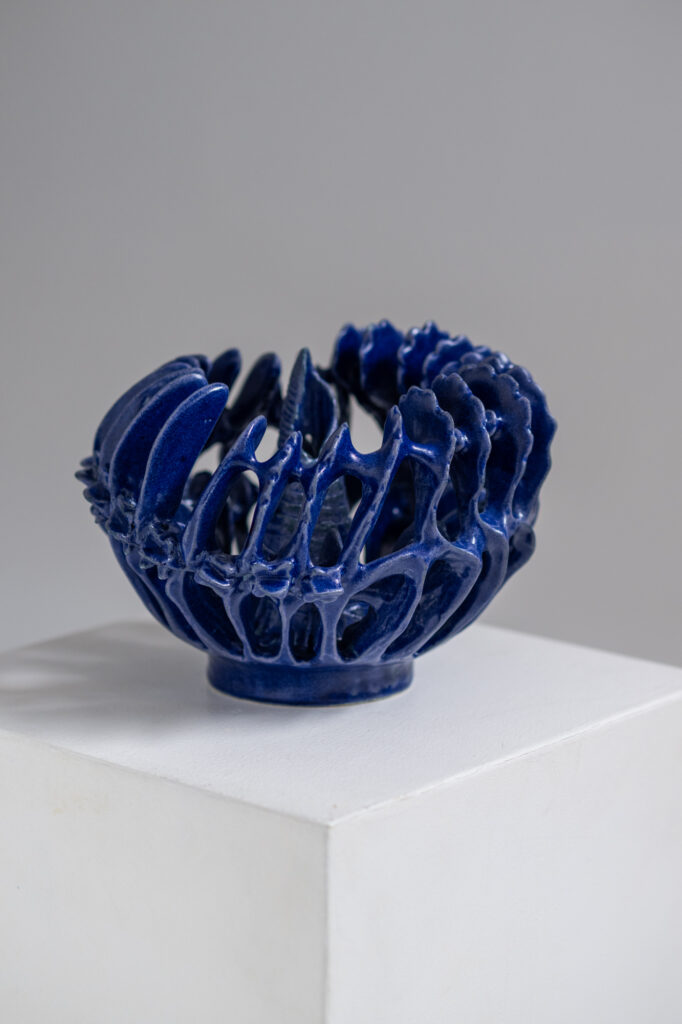
Panopoulou’s most recent series, “The Last Bloom,” is her most explicitly political. Drawing on the horn of Amalthea, the mythological symbol of plenty, the collection features cornucopias that begin to flower but end in thorns and bone fragments: the remains of an animal that once sustained life. Cobalt blue dominates the pieces, evoking the sea and the natural world while signaling the cost of humanity’s disconnection from it.
“We exploit animals and harm the Earth. That horn of plenty may have nothing left to give,” the artist says. The statement runs through her entire body of work: growth and decay share the same form, just as they would in any living ecosystem.
From London to Athens: the turn toward clay
Born in Athens in 1989, Panopoulou moved to London in 2008 to study at Central Saint Martins, one of the most prestigious art and design schools in the world. She graduated in 2011 with honors in product design. Returning to Greece in 2017, after years immersed in the functional logic of industrial design, she looked for a slower, more tactile way of making and found in ceramics what she describes as “a deep connection.”
She developed her technique over four years at Iridanos School in Athens, studying under Menandros Papadopoulos and specializing in hand-building, a method that does away with the wheel and foregrounds direct contact between the hands and the material. From 2021 to 2024, she continued her technical training with Vangelis Magopoulos, this time focusing on traditional pottery. In March 2025, she broadened her practice further with a porcelain casting course led by ceramicist Frans Gregoor.
The shift was not only technical. For Panopoulou, working with clay marked a fundamental break: away from rational planning and toward intuitive process. She rarely starts with detailed sketches. The impulse to make typically comes from a walk in nature or a moment of quiet observation, followed by a loose drawing that serves only as a jumping-off point.
Greek summers and the architecture of the sea
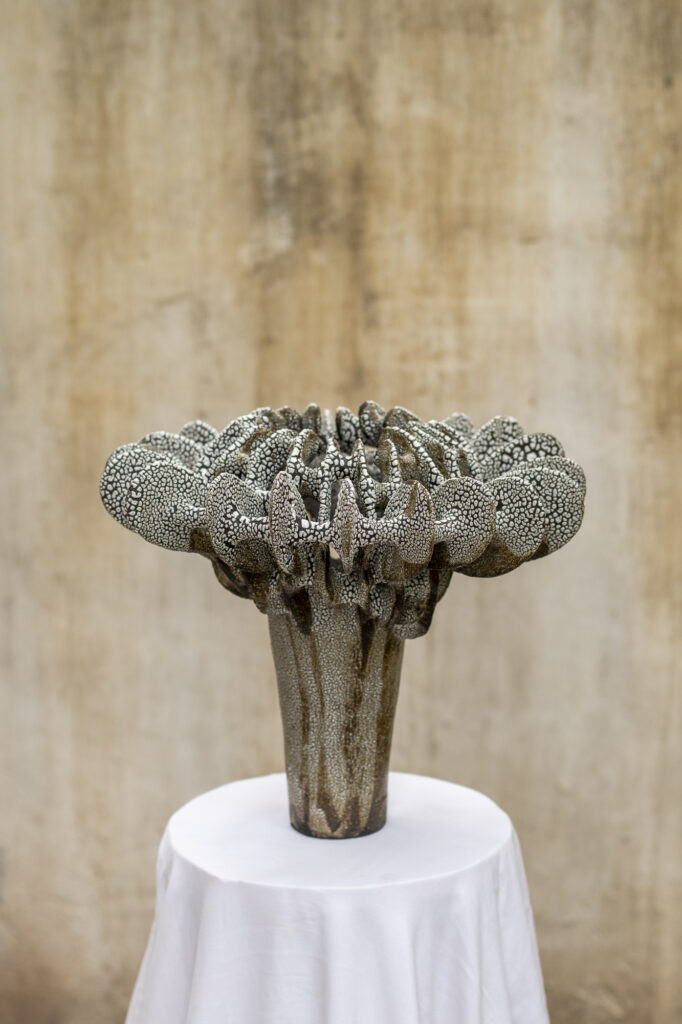
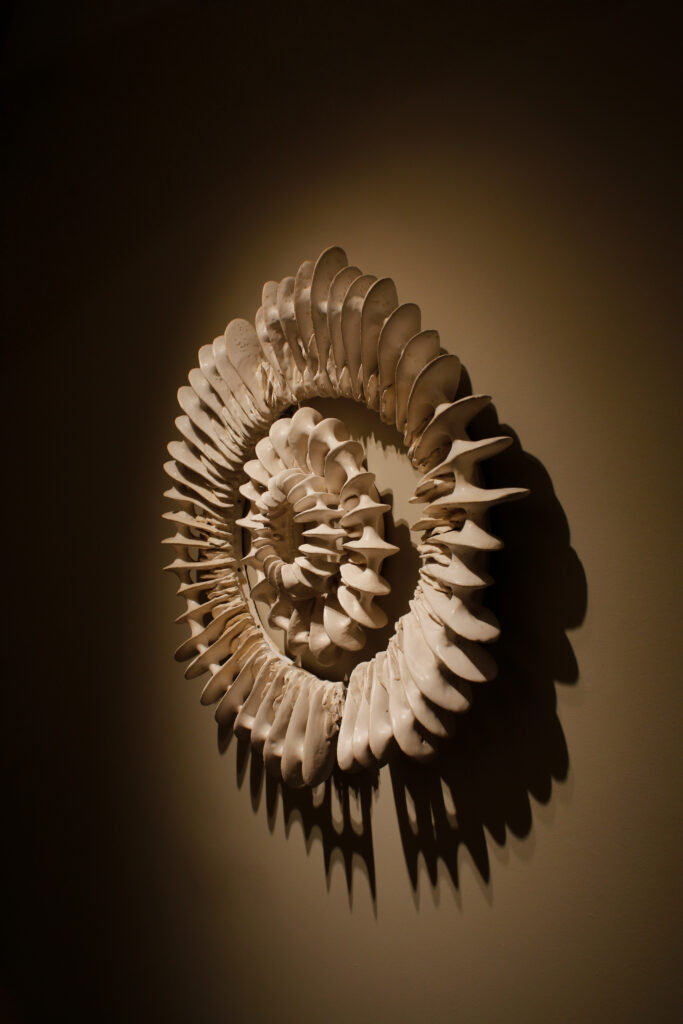
The first collection Panopoulou presented when she opened her studio, in 2021, already laid out the visual language that would run through everything she made: forms drawn from marine creatures, corals, flowers, and fish bones. The series “Looking Into the Deep Sea” is rooted in childhood memories of Greek summers spent with her father and sisters, fishing, collecting shells, and diving to discover the delicate structures of underwater life.
That bond with the natural world is sustained by her daily life as well. She spends much of her free time hiking and, during summers, camps with her husband and son on remote, quiet beaches. Nature is not, then, simply a theme or an aesthetic reference. It is the source of her visual and emotional language, the starting point for new work.
Panopoulou’s influences also include Gothic architecture and the work of Antoni Gaudí, references that might seem far removed from the Greek sea but that she connects through a shared quality: rhythm, growth, and structural fluidity. Those influences surface in forms that appear to grow from the inside out, like living organisms, as though the clay itself had its own intentions.
International galleries and luxury commissions
In just a few years, Panopoulou has built an exhibition record that few ceramicists of her generation can match. In 2023, she showed at the concept store 10 Corso Como in Milan as part of the group exhibition “Blue.” That same year, she participated in “Resilient Clay, Contemporary Ceramicists from Athens” at the Invisible Collection in London, a platform representing some of the world’s most significant furniture and object designers. In 2025, she exhibited at Morbee Gallery in Knokke, Belgium, and at the Lille Art Up fair in France.
Alongside her exhibition work, Panopoulou collaborates with architects on site-specific commissions for private residences and hotels. Among the most notable are the Gundary resort in Folegandros (2024), the One & Only Kea Island Resort (2024), Patmos Aktis Suites and Spa (2024), and Black Rose Suites in Santorini (2025). In 2024, she produced an exclusive edition of vases for the Benaki Museum store, one of Greece’s most important cultural institutions. In 2025, she received one of European craft’s most sought-after distinctions: inclusion in the Homo Faber Guide, a publication by the Michelangelo Foundation that maps the continent’s master artisans and serves as a compass for collectors, curators, and cultural institutions in search of excellence in handmaking. Being listed places Panopoulou alongside celebrated names in goldsmithing, weaving, woodworking, and European ceramics, cementing her reputation well beyond the Greek circuit.
A practice in continuous evolution
What sets Panopoulou’s work apart is not only technical skill or formal originality. It is the conceptual consistency of a practice that unfolds like a living organism. Each series grows out of the one before it, expanding both conceptually and technically. The “Horn of Plenty” series, from 2023, reinterpreted the mythological symbol of Amalthea to examine the contemporary relationship with abundance and consumption. “The Last Bloom,” from 2025, deepened that critique by introducing the cobalt blue palette and bone imagery, making the ecological argument more direct.
At this point in her career, Panopoulou says she wants to pursue a more expressive and inward-looking direction, one that prioritizes personal intuition, uncertainty, and emotional resonance. It is a choice that runs counter to market pressures, which tend to reward reproducibility and scale. For her, the value lies in the opposite: in the singularity of each piece, in the gesture that cannot be replicated, in the silent conversation between her hands and the clay.
With a portfolio that spans Greece and Western Europe and reaches into the interiors of Mediterranean luxury resorts, Kallia Panopoulou has secured a rare position in contemporary ceramics: that of an artist whose work is at once deeply local, rooted in the myths, memories, and landscapes of Greece, and universally legible in its urgency. What is at stake in her cornucopias of bone is not only Hellenic mythology. It is the world we inherited and what we are leaving behind.
Website: http://www.kalliapanopoulou.com/
Instagram: https://www.instagram.com/kalliapanopoulou/