 Serpa
Serpa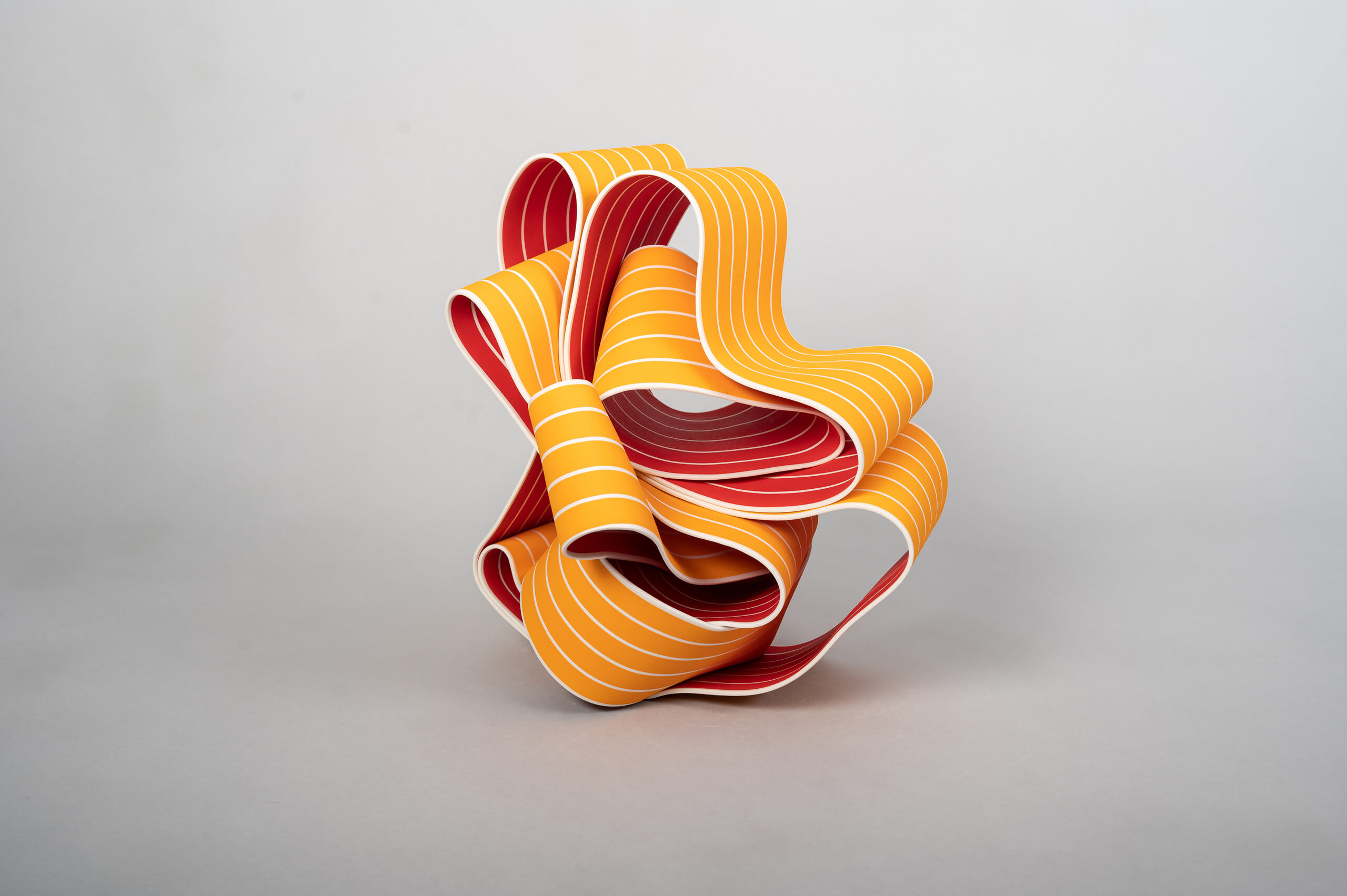
“Folded Radiance”
A PhD in Biology, Simcha Even-Chen Subverts Traditional Logic and Builds Works Directly During the Firing Process
Israeli ceramicist Simcha Even-Chen has developed a singular artistic practice that subverts the traditional logic of ceramics. Rather than avoiding the deformations and ruptures that normally signal failure in the firing process, she deliberately incorporates them as a central creative tool. Her work, built from paper porcelain, explores the physical limits of the material at extreme temperatures, transforming what would be considered a technical error into a constitutive element of the final form. The result is sculptures of complex geometry that exist in permanent tension between structural order and organic fluidity, between mathematical precision and material unpredictability.
The artist, who has worked in ceramics since 1996 and focused specifically on porcelain from 2017 onward, constructs her pieces from multiple individually hand-formed elements. Each component receives a separate application of patterns and colors on both its inner and outer surfaces before assembly. The process culminates in a radical intervention: the final construction takes place directly inside the electric kiln, where elements are carefully lined up and assembled. Subjected to temperatures between 1240°C and 1280°C, the components soften and deform under the combined action of heat and gravity. The controlled collapse that follows does not destroy the structure; it transforms it. Rather than remaining autonomous, the elements press against and support one another, generating structurally interdependent systems.
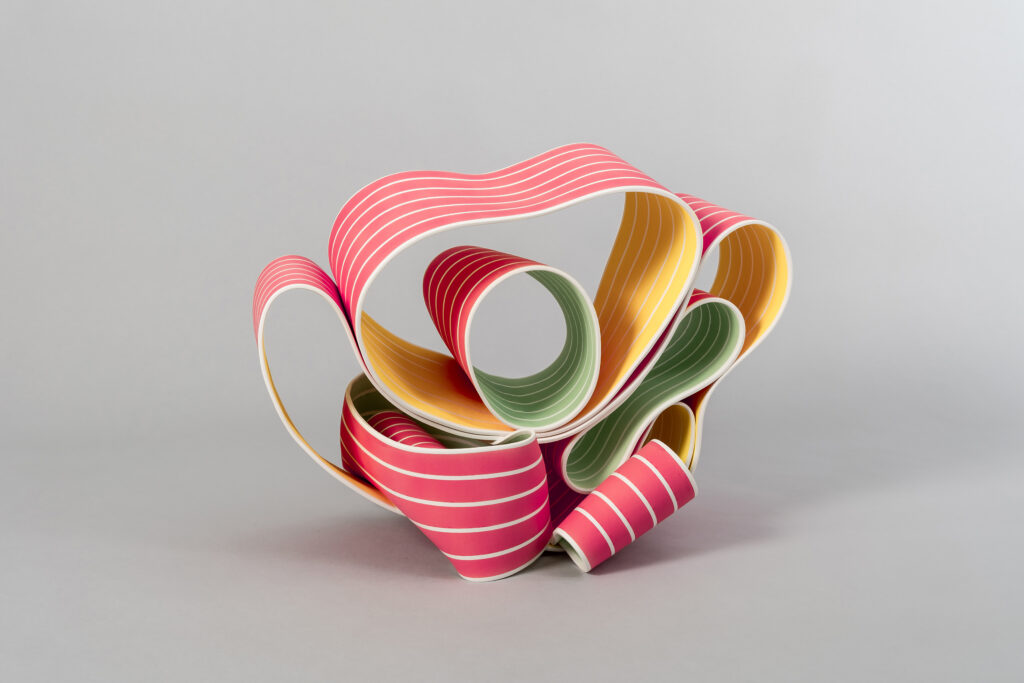
“Entangled Flow”
This methodological approach reflects Even-Chen’s hybrid background. As both a senior scientist and an artist, she combines analytical reasoning with material experimentation. Her sculptures emerge from the integration of systematic thinking and hands-on practice, producing interlaced spatial forms where mathematics and physics become partners in artistic expression. Porcelain, a material traditionally associated with fragility and finished perfection, reveals a different nature here: its capacity for plasticity in extreme states and its paradoxical resistance when subjected to the very forces that should destroy it.
The visual system she has developed reinforces this ambiguity between control and freedom. Continuous circumferential stripes travel across the surfaces of her sculptures, flowing seamlessly from exterior to interior. This graphic treatment dissolves the usual boundaries between inside and outside, creating spatial continuities that challenge conventional perception of volume. The ribbon-like forms that unfold in space invite viewers into a dynamic experience, where understanding of the work shifts depending on the vantage point. Geometry, far from imposing rigidity, serves here as a supporting framework for movement and transformation.
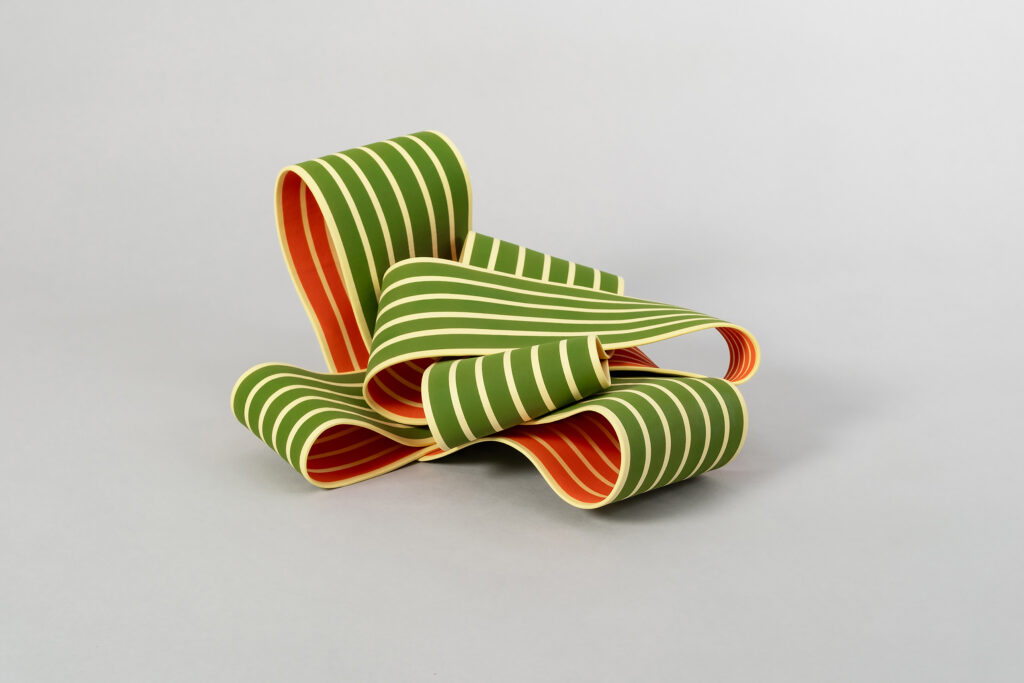
“Inner Fleme”
Even-Chen’s international career attests to the recognition her material research has earned in the field of contemporary ceramic art. She has participated in major biennials and triennials, including the Taiwan Ceramics Biennale and the International Ceramic Art Biennale in Jingdezhen, China. Artist residencies at the Taoxichuan Ceramic Art Center in Jingdezhen and the Yingge Ceramics Museum in Taiwan brought her into close contact with Asia’s historic centers of ceramic production, enriching her practice with cross-cultural dialogue. The GCB Award, received in Korea, and First Prize at CERCO in Spain have solidified her position as one of the most original voices in experimental ceramics today.
The presence of her work in public collections across Europe and Asia speaks to her sculptures’ ability to transcend specific contexts and engage with universal formal questions. The tension Even-Chen establishes between two-dimensional patterns and free three-dimensional forms, between design intention and autonomous material behavior, resonates with contemporary debates on agency and control in artistic production. Her work challenges the dichotomy between planning and chance, proposing a third path where chance is summoned, prepared, and directed, but never fully tamed.
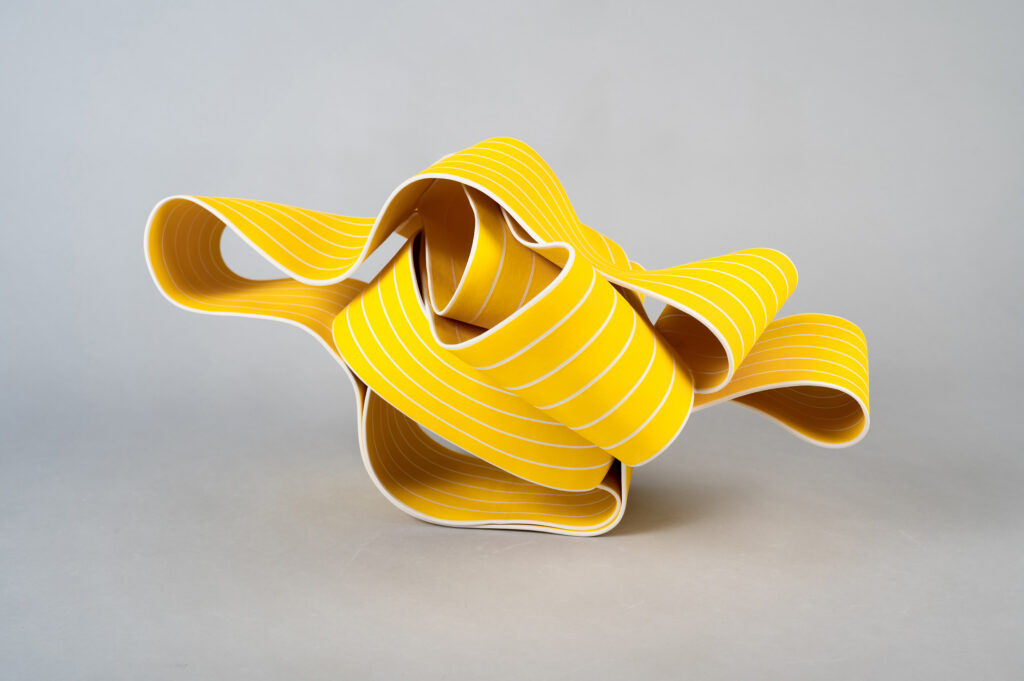
“Radiant Bound”
The choice of porcelain as her primary material is not incidental. Historically associated with technical excellence, translucency, and formal purity, porcelain in Even-Chen’s hands reveals other qualities: its density, its plasticity in extreme states, and its capacity to record physical processes. The material becomes witness and protagonist at the same time, preserving in its final structure the marks left by the fire and gravity that shaped it. The stripes circling its surfaces function as force diagrams, visualizing trajectories of tension and compression running through the ceramic mass.
Even-Chen’s practice also challenges traditional categories of sculpture. Her works occupy three-dimensional space while maintaining an intimate relationship with surface and pattern, territory more commonly associated with painting or drawing. The circulation of stripes between outer and inner faces proposes a continuous topology where outside and inside belong to the same mathematical surface. This threshold condition, existing at the boundary between categories, defines the identity of her work: pieces that resist stable classification and exist in states of permanent transition.
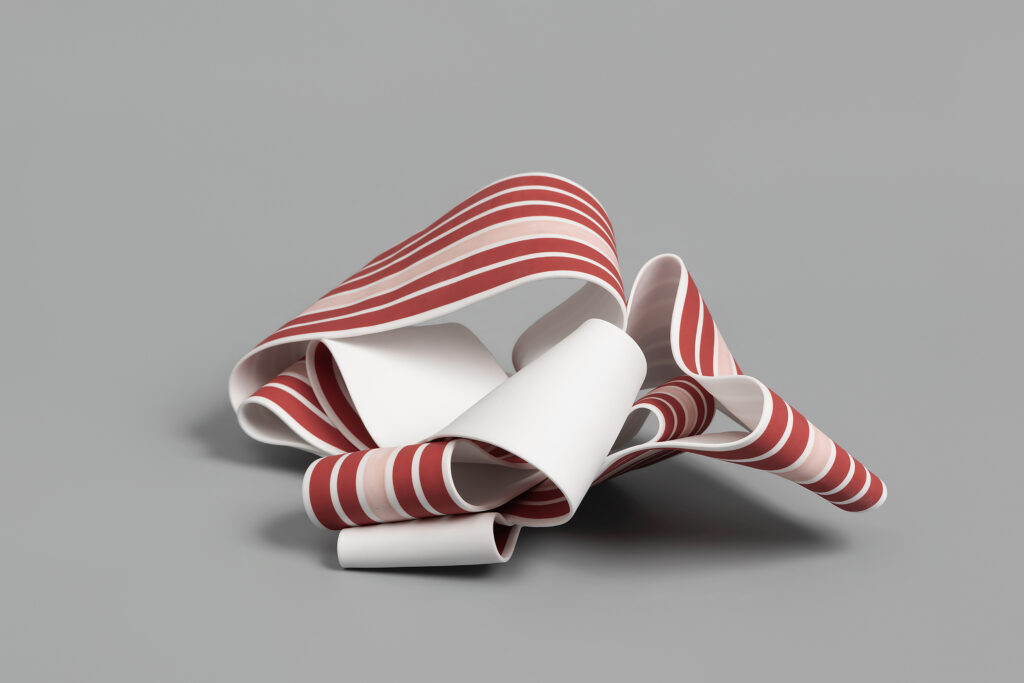
“Folded Interior”,
The methodology she has developed demands considerable technical precision. Controlling the collapse of porcelain at high temperatures requires a deep understanding of material behavior, the ability to anticipate its reactions, and the preparation of structures capable of sustaining desired deformations without completely falling apart. The kiln becomes a studio, laboratory, and gallery all at once, the place where the work is finally composed, where the artist’s intention meets the resistance and collaboration of the material. This shift of final assembly into the interior of the kiln upends the conventional timeline of ceramic production, where firing is normally the stage that locks in previously established forms.
Even-Chen’s trajectory illustrates the possibilities of dialogue between seemingly distant fields of knowledge. Her training in biology, a discipline that studies living systems in their complex interactions, appears to find a direct echo in how she approaches ceramics: as a dynamic system subject to multiple variables, capable of emergent behavior. Porcelain, treated as a physical system with its own properties, responds to thermal stimuli in ways that cannot be fully anticipated, requiring the artist to listen closely and adapt continuously.
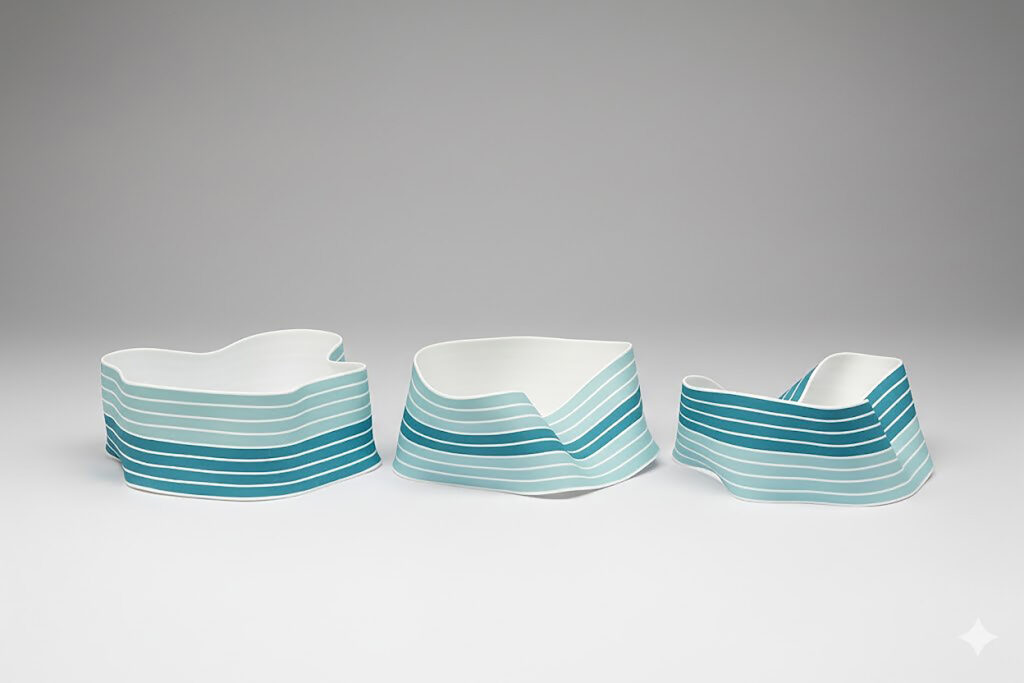
“Settled Layer”,
The international recognition she has achieved reflects the relevance of her formal and conceptual concerns. At a moment when contemporary art is intensely debating the boundaries between authorship and process, between control and randomness, and between technique and concept, Even-Chen offers concrete and visually compelling proposals. Her sculptures do not illustrate preconceived ideas; they materialize thought processes in action, making visible the negotiations between human intention and material behavior.
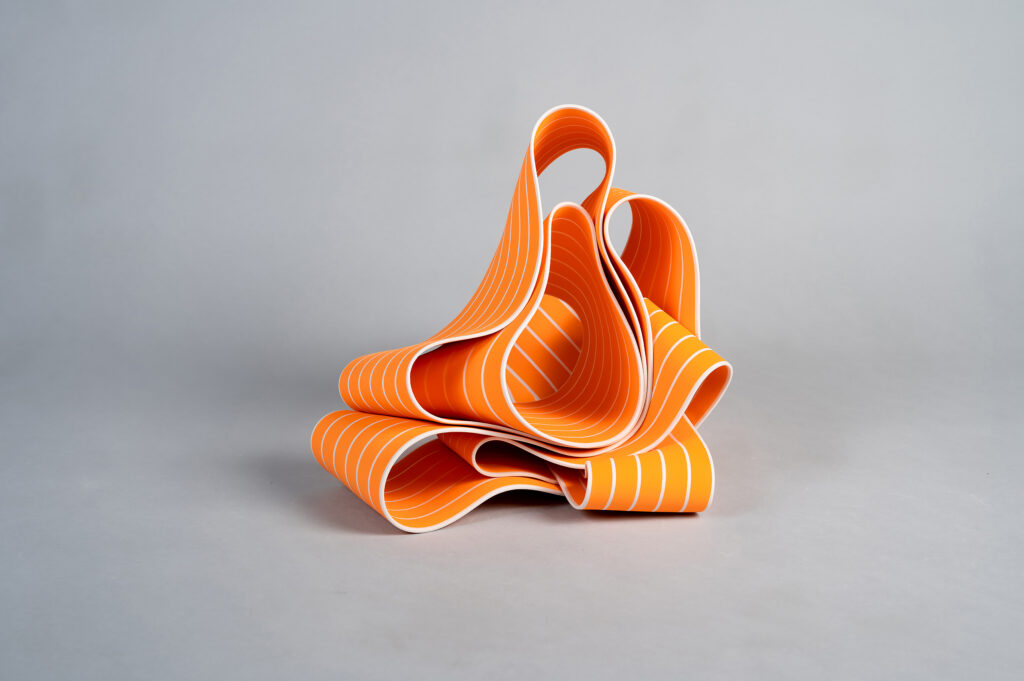
“Entrapped”,
Based and working in Rehovot, Israel, the artist maintains an ongoing dialogue with the dynamic centers of ceramic production across Asia. This creative geography, connecting the Middle East to the centuries-old traditions of China and Taiwan, positions her work at a rich cultural crossroads. Porcelain, invented in China and reinvented across centuries in different cultural contexts, undergoes yet another transformation in Even-Chen’s hands: no longer a vessel or utilitarian object, but a field of physical and visual experimentation, a territory where mathematics, physics, and aesthetics meet in a state of fusion.
The work of Simcha Even-Chen invites us to reconsider apparently stable categories: technical success and failure, control and freedom, form and process. By making collapse her central method, she proposes an ethics of material vulnerability, where accepting transformation becomes a condition for creation itself. Her sculptures, the result of an intense dialogue between artist and material, between intention and chance, between ceramic tradition and contemporary experimentation, stand as a significant contribution to the expanded field of sculpture today.
Website: https://simcha-evenchen.com/
Instagram: https://www.instagram.com/evenhcen/