 Serpa
Serpa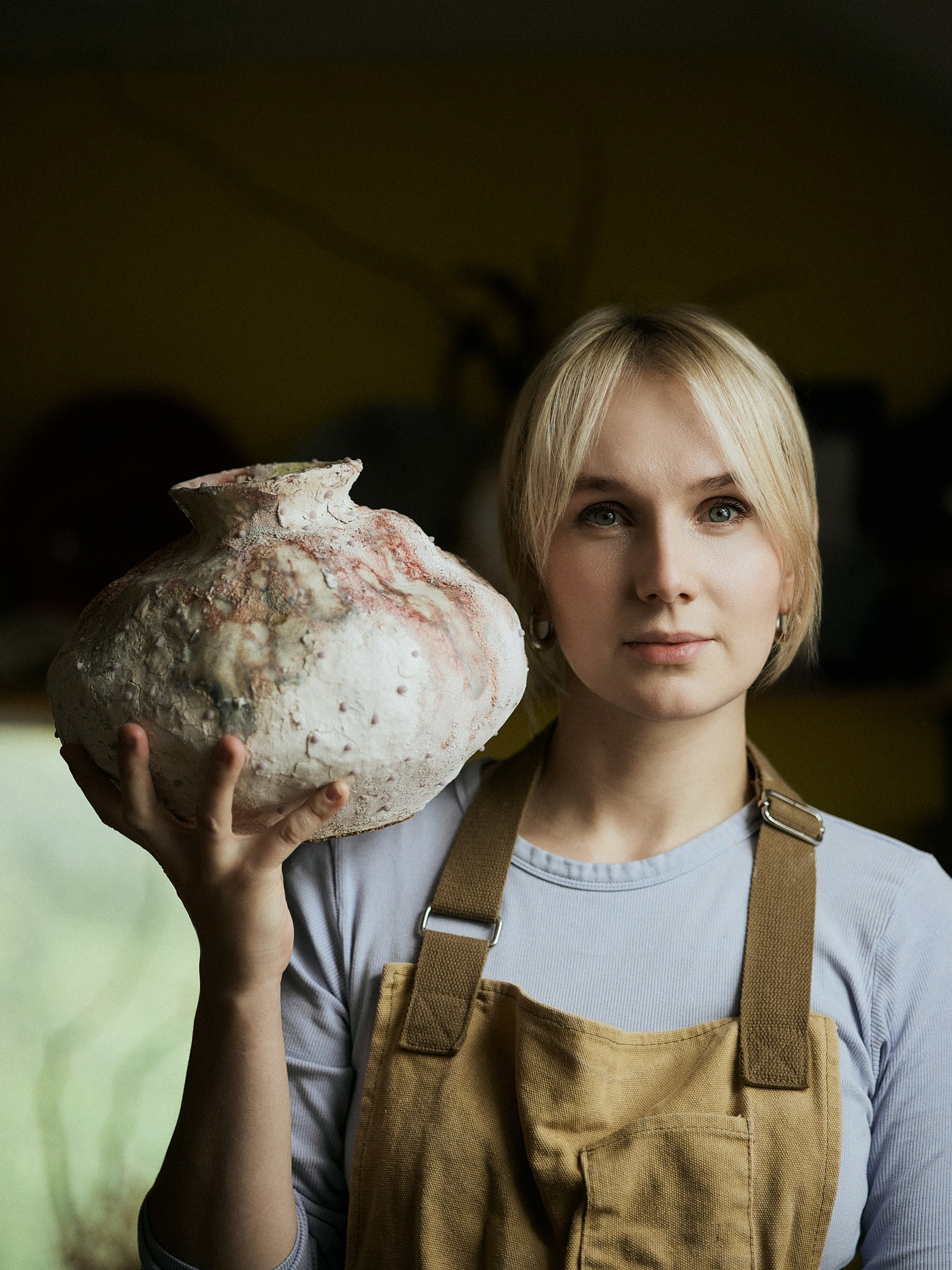
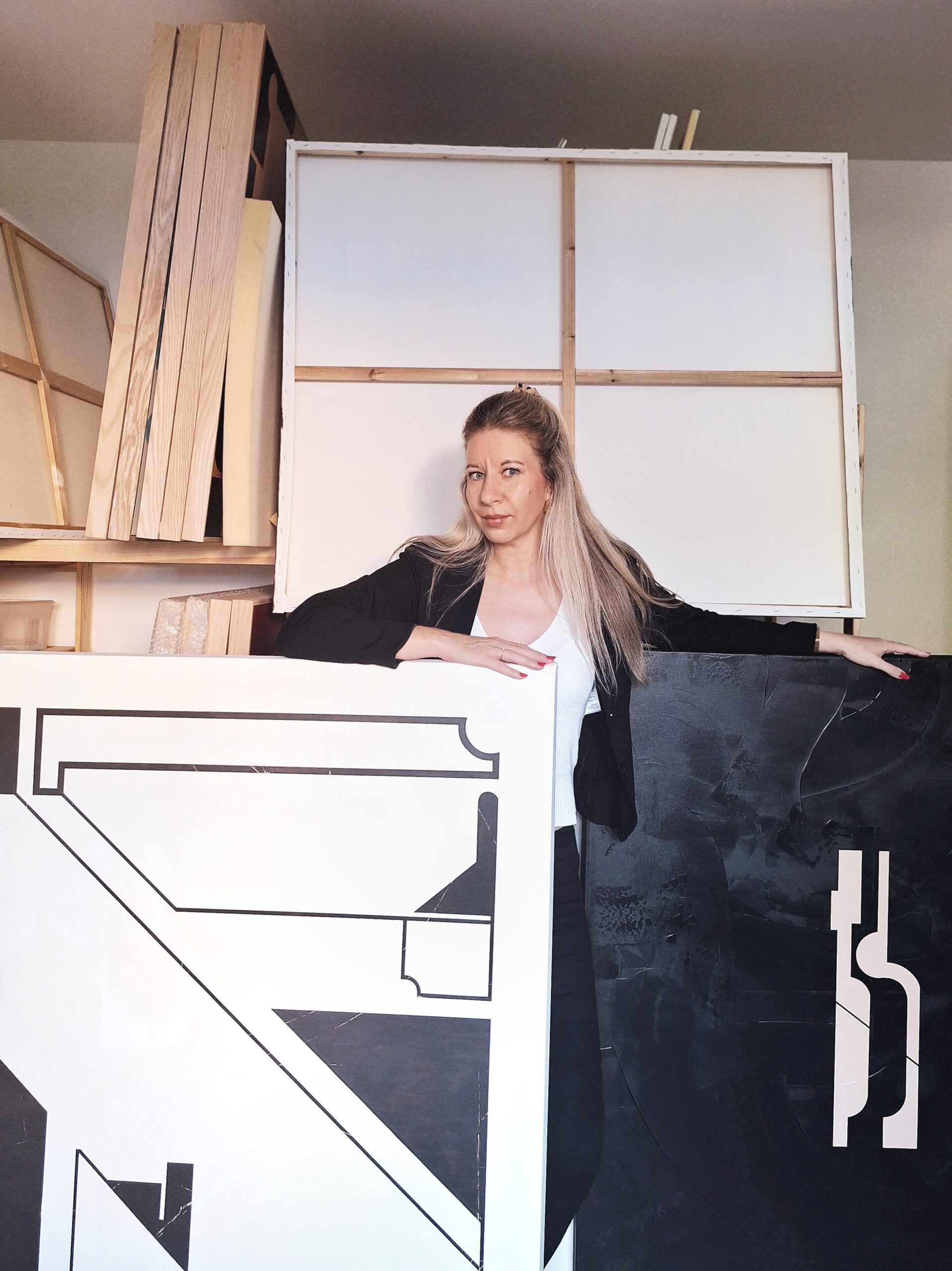
Lada Donchenko in her studio, holding one of her Empath Ceramics sculptures. Photo: Empath Ceramics
Lada Donchenko, creator of the Empath Ceramics project, presents clay sculptures produced through up to ten successive firings at Maison & Objet, Révélations, Paris Design Week, and Milan Design Week, a circuit reserved for the global elite of design and high-end craft
Ukrainian ceramist Lada Donchenko traveled to four of the most important international design and craft events in the world to present her project, Empath Ceramics: Maison & Objet, the Parisian trade fair widely regarded as one of the three most important in Europe for interior design; Révélations, a biennial held beneath the glass roof of the Grand Palais in Paris, now recognized as the leading global platform for contemporary fine craft; Paris Design Week, a festival that transforms the French capital into an open-air creative laboratory for ten days each September; and Milan Design Week, the largest and most prestigious design event on the planet. Her works have also been auctioned by the French auction house Piasa and are held in private collections across Europe and the United States.
The project does not fit within traditional utilitarian ceramics. Donchenko does not make bowls, plates, or cups. Her pieces are sculptures conceived for contemplation, objects that undergo up to ten firings in sequence before reaching their final form. This deliberately destructive and cumulative process imprints cracks, grooves, and deformations onto the clay surface. The result is artifacts that visually carry the memory of their own making.
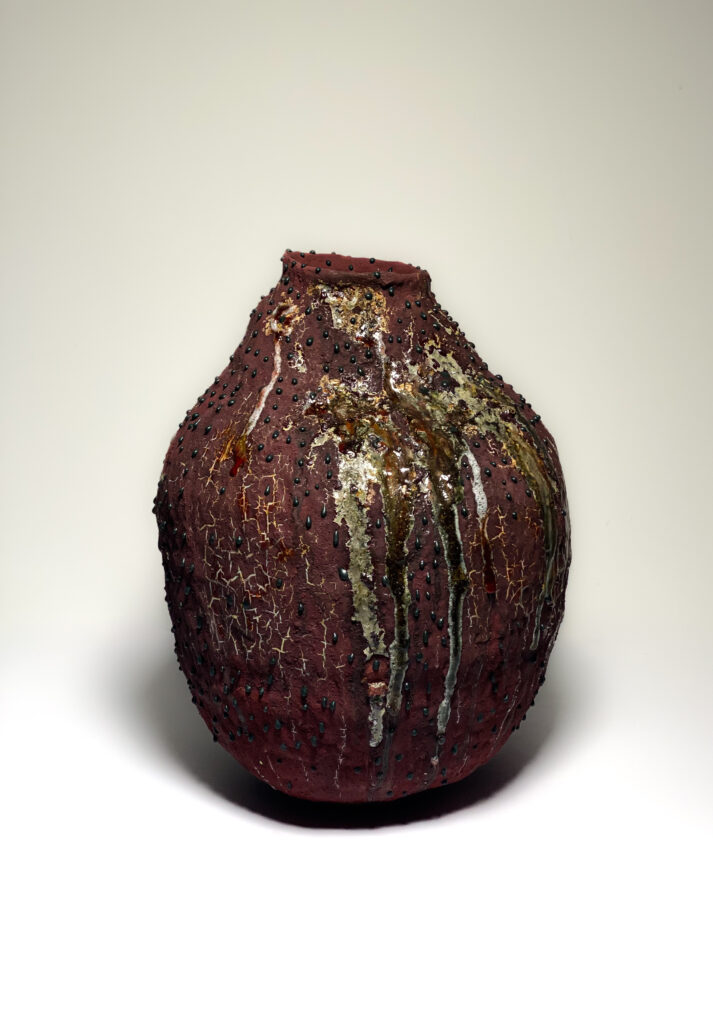
Empath Ceramics. The crackelé surface and scattered black nodules record successive layers of glaze applied across multiple firings. Photo: Empath Ceramics
The four global showcases of contemporary design and craft
Donchenko’s presence at four of the sector’s most important international events is not a résumé footnote. It is the most objective measure of the reach that Empath Ceramics has achieved within the global circuit of high-end design and craft.
Maison & Objet, held twice a year at the Paris Nord Villepinte Exhibition Center, is frequently compared to Paris Fashion Week: just as Fashion Week sets the tone for what the world will wear in coming seasons, the fair defines the objects that will inhabit the world’s most relevant homes, hotels, and commercial spaces on the planet. Founded in 1994 through the merger of seven smaller industry events, it brings together approximately 2,500 exhibitors from 150 countries, draws an average of 80,000 visitors per edition, and attracts 1,500 specialist journalists and opinion leaders. Over three decades, it has established itself as the only international event to combine interior decoration and furniture under one roof, serving as a trend barometer for architects, decorators, retail buyers, and creative directors at luxury brands. The September edition, which coincides with Paris Design Week, places particular emphasis on innovation and emerging talent, precisely the profile Donchenko embodied when she first presented her sculptures to a European audience.
Paris Design Week, running simultaneously with Maison & Objet, spills beyond the exhibition pavilions and takes over the entire city. Spread across more than 375 venues, from the historic cobblestones of Le Marais to the elegance of Saint-Germain-des-Prés, from the bustling Opéra district to the vibrant neighborhoods around La Bastille, the festival opens galleries, design schools, historic monuments, and concept stores to professionals and enthusiasts alike for ten days. Its organizers describe it as “an open-air observatory of creativity.” The 2025 edition, the event’s 15th, celebrated the theme of “Regeneration” and introduced 130 emerging talents through the Paris Design Week Factory, a space integrated into Maison & Objet that has become one of the most closely watched barometers of design innovation in France and beyond.
If Maison & Objet is the space of industry and Paris Design Week is the urban laboratory of creativity, Révélations occupies a different position altogether: it is the sanctuary of contemporary fine craft. Organized by the Ateliers d’Art de France and held at the Grand Palais, the monumental iron-and-glass palace built for the 1900 World’s Fair, the biennial gathers high-quality craftspeople, workshops, galleries, designers, foundations, and schools from around the world, presenting unique works created specifically for the event. The most recent edition, in 2025, recorded more than 45,000 visitors over five days, a 24% increase over the previous edition, and was attended by President Emmanuel Macron and members of the French government. Across its seven editions, Révélations has become a living manifesto of contemporary creation: it does not select decorative objects, but works that embody a point of view on material, form, and process, and that is precisely Empath Ceramics’ proposition.
Completing the circuit, Milan Design Week, also known as Salone del Mobile, is, by critical consensus, the largest and most prestigious design event on the planet. Dating back to 1961 and drawing nearly 500,000 visitors per edition, the Milanese week operates on two simultaneous fronts: the Salone del Mobile, the official fair held at the Rho exhibition center, and the Fuorisalone, a decentralized series of events spread across the neighborhoods of Brera, Tortona, 5VIE, and Isola, in historic palaces, galleries, repurposed industrial spaces, and gardens. The Fuorisalone emerged spontaneously in the early 1980s at the initiative of independent creators and grew to become, for many, the most vibrant part of the week. It is within this ecosystem that works like Donchenko’s find their most natural place, in a city that, for one week each year, transforms itself into an inhabitable work of art.
Ceramics as inquiry: entropy and transformation
To understand why a Ukrainian ceramist has found a place within these platforms, it is necessary to understand what Donchenko actually does, which is considerably more complex than making vases.
Trained as a cellist, she brings to ceramics a musical sensibility for rhythm, pause, and emotional intensity. Self-taught in clay, she has developed her own glaze formulas and treats the material as a living, reactive system that undergoes unpredictable transformations with each firing.
The central concept of her practice is entropy, the principle in physics that describes the tendency of systems toward disorder and the dissipation of energy over time. Donchenko adopts this principle not as a poetic metaphor, but as a concrete working method. “My practice centers on the study of entropy, the processes of destruction, accumulation, and transformation, as well as the interaction between the controlled and the uncontrollable. I am drawn to slow natural change and interior states that demand concentrated immersion: something that is simultaneously catastrophic for the structure and poetic to the observer,” the artist says.
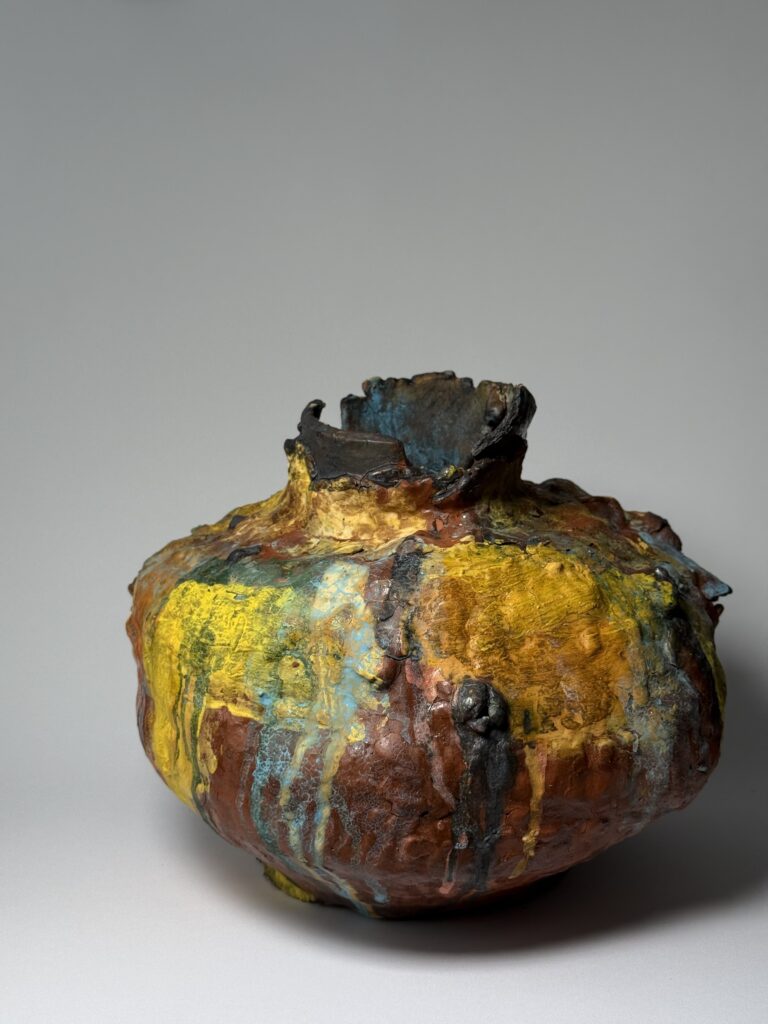
Empath Ceramics. Layers of yellow, copper, and dark glaze record successive firings; the jagged rim preserves the rupture exactly as it occurred. Photo: Empath Ceramics
Rather than seeking total control over the final result, she designs conditions in which chemical reactions and semi-controlled chance participate in the authorship of each piece. Each firing destabilizes the previous form and redefines the surface with layers of glaze that have reacted differently at different temperatures, cracks that emerged and were partially filled in subsequent firings, and grooves opened by fire that the artist has chosen to preserve.
Reading a Donchenko sculpture is like reading stratigraphy, the same technique geologists use to reconstruct the history of terrain from its overlapping layers.
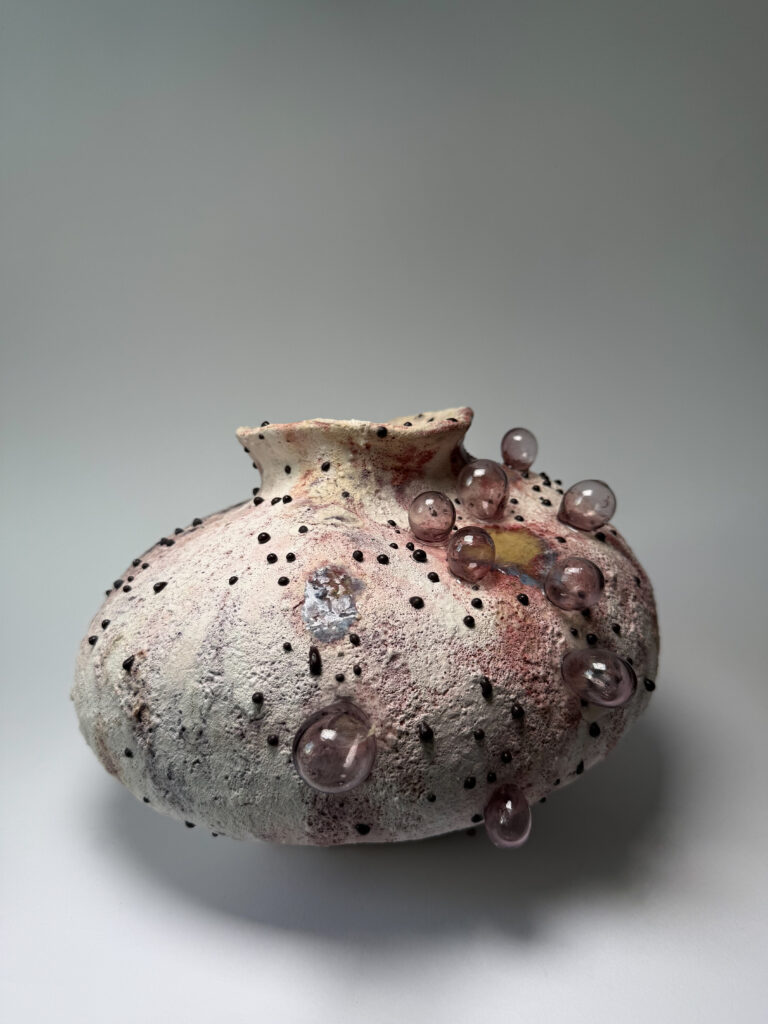
Empath Ceramics. Translucent glaze spheres emerge from the clay surface as if growing from within, illustrating Donchenko’s concept of the material as a living, reactive system. Photo: Empath Ceramics
Collections, auction, and academic recognition
The trajectory through international fairs has yielded concrete results in the art market. Donchenko’s works have been acquired by private collectors in Europe and the United States, and her practice has been documented in the book Contemporary Ukrainian Craft, a volume held in the library of the Royal College of Art in London, one of the world’s most prestigious institutions for art and design education.
The sale of works through the auction house Piasa represents one of the most significant markers of her career. Founded in 1996 and specializing in modern and contemporary art, Piasa is one of the leading auction houses in France. Selling through this institution positions Donchenko in a circuit distinct from the design fair world, the circuit of art collecting, where objects are evaluated on the basis of singularity, appreciation potential, and conceptual relevance.
Creating under pressure: art in a time of war
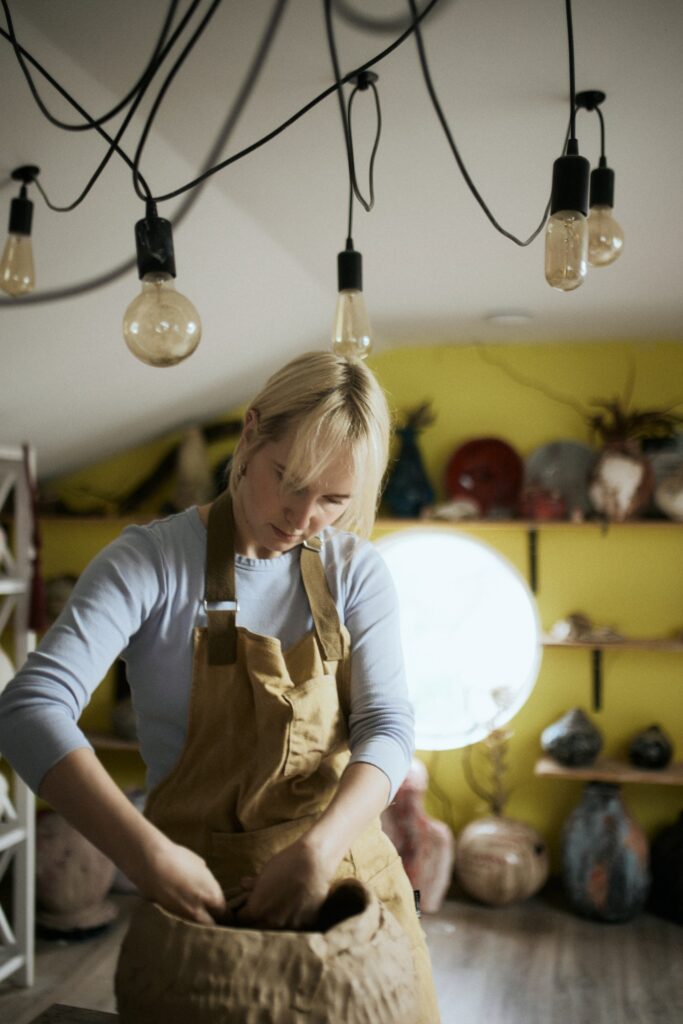
Donchenko at work in her studio in Ukraine. Behind her, shelves hold works in progress alongside completed pieces. Photo: Empath Ceramics
Lada Donchenko lives and works in contemporary Ukraine, a country at war since the large-scale Russian invasion launched in February 2022. The context of extreme instability, with constant threats to electrical infrastructure, civilian routines, and physical safety, is inevitably present in the artist’s work, though never in any overtly political way.
Her pieces, which undergo deliberate processes of rupture, deformation, and reconstruction before reaching their final form, carry a profound resonance with the collective experience of a country in struggle. Each sculpture emerges as something that has undergone its own transformation, surfacing with scars that have become part of the object’s beauty.
This dimension is not necessarily intentional or explicit. But art rarely exists apart from the world in which it is produced. There is something deeply coherent in the fact that an artist who studies entropy, destruction as process, crisis as aesthetic, resistance as form, works in the midst of one of the greatest geopolitical crises of the century.
Objects for silence, not for function
Empath Ceramics is, in Donchenko’s own words, created “not for function, but for silence, for contemplation, for meditation.” It is an invitation to dialogue about fragility, resilience, and the human presence in time.
This refusal of utility is a philosophical choice before it is an aesthetic one. By positioning her objects outside the tradition of functional craft, Donchenko places them directly within the field of visual art, where the value of a piece is not measured by its usefulness but by its capacity to provoke something in those who stop before it.
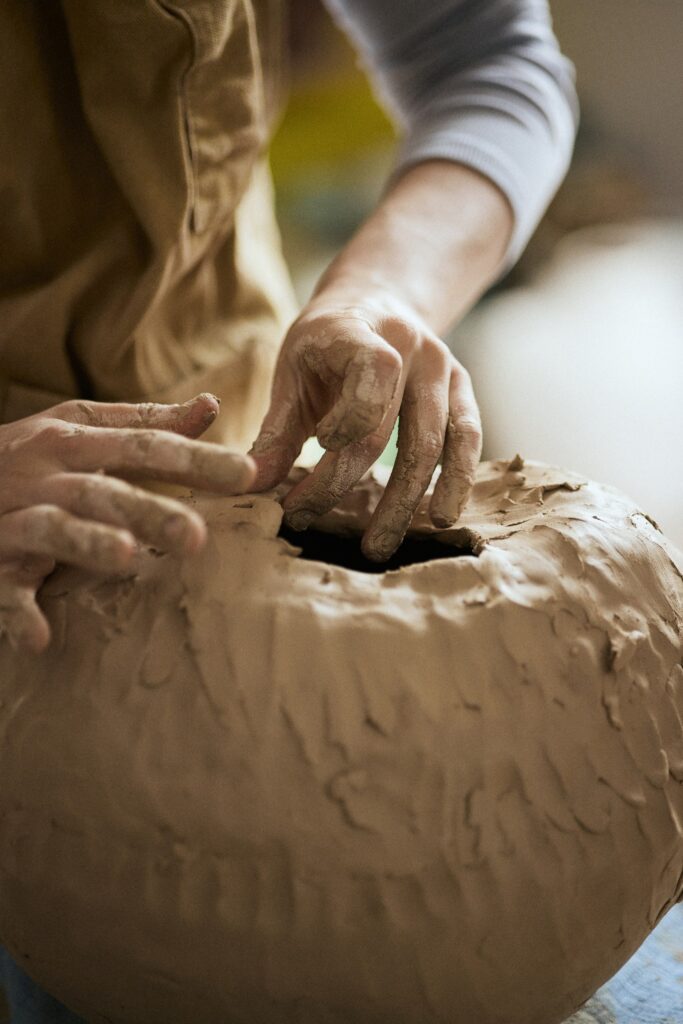
The artist’s hands shaping raw clay. Manual gestures and the traces of making remain deliberately visible in the finished works. Photo: Empath Ceramics
Earlier works delegated authorship largely to chemical reactions and semi-controlled chance. The most recent pieces project a more commanding formal presence: manual gestures and traces of the making process remain deliberately visible, like a human signature inscribed upon chaos. This evolution signals the maturation of an artist who, after years of learning to yield to the material, has begun to negotiate with it on more equal terms, without relinquishing the unpredictability that defines her aesthetic identity.
For project inquiries: empathceramics@gmail.com | +38 066 809 7477
Empath Ceramics is a project by Lada Donchenko, Ukrainian artist and researcher. Her works are documented in the book Contemporary Ukrainian Craft, held in the library of the Royal College of Art in London, and are part of private collections in Europe and the United States.