 Serpa
Serpa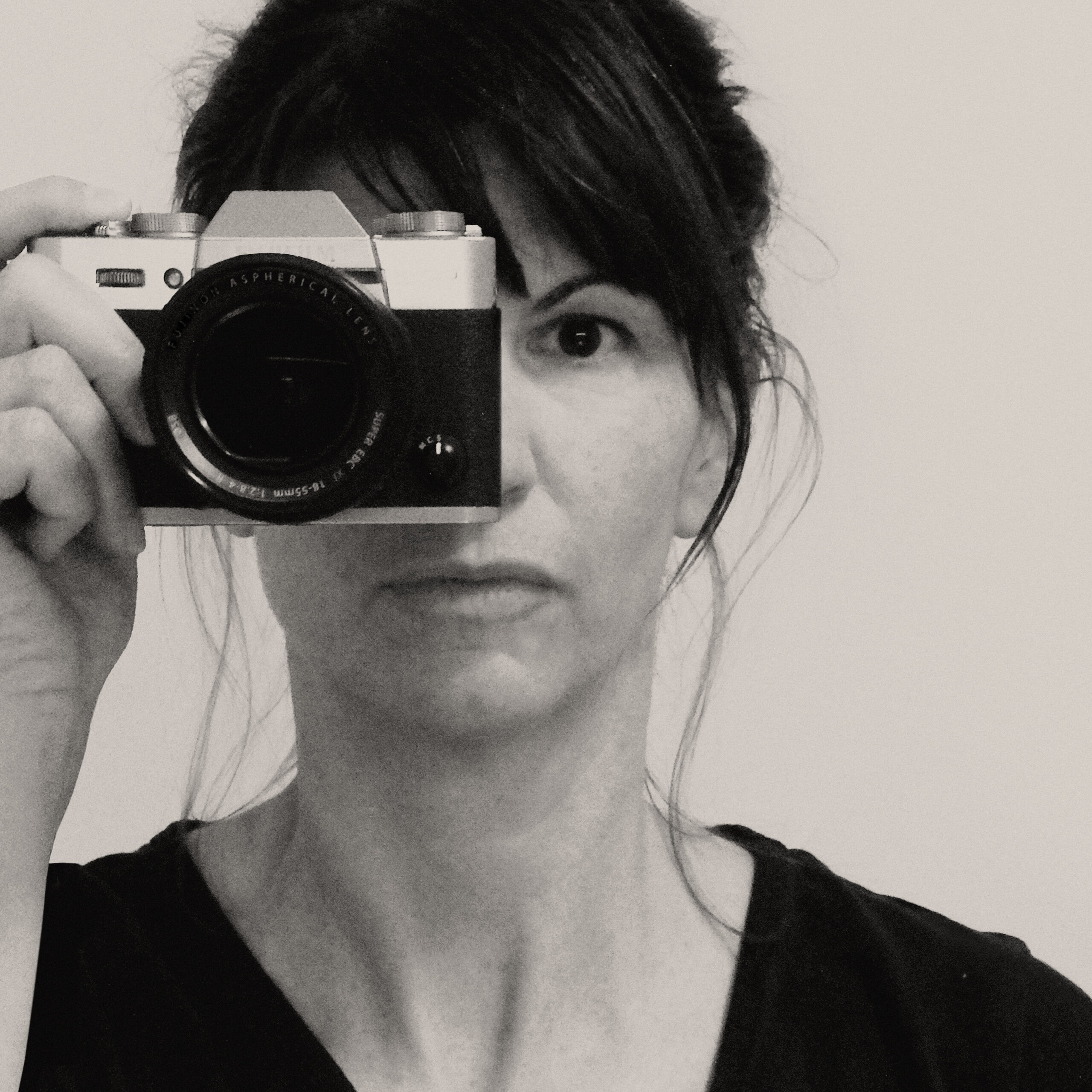
Bea Berg
Based in Lyon, France, Bea Berg stepped away from two decades of large-scale architectural projects across Europe to devote herself entirely to art. Her work fuses minimalist photography with manual techniques such as gold leaf and acrylic paint to reveal the beauty that the everyday gaze can no longer see.
Lyon, France
There is an apparent contradiction at the heart of Bea Berg’s career: the same woman who, over the course of twenty years, helped build airports, sports arenas, and school complexes across Europe now devotes her time to photographing emptiness. Not emptiness as absence, but as deliberate presence, a visual silence that, in her own words, is the only possible antidote to a world that never stops talking. Born in Germany in 1977, trained as an architectural engineer at the University of Darmstadt, and based in Lyon since 2006, Berg walked away from her executive career in 2021 to become a full-time artist. Since then, she has accumulated international awards, exhibitions in museums and galleries across France, the Netherlands, and the United Kingdom, and a visual language that challenges viewers to perceive what is on the verge of disappearing from their field of vision.
At a time when algorithms compete for human attention and the production of images grows at an unprecedented pace, Berg’s work proposes the opposite: radical deceleration. Her photographs, the foundation of her entire creative process, draw from landscapes, floral motifs, or portraiture, but are subjected to a rigorous process of refinement that strips away the superfluous and preserves only the essential. Geometric or organic lines, clean forms, white spaces that breathe. The result is a composition that, at first glance, appears almost abstract and reveals its subject only to those willing to look with patience and care.
The Break: From the Construction Site to the Canvas
The decision to leave architecture was not impulsive. Berg built her professional path methodically: she studied at the School of Arts in Herxheim, attended the Polytechnic University of Madrid, and completed her training as an architectural engineer in Darmstadt. She arrived in Lyon drawn by the city’s cultural vitality and quickly joined large-scale projects. For two decades, her daily life was shaped by the relentless logic of deadlines, client demands, and the pressures of major architectural firms.
But something was building beneath the surface. The frenetic pace of large construction projects, the restless rhythm of European city life, and a growing sense of disconnection from nature, which had shaped her deeply during childhood in the rural southwest of Germany, created a tension that eventually became unsustainable. In 2021, Berg made the decision that many colleagues considered bold, and some considered reckless: she closed out her pending projects and opened her studio.
The shift did not represent a break from what she had learned. On the contrary: her technical and aesthetic training in architecture became the foundation of her new artistic language. Her sense of composition, her relationship with materiality, her obsession with proportion, and her respect for the functionality of form all carried over, transformed, into the works she began producing. The architect did not disappear. She simply changed her scale.
The Process: Photography, Gold, and the Weight of Silence
Berg’s working method is, in itself, a statement of intent. Everything begins with minimalist photography: images she captures herself, with an eye trained to find geometry where others see only landscape or still life. Those photographs are then subjected to careful manual interventions, including the addition of cotton threads, shifts of textured paper, acrylic paint, gold leaf, or wood engraving. What might appear to be an arbitrary layering of techniques is, in fact, a calculated dialogue between light and shadow, between the photographic and the handcrafted, between the recording of the world and its personal interpretation.
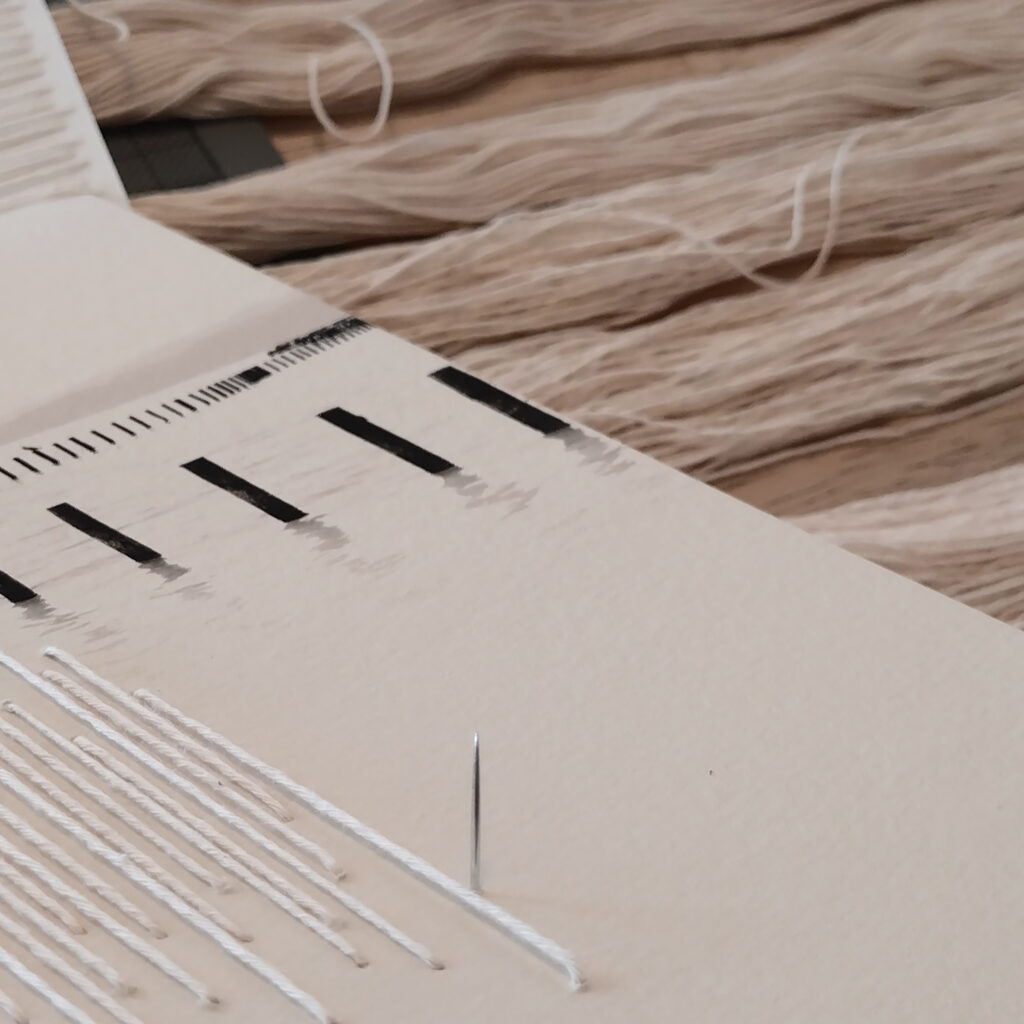
Studio view: cotton threads and acrylic paint applied over photographic print
Gold leaf, in particular, is a recurring element that lends the works an almost sacred dimension. This is not about opulence, but about luminosity: gold reacts to ambient light in unpredictable ways, creating reflections that shift depending on the viewer’s angle. A work by Berg is never quite the same seen head-on as it is from the side, in daylight as it is at dusk. That visual instability is deliberate, compelling the eye to move, to search, to resist settling.
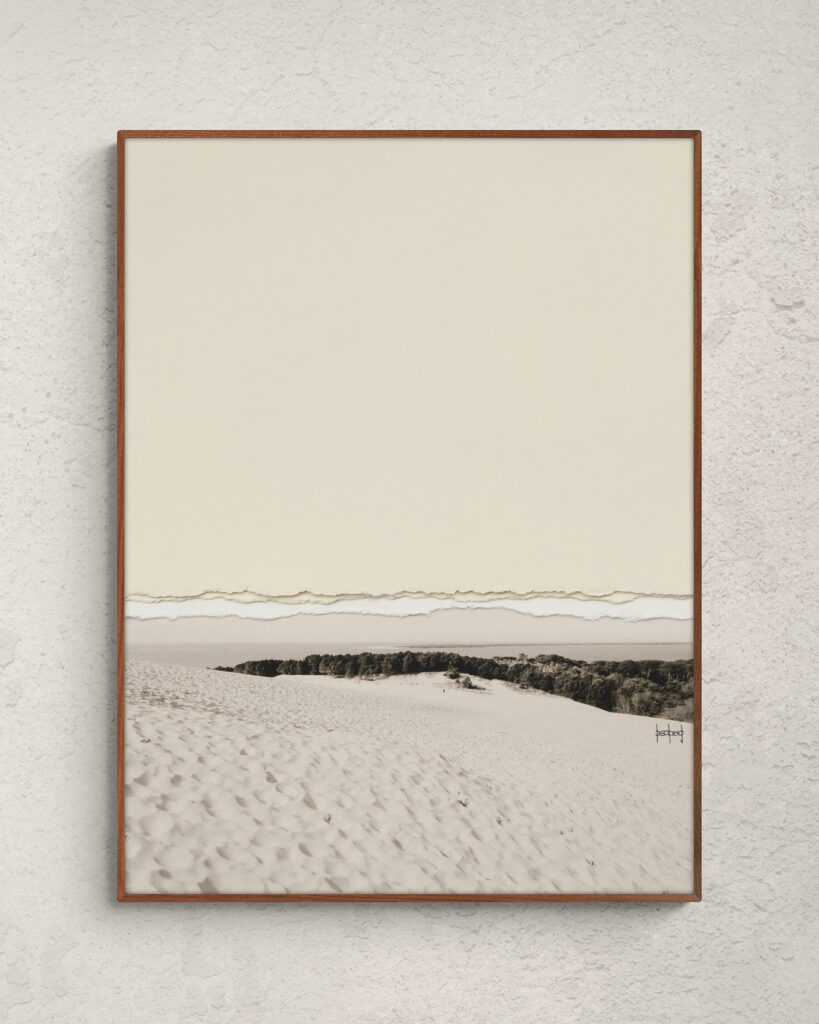
La Dune II (detail) — textured paper layers and gold leaf edge
The result is what Berg describes as a symbiosis between photography and classical techniques: a hybrid that belongs entirely to neither tradition, yet engages both with equal fluency. The artist resists labels, but accepts comparison with the minimalist tradition, provided one understands that, in her work, the minimal is never empty. It is, on the contrary, saturated with latent meaning.
The Context: Art as a Response to Contemporary Overload
Berg’s work does not exist in a vacuum. It is a conscious and articulate response to the condition of human beings in the hyperconnected world of the 21st century. In her most recent artist statement, titled “Between The Lines 2025,” she is direct: we are being flooded by information and images at an unprecedented speed and volume. In that relentless flow, our capacity to notice the small details that remind us we are still surrounded by beauty, magic, and poetry steadily atrophies.
For Berg, minimalist art is not a formal or intellectual exercise. It is, above all, a breathing practice. Her works invite the viewer to pause, to step out of the accelerated flow of everyday life and engage in an inner dialogue she describes as a process of abstraction. In that process, the mind quiets, the senses sharpen, and what previously seemed irrelevant, a line on the horizon, the veining of a leaf, the curve of a shadow, begins to command full attention with all its elegance and singularity.
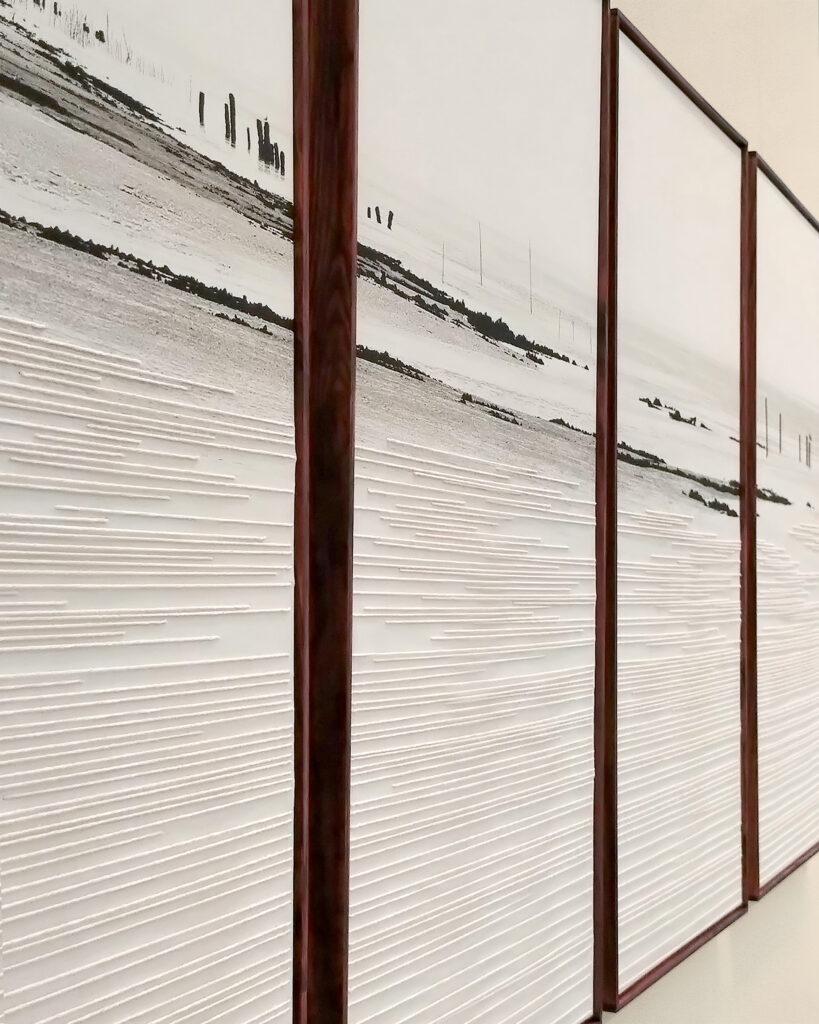
Between The Lines, 2025. Mixed media: minimalist photography and textured paper
This proposition resonates with a growing and diverse audience. It is no coincidence that Berg has maintained a steady presence in both solo and group exhibitions moving between institutional high art and alternative circuits: from the Réfectoire des Cordeliers in Paris to the Bastille Design Center, also in the French capital; from the Fort de Vaise in Lyon to Loods 6 in Amsterdam; from the Saatchi Gallery in London to the Atelier Richelieu in the historic heart of Paris. The geographic breadth of her exhibition record suggests that the language she has developed resonates well beyond national borders and the preferences of any specific niche.
Recognition: Awards and the Endorsement of International Critics
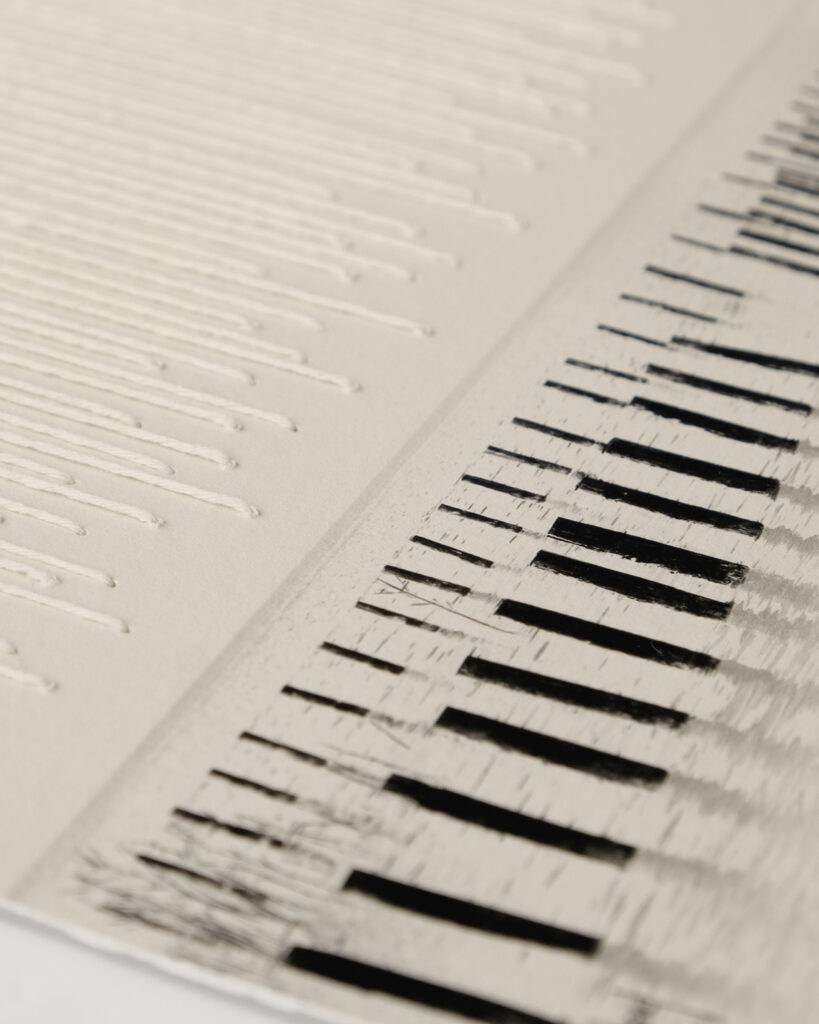
In Line V, installation view. Mixed media polyptych
Critical validation of Berg’s work has come consistently and progressively. In 2024, she won 1st Prize in the Nature category at the Fine Art Photography Award in London, one of the most prestigious international recognitions in art photography. That same year, she received 2nd Prize in the same category from the ND-Magazine Photography Award, was officially selected in the Fine Art/Minimal category of the International Photography Award (IPA) in New York, and received an Honorable Mention in the Fine Art/Landscape category of the International Foto Award in Tokyo. Four international honors in a single year, across four different countries, a run that, within the world of art photography, signals an established career.
In 2025, the artist continued adding to her record: she received the Jury Award from Lety Gallery in Vienne and participated in at least eight group exhibitions of note, including the Salon National des Beaux Arts at the Réfectoire des Cordeliers in Paris, one of France’s most enduring collective art shows. For 2026, two solo exhibitions are already confirmed: one at Alcôve Gallery in Lyon and another at Lety Gallery in Vienne, along with participation in the group show “Un Fragment d’Art” in Ribérac.
White, Black, and the Pause: An Aesthetic Manifesto for Our Time
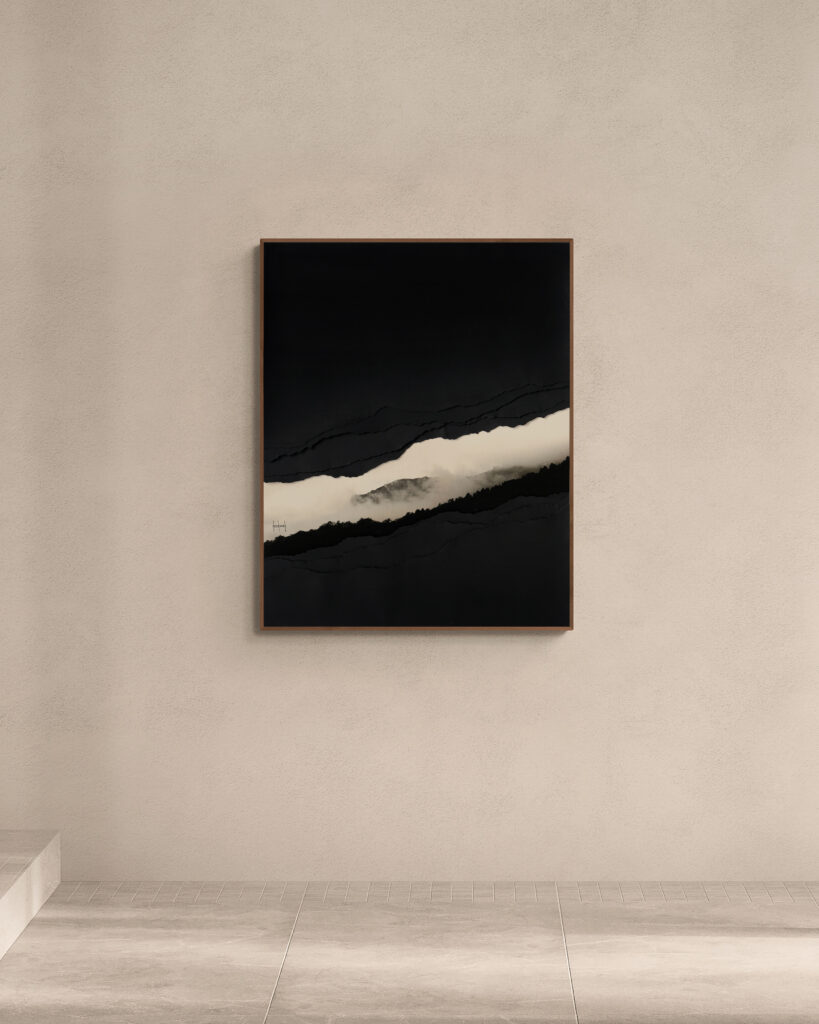
Black Fog, 2024. Photography and acrylic paint on paper
There is a kind of implicit manifesto running through Berg’s trajectory, and it is not exclusively about art. It is about a way of being in the world. In choosing white, black, and the pause as the fundamental elements of her visual language, she is not merely making aesthetic choices: she is proposing an ethics of attention. In her works, white is not the background against which something happens. It is, itself, an event. Emptiness is not what remains after the unnecessary has been removed. It is what is left once the essence has been found.
This distinction, subtle in theory and visible in practice, is what separates Berg’s work from merely decorative minimalist production. Her compositions carry emotional weight. They produce in the viewer a kind of recognition, the sense that what is being shown has been seen before, but never so clearly. Reduction does not impoverish the subject: it liberates it. And in liberating the subject, it liberates the gaze of those who contemplate it.
There are echoes, in this approach, of diverse philosophical and artistic traditions, from American minimalism of the 1960s to Japanese wabi-sabi, and through Merleau-Ponty’s phenomenology and the poetics of simplicity found in the work of artists such as Agnes Martin and Giorgio Morandi. Berg does not claim allegiance to any of these currents, but the convergence is undeniable: in every case, the conviction holds that the most powerful art is the art that knows what to leave out.
What Remains: Landscape as a State of Mind
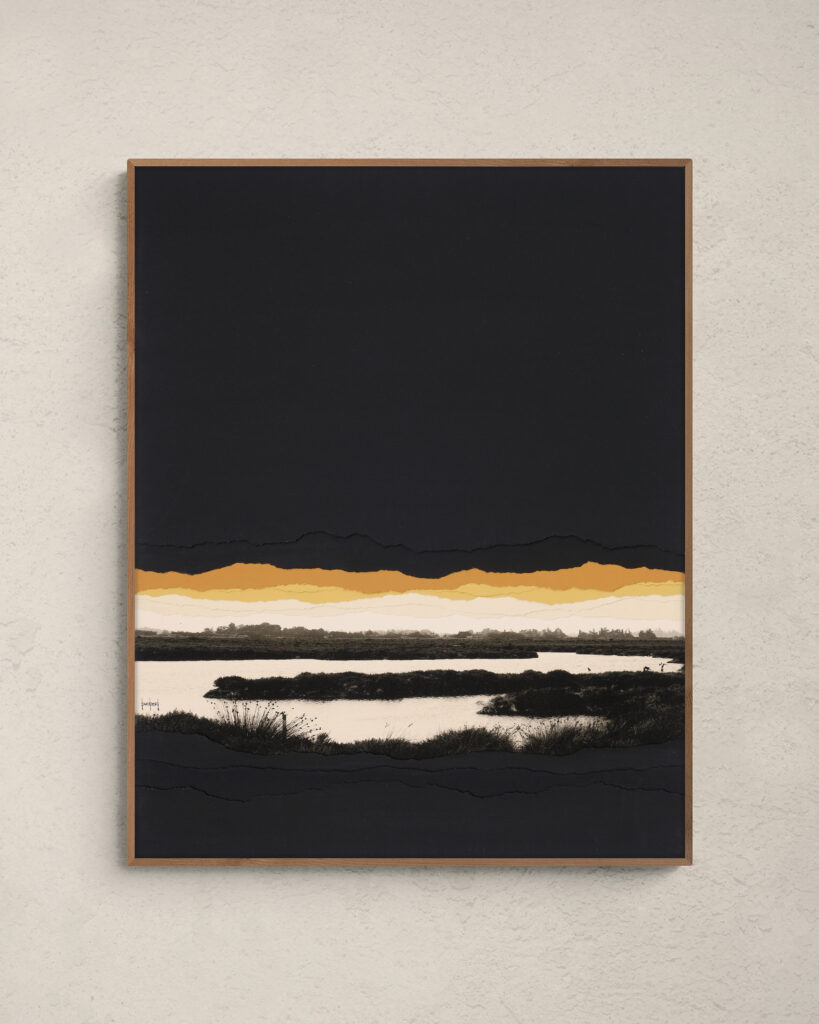
Yellow Lagoon, 2024. Photography, acrylic paint and gold leaf on paper
Growing up in rural southwestern Germany left marks that two decades of intense urban life could not erase. It is that original bond with nature, with the slowness of the seasons, with the geometry of open fields, with the light that shifts in quality as the day moves, that ultimately feeds the entirety of Bea Berg’s artistic output. Lyon, with its dynamic architecture and vibrant cultural scene, provided the right environment for professional growth. But it was the countryside of her childhood that shaped her eye.
In her photographs, landscape is not merely a subject. It is a state of mind. A way of being present in the world without the background noise that contemporary life imposes as default. When Berg removes the unnecessary from an image and keeps only its fundamental lines, she is not documenting a place, but proposing an experience. The experience of looking, without urgency, at something that has always been there, waiting to be seen.
In that sense, Bea Berg’s work is simultaneously an act of resistance and a gesture of generosity. Resistance to the imperative of speed, quantity, and excess. And generosity in offering the viewer, amid the noise of daily life, a moment of balance, contemplation, and beauty that asks for nothing beyond a willingness to linger. In a world that never stops producing images, she produces visual silences. And it is precisely in that silence that, paradoxically, everything that matters can finally be heard.
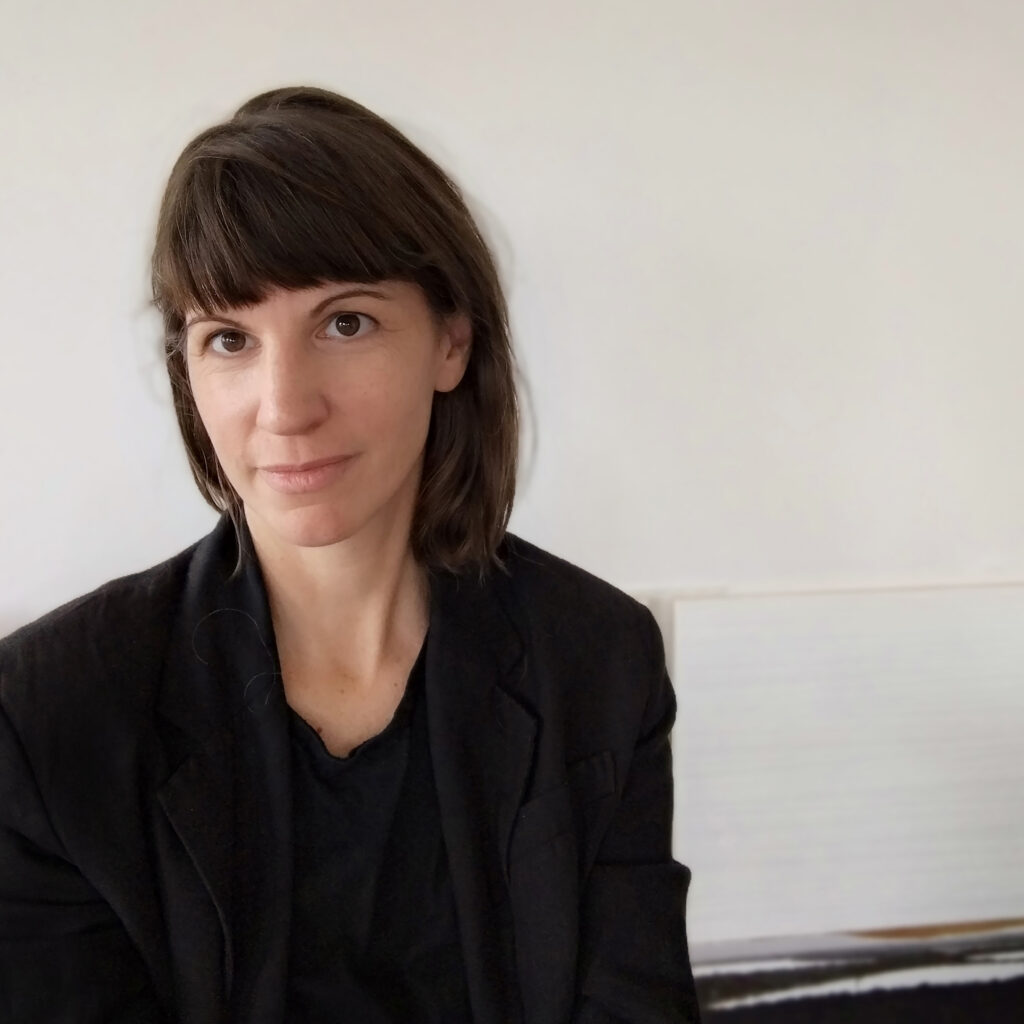
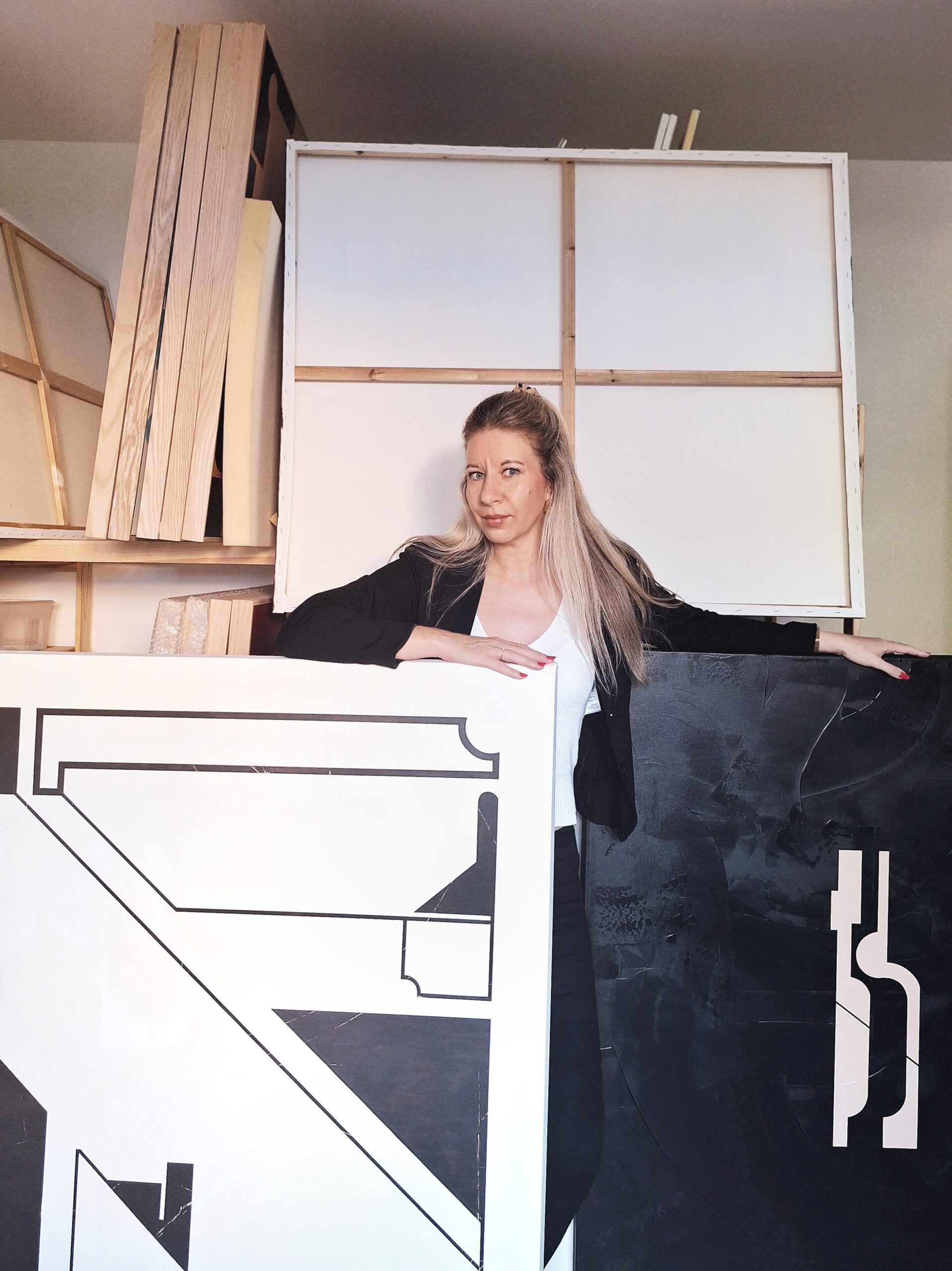
Bea Berg in her studio, Lyon, France.
Bea Berg’s confirmed exhibitions in 2026: Solo show at Alcôve Gallery (Lyon, France), Solo show at Lety Gallery (Vienne, France), and group exhibition “Un Fragment d’Art” (Ribérac, France).
More information: https://www.bea-line.de/