 Serpa
Serpa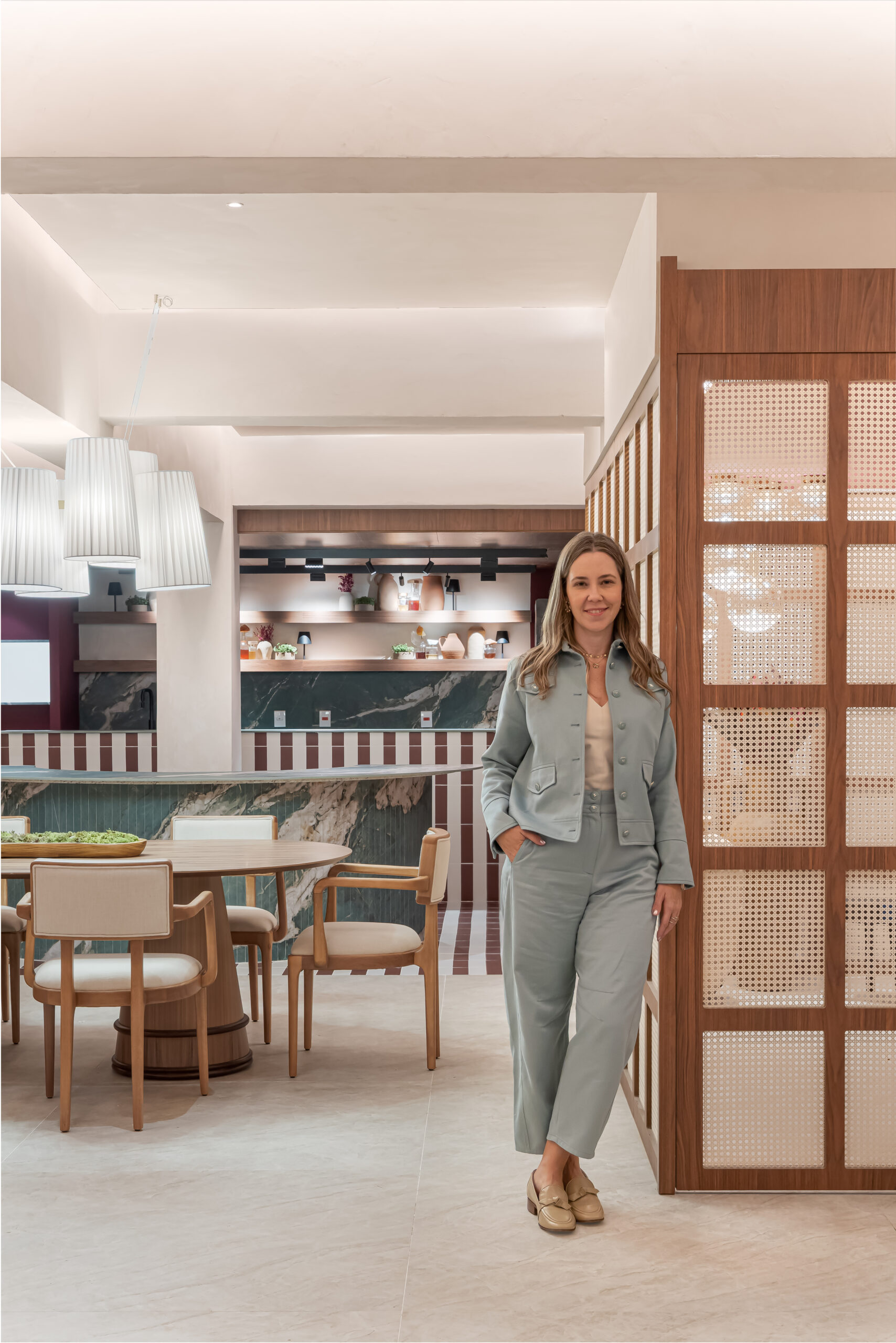
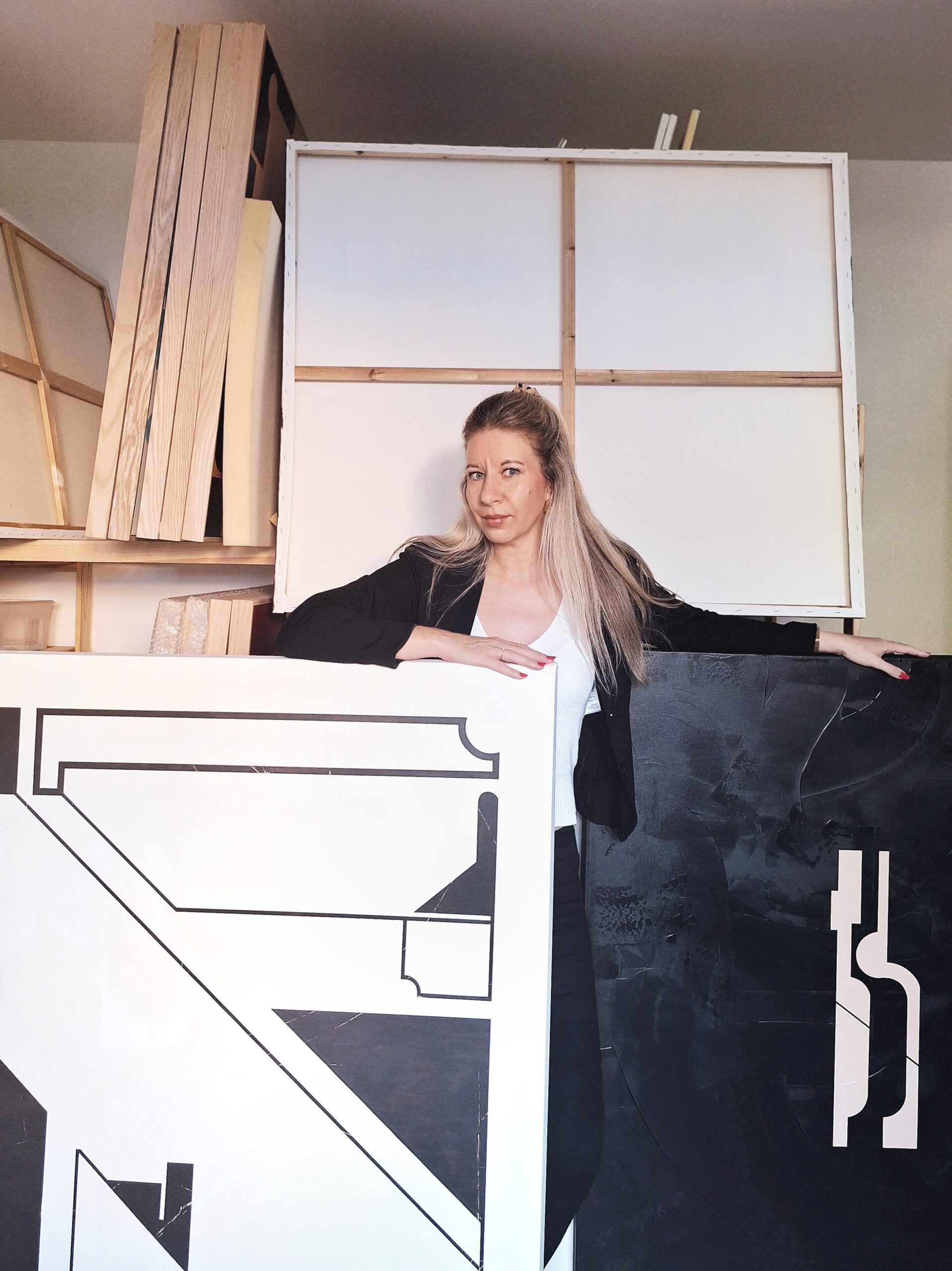
Marta Martins in the space she designed for CASACOR São Paulo 2026, the green marble bar and rattan partition visible behind her. The studio she founded in 2006 marks its 20th year with this project. Photo by Camila Santos
“Raiz” channels natural materials, an earthy palette and an exclusive mural by French artist Dominique Jardy into a 220-square-meter meditation on belonging, marking two decades of the Brazilian architect’s practice
SÃO PAULO – There is a particular kind of space that does not announce itself. It does not compete for attention or perform its own sophistication. It simply receives you, and then makes you reluctant to leave. That is precisely what architect Marta Martins set out to create with “Raiz,” her contribution to CASACOR São Paulo 2026, and by most measures, she has succeeded.
Occupying 220 square meters at Parque da Água Branca in the Brazilian city’s western zone, the space serves as the Mesa Viva restaurant for the 39th edition of the show, open from June 2 through Aug. 9, 2026. The title of the project translates from Portuguese as “root,” and the word carries the full weight of its symbolism here: belonging, continuity, the quiet insistence of things that grow slowly and hold firm.
Martins conceived “Raiz” not as a dining room in any conventional sense but as a place of genuine human exchange, where the pace of a meal might resist the relentless acceleration of contemporary life. The project responds to the edition’s theme, “Mind and Heart,” with uncommon directness and without resorting to literal interpretation.
“I wanted to create a restaurant where people truly want to stay. A quiet, comfortable and welcoming space that values encounter and shared time,” Martins said.
Material Honesty and Sensory Restraint
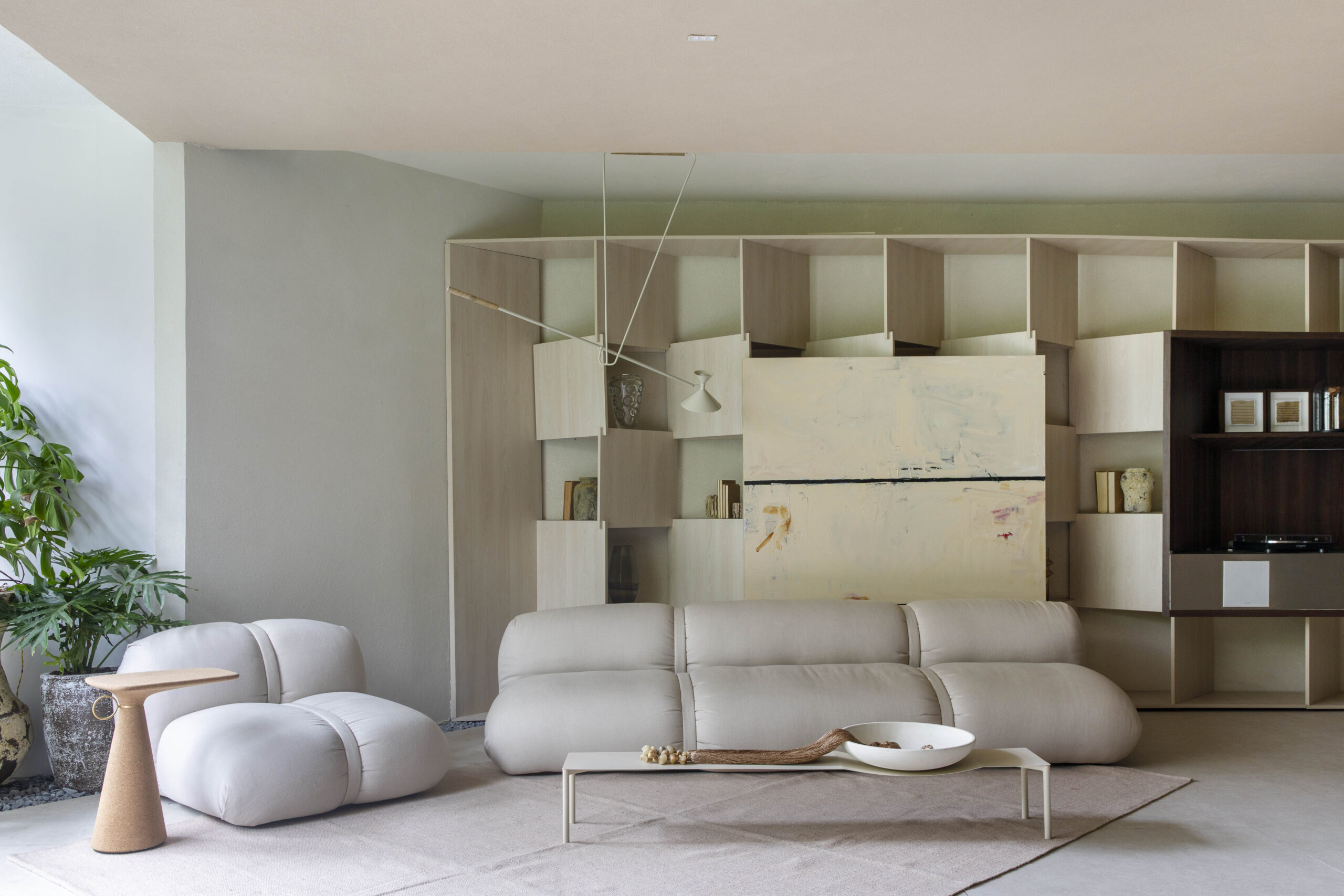
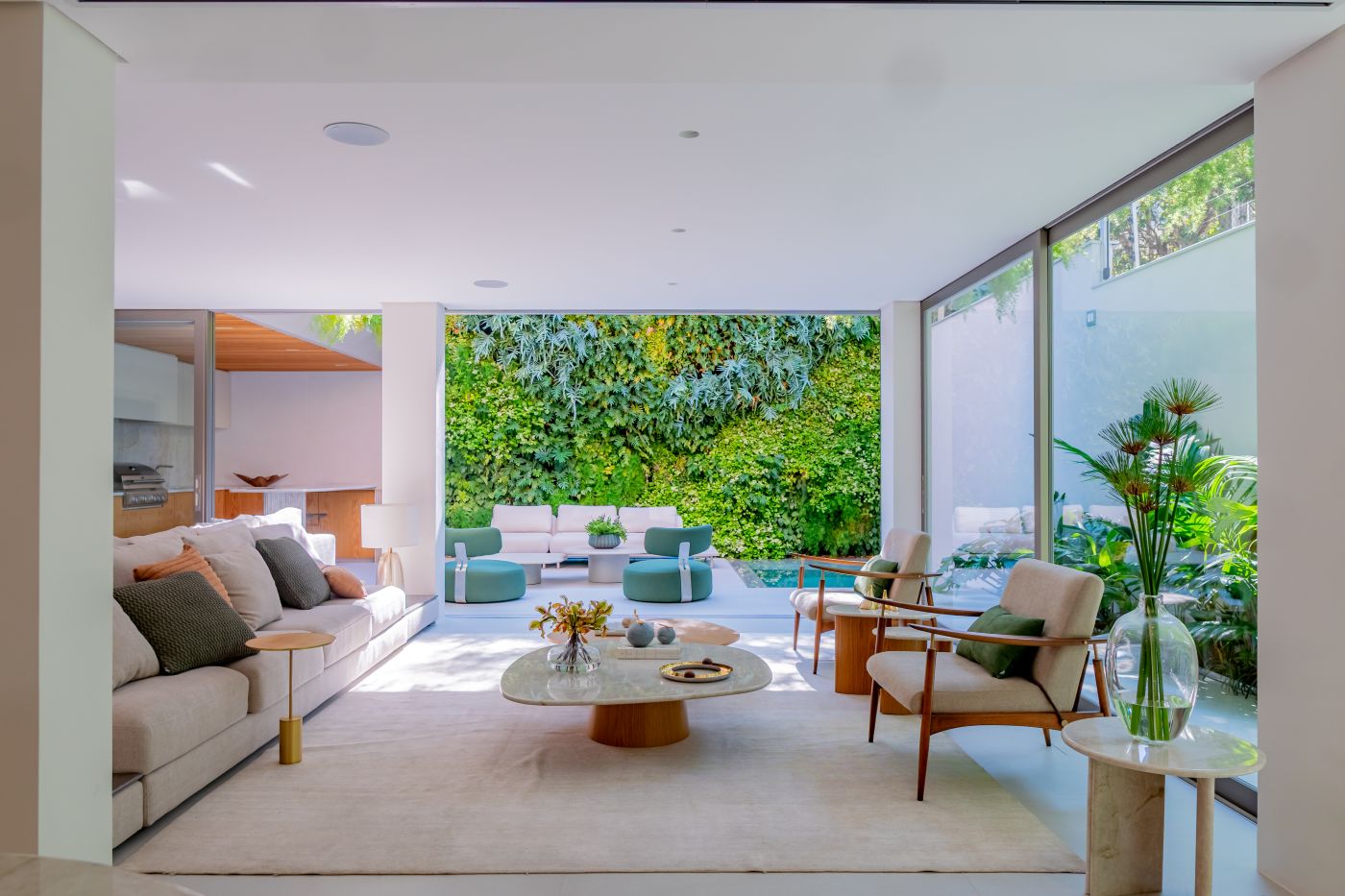
Arriving at “Raiz,” the first thing one notices is the absence of spectacle. No statement ceiling, no theatrical lighting rig, no material chosen primarily to photograph well. Instead, Martins has built the atmosphere from the ground up through layers of sensory intelligence: natural materials, diffused light and a palette that draws from soil, bark and stone.
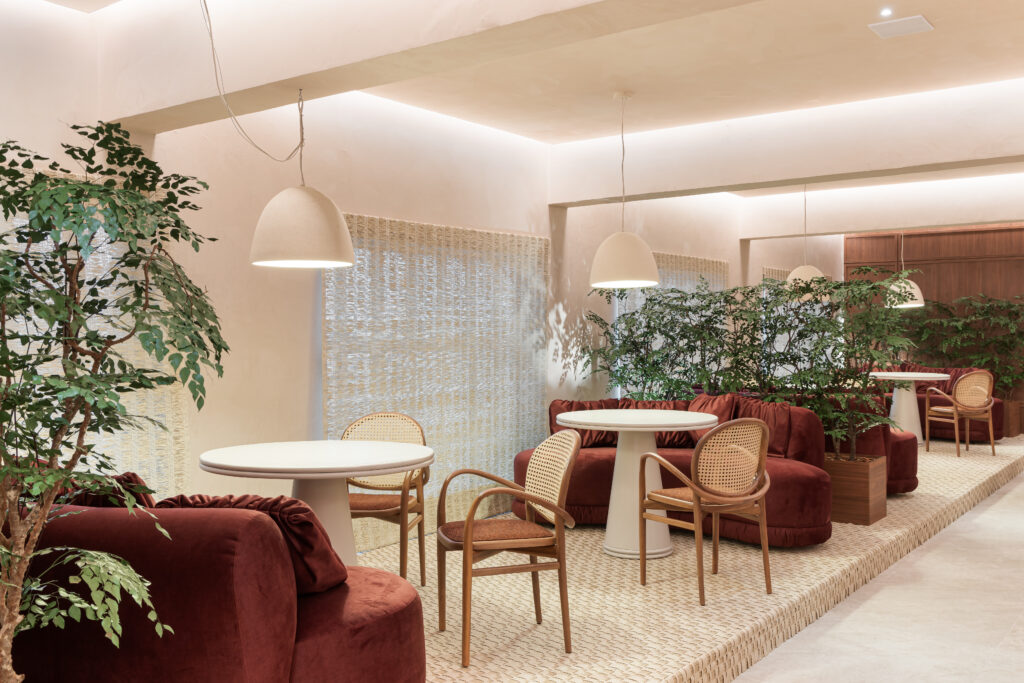
Deep burgundy sofas in rounded velvet forms anchor the lounge area of “Raiz,” where rattan chairs, indoor trees and woven textile screens compose a room that asks nothing of you except to remain.Photo by Camila Santos
Wood and organic fabrics form the primary vocabulary of the space, supplemented by textures that reward touch as much as sight. The overall impression is of a room that has settled into itself, that carries a sense of time without being in any way nostalgic. Neutrals dominate, but they are warm neutrals, alive with variation rather than deadened by uniformity.
Sustainability here is not a badge or a talking point. Durable, natural materials were chosen because they are the right materials for this kind of space, and the decision to avoid excess, both decorative and environmental, reflects a coherent design philosophy rather than a compliance checklist.
The Mulungu Mural and the Bar’s Counterpoint
Against this composed backdrop, French visual artist and muralist Dominique Jardy introduces the space’s most arresting gesture. Her work “Mulungu,” created exclusively for the project, takes the image of a tree as its central motif, translating into paint the same ideas of strength, rootedness and natural presence that anchor Martins’ spatial concept. The mural is large enough to command the room without dominating it, a balance that speaks well of both artists involved.
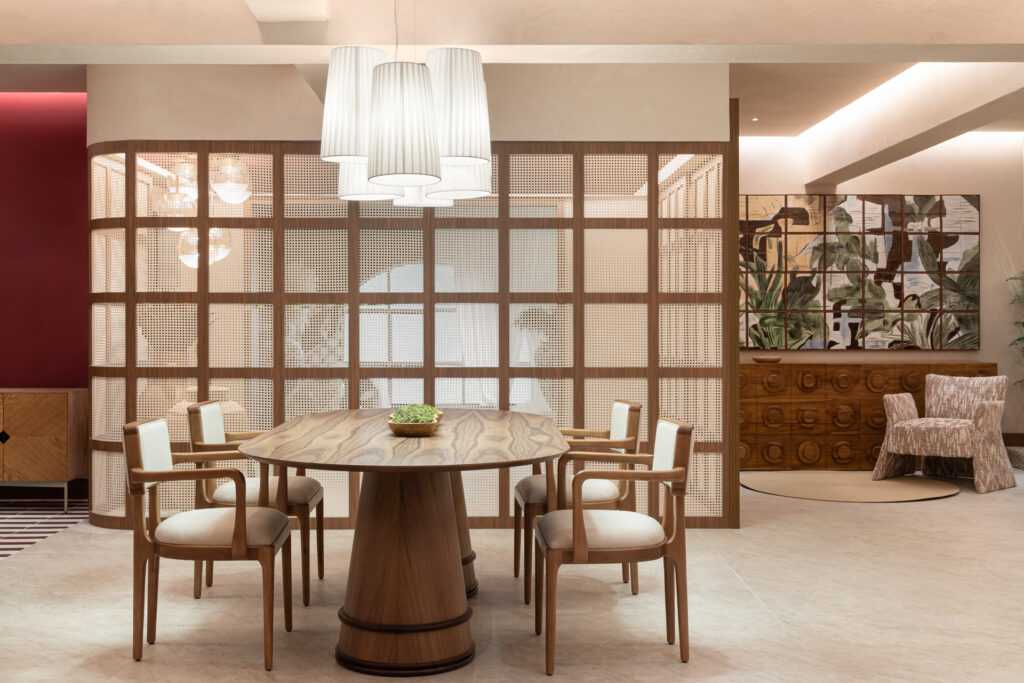
A solid wood round table, turned on a cylindrical pedestal base, gathers the space into itself. Behind it, a full-height rattan screen filters light between zones while Jardy’s mural holds the far wall. Photo by Camila Santos
Providing a deliberate tension within the overall palette, the bar deploys green stone alongside deep wine tones, a pairing that reads as confident and precise against the earthy neutrality surrounding it. Where the rest of the space settles and soothes, the bar punctuates. The effect is of a room that breathes, expanding and contracting across its surfaces.
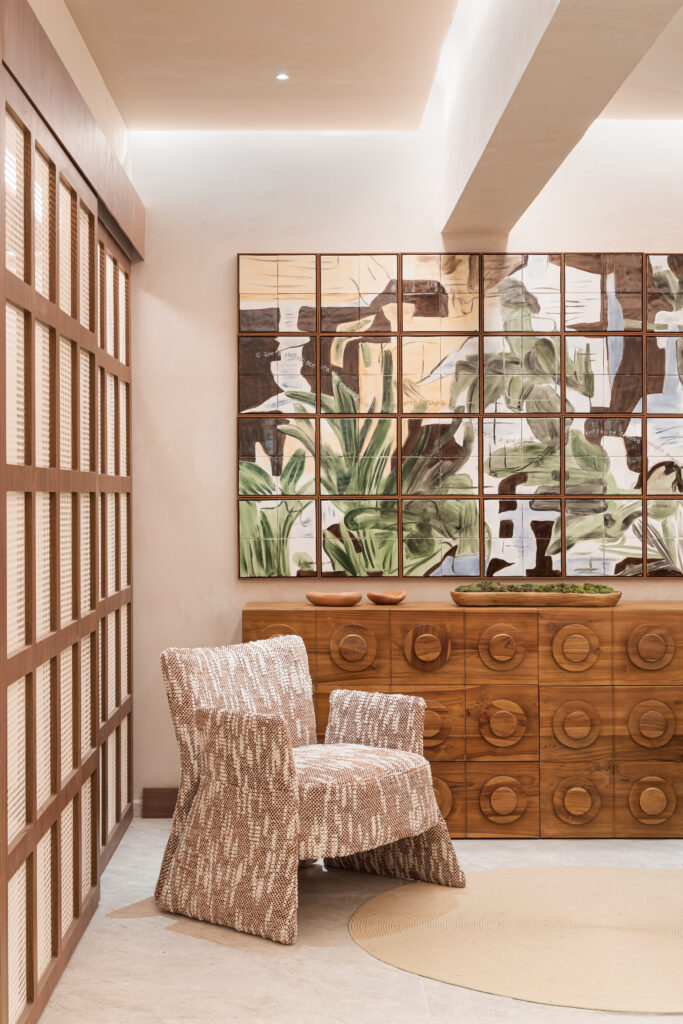
Dominique Jardy’s “Mulungu” mural, rendered across a grid of individual ceramic panels, presides over a sculptural wood credenza with circular relief detailing. A woven armchair in natural fiber completes the vignette.Photo by Camila Santos
Centered in the composition, the table asserts its primacy as both functional object and cultural symbol. Gathering around it, the act of sharing a meal is elevated from transaction to ritual, from fueling to actual presence with one another.
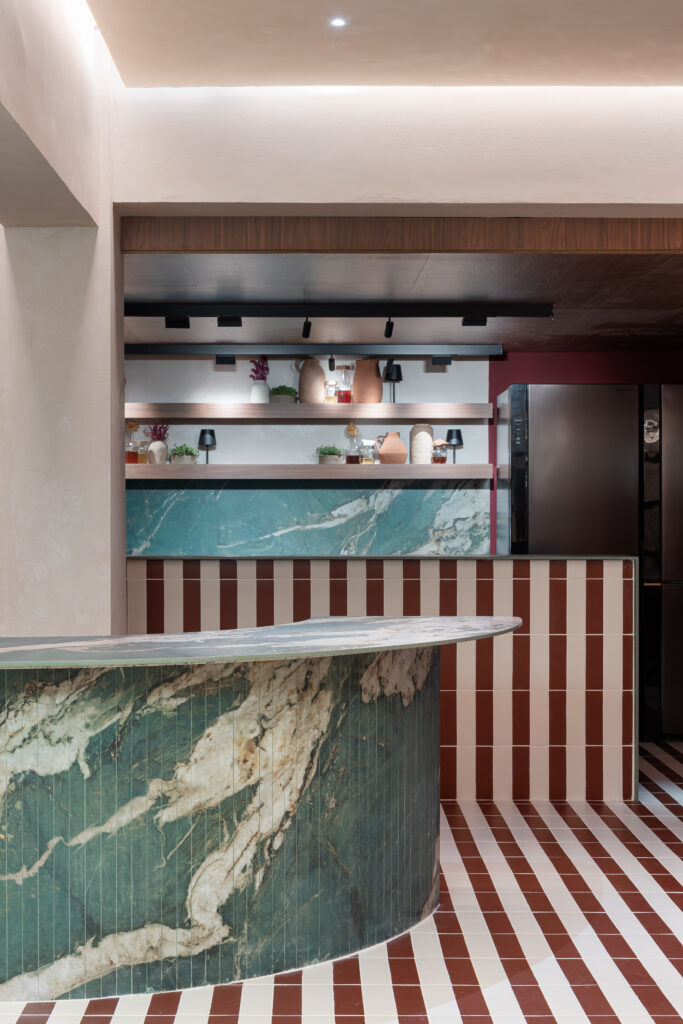
The bar at “Raiz” is its most declarative moment: a curved counter clad in veined green stone meets a floor and fascia of burgundy-and-cream striped ceramic tile, the room’s sharpest chromatic argument.Photo by Camila Santos
A Practice at Twenty
Coinciding with the project’s debut, Marta Martins Arquitetura marks its 20th anniversary in 2026. Founded in São Paulo in 2006, the studio has built a body of work across high-end residential and commercial projects in São Paulo and beyond, establishing a signature defined by clean lines, an enduring palette and a precision that never tips into coldness.
Before launching her own practice, Martins accumulated nearly three decades of professional experience in architecture, a foundation that gives her current work its quality of earned confidence. Nothing in “Raiz” reads as a provocation or an experiment. Everything reads as a considered position.
“Over these 20 years, I realized that the most important architecture is the kind capable of bringing people closer and creating genuine connections. This space expresses exactly that idea of belonging and presence,” she said.
That maturity is visible in the project’s refusal to overexplain itself. The concept is embedded in the materials, the proportions and the light rather than declared through surface-level gestures. Belonging and permanence are not themes applied to the space from outside. They emerge from within it.
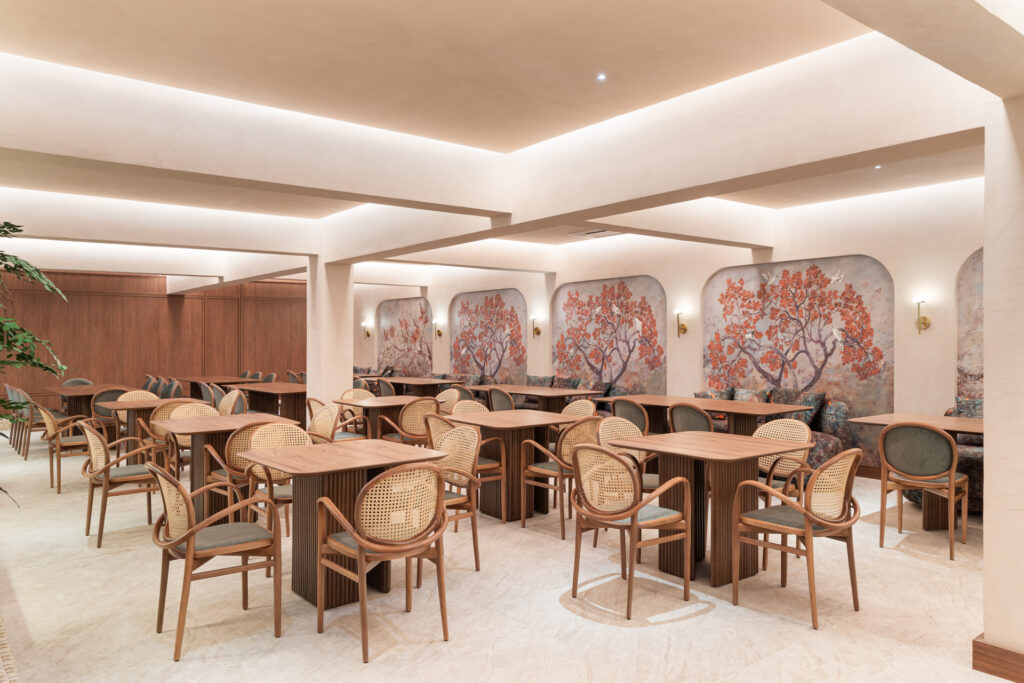
The main dining hall of Mesa Viva unfolds beneath coffered ceilings and warm indirect light. Three arched niches frame the “Mulungu” mural in repeat, the Mulungu tree rendered in coral and ochre across the room. Photo by Camila Santos
CASACOR São Paulo 2026
Now in its 39th edition, CASACOR São Paulo remains the country’s most significant platform for architecture and interior design, gathering environments by architects, interior designers and landscape architects under a single roof each year. This edition is housed at Parque da Água Branca, located at Rua Dona Ana Pimentel, entrance G4, in the Água Branca neighborhood on the city’s west side.
Running Tuesday through Sunday from 11 a.m. to 10 p.m., with the ticket office closing at 8:15 p.m., the show remains open through Aug. 9, 2026. Photography of “Raiz” is by Camila Santos. Suppliers include Portinari, Deca, Duratex and Atelier Dominique Jardy.