 Serpa
Serpa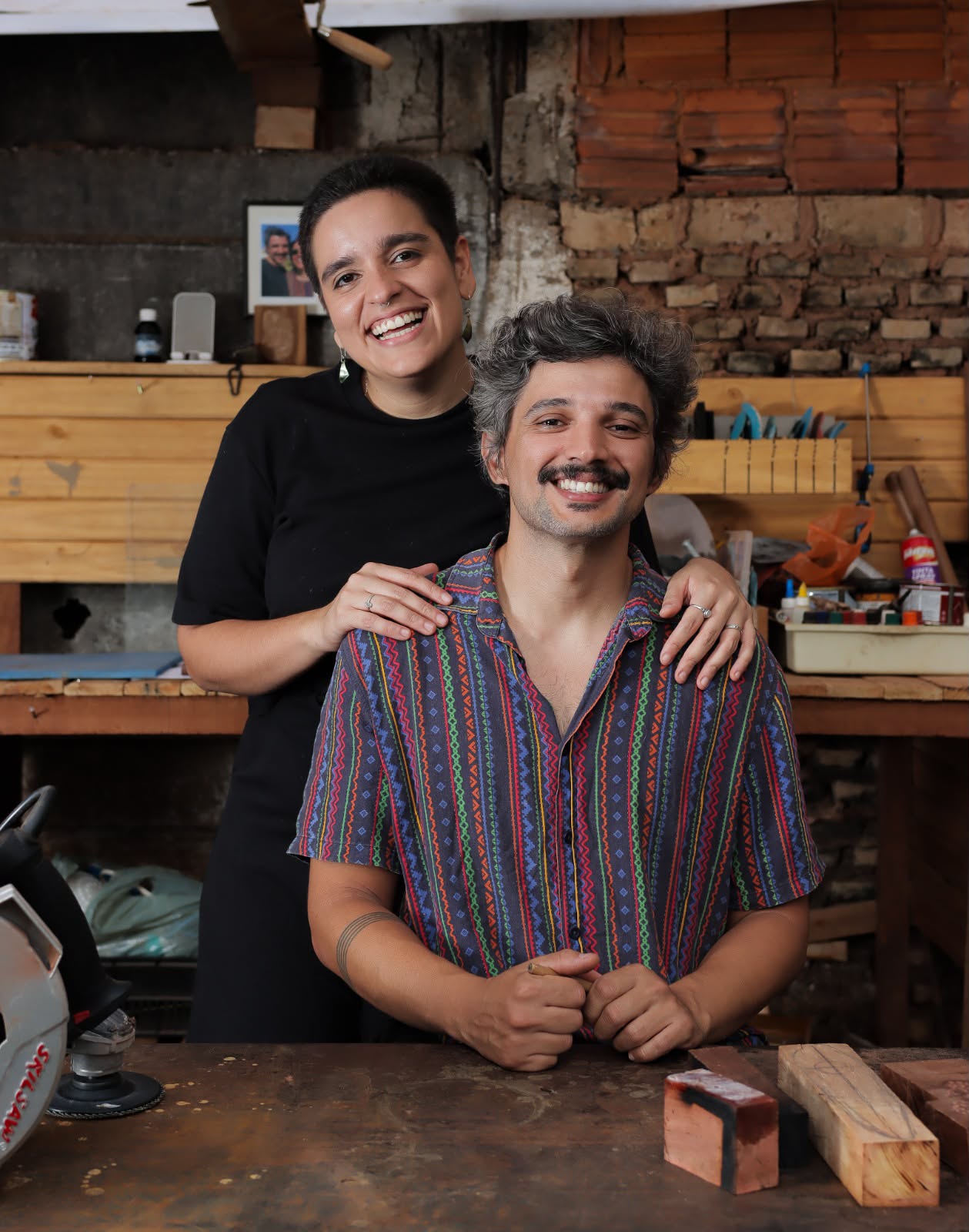
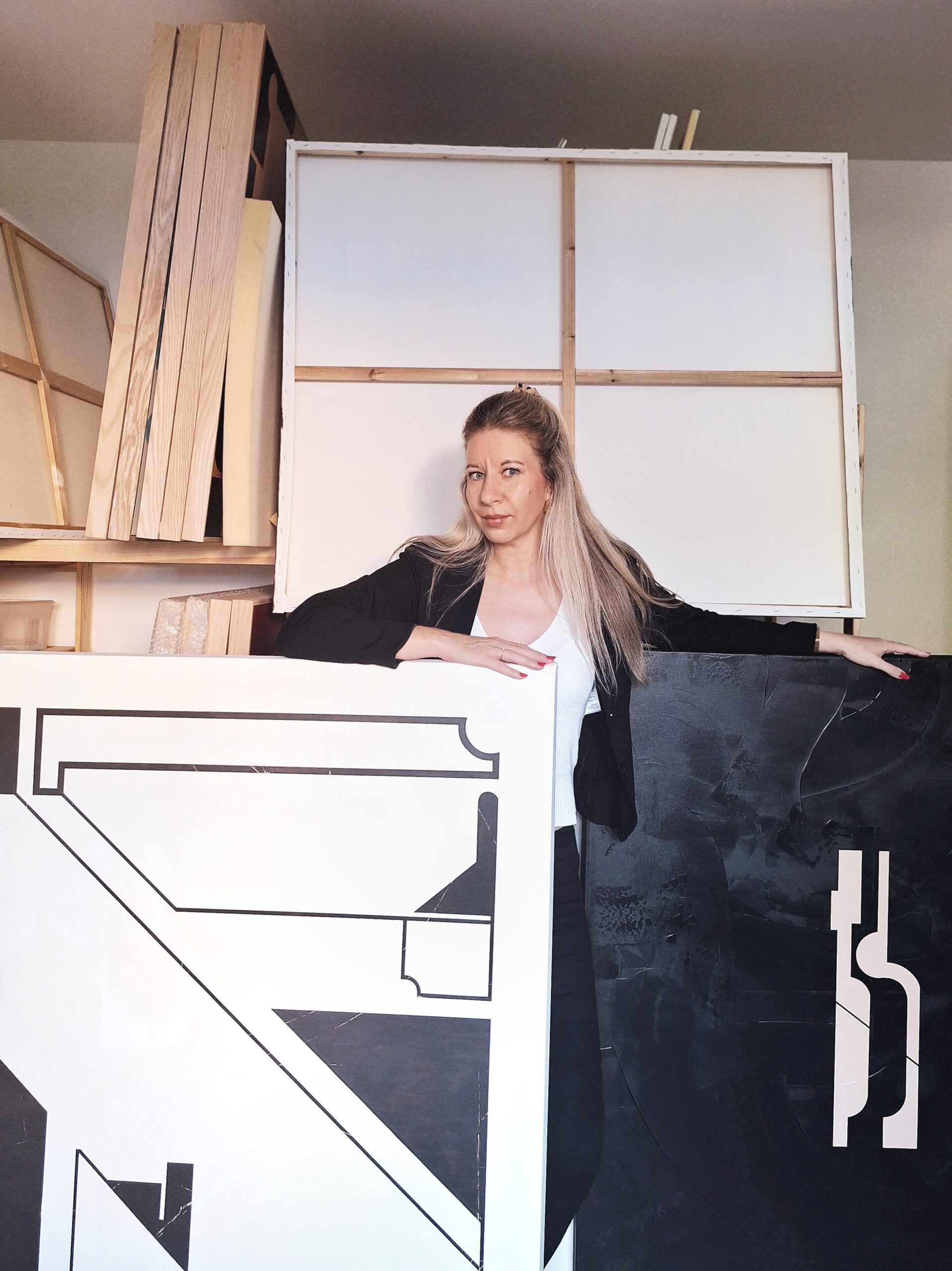
Gustavo Euzébio and Maria Luiza.Credit: Estúdio Pinhalimão
Atelier founded by Gustavo Euzébio and Maria Luiza debuts with five hand-carved objects in four native species, blending original design with artisanal production
Atelier’s Debut
Estúdio Pinhalimão, a Brazilian atelier specializing in original product design, presents the Coleção Enigma 2026, a set of hand-carved objects that includes lighting fixtures, a centerpiece and a candleholder made from native wood. The collection marks the studio’s debut in the original design market and brings together five creations that move between sculpture and function, each crafted from a different species of Brazilian wood.
Conceived by architect Gustavo Euzébio and Maria Luiza, a professional with a background in the corporate sector, Pinhalimão oversees every project from initial design to final finishing, with no outsourced steps. Its goal is to guarantee each piece a distinct identity, produced in a serial edition with unique, certified numbering.
For the founders, the collection grows out of Brazilian experience and a direct relationship with raw materials. “Pinhalimão is born from Brazil’s creative freshness,” the pair behind the project said. Their words capture the atelier’s concept, which transforms solid wood blocks into objects with sculptural presence while preserving each item’s original function.
A Handcrafted Process
Every piece in the Enigma line starts from a single block of wood, shaped until it reveals its final form. Without industrial molds, the process carries each item’s natural variations, such as grain, knots and tone, into the finished piece. This quality makes the production collectible, since no creation exactly repeats the design of another, even within the same edition.
Individually numbered, all of Pinhalimão’s creations are made in serial editions. This model, the atelier said, reinforces the exclusive character of the objects, aimed at a public that values originality and artisanal quality. No item goes through the mass manufacturing processes typical of the conventional furniture industry.
Lighting Fixtures in the Collection
Named Eclipse, the first lighting fixture is carved from tauari wood. Its organic shape features an upward curve that cradles an illuminated globe at the top, designed to light rooms with a subtle glow.
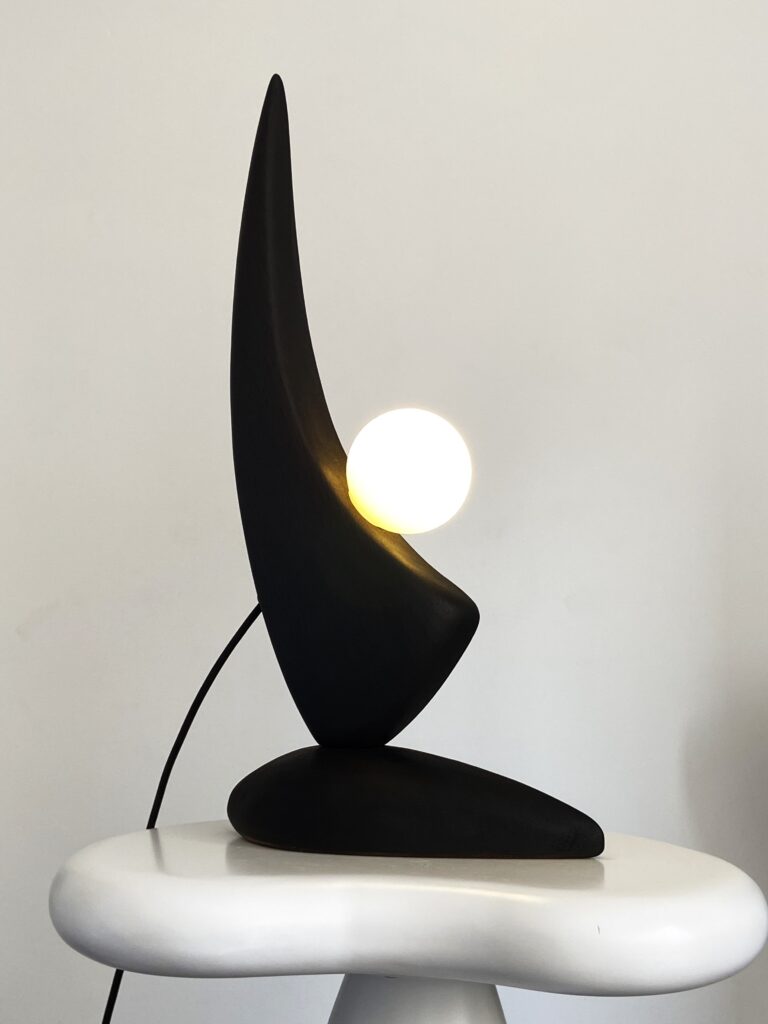
Eclipse table lamp in its small format, showing the sculptural curve that cradles the light globe. Credit: Estúdio Pinhalimão
Unlike Eclipse, the Gota lamp rests its glowing globe on a garapa base, creating an informal light suited to spaces that call for less formality, without sacrificing the solidity of solid wood.
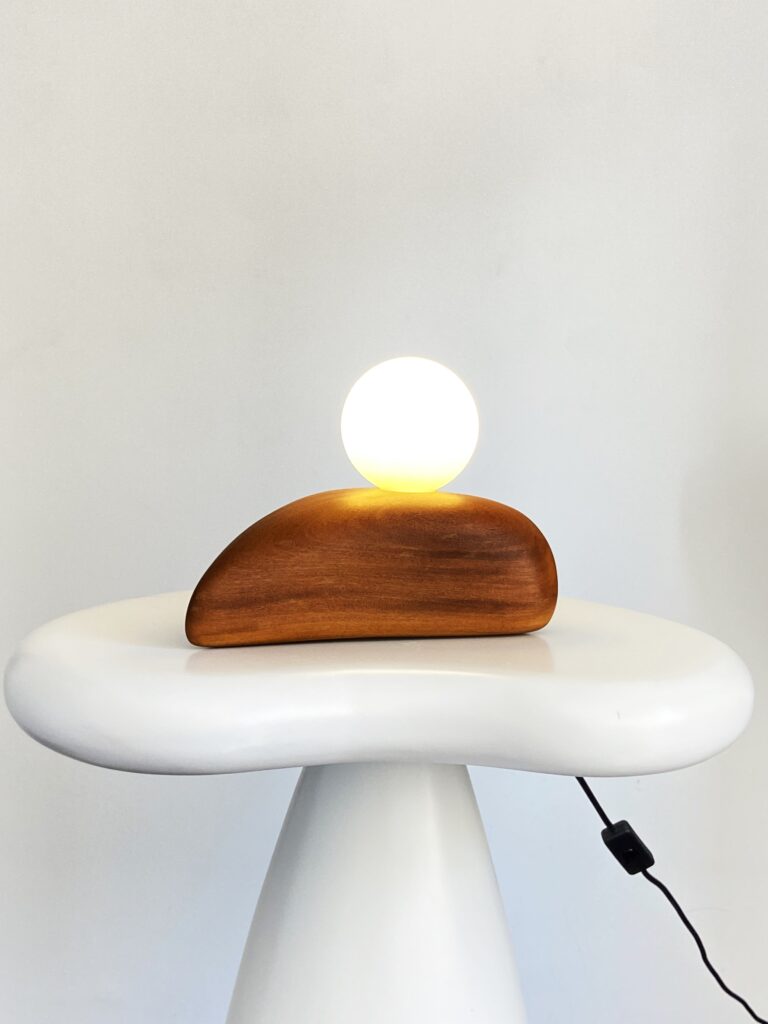
Gota lamp, carved from garapa wood, with its globe resting directly on the solid base. Credit: Estúdio Pinhalimão
Closing out the line, the Carbo lamp returns to muiracatiara wood, treated with a carbonization technique that darkens the surface and highlights the object’s natural texture. In this piece, a milky globe sits atop the darkened base, in a composition Pinhalimão described as a balance between light and shadow.
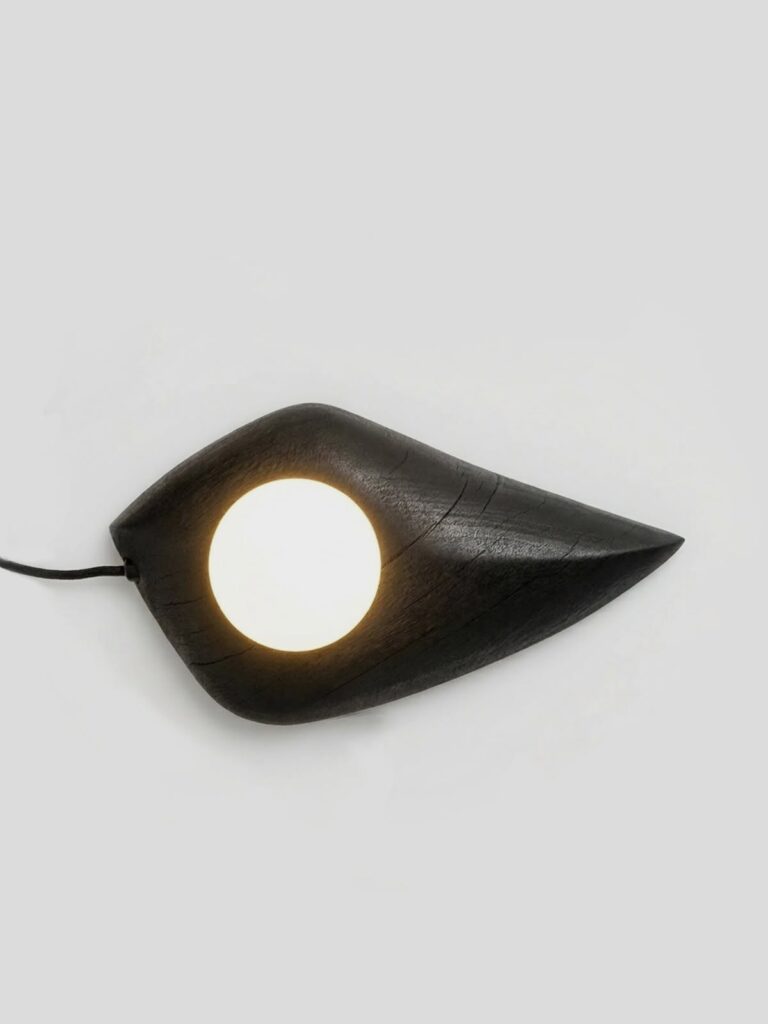
Carbo lamp, made from carbonized muiracatiara, pairs a darkened base with a milky glass globe. Credit: Estúdio Pinhalimão
Centerpiece and Candleholder
Different from the lighting fixtures, the Folha centerpiece is carved from solid muiracatiara. Its curves cradle fruit and everyday items, combining domestic utility with sculptural value.
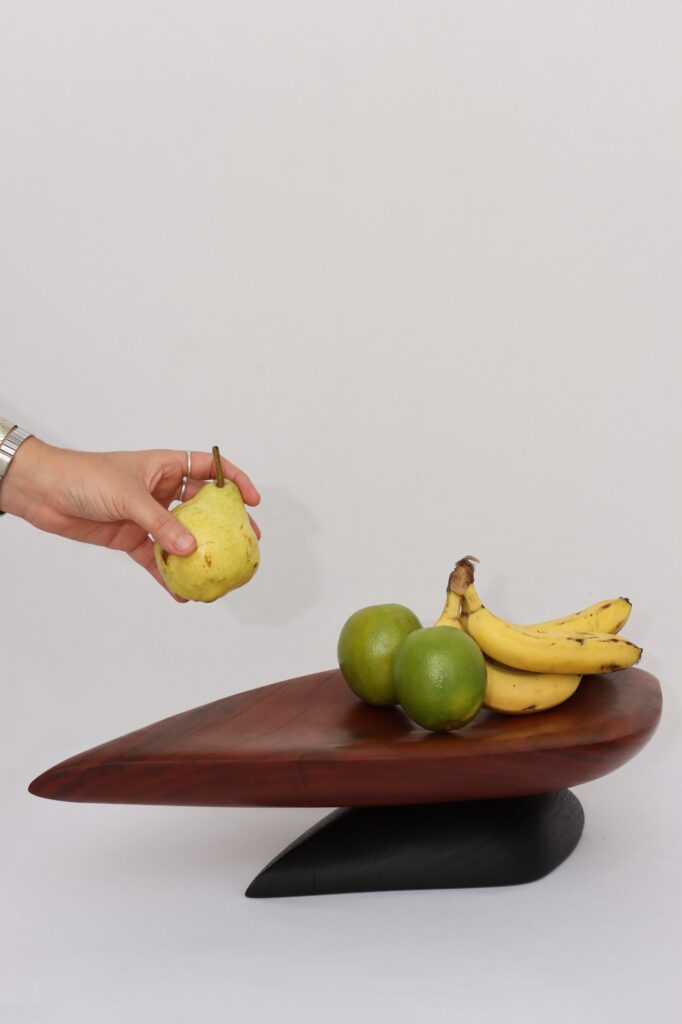
“Leaf” Centerpiece, Wood: Natural and Charred Muiracatiara. Credit: Pinhalimão
Meanwhile, the Pedra candleholder relies on faveiro wood, balanced atop a carbonized base. According to the atelier, the contrast between the two surfaces makes the candle’s flame the focal point of the composition, reinforcing the idea of treating utilitarian objects as protagonists of a space.
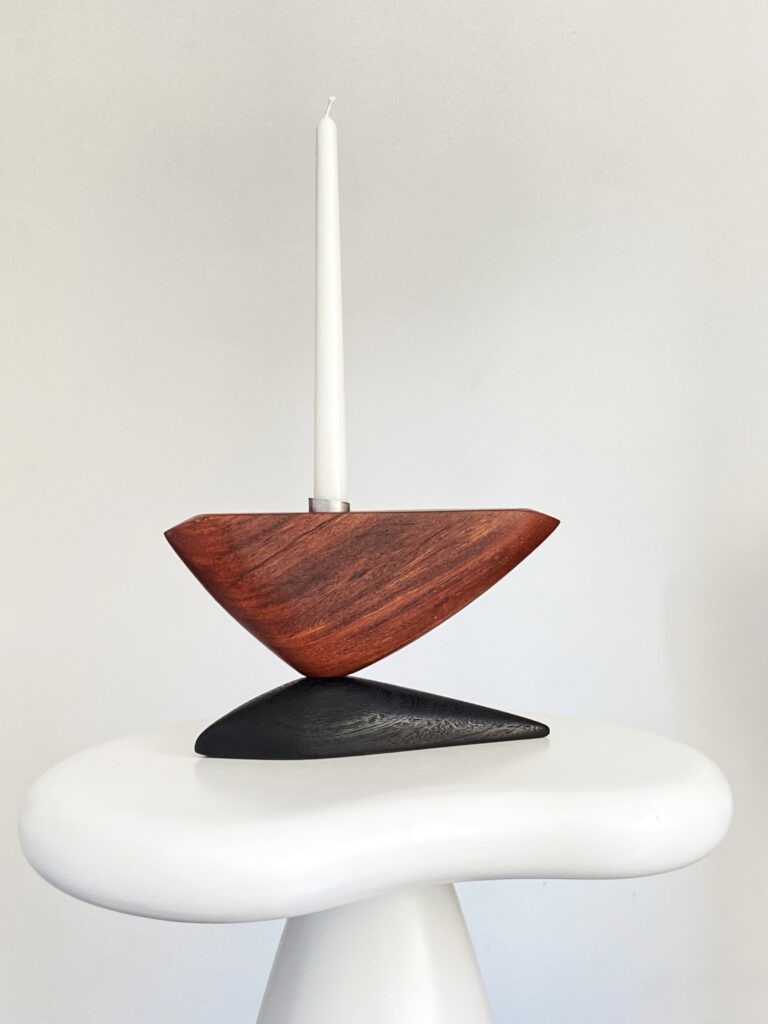
Pedra candleholder combines a faveiro wood body with a carbonized base. Credit: Estúdio Pinhalimão
Tauari, Eclipse’s Light Base
Native to the Amazon, tauari is found mainly in the Brazilian states of Amazonas, Acre, Pará, Rondônia and Maranhão. Belonging to the Couratari genus, it ranges in color from yellowish-white to beige, with little contrast between heartwood and sapwood, giving the finished piece a uniform look.
Classified as a medium-density wood, tauari is considered easy to work with, accepting cutting, gluing and bending without losing structural strength. This trait explains its use in the Eclipse lamp, whose upward curve requires material that can be shaped without compromising the piece’s integrity. In the timber market, the species is also used to make panels, door and window frames and, occasionally, musical instruments, thanks to its favorable acoustic response.
Muiracatiara, Featured in Two Creations
Compared with tauari, muiracatiara stands out for its intense coloring, with heartwood that ranges from pinkish beige to dark reddish-brown, marked by darker streaks. It occurs across the Amazon and in states including Acre, Amapá, Maranhão, Mato Grosso, Pará and Rondônia. The species is also known popularly as gonçalo-alves or aroeira, though muiracatiara is the more common commercial name in woodworking.
Considered a high-density wood, it has irregular grain and good hardness when cut, characteristics that explain its use in the Folha centerpiece and the Carbo lamp. In the latter, the carbonization technique darkens the wood’s outer layer and enhances its texture, creating contrast between the treated base and the light globe that rests on it.
Faveiro, the Choice for the Pedra Candleholder
Used in the Pedra candleholder, the wood identified as faveiro belongs to a group of native species known for relatively low density compared with other prized Brazilian woods and for limited natural resistance to fungi and wood-boring insects when left untreated. On the other hand, it works well in cutting and finishing, which supports the hand-carving process.
Inside the candleholder, the base undergoes carbonization, a technique that reduces the wood’s permeability and darkens its surface, creating the visual contrast with the candle’s flame that the atelier highlighted as the piece’s central element.
Garapa, the Vivid Yellow of the Gota Lamp
Also known as garapeira, garapa is a species native to the Atlantic Forest, found from Bahia to Rio Grande do Sul. Scientifically named Apuleia leiocarpa, it is also popularly called amarelinho or gema-de-ovo, names that reference the wood’s characteristic yellow color.
Moderately heavy in density, garapa is known for being easy to work with and for taking finishes well, though it requires careful drying to avoid cracking. In the Gota lamp, the wood’s vivid yellow tone serves as the base for the illuminated globe, creating an effect the creators compared to a small sun resting on the surface.
Carbonization Technique Links Two Pieces
Applied to both the base of the Carbo lamp and that of the Pedra candleholder, carbonization is a heat treatment technique that darkens the wood’s outer layer through controlled burning. Beyond its aesthetic effect, the process reduces the material’s permeability to moisture and wood-boring organisms, increasing the piece’s durability without altering its internal structure.
Custom Projects
Beyond its current line, the studio develops made-to-order projects, with functional sculptures created to interact directly with the architecture of each space. Such objects do not belong to a closed collection but to the space for which they were conceived, combining an original creative process with the specific needs of each residential or commercial project.
According to Gustavo Euzébio and Maria Luiza, the studio’s original design approach represents a way of valuing Brazilian handmade production in a market dominated by industrial processes. Each object, they said, carries national memory and culture while occupying physical space with clear aesthetic intent.
With the Coleção Enigma 2026, Estúdio Pinhalimão officially begins its journey in the Brazilian original design market, betting on the combination of function, sculpture and native raw materials as the central identity of its work.
Instagram: https://www.instagram.com/pinhalimao/