 Serpa
Serpa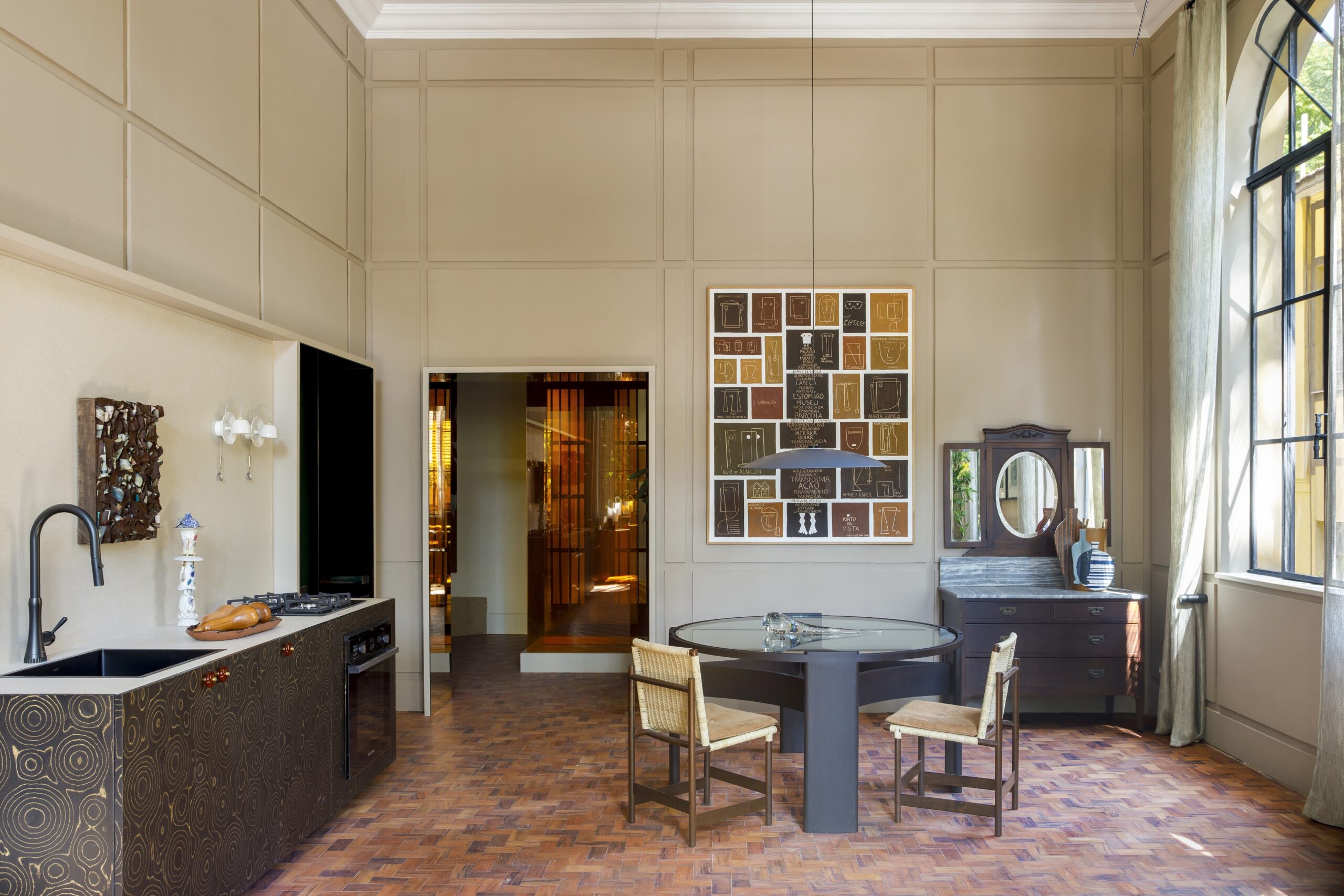
Overview of the loft, with the kitchen in the foreground and the dining room in the background, unified by the herringbone-patterned floor that runs throughout the space.
Photo: MCA Estúdio
“Casa Jacob | Itaú Personnalité” brings together family heirlooms, artwork and a botanical installation at Parque da Água Branca; show runs through Aug. 9
SÃO PAULO – Brazilian architect Felipe Carolo returns to the 39th edition of CASACOR São Paulo with a 77-square-meter environment installed in Building 23 at Parque da Água Branca, in the western zone of the city, honoring the centennial of his paternal grandfather, farmer, teacher and politician Jacob Carolo. Named “Casa Jacob | Itaú Personnalité,” the project will be open to the public from June 2 through Aug. 9, 2026.
Organized around an open floor plan integrating a living room, kitchen, home office, powder room and suite, the loft features 14.7-foot ceilings and offers a contemporary take on how work, intimacy and domestic life can coexist without rigid boundaries. For the architect, the proposal goes beyond spatial composition: it is a statement about legacy, emotional inheritance and the passage of time.
Three family pieces anchor the narrative of the space. Originally from his grandfather’s library, an English writing desk was restored with a finish that preserves the natural wood while incorporating contemporary black, now serving as the centerpiece of the home office. A sideboard inherited from the architect’s aunt, also part of Jacob’s collection, integrates the living room composition. In the bedroom, the great-great-grandfather’s trunk occupies a central position, functioning at once as furniture and as an emotional landmark.
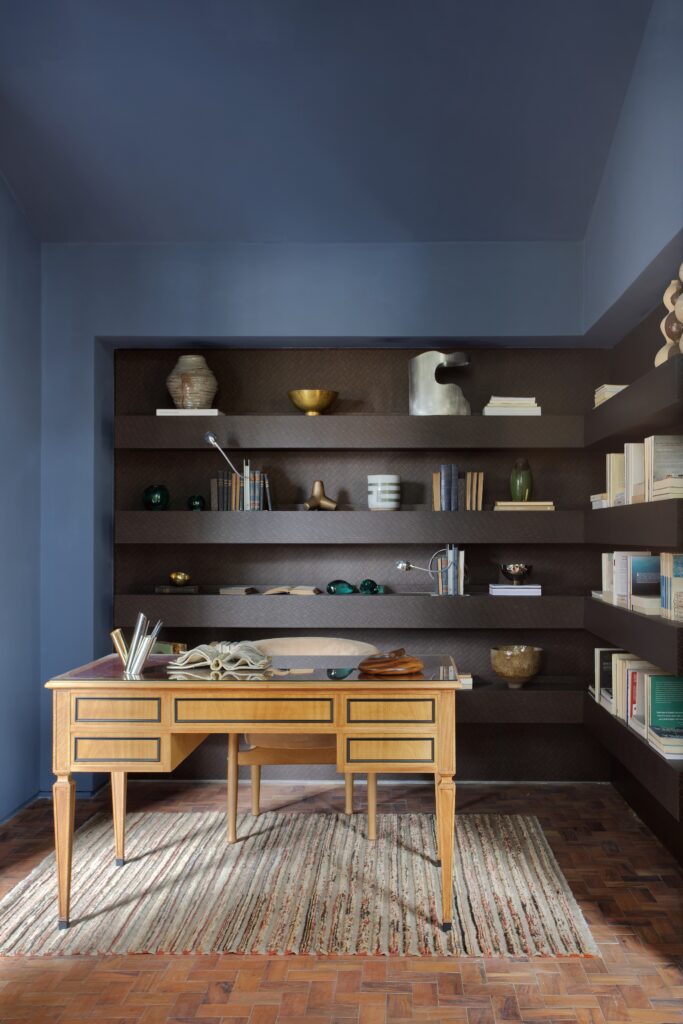
The English desk that once belonged to the library of Jacob Carolo, the architect’s grandfather, now takes center stage in the loft’s home office. Photo: MCA Estúdio
“My grandfather took me in during a difficult time for the family and was decisive in my choice of profession,” Carolo said. Born in Pontal, in the interior of São Paulo state, Jacob lost his parents as a child. He started as a woodcutter, became a teacher and went on to enter politics, becoming a reference figure in his community. That trajectory is the thread that runs through the entire spatial logic of the loft.
A Palette Built Around Blue
Dominant across surfaces, upholstery and wall coverings, the deep blue was chosen by the architect as a reference to the world of study and education, values central to his grandfather’s life story. Set against that tone, natural wood in Alpi Wood veneer, geometric panels in bronze and black, and leather textures coexist with terracotta and moss green accents.
Stitching every space together without interruption, the herringbone floor runs across the entire perimeter of the loft. That choice gives the project a visual cohesion that, according to the architect, harmonizes the environments without erasing the distinctions between them.
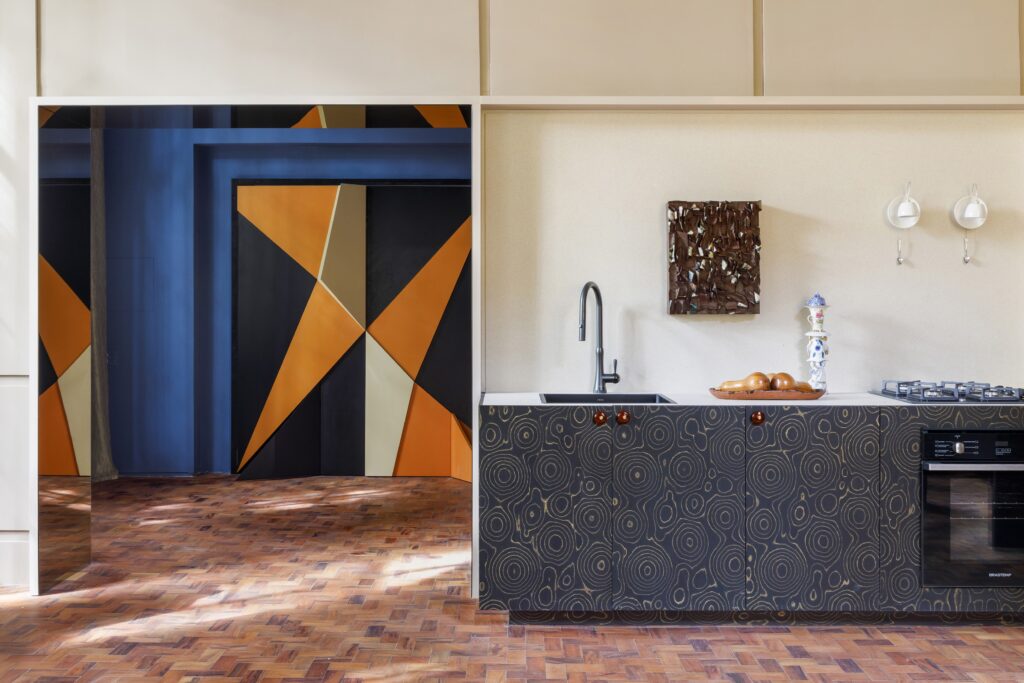
Geometric panels in black, bronze, and orange mark the transition between the kitchen and the loft’s other rooms. Photo: MCA Estúdio
In the kitchen, cabinets with a circular design and a Corian countertop engage with the project’s overall identity. Free of excessive ornamentation, the space incorporates Brastemp appliances in a composition that prioritizes functionality without sacrificing the aesthetic language of the whole.
Rejecting the orientalist clichés common in contemporary design, the suite opts for a low bed on a fabric base that shares the room with a pachira mural, a folding screen and a central shower enclosure wrapped in 1970s-style film. The result presents the retro as a possibility for the future, not as decorative nostalgia.
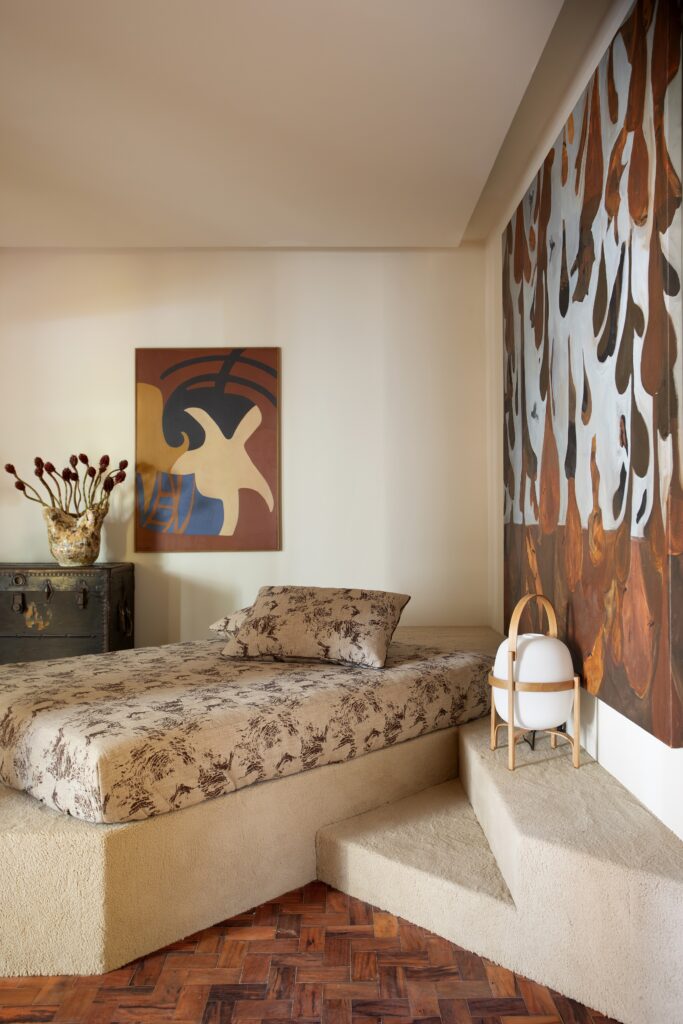
A low bed on a fabric base in the suite, flanked by a chest that belonged to the architect’s great-great-grandfather and a mural with a ’70s aesthetic. Photo: MCA Estúdio
Formal References in Layers
Drawing on Brazilian modernism, mid-century aesthetics and classical Eurocentric references, the project’s formal vocabulary brings arched windows and the traditional separation between powder room and bath into dialogue with collectible furniture and contemporary works of art. None of the citations operates in isolation: all articulate within a coherent ensemble logic.
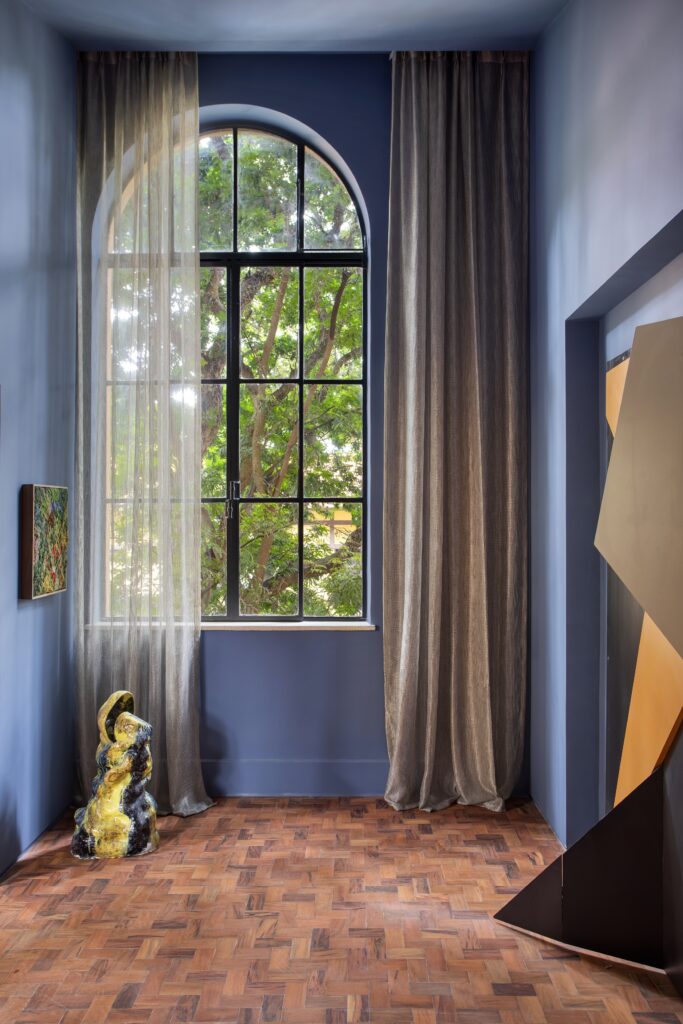
An arched window framed by curtains; this typology is part of the repertoire of classical Eurocentric references incorporated into the project. Photo: MCA Estúdio
Among the highlights is a door-sculpture inspired by Lygia Clark’s Bichos series, filtered through Bauhaus constructive rigor. Commanding the loft’s generous ceiling height in the living room, the Flying Disc chandelier by German designer Ingo Maurer serves as another focal point. A decorative fireplace in bronze Formica with candles evokes pre-war European and American apartments. Stripped of any museological austerity, a leather Chesterfield sofa directly recalls the grandfather’s living room.
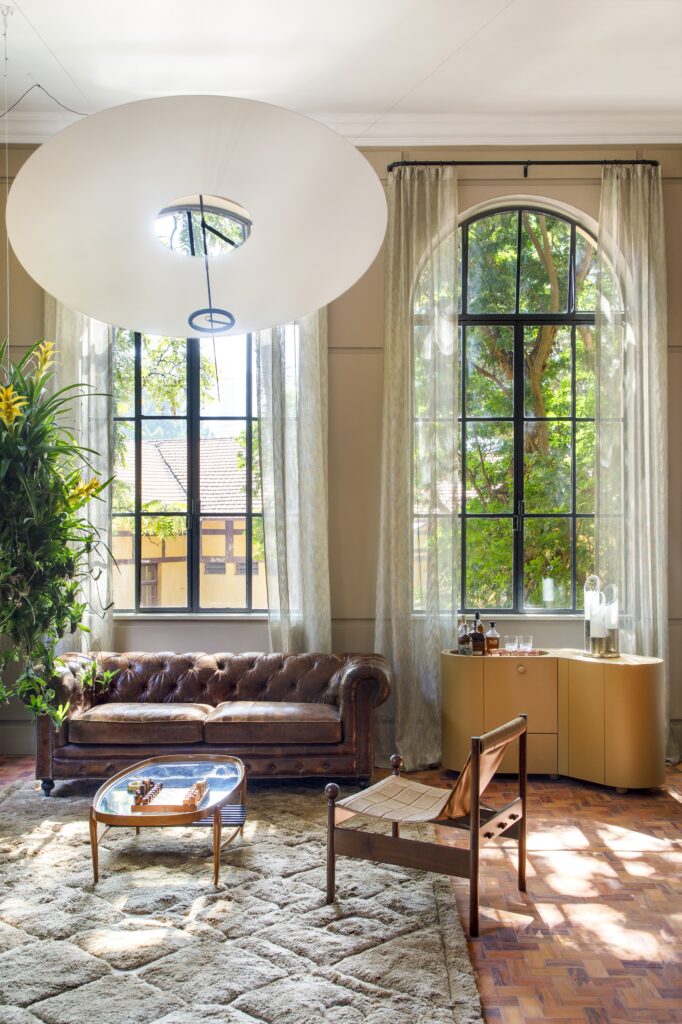
A leather Chesterfield sofa and arched windows in the loft’s living room, a space also highlighted by the Flying Disc chandelier by Ingo Maurer. Photo: MCA Estúdio
Affirming the connection between Brazilian authorial design and the international circuit, the Sushi and Pirarucu collection by brothers Fernando and Humberto Campana is not a casual choice. Positioned at that intersection between the country’s cultural heritage and the languages of global design, Carolo’s work functions as a synthesis of a Brazilian creative approach that engages with the outside world without subordinating itself to it.
Botanical Installation and Art Curation
Made up of bromeliads, Jacob’s favorite flower, the botanical installation by landscape designer Aline Matsumoto moves through the space as an organic presence. Beyond connecting the project to its most immediate emotional dimension, the plant element grounds the narrative in a concrete detail from the honored patriarch’s biography.
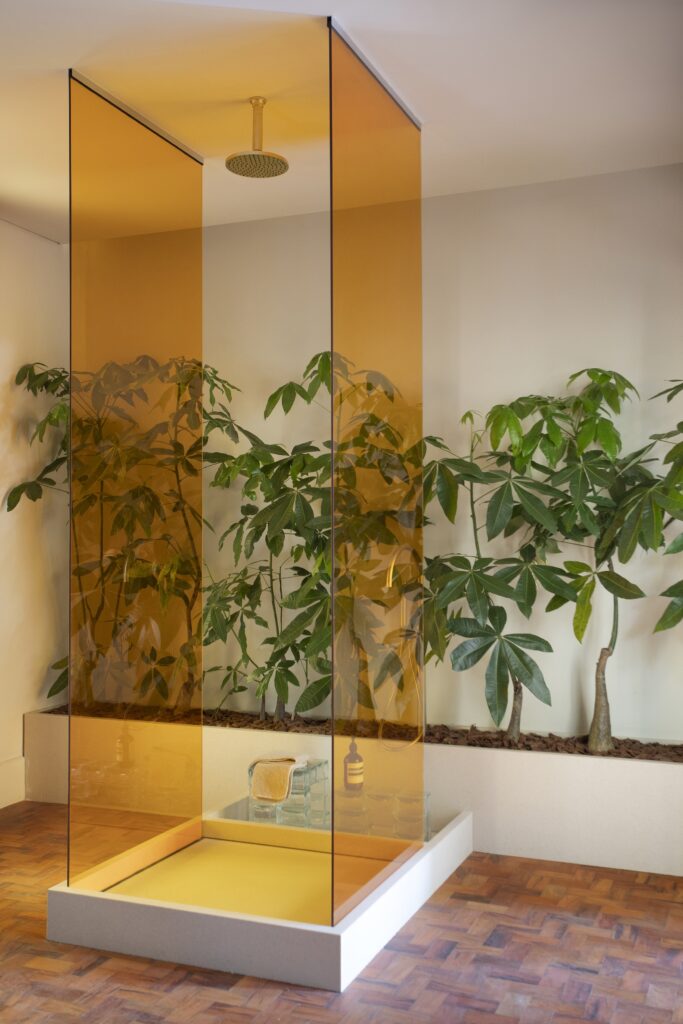
A shower enclosure with amber-colored glass installed next to the pot of pachira plants, part of the botanical installation designed by Aline Matsumoto. Photo: MCA Estúdio
Bringing together works from artists with distinct practices, the art curation includes pieces by Maria Antonia from the series Carne da Terra. Julio Villani, Pierre Verger, Jandira Waters, Poliana Toussaint, Tathyana Santiago and Carol Ambrosio make up the pictorial roster. Developed in partnership with the architect specifically for the project, the collection of authorial ceramic objects named Tempo is signed by Luiza Navarro.
Gustavo Pla, who works professionally as Gustavo Peres da Silva, also contributes objects to the space. A portion of the works comes from Galeria Estacao, Galeria Mario Choen and Galeria WG, which form part of the project’s institutional curation.
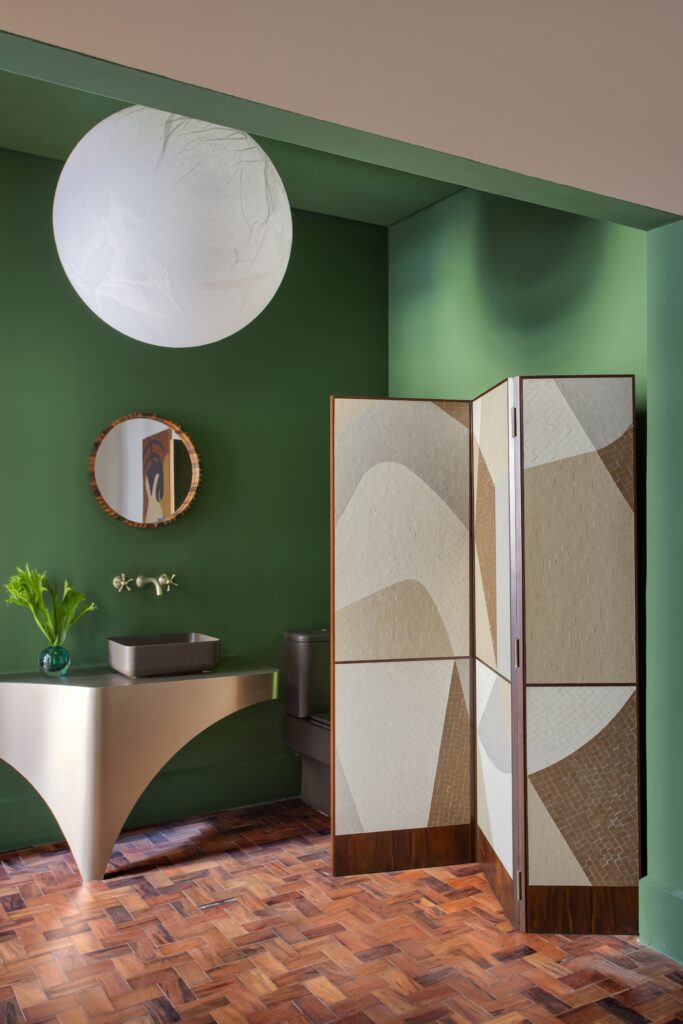
A moss-green half-bath, featuring a handcrafted screen and a sculptural metal sink, is part of the design’s proposed traditional separation between the half-bath and the full bathroom. Photo: MCA Estúdio
A Stance on Design and Artificial Intelligence
More than a set of aesthetic choices, the project is an authorial stand. Positioning his work in opposition to what he describes as the standardization driven by artificial intelligence in creative processes, Carolo adopts bespoke craftsmanship as a methodological principle, not merely a commercial argument.
According to the architect, expressions such as “emotional memory” have been repeated so often in the industry’s discourse that they have lost real content. Every choice in the project must be justified by a concrete experience, not by an algorithm-generated brief. That is the premise guiding the conception of the loft from entrance to ceiling.
Grounded in the architect’s consistent body of work, that market identity is associated with colorism, typological experimentation and a systematic rejection of the decorative neutrality that defines much of the high-end segment.
Suppliers and Sponsors
Established names in the industry supply the project across different specialties. Novaes Ferreira and See Planejados handle the custom woodwork. FAS Iluminacao and Blinkie Iluminacao are responsible for the technical and decorative lighting. Donatelli and Caran Concept, in partnership with Hunter Douglas, supply fabrics and window treatments. Botteh Tapetes provides the living room rug.
Studio Vitty is responsible for the countertop, shower area and planter. The furniture selection includes pieces from Dpot, Etel and Quina Mobilia. By Kamy supplies the Chesterfield sofa. Jacqsa Vidros and Severino Vidros provide the glass elements and entrance door, while JP Cores handles the restoration and painting of freestanding furniture.
Rounding out the supplier list, Abc Control supplies window film; Alpi Wood provides the wood veneers; Casa Picolo, the mattress and bed upholstery; Coral, the paints; Deca, plumbing fixtures and hardware; Duratex, the MDF panels; F. Studio and Iludi, decorative objects; Richard Calhabeu, individual pieces; St James and Dpot Objeto, additional objects; and Trousseau, on Alameda Gabriel Monteiro da Silva, the bath accessories.
Electrical engineering is under the responsibility of engineer Edison. Structural work was carried out by Atiossi. Floor sanding was performed by Cleber. Formica laminates applied at various points throughout the environment complete the range of materials used in the project.
About the Architect
Based in São Paulo, Felipe Carolo has built a body of work over the past several years that places him among the most distinctive voices of the new generation of Brazilian interior architecture. Functioning as an affective and aesthetic translation of what the patriarch’s life represents for the architect’s personal and professional formation, the project goes beyond a literal reconstruction of his grandfather’s home.
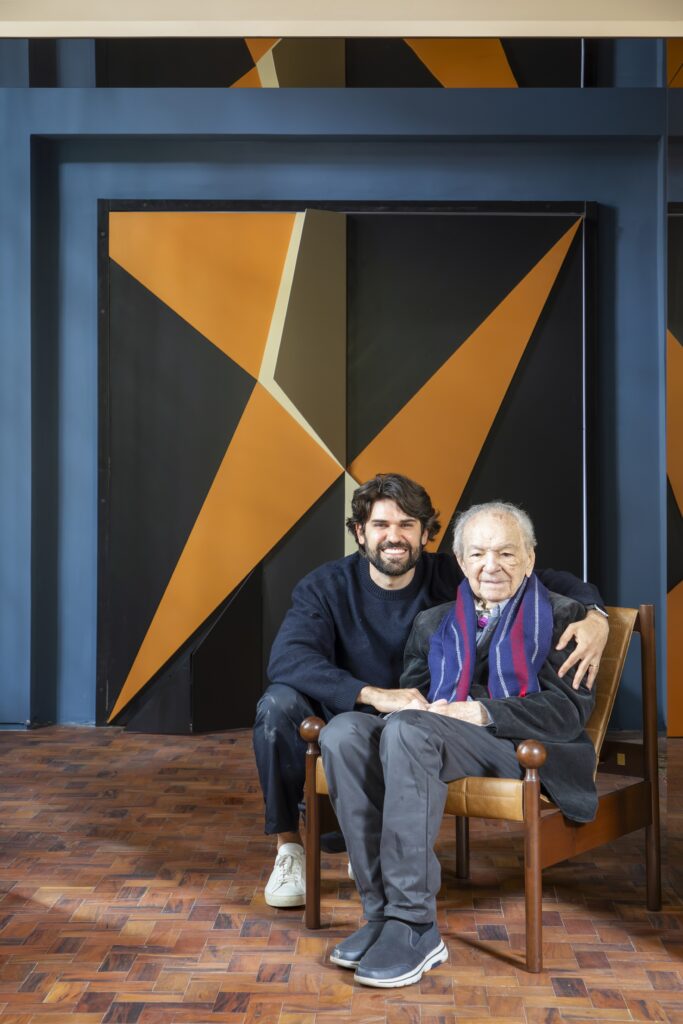
Felipe Carolo and his grandfather, Jacob Carolo, who was honored by the “Casa Jacob | Itaú Personnalité” project at the 39th edition of CASACOR São Paulo. Photo: MCA Estúdio
CASACOR São Paulo 2026
Located at Parque da Água Branca, Dona Ana Pimentel Street, in the western zone of São Paulo, the 39th edition of CASACOR São Paulo runs from June 2 through Aug. 9, 2026, with paid admission.
Event information
CASACOR São Paulo 2026 | June 2 – Aug. 9, 2026
Parque da Água Branca, Dona Ana Pimentel Street, São Paulo, Brazil
www.casacor.com | @casacor_oficial
Felipe Carolo Arquitetura
www.felipecarolo.com | @felipecaroloarq