 Serpa
Serpa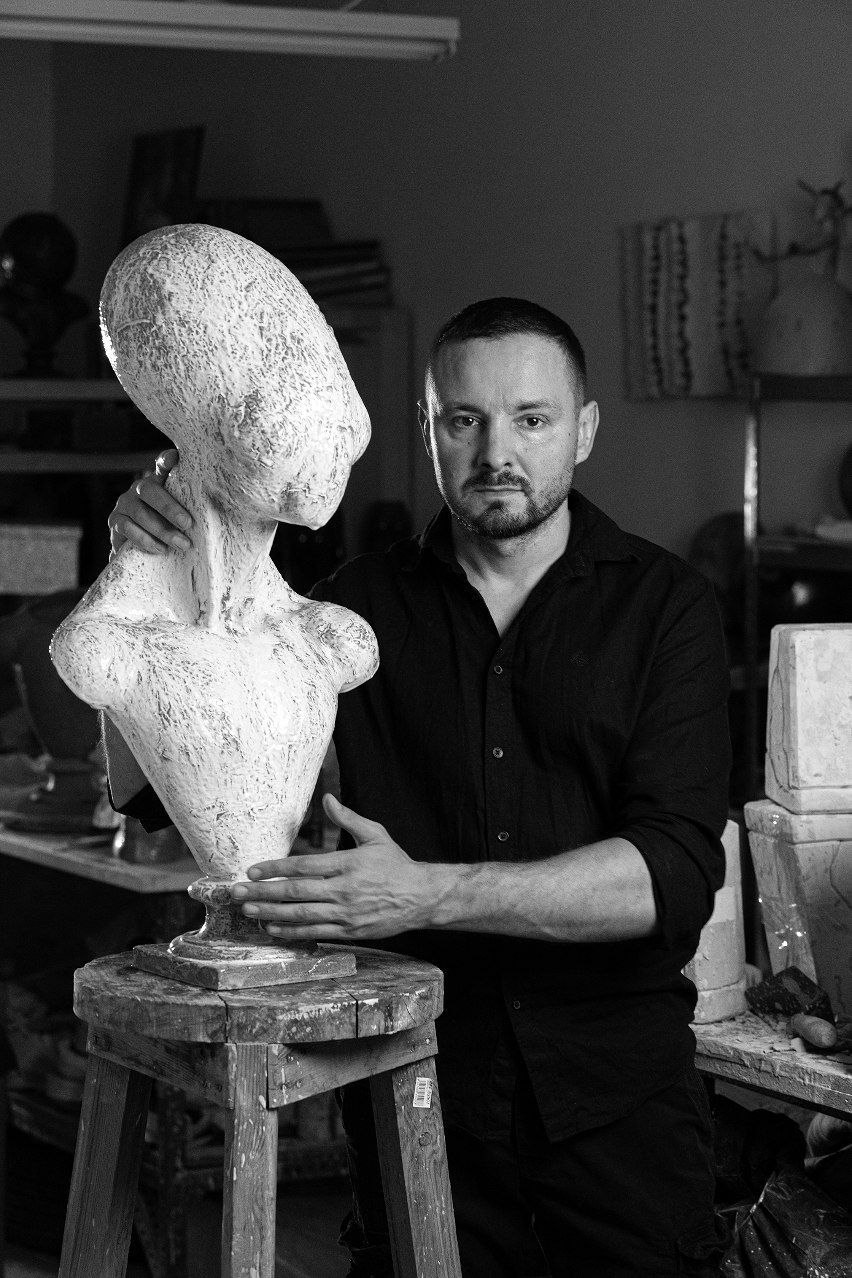
Yuriy Musatov
Yuriy Musatov, who won second prize at the Manises Biennial in 2024, creates hybrid and alien-like figures as a metaphor for exile and migration.
Ukrainian ceramist Yuriy Musatov, 44, who has been living and working in Spain since leaving his homeland after the outbreak of war, has permanent works in the collections of eight international museums, including the National Museum of Ceramics González Martí in Valencia and the Musée Ariana in Geneva. With more than 20 solo exhibitions and 100 group shows held between 2012 and 2026, the artist is a member of the International Academy of Ceramics (IAC), a UNESCO-affiliated body that brings together the world’s most prominent ceramic artists, and of the National Union of Artists of Ukraine. His trajectory places him among a small group of artists from Eastern Europe who have managed to build a sustained international presence without relying on the commercial gallery infrastructure of Western art capitals.
Musatov’s career gained international recognition in 2024, when he won Second Prize at the XVI International Ceramics Biennial of Manises, in Spain, one of the most prestigious competitions in the field. The award brought renewed attention to a body of work that had been steadily expanding across continents for over a decade. The following year, in 2025, he took part in the International Ceramics Biennial of Aveiro, in Portugal, and opened the solo exhibition I Am Alien at the Casa de Cultura de Manises, a title that encapsulates the core of his artistic inquiry: the figure of the displaced person, alien to his own surroundings. The show was received as one of the most coherent statements he has made about identity and belonging in the context of forced migration.
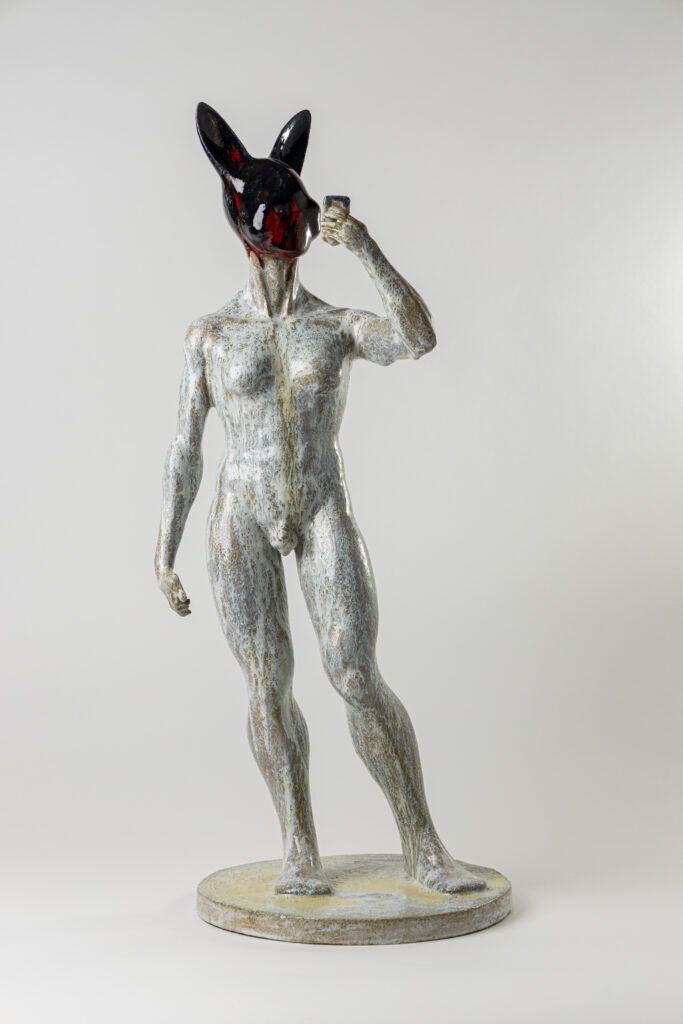
MODERN DAVID 2024 63x26x25cm
Institutional acquisitions over the past five years reveal the global reach of his work. In addition to Valencia and Geneva, his pieces are part of the permanent collections of the Ceramics Museum in Ludwigsburg, Germany, the FuLe International Ceramic Art Museum (FLICAM) in China, the National Museum of Slovenia, the Aveiro Municipal Museum in Portugal, the National Open-Air Museum of Ukrainian Pottery, and the Panevezys Civic Art Gallery in Lithuania. Having works in public collections across three continents is uncommon for artists outside the major art market centers, and it speaks to the cross-cultural legibility of his sculptural language, which communicates its emotional charge without depending on cultural specificity or linguistic mediation.
Born in 1981 in Ukraine, Musatov earned his master’s degree from the Lviv National Academy of Arts in 2008, where he developed a foundation in traditional ceramic techniques that he would later expand into a fully contemporary sculptural practice. For years he built his career while remaining based in Ukraine, gaining recognition through international residencies and exhibitions before the war changed the calculus entirely. The move to Spain, driven by the circumstances of the Russian invasion, deepened the themes already running through his work: displacement, otherness, and the construction of identity in unfamiliar territory. “The alien is not a fictional being,” the artist explained in a statement about his poetics. “It is a symbolic figure representing sensitivity, vulnerability, and heightened perception,” a portrait that could easily describe the refugee himself. In this sense, the war did not redirect his art so much as collapse the distance between his subject and his lived experience.
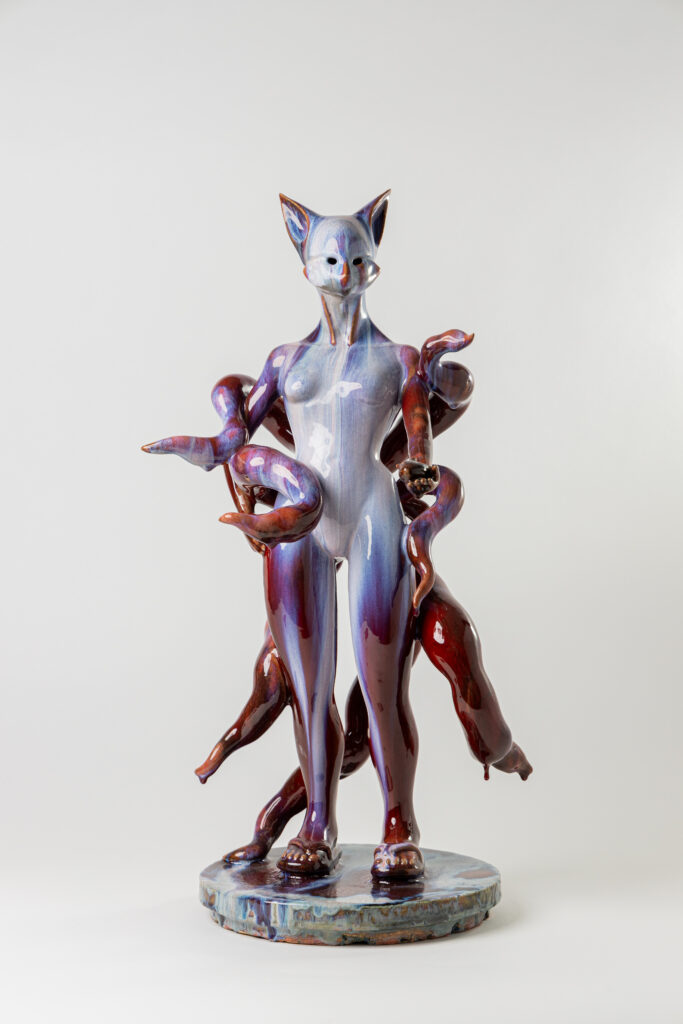
KITSUNE NAMED SAKURA 2024 57x25x25cm
His membership in the International Academy of Ceramics, granted in 2017, is one of the milestones that set Musatov apart in the field of applied arts. Founded in 1952 and headquartered in Geneva, the IAC is the leading global organization dedicated to ceramic art and operates under the umbrella of UNESCO. Its members, selected through a rigorous admission process based on portfolio and international standing, number around 1,500 artists, curators, researchers, and institutions across more than 50 countries. The academy organizes biennials, commissions research publications, and maintains a peer network that functions as one of the primary legitimizing structures for the recognition of ceramics as a major art form rather than a decorative craft. Admission is not automatic and carries real institutional weight: it signals that an artist’s practice has been evaluated and validated by a global community of specialists. For Musatov, joining the IAC opened doors to residencies and exhibitions at museums that rarely welcome artists outside established circuits, including the Musée Ariana in Geneva, which both acquired one of his pieces and included him in the group show Migration(s) in 2022. The IAC connection also placed his work alongside that of artists from Japan, South Korea, China, and Western Europe, reinforcing the genuinely international scope of his reception.
In terms of artistic language, Musatov works with figurative ceramic sculpture, producing busts and objects that occupy a space between sculpture and design. The human figure is not rendered literally or anatomically but reduced to its essential emotional core, a carrier of inner states rather than a portrait of outer appearance. Clay is the central material, but glaze, both matte and glossy, plays an equally defining role. The artist describes glaze not as a decorative layer but as a sculptural tool: color shapes the emotional state, atmosphere, and presence of each piece. He works intuitively with chromatic transitions and surface contrasts, allowing mood, tension, and stillness to emerge through the interplay of volume and finish rather than through narrative imagery. Simplified volumes, restrained surfaces, and carefully balanced forms characterize a visual vocabulary designed to hold its own in museum settings as much as in private interiors. The pieces invite slow looking, the kind of sustained attention that institutional spaces encourage but that domestic environments rarely demand, and Musatov has said that this tension between contexts is itself part of his interest.
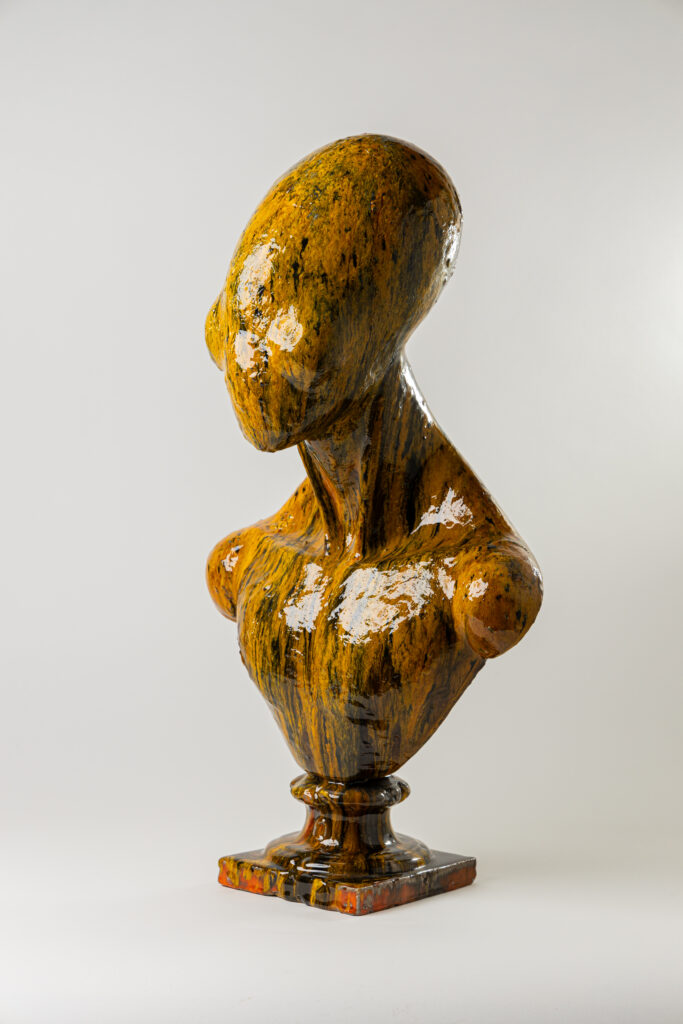
Yellow bust 2024 74x37x30 cm
His creative process begins not with a fixed sketch but with observation and reflection. Musatov has described his method as a direct dialogue with the material, in which the figure emerges gradually through intuition rather than being imposed from a predetermined plan. This approach aligns with a broader tradition in ceramic art that treats the making process as inseparable from the meaning of the finished work, where the resistance and responsiveness of clay become part of the artistic statement. In his case, that statement is consistently about what it feels like to exist on the margins of belonging, to be present in a place without being fully of it.
Musatov’s place in the international circuit is also built through artist residencies, which have taken him to four countries across two continents over the past decade. In 2026, he participated in the CCCA Yixing Ceramic Art Residency in China, a program hosted in one of the country’s most storied centers of ceramic production. Earlier residencies included the Double 24 International Summer Ceramic Workshop in Foshan, China (2025), the International Ceramic Studio in Kecskemét, Hungary (2022), the Clayarch Gimhae Museum in South Korea (2017), and FLICAM in Fuping, China (2016). These programs are not merely professional development opportunities; they have provided direct pathways to the museum acquisitions and institutional relationships that now define his career. The Clayarch Gimhae residency, for instance, placed him in contact with a curatorial network that later contributed to the inclusion of his work in the Voyage of Discovery exhibition at that same museum.
Musatov continues to develop projects that engage with architecture, public space, and private collections. His work is conceived to interact naturally with built environments, whether a gallery white cube, a cultural venue, or a restaurant, without losing its autonomy as an object. That ability to function across different spatial and institutional registers is perhaps what has made his pieces attractive to such a diverse range of collectors and institutions.
Instagram: https://www.instagram.com/yuriy.musatov/