 Serpa
Serpa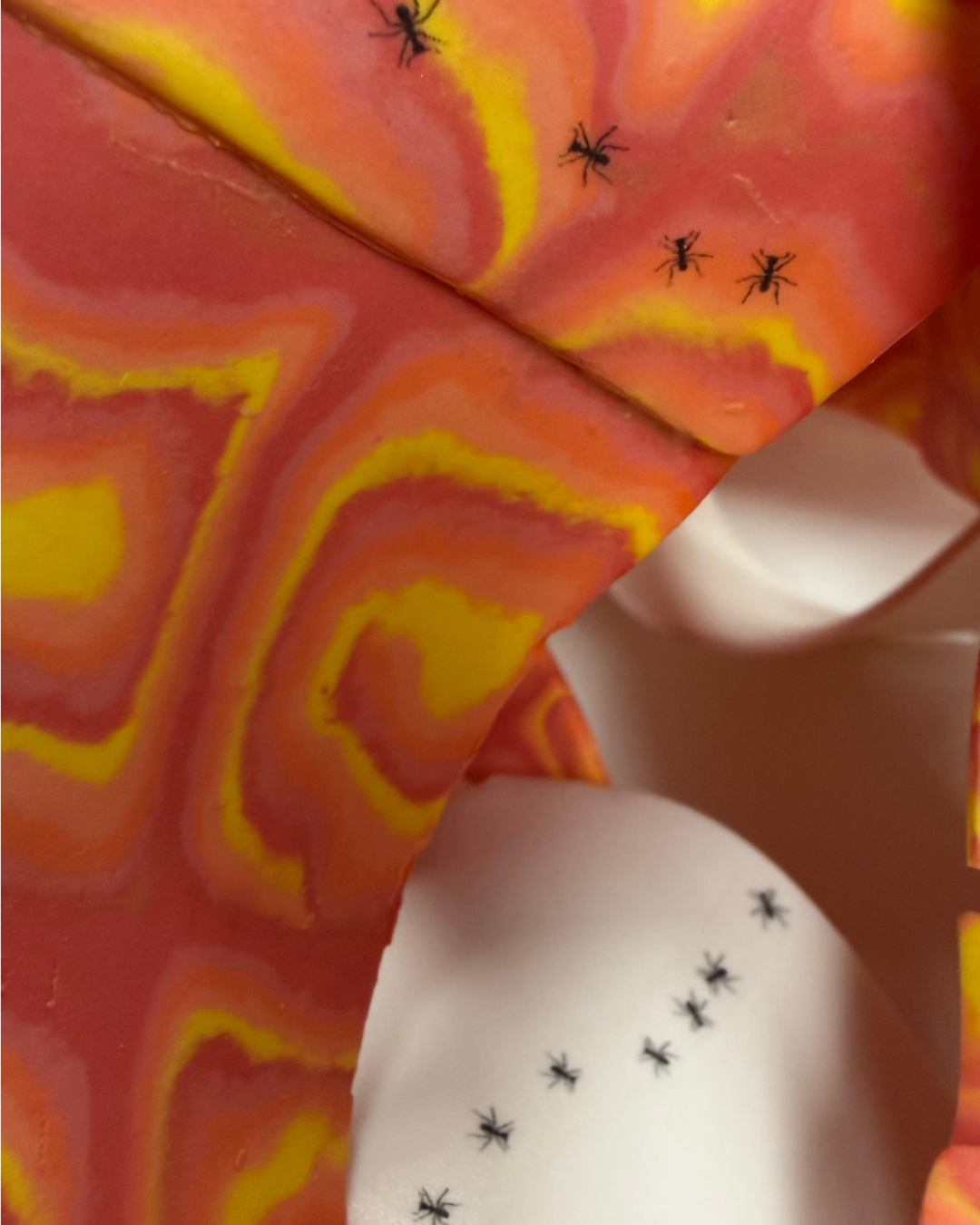
Elizabeth Dychter, a member of the International Academy of Ceramics, answers that question with kilns, porcelain, and a deeply unsettling new series about the limits of human sanity.
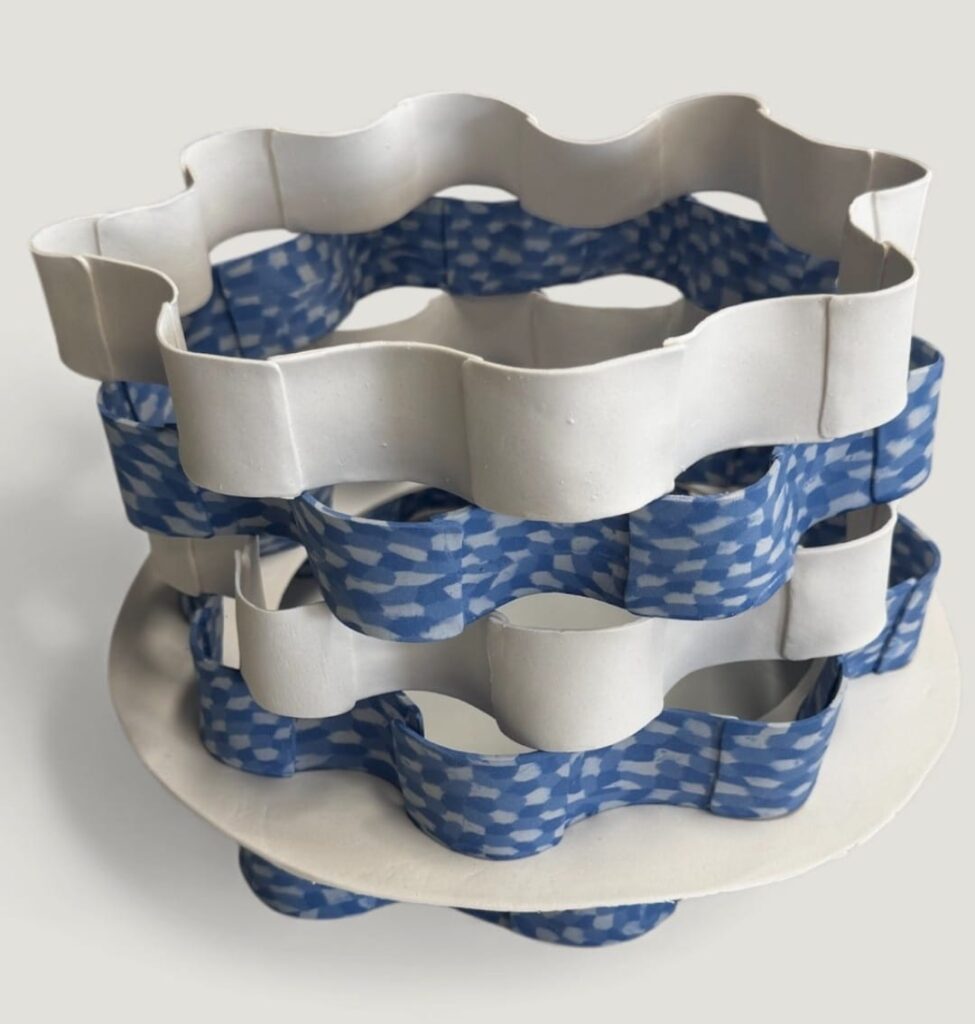
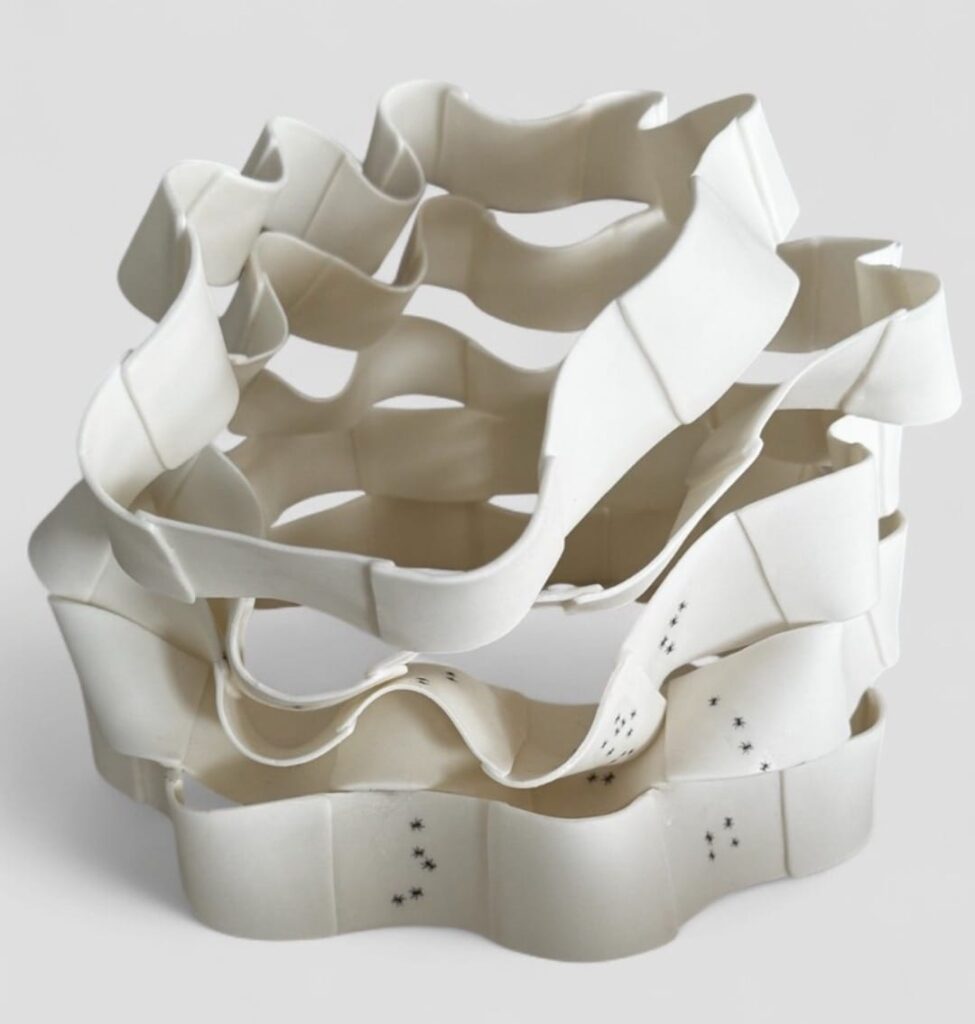
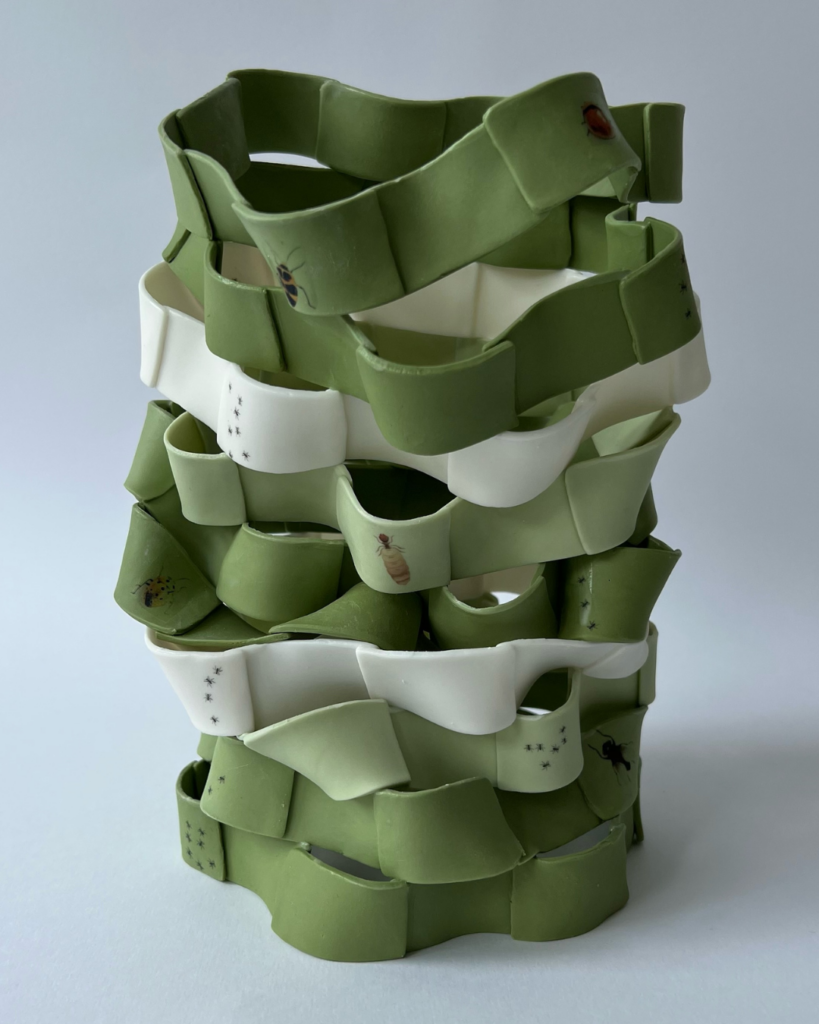
A piece of porcelain crumbling inside the kiln before it is finished. Thin waves collapsing under extreme heat. Psychedelic colors bursting out of the void. Insects creeping between shapes. For Elizabeth Dychter, an Argentine artist based in Punta del Este, Uruguay, and a member of the International Academy of Ceramics since 2017, these are not studio accidents: they are deliberate metaphors for the human mind on the verge of collapse. Her most recent body of work, the product of a career spanning more than 35 years in ceramics and artistic residencies across four countries, calls into question the boundaries between sanity and madness, beauty and decay, and meditation and chaos.
The daughter of a Holocaust survivor, Dychter grew up with a sharp awareness that life can vanish in the blink of an eye. During the first two decades of her career, that inherited memory shaped the vocabulary of her pieces, marked by the weight of history, the obligation of remembrance, and the pain passed down between generations. But a personal turning point changed the direction of her work. “I realized that what moved me was the need to create awareness about that very knowledge: life is not granted,” the artist writes in her most recent statement. From the memory of the Holocaust, her gaze shifted toward another form of human fragility: mental health.
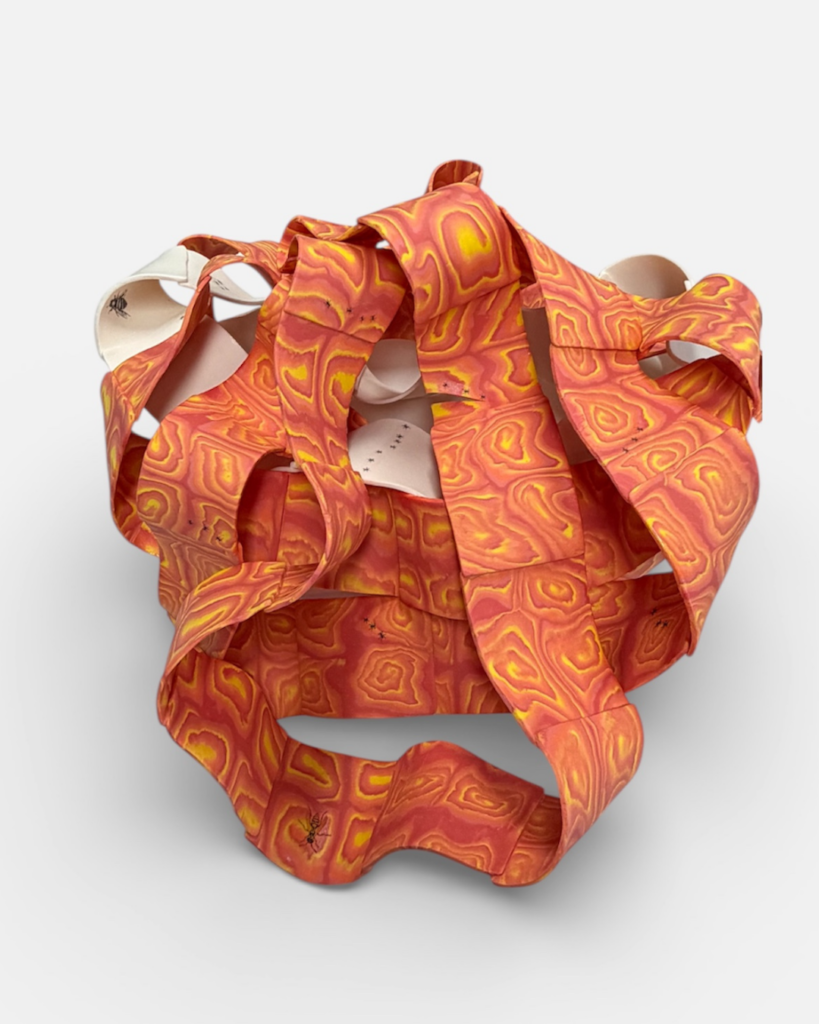
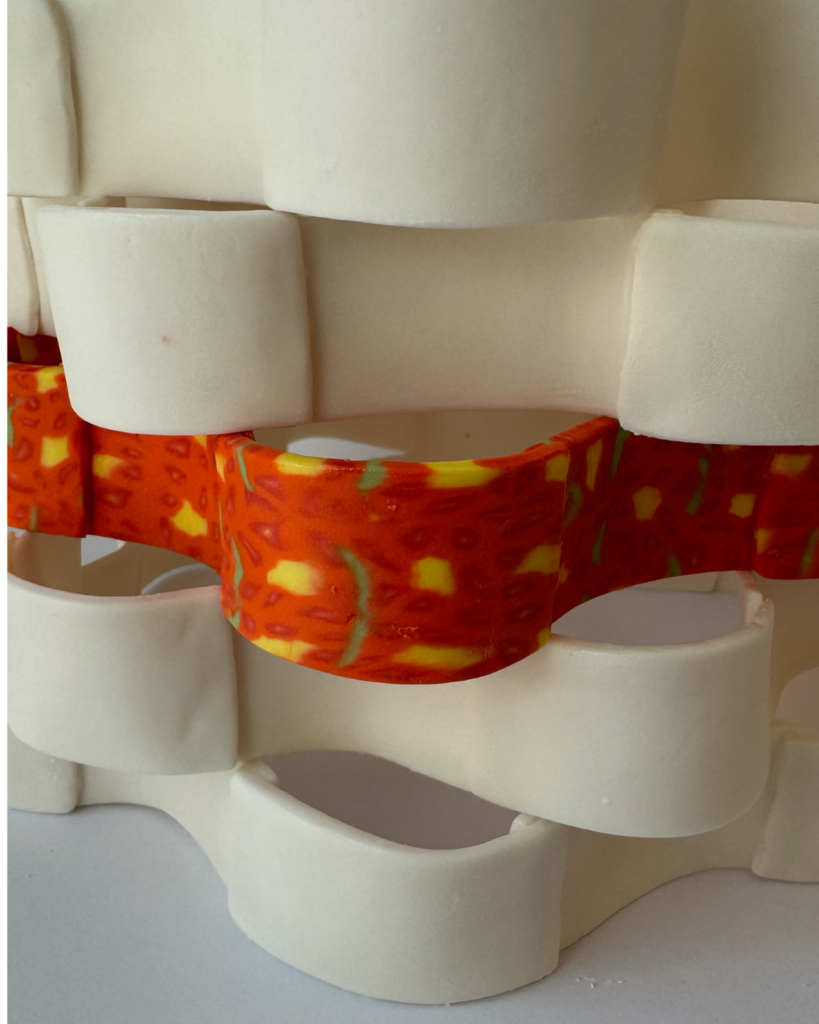
The new series explores that transition with both technical precision and poetic depth. The choice of porcelain is no accident: the material, one of the most delicate and demanding in ceramics, behaves unpredictably when exposed to kiln temperatures, much like the human mind under stress and suffering. The waves that collapse inside the kiln become, in Dychter’s language, a direct representation of psychic fragility. The void that emerges from the pieces, intentionally preserved and left unfilled, speaks to the inner silence of mental crises. Vibrant, psychedelic colors coexist with the nerikomi technique, a Japanese method of inlaying colored clay that demands meticulous planning and that, paradoxically, can be read either as a meditative exercise or as an expression of complete mental chaos.
Three Decades, Four Continents
Dychter’s trajectory began in Buenos Aires in 1988, when she started studying ceramics under Professor Alejandra Jones. Before that, she had worked in fashion, graduating in fashion design from ABM in 1985 and 1986, and in tapestry, under Professor Rosa Chernoff, which gave her a singular understanding of the tactile and visual possibilities of handcraft. In the years that followed, she expanded her training with raku, sawdust firing, and glazing techniques, taking part in the Jornadas Internacionales de Ceramica in Buenos Aires in 2004, 2005, 2006, and 2008, and studying with Israeli professor Yehuda Koren at the National University Institute of Arts (IUNA).
Over more than three decades, the artist has built a resume of international reach. Her most notable awards include the Grand Prize of Honor and second and third place at the International Ceramics Salon of the Argentine Center of Ceramic Art (CAAC), along with honorable mentions at the Bienal de Berazategui, the Salon Municipal de Avellaneda, and the National Foundation of Cancer. Her work has been shown at ArtExpo New York (2011), the 5th Ceramics Triennale Unicum in Ljubljana, Slovenia (2023), the 41st International Ceramics Competition CICA in L’Alcora, Spain (2022), and the 32nd Contemporary Ceramics Competition in Grottaglie, Italy (2025), among dozens of other exhibitions across Latin America, Europe, and the Middle East.
Not only that, but her pieces are held in permanent collections at museums and institutions across four continents, including the Holocaust Memory Museum and Foundation in Buenos Aires, for which she mounted a solo exhibition in 2009, the Museum of Contemporary Ceramic Tiles in San Nicolas, Argentina, the Contemporary Museum of Ceramics in the Dominican Republic, the International Museum of Ceramics (MIC) in Faenza, Italy, the Armazem das Artes in Alcobaca, Portugal, the Ceramics Museum of Grottaglie, and the Kanoria Centre for Arts in Ahmedabad, India. The presence of her work in these collections reflects the recognition of an artistic language that moves fluidly across the ceramic traditions of different cultures.
Residencies That Shaped a Poetics
A central element in Dychter’s ongoing development is her commitment to artistic residencies. In 2012, she spent time in Vallauris, France, the mecca of European art ceramics made famous by Pablo Picasso, where she exhibited at the Aqui Siam Ben and Le Cabanon galleries. In 2013, she went to Rome, taking part in the C.r.e.t.a. Rome program. In 2014, she returned to Vallauris through the IOA program. In 2019, 2023, and 2024, she completed residencies in Faenza, the Italian city that gave its name to the faience technique and is home to the MIC, one of the most important ceramics museums in the world, where she also mounted a solo exhibition in 2024. These immersions in historic centers of European ceramics deepened both her technical mastery and her understanding of the conceptual possibilities of clay.
Dychter’s current series can be read as a synthesis of all these influences, technical, historical, personal, and conceptual. The artist does not treat mental health as an external or abstract theme but as a lived field, felt in the material itself. The nerikomi technique, intricate and time-consuming, is at once a contemplative practice and an exercise in controlling chaos, which is precisely what mental disorders put at risk. The insects that appear in the pieces evoke restlessness, the inability to stay still, and the movement beneath the surface of normality. The psychedelic colors, rather than suggesting joy, point to the sensory overload of a mind in collapse.
Sanity Always on the Edge
For an artist who grew up hearing accounts of extreme survival, the question of the limits of human resistance has always been at the center of her worldview. Ceramics, with its dependence on fire and chance, its demand for patience, and its vulnerability to the kiln, is the ideal medium for exploring that question. A piece can crack at the very last moment. It can come out unrecognizable. It can be exactly what the artist envisioned or the complete opposite. “Sanity is always on the edge,” Dychter writes in her statement, a sentence that captures both her artistic vision and the arc of her life.
Dychter’s work arrives at a moment when the conversation about mental health has gained unprecedented global visibility, accelerated by the crises of the pandemic and by a growing awareness of disorders that remained invisible for decades. In the world of contemporary art, clay is experiencing a period of revaluation: artists everywhere are rediscovering in the material a resistance to digital ephemerality and a connection to the body, to time, and to imperfection. Within that context, Dychter’s work occupies a distinctive place, being at once the product of a deep technical tradition and an original conceptual contribution to the debate about what it means to be human in a world that constantly demands the performance of stability.
Dychter’s membership in the International Academy of Ceramics (IAC/AIC) since 2017 represents one of the most significant distinctions in the world of ceramic art. Founded in 1952 in Geneva, Switzerland, by the Frenchman Henry J. Reynaud, the IAC is the leading international organization dedicated exclusively to ceramics as an artistic language. It brings together artists, designers, educators, curators, collectors, and institutions from across the globe, with members in more than 50 countries. Its headquarters are at the Musee Ariana in Geneva, one of Europe’s most important museums dedicated to ceramics and glass. Since 1958, the organization has maintained a formal relationship with UNESCO, becoming an official partner of the cultural sector in 2001. Every two years, the IAC holds an international congress: the 51st took place in 2024 in Alcobaca and Caldas da Rainha, Portugal, under the theme “Ceramics in the Mediterranean World: From Antiquity to the Contemporary,” and the 52nd is scheduled for 2026 in Jingdezhen, China, considered the world capital of porcelain. Admission to the IAC is by invitation or nomination and requires consolidated international recognition, making the presence of a Latin American ceramist in its ranks a remarkable achievement in the region’s visual arts landscape.
It was through the IAC that Dychter participated in the organization’s 2024 members’ exhibition in Alcobaca, Portugal, with a work now incorporated into the permanent collection of the local Armazem das Artes. In 2025, she has a piece selected for the 32nd Contemporary Ceramics Competition in Grottaglie, in the Puglia region of southern Italy, whose permanent collection already holds her work. Her pieces are also held in collections in Monterrey, Mexico, Quilmes and Olavarria, Argentina, and the Escuela Arranz in Buenos Aires, and her work has appeared in specialized publications including La Ceramica Moderna & Antica and Revista Ceramica Argentina.
Life and death, beauty and decay, madness and light. The pairs Dychter chooses as the coordinates of her artistic vision are not opposites that exclude each other; they are, in her view, the two faces of a single reality that ceramics, more than any other medium, has the capacity to hold. Because clay, like the mind, needs fire to become what it is. And because, in the kiln as in life, no one ever knows exactly what they will find when the temperature finally comes down.
Website: https://elizabethdychter.com/
Instagram: https://www.instagram.com/elizabethdychter/