 Serpa
Serpa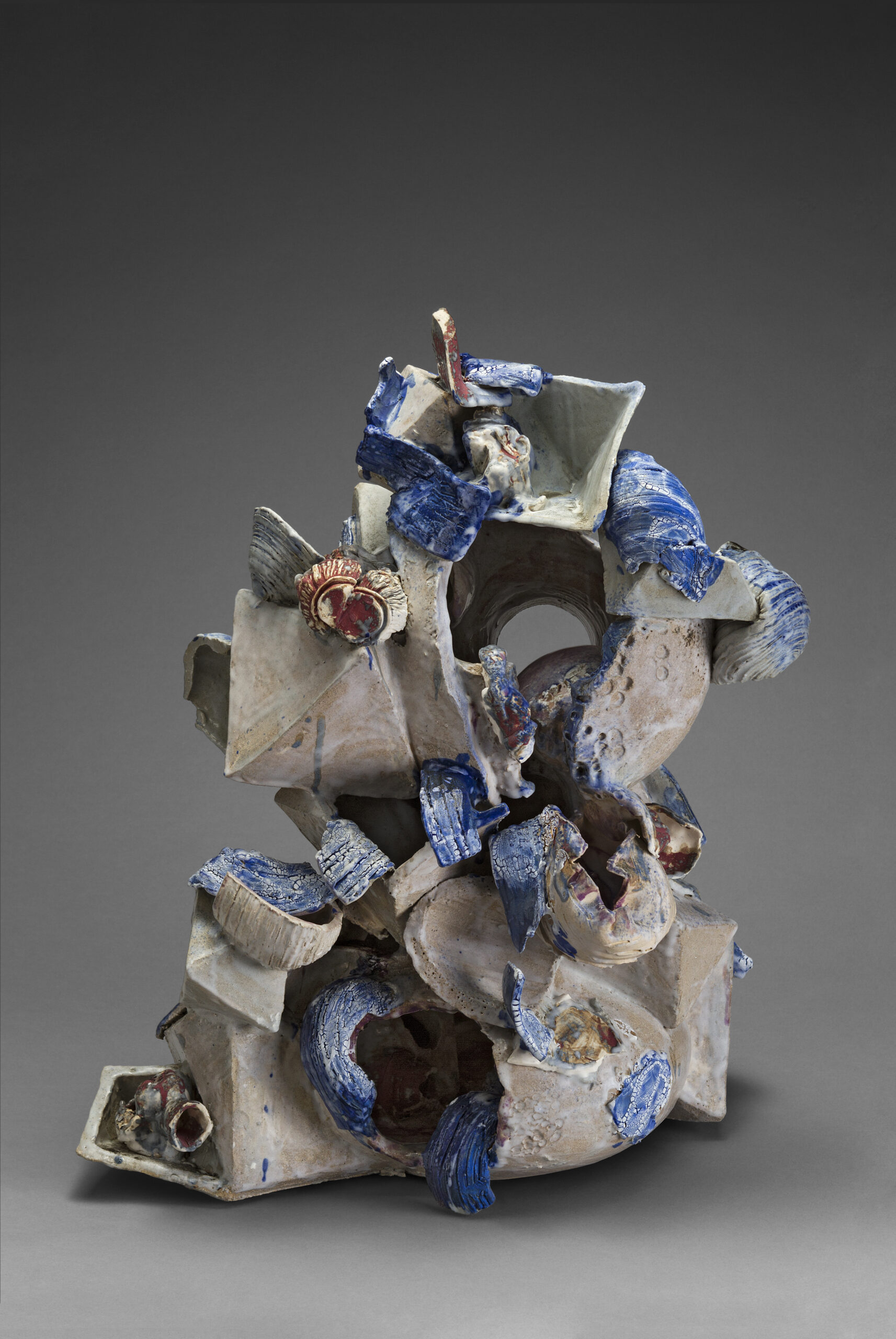
El encanto de las ruinas
With “Textiles del mar,” “Cero Zen,” “El encanto de las ruinas,” and “Cargas Peligrosas,” Argentine artist Sofia Donovan has mapped in clay and textile the forces that transform, fragment, and yet persist
Sofia Donovan does not seek perfection in her work. She seeks the opposite: the crack, the collapse, the piece that looks like it is about to fall apart. It is precisely in that tension between destruction and permanence that the Argentine artist, born in Buenos Aires in 1972 and now based in Uruguay, has built one of the most consistent careers in contemporary Latin American art. With exhibitions in London, Paris, Rio de Janeiro, and Santiago, and a monograph published in 2024, Donovan enters a new phase of her career with the clarity of someone who has spent decades in intimate dialogue with clay, textile, and drawing.
Her work can be summed up in a phrase she uses to define her own practice: “bodies in transit, active ruins, persisting in their mutation.” This is no empty metaphor. Every piece Donovan makes carries the physical marks of its own process: burned, fractured, unfinished. The surface is the content.
Cero zen – Muerte de esferas
A Career Shaped by Plural Training and International Recognition
Donovan trained at the Prilidiano Pueyrredón National School of Fine Arts, a historic institution in Argentine artistic education. She later moved to Chile, where she lived and worked from 2003 to 2025, completing diplomas in Theory and Philosophy of Visual Arts and in Aesthetics at the Pontifical Catholic University of Chile. The combination of hands-on practice and theoretical rigor would prove decisive in shaping the kind of artist she became.
In Santiago, she founded the studio La Roca, a space that functioned both as a personal laboratory and a collective platform, bringing together other artists through collaborative projects, artistic actions, and exhibitions. The studio was never just infrastructure: it was a constitutive part of her poetics, which has always placed process and exchange at the core of artistic practice.
Institutional recognition followed. Donovan received the Open Window Fund from the Chilean Ministry of Culture, was recognized by the Argentine Embassy in Santiago, and in 2021 became a member of the International Academy of Ceramics, a Geneva-based organization that gathers the most prominent names in contemporary ceramics worldwide.
Cargas Peligrosas
Presence at Biennials and Art Fairs Cements Her Place in the Global Circuit
Donovan’s exhibition history spans continents. In 2017, she appeared simultaneously in two major international platforms: the Trio Biennial “Vestir el mundo” in Rio de Janeiro and the show “Contemporary Visions 8” at Beers gallery in London. The following year, she was included in the publication “Conversatorio: 15 artistas multidisciplinarios argentinos contemporáneos” in Buenos Aires, and in “Fibras latinoamericanas,” published by Arte al Límite in Chile.
In 2019, her work reached the Grand Palais in Paris as part of the Biennale Révélations, one of the most important international fairs dedicated to applied arts and high-end design. In 2021, she exhibited at the Museo de Artes Visuales in Santiago with the show “La deriva del gesto y la forma.” Two years later, she presented “Cargas Peligrosas” at the Centro Cultural Las Condes, also in the Chilean capital.
Beyond institutional exhibitions, Donovan has participated in fairs including ArteBA and MAPA in Buenos Aires, Cha.co in Chile, and Parc in Peru, all key circuits for visibility in the regional art market.
In 2024, she published “Hablemos de tormentas,” a monograph that brings together her body of work and stands as a comprehensive document of a career built with rigor and continuity.
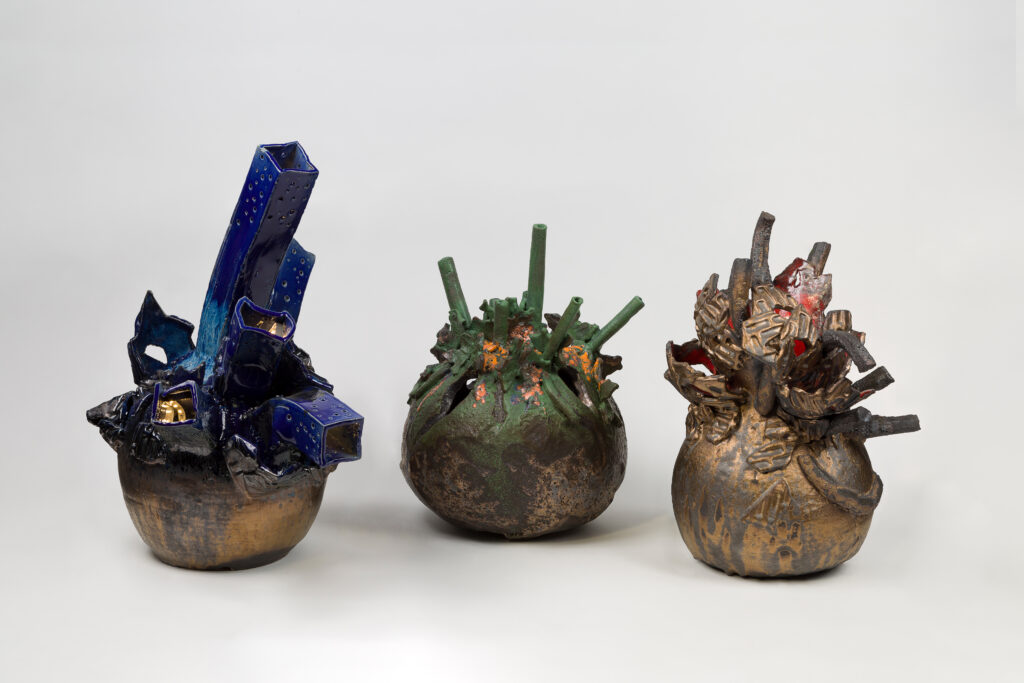
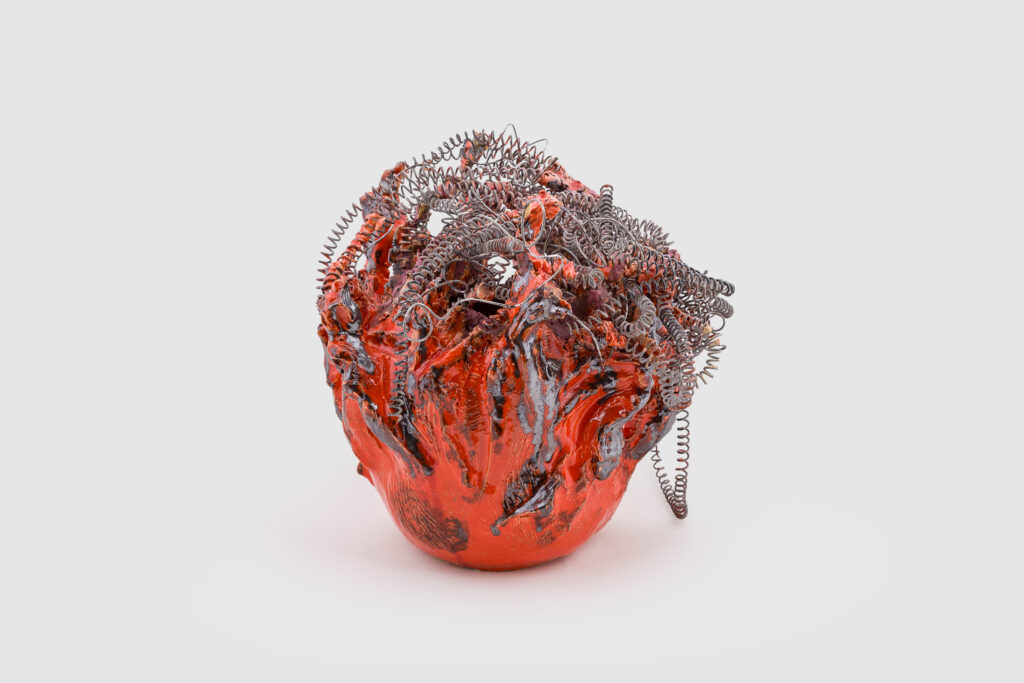
Cargas Peligrosas
Ceramics as Paradox: Resistance and Vulnerability in the Same Body
At the center of Donovan’s practice is clay. Not as a neutral support, but as an interlocutor. “I embrace ceramics for its tendency to collapse and its capacity to remember,” she says. For her, every crack or rupture that emerges during the process is not a mistake to be corrected but part of the piece’s narrative.
This perspective echoes the Japanese philosophy of kintsugi, the art of repairing broken ceramics with gold, but goes further: Donovan does not repair the fragment. She preserves it as a fragment, assembling pieces into new compositions that function, in her words, as “incomplete organisms that evolve into coherent bodies, somewhere between the monstrous and the beautiful.”
The choice of ceramics is also conceptual. The material holds memory of touch, temperature, and pressure. It is malleable when wet, fragile when dry, and nearly eternal when fired. This arc of transformations mirrors the themes Donovan explores—vulnerability, vulnerability, resilience, and repair—with a precision no other material could offer in quite the same way.
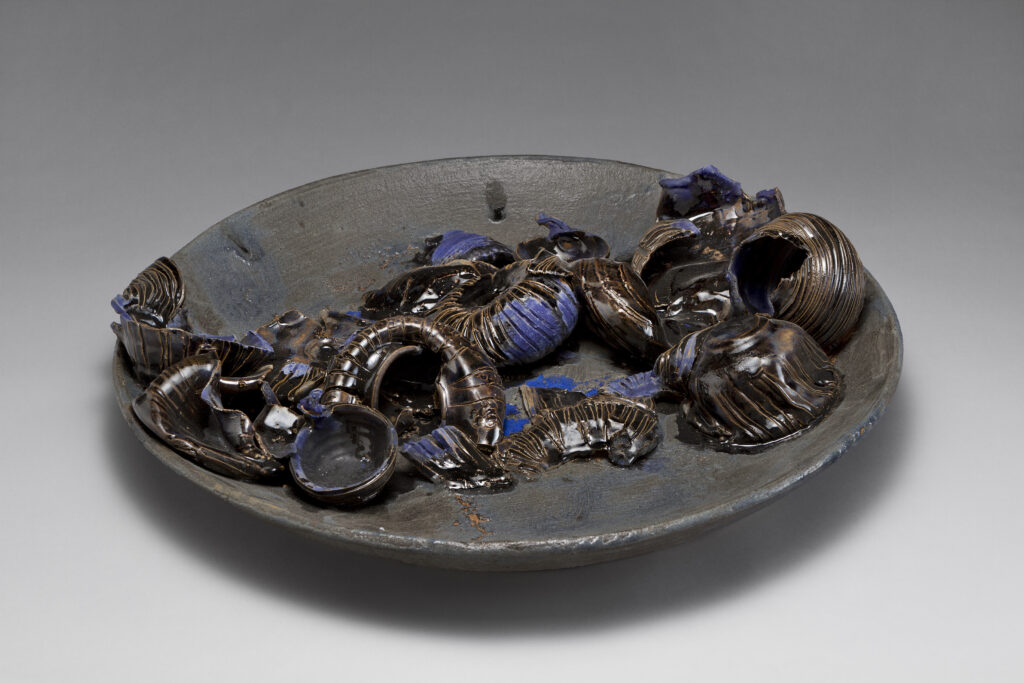
Cero zen
The Female Body as a Territory of Contradictions
Beyond clay, one thematic axis runs through the entirety of Donovan’s work: the body. More specifically, the female body is understood not as an image or representation but as a territory of contradictory forces.
“What drives me is the body, and in particular the female body, as a site of contradiction: powerful and porous, shaped by external forces and yet persistent,” the artist explains. Her abstract forms evoke skin, organs, and wounds, anatomical references that never become literal but instill an unmistakable physical presence in each piece.
This approach positions Donovan at the fertile intersection of contemporary debates on art and gender, without her work ever becoming didactic. The political emerges from the formal, not the other way around. The power of her sculptures lies in the sensory experience they provoke before any conceptual reading can take place.
A Body of Work Built on What Cannot Be Controlled
Four series. Four ways of saying the same thing: that the world is made of forces that move through us and that art is one of the few ways to look at that without turning away.
In “Textiles del mar,” Donovan takes movement itself as her material. The textiles do not represent the sea; they embody it: the push of the wind, the flow of water, and the intensity that alternately soothes and drags. The pieces carry something of the behavior of plants in the wind, that back-and-forth that is not weakness but response, a sensory relationship between body, landscape, and transformation. The material yields because yielding is also a way of persisting.
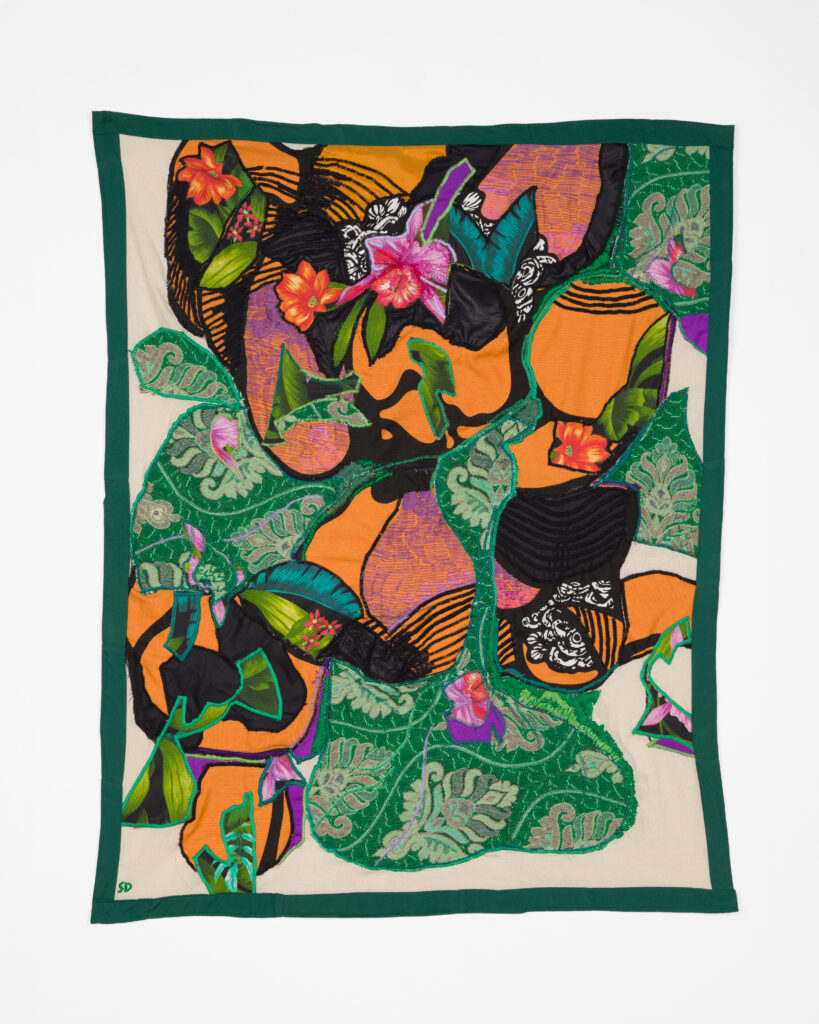
“Textiles del mar”
In “El encanto de las ruinas,” the fascination is not with destruction itself but with what it reveals. Donovan sets culture and memory against the organic and the destructive, exploring nature and time as forces that simultaneously erase and inscribe. The ruins here carry no nostalgia: they are symbols of transience, bodies worked over by time that, for exactly that reason, still have something to say about what we were and what remains.
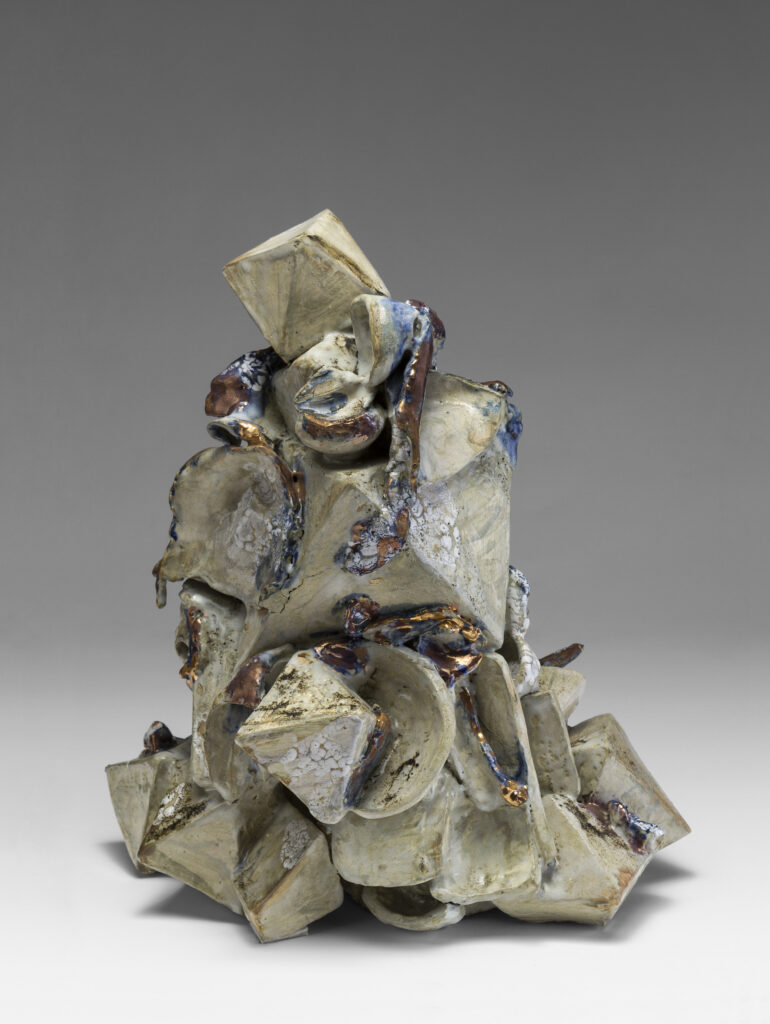
“El encanto de las ruinas”
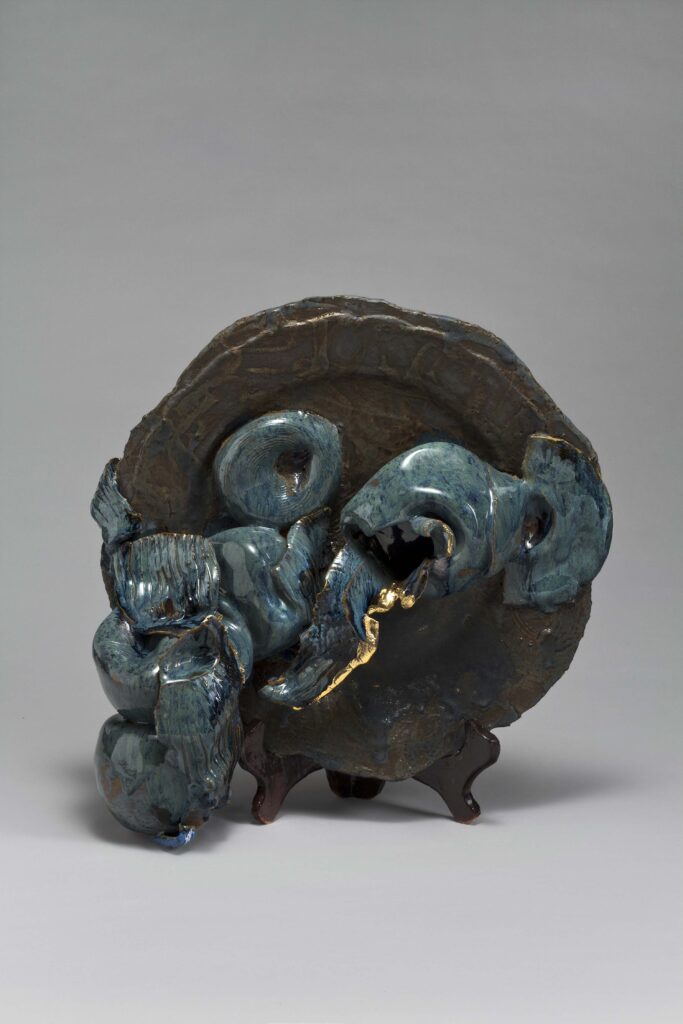
“Cero Zen” is the most directly anchored series in the present. Donovan draws from a personal experience, the moment a yoga teacher walks out of a psychiatrist’s office with an expression that dismantles the promise of perfect serenity, to build a reading of contemporary life informed by Peter Sloterdijk. In an accelerated, saturated world where daily routines, consumption, and social media self-observation have made any monastery of peace impossible, “Cero Zen” proposes a philosophy of resistance with no promise of redemption. The clay is worked through excess and deformation: irreverent colors, unstable forms, ruptures that offer no apology. It is the “burnout society” materialized in ceramics, as ephemeral and banal as the time it depicts.In “Cargas Peligrosas,” Donovan plunges into the metaphors of fire and explosion as fundamental paradoxes of existence. Fire embodies birth and death simultaneously, magnificence and decay. The explosion, far from being merely destructive, carries within it the seed of new beginnings. The series seeks harmony within chaos, not as resolution but as coexistence: a serene sphere in the middle of the symphony between creation and destruction, where active stillness is ignited by the flame itself. In the context of a turbulent era, the work wagers on the transformative potential of reality, a live ember at the heart of existence’s crucible.
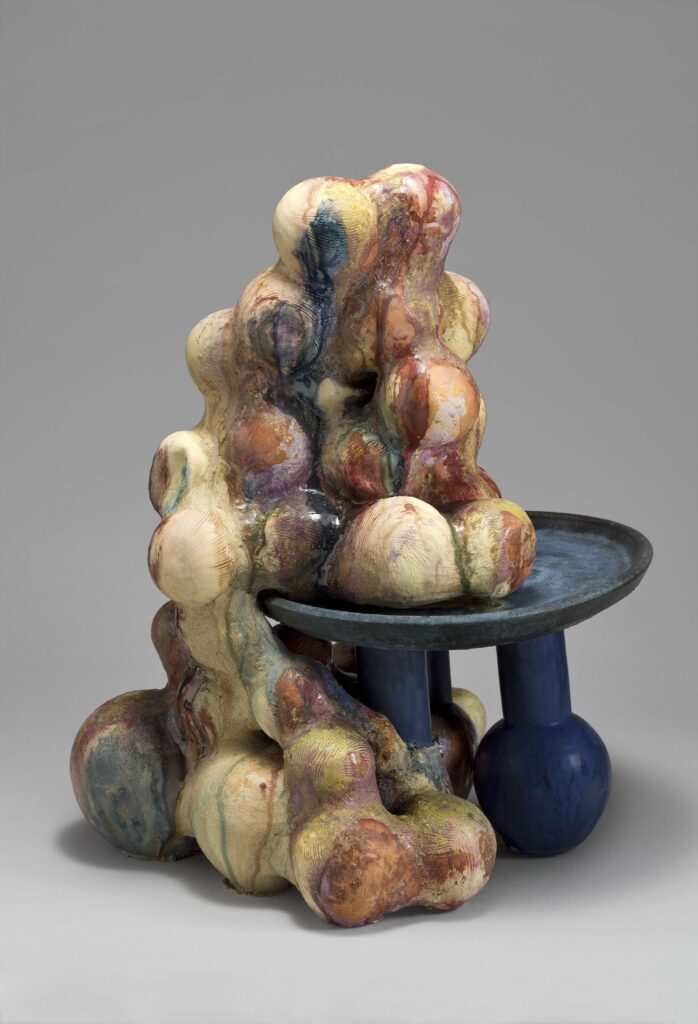
“Cero Zen”
Together, the four series form a coherent map of Donovan’s practice: the world presses, transforms, and fragments. And art, made of clay, textile, and memory, is the gesture of someone who decides to keep making meaning even inside the collapse.
Instagram: https://www.instagram.com/sofidonovan/