 Serpa
Serpa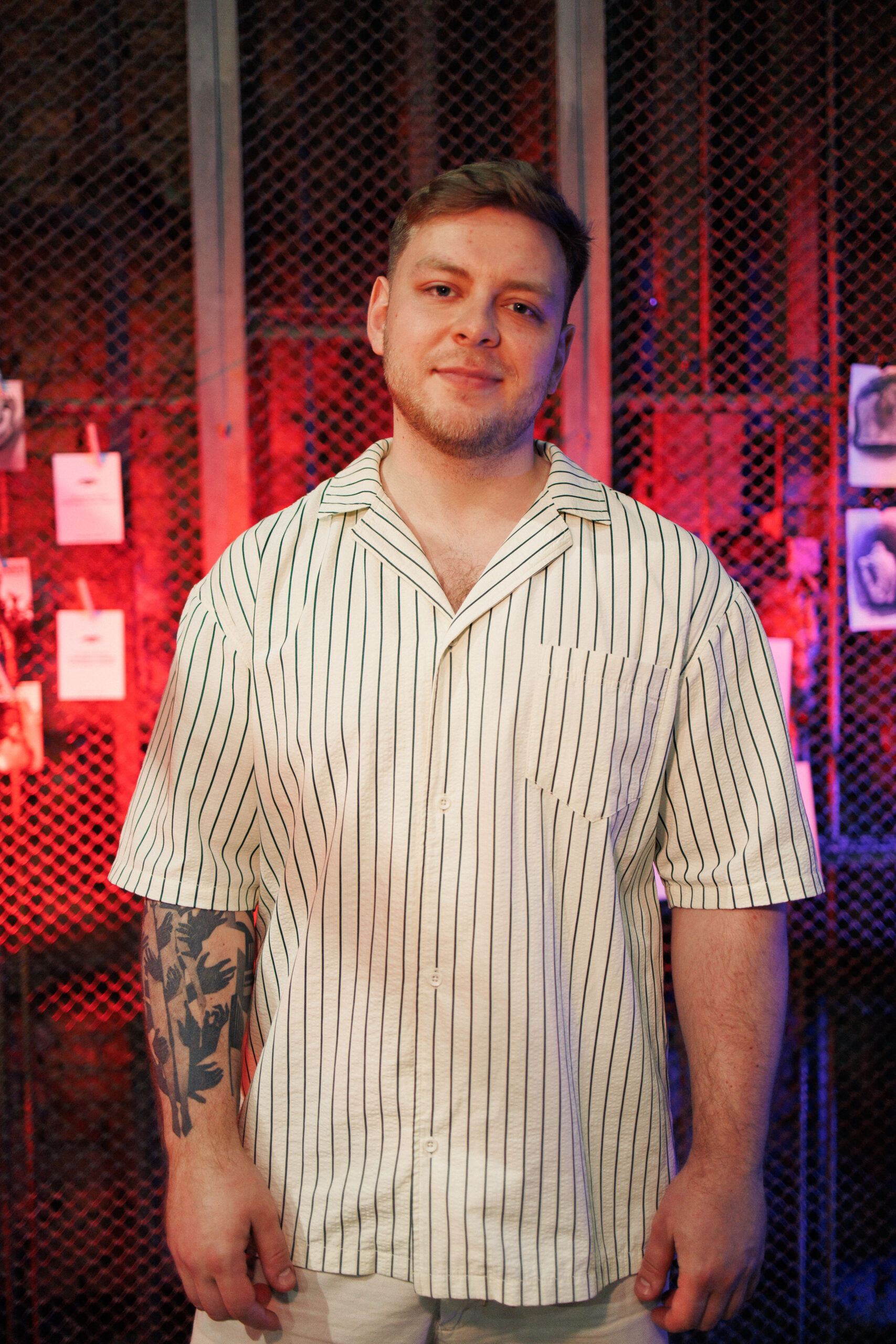
Vitaliy Krasutskyy at one of his exhibitions in Lviv. Photo: personal archive
Self-taught artist Vitaliy Krasutskyy creates sculptures that explore anxiety, catharsis, and the human condition in shows ranging from Lviv to Como, Italy; his works have raised over 155,000 hryvnias in charity auctions for war victims
Lviv, Ukraine
A self-taught Ukrainian ceramist who has been sculpting monsters since childhood as a way to externalize his innermost fears has, at 28, exhibited his work in Italy, shown at art fairs in Kyiv, and raised the equivalent of tens of thousands of dollars in charity auctions for war victims. Vitaliy Krasutskyy, born in Kalush in 1997 and based in Lviv, has emerged as one of the most compelling voices in contemporary Ukrainian ceramic sculpture, recognized for transforming existential anguish into forms that provoke discomfort and, at the same time, catharsis.
In 2026, Krasutskyy took part in the exhibition “The Beloved Promises” in Como, Italy, joined the show “Resound” at the historic Powder Tower in Lviv, and was included in the project “Art Reconstruction” at the Lviv Art Palace. The international recognition crowns a trajectory that began in complete solitude, with no formal art training, inside the apartment of a young civil engineering student.
From engineering to ceramics: a career off-script
In 2018, Krasutskyy earned a bachelor’s degree in Civil and Environmental Engineering from Lviv Polytechnic National University. Art was never part of his curriculum, and there were no plans to turn sculpture into a career. What had been there since childhood was the habit of molding monstrous figures as an emotional release, a practice that stayed private for years, far from any outside eye.
“My art is my vision of feelings and emotions. First and foremost, it was only for myself and not for the general public,” the artist says. The turning point came when Krasutskyy realized that his sculptures, disturbing yet aesthetically deliberate figures, were producing a therapeutic effect on those who encountered them. Psychotherapists in his circle began pointing out the emotional release his works triggered in viewers.
That phenomenon transformed what had been a private exercise into a public language. Starting in 2022, Krasutskyy began exhibiting systematically. His first appearance in a formal cultural venue was at the exhibition “ShcheMyt” at the traditional Franko House in Lviv, a milestone that opened the door to an intense series of solo and group shows in the years that followed.
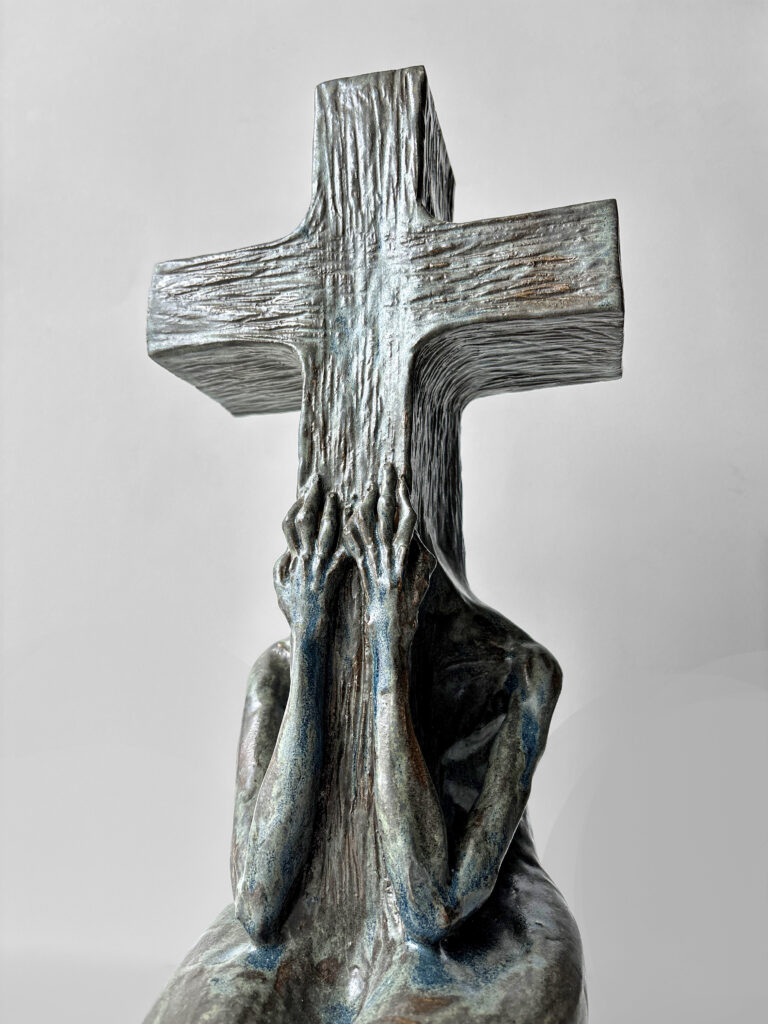
“Religion” (2025) — chamotte clay with glazes, 38 × 18 cm. A kneeling human figure clasps a roughly textured cross in metallic silver and blue tones. Photo: Vitaliy Krasutskyy
Existential expressionism: the language of fractured forms
Krasutskyy’s output centers on figurative-conceptual sculpture in chamotte clay with glazes, blending expressionist influences with what the artist himself calls “existential surrealism.” His pieces, generally medium-sized with heights ranging from about 12 to 22 inches, depict fragments of the human body and contorted organic forms that function as metaphors for inner states: pressure, silence, decline, religiosity, and the crossroads of existence.
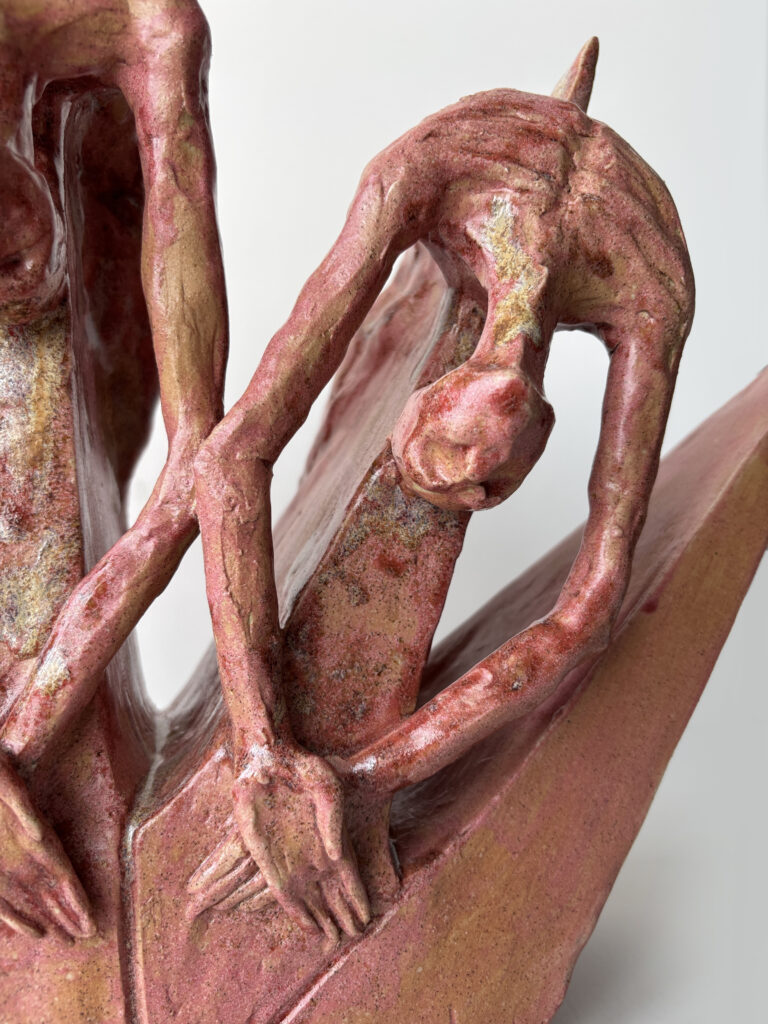
“Crown” (2025) — 56 × 35 × 18 cm. A crown of figures in dark clay with silver glaze. Photo: Vitaliy Krasutskyy
Among the standout pieces from 2025 are “Crown” (56 × 35 × 18 cm), “Pressure” (40 × 32 × 10 cm), and “The Path,” the latter composed of two complementary elements of different dimensions, evoking the duality of human journeys. All are produced in Lviv using chamotte clay and glazes, a technique that gives the surfaces a raw, expressive texture that amplifies the emotional impact of the forms.
“I’m self-taught, so I do what I can, not what I’m supposed to,” says Krasutskyy. The phrase sums up a deliberate aesthetic stance: the rejection of academicism as the condition for a more visceral, direct practice, where error and imperfection are integral to the creative process. The resulting works oscillate between the beautiful and the disturbing, between attraction and repulsion — a tension the artist cultivates consciously.
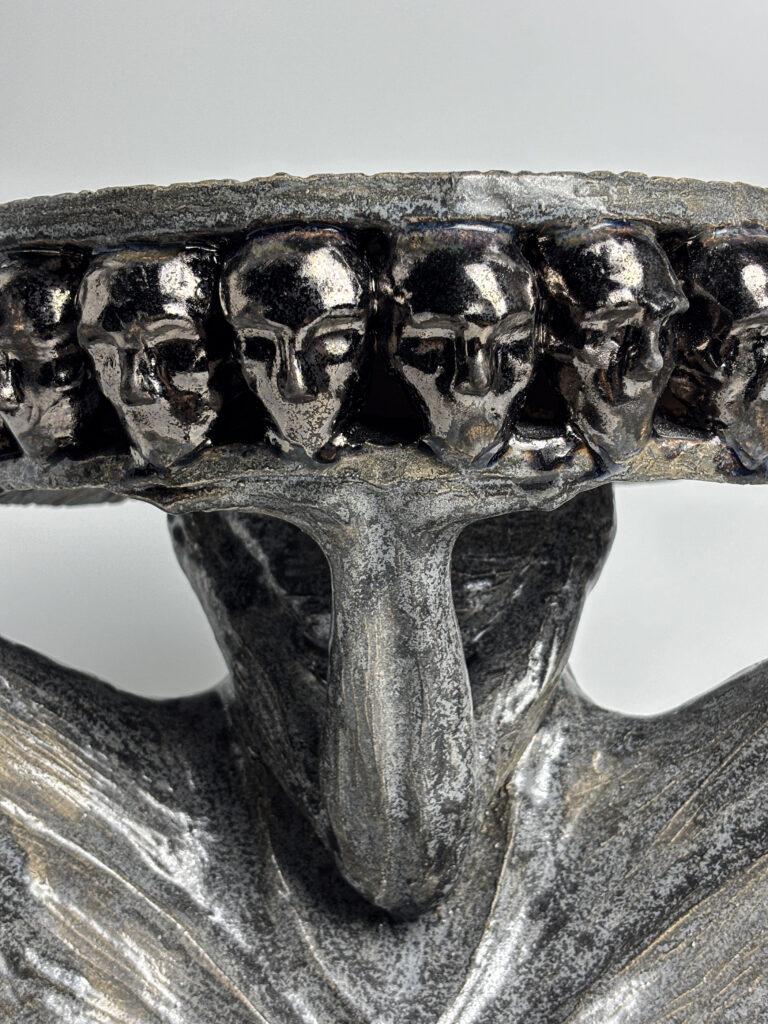
“Silence” (2025) — chamotte clay with glazes, 30 × 30 × 23 cm. A meditative figure bears a circular weight filled with fused aces, in a dark metallic finish. Photo: Vitaliy Krasutskyy
Art in wartime: charity auctions, solidarity, and cultural resistance
Krasutskyy’s trajectory has unfolded alongside the war ravaging Ukraine since Russia’s full-scale invasion in February 2022. In this context, his art has moved beyond gallery spaces and into solidarity initiatives. In 2024, the work “Flowers of My Soul” sold for 30,000 Ukrainian hryvnias at a charity auction in Morshyn, in support of the Saint Charbel institution.
In 2025, the auctions grew even more significant. “Renaissance” sold for 40,000 hryvnias to benefit recipients in Zaporizhzhia through the platform safecharity.org.ua. The piece “Wall” reached 85,000 hryvnias, the highest amount Krasutskyy has ever obtained at auction, with proceeds directed to victims in Kharkiv through the project “We’ll Meet Under the Thermometer.” In total, solidarity sales have exceeded 155,000 hryvnias over two years.
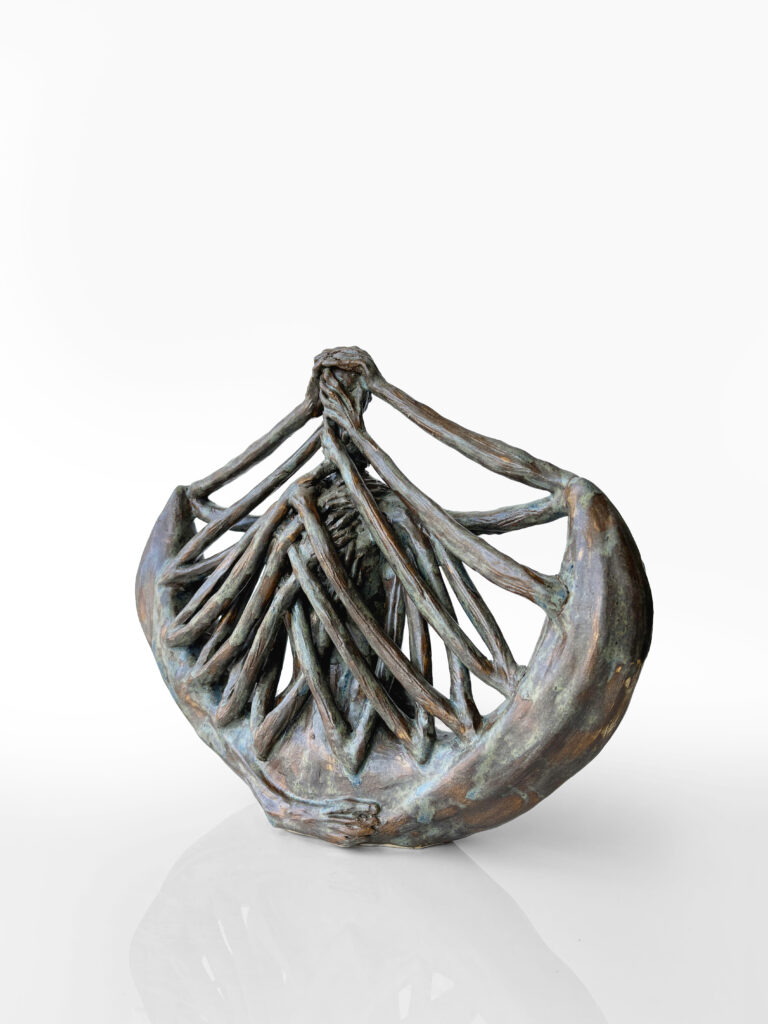
“Pressure” (2025) — 40 × 32 × 10 cm. An organic chamotte clay form that squeezes and tightens. Photo: Vitaliy Krasutskyy
For the artist, the political and humanitarian dimension of his work does not contradict its introspective nature; on the contrary, it deepens it. Sculpting emotional states such as anxiety, decline, and pressure in the middle of a war is, for Krasutskyy, a way of giving shape to the collective unspeakable. His works function as resonance chambers for a country confronting trauma on a civilizational scale.
A growing presence: publications, exhibitions, and the international circuit
Krasutskyy’s recognition within the Ukrainian art world has been consolidated through a series of specialized publications. In 2023, he was included in selections of Ukrainian artists and had works published in the online gallery Kosssgallery and in outlets focused on large-scale sculpture. In 2024, he was featured in a dedicated selection of Ukrainian sculptor-ceramists and was highlighted by the ceramic community Ministry of Ceramic Affairs, an influential collective in the Eastern European ceramic art scene.
In 2025, he was interviewed by the same collective’s channel and had his work analyzed on video by art critic and manager yaroslavakram_art_manager. He was also selected for the list of featured Ukrainian artists by the platform Uartist. In 2026, his name appeared among the best Ukrainian ceramic artists according to Forsagallery. Eleven exhibitions in four years attest to a prolific output and growing demand both at home and abroad.
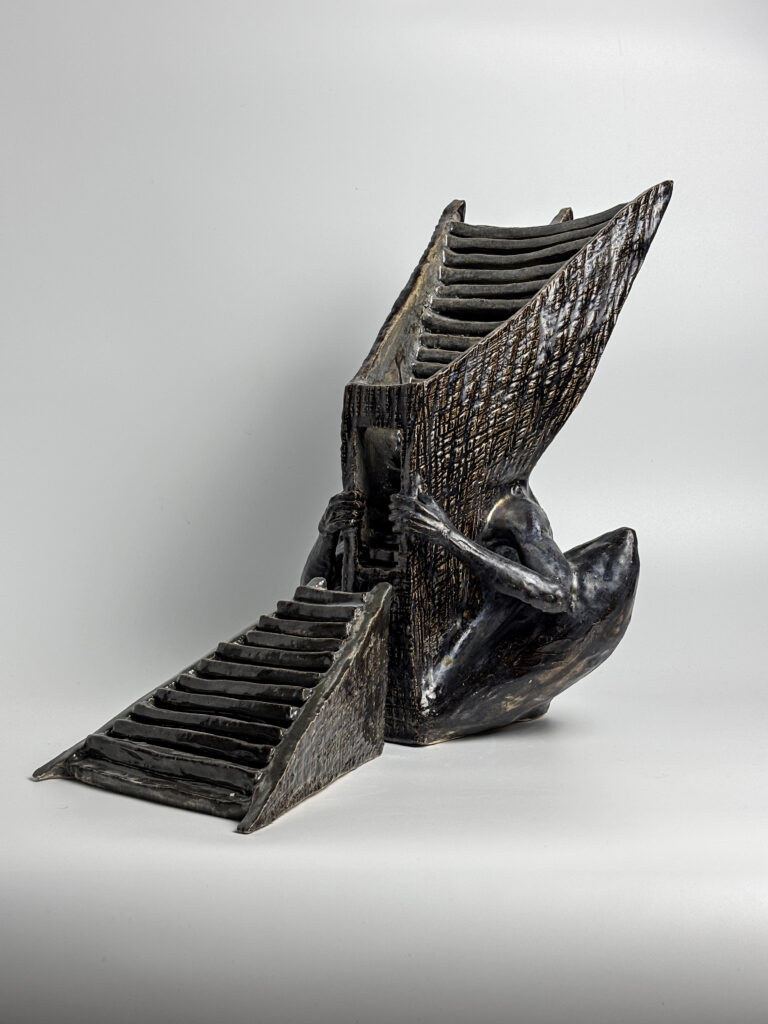
“The Path” (2025) — 40 × 25 × 30 cm / 20 × 20 × 10 cm. Two-element sculpture: a human figure before a staircase that folds back on itself, in chamotte clay with black glaze. Photo: Vitaliy Krasutskyy
Krasutskyy currently has works for sale at the Lviv House of Arts, located at Stryyska St., 202 B. His trajectory, from civil engineering to international ceramic sculpture by way of wartime auctions and European exhibitions, is itself a way of narrating contemporary Ukraine: a country that produces art at the boundary between destruction and reconstruction, between forced silence and the urgent need to speak.