 Serpa
Serpa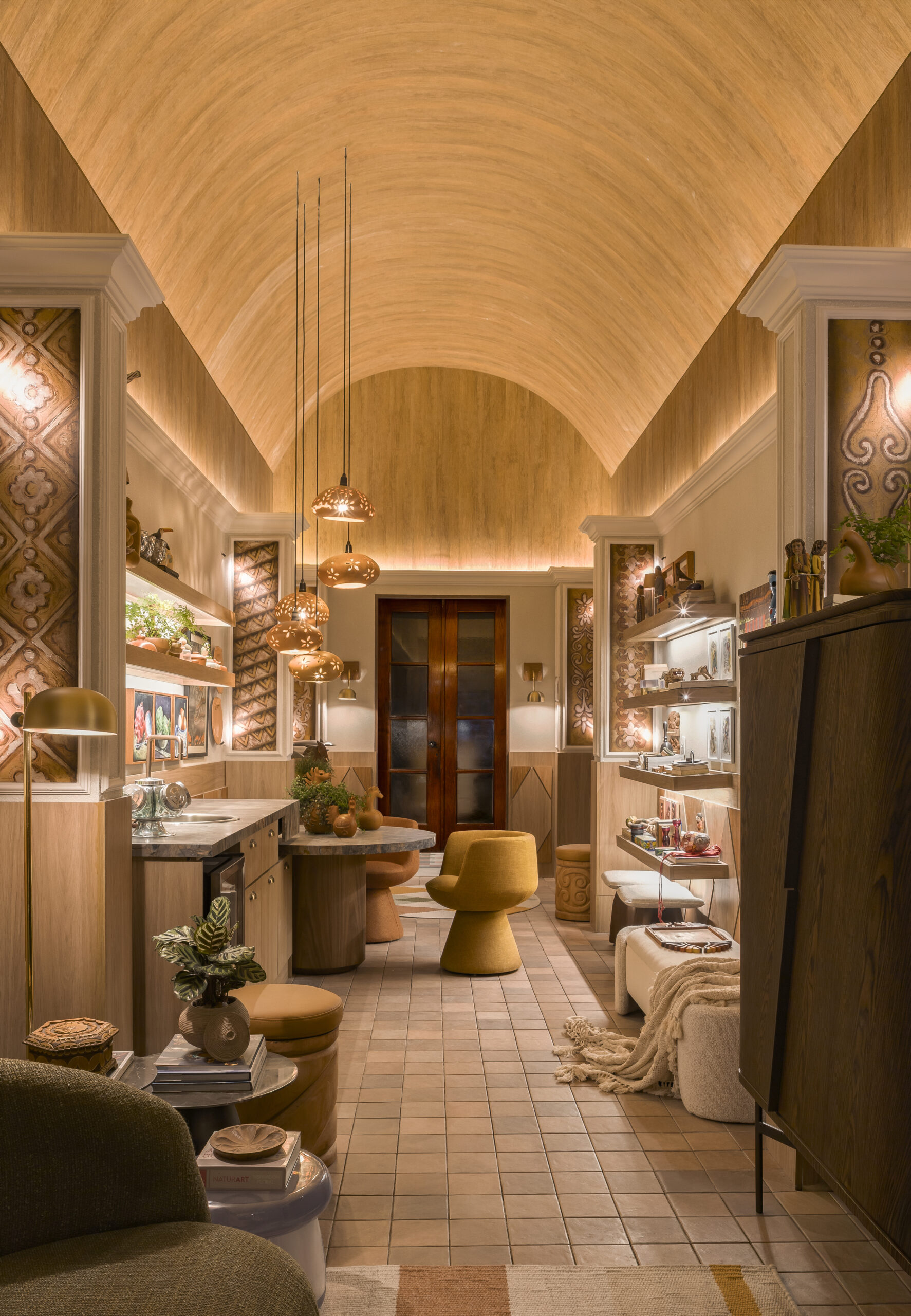
Co-Living Chiquitano at CASACOR São Paulo 2026: the vaulted vinyl ceiling evokes the barrel vaults of the Chiquitania’s historic Jesuit churches. Photo: Carolina Mossin
Eduardo Baldelomar signs a 32-square-meter space inspired by Bolivia’s Jesuit missions; the show runs at Parque da Água Branca from June 2 through Aug. 9
São Paulo – With the most personal project of his career, Bolivian architect Eduardo Baldelomar returns to CASACOR São Paulo. In the Co-Living Chiquitano, a 32-square-meter space open to the public starting Monday at Parque da Água Branca, he introduces Brazilian visitors to a little-known face of his country: the culture of the Chiquitania, a region in eastern Bolivia shaped by the encounter between indigenous peoples and Jesuit missionaries in the 17th and 18th centuries.
In its 39th edition, CASACOR São Paulo is organized around the theme “Mind and Heart” and brings together more than 65 spaces, including architectural projects, artistic installations, shops and restaurants. The show runs through Aug. 9, Tuesdays through Sundays and on holidays, from 11 a.m. to 9 p.m.
For Baldelomar, the theme translates directly into his design. “The mind appears in the extensive research I undertook to understand the missionary architecture of the Chiquitania. The heart is in my memories, in the emotional references from childhood and in the feeling of transforming my origins into architecture,” said the architect, who is simultaneously participating in CASACOR Bolivia with a separate project.
Field Research
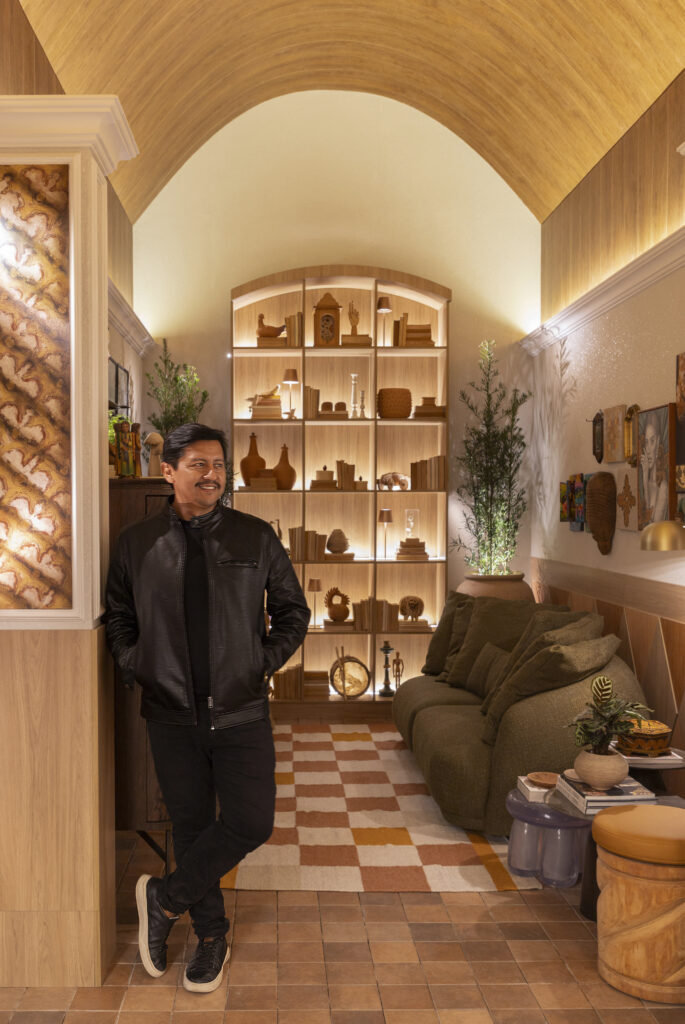
Architect Eduardo Baldelomar in the Co-Living Chiquitano. A native of Santa Cruz de la Sierra, he made four research trips to the Chiquitania before designing the space. Photo: Carolina Mossin
Designing the Co-Living Chiquitano required deep immersion. Between November of last year and the months leading up to the show’s opening, the architect made four trips to the Chiquitania, visiting churches, villages and historic centers, and meeting with indigenous leaders and local craftspeople. The process forced him to confront gaps in his own education: a native of Santa Cruz de la Sierra, he acknowledges that during his school years he received little instruction on the ancestral heritage preserved in the region.
“I was deeply moved by the history of the Chiquitania and by the way this legacy remains alive through art, music, architecture and craftsmanship,” he said. “This participation in CASACOR ended up becoming a very personal mission.”
Recognized as a UNESCO World Heritage Site since 1990, the Jesuit Missions of the Chiquitania hold a singular architectural identity. There, European Catholic architecture came to coexist with indigenous techniques and traditions, giving rise to what is known as the mestizo baroque of the jungle, preserved to this day in music, wood sculpture and handicrafts.
The Space
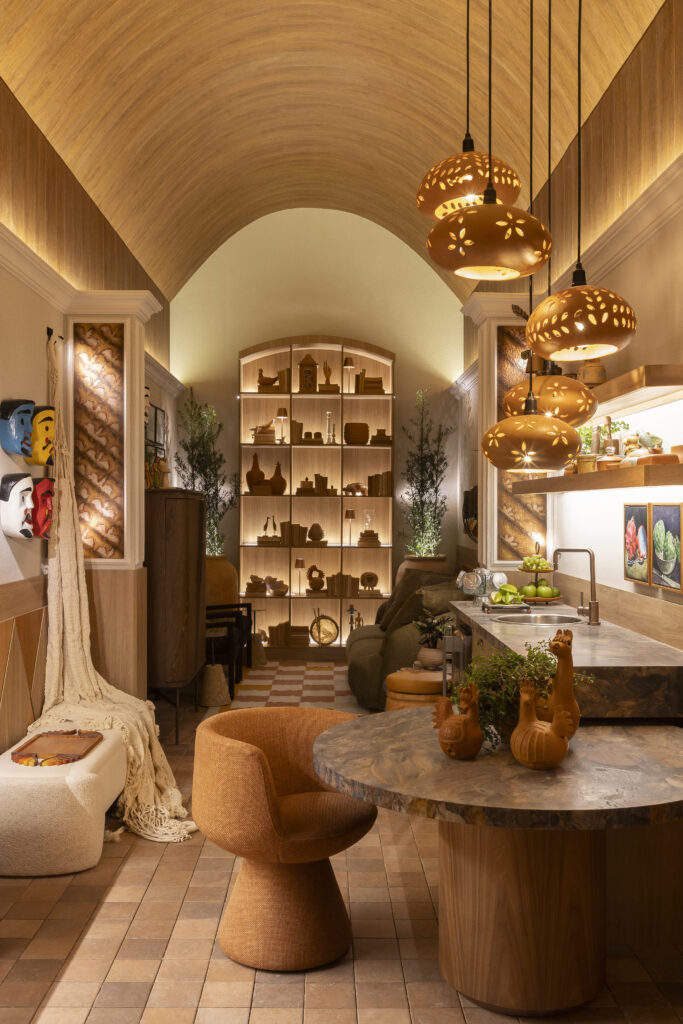
The dining area features a round natural-stone table and hand-pierced ceramic pendant lights. In the background, the illuminated shelving unit displays more than 200 objects brought directly from Bolivia. Photo: Carolina Mossin
Rich wood envelops visitors from the moment they enter the Co-Living Chiquitano. The six columns of the space were adorned with paintings by Bolivian visual artist Leoni Antequera, who used natural pigments to recreate references to the indigenous plants and flowers found in the region’s historic churches. A ceiling with an organic design, executed in vinyl material, evokes the vaulted forms found in the churches of Immaculate Conception and San Jose de Chiquitos.
Wooden panels cover the walls and include geometric diamond-shaped details, an allusion to the ornamental patterns typical of colonial-era constructions led by Swiss Jesuit Martin Schmidt in partnership with local indigenous communities. In earthy tones, the square ceramic flooring echoes the surfaces of the old missionary churches and connects the space to the landscapes of the plains and dry forests of eastern Bolivia.
“The most fascinating thing about the architecture of the Chiquitania is precisely this cultural blending. There was a millennial tradition before the Jesuits arrived, and it continued to thrive after they left. Music, wood sculpture, designs and customs remained present because there was respect for local traditions,” the architect said.
More Than 200 Works
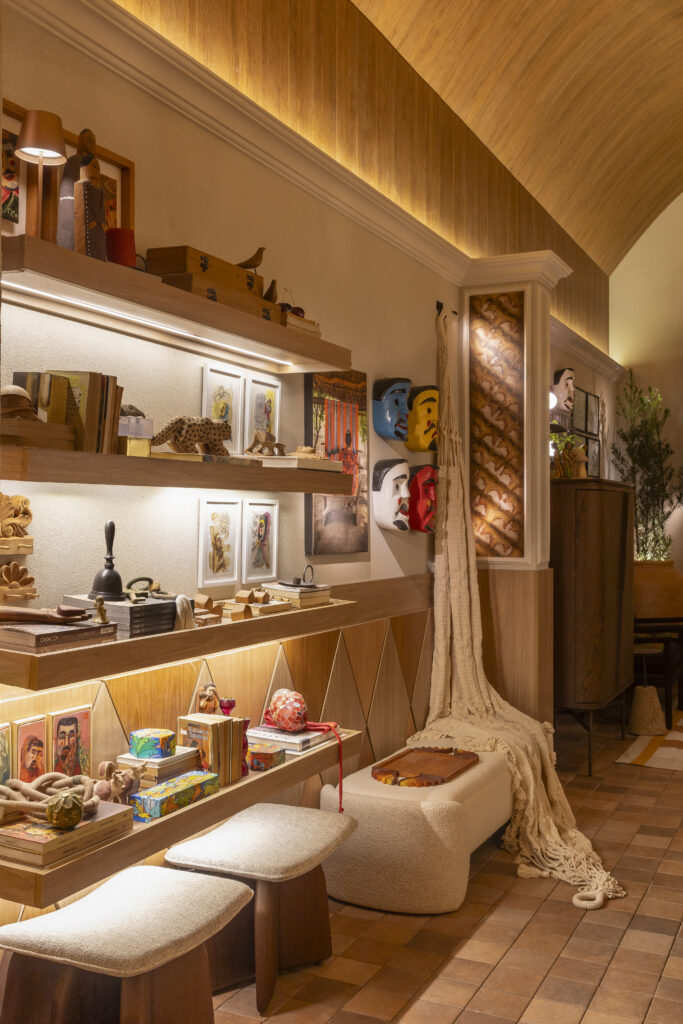
The dining area features a round natural-stone table and hand-pierced ceramic pendant lights. In the background, the illuminated shelving unit displays more than 200 objects brought directly from Bolivia. Photo: Carolina Mossin
Gallery and living room coexist within the 32 square meters of the Co-Living Chiquitano. The space brings together more than 200 pieces, including paintings, sculptures, masks, photographs, historical maps, ceramics, baroque sheet music, textiles, utilitarian objects and musical instruments brought directly from the Chiquitania. A large portion was produced specifically for the show by Bolivian artists and craftspeople, including pieces from Artecampo, an association of rural artisans from the country’s indigenous communities.
Four colorful masks carved in wood by artisan Luis Felipe Pari, known as Pitagoras, are among the objects with the greatest symbolic resonance. Called “masks of the grandparents,” they were worn by elders as a symbol of resistance against the culture imposed by Spanish colonizers. Another object of strong historical weight is an original violin scorched by a fire in the Chiquitania region: marked by burn damage, the instrument carries an engraved piece of legislation against wildfires, making it a symbol of the region’s cultural and environmental resistance.
Also present in the soundtrack, music reinforces its centrality to Chiquitano culture. Bolivia is today the only country that preserves more than 3,000 pieces of mestizo baroque sheet music written by indigenous peoples themselves, a heritage discovered during church restoration work. Provided by the Association Pro-Art and Culture of Bolivia (APAC), the soundtrack reproduces sounds preserved for centuries by local communities.
Original Design
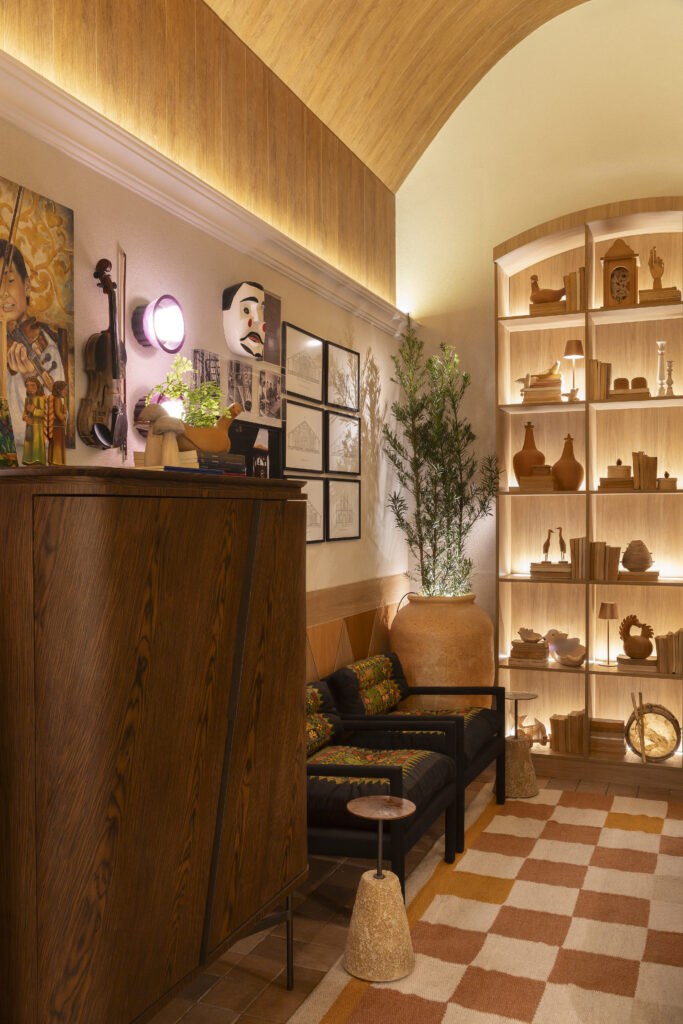
The dining area features a round natural-stone table and hand-pierced ceramic pendant lights. In the background, the illuminated shelving unit displays more than 200 objects brought directly from Bolivia. Photo: Carolina Mossin
Beyond the curatorial work, Baldelomar also designed pieces produced specifically for the space. Two cedar wood ottomans were hand-carved in San Miguel, inspired by the columns of the missionary churches. Hand-loomed rugs with geometric patterns reinterpret the graphic motifs of the churches of Immaculate Conception and San Jose de Chiquitos, featuring diamond and square shapes drawn from the mission temples.
Embroiderers from Lomerio, a community that preserves ancestral knowledge passed down through generations, were responsible for the upholstery on the two living room armchairs. The bench received fabric produced by the women weavers of Urubichá, further broadening the representation of Bolivian craftsmanship in the project.
To Live and to Contemplate
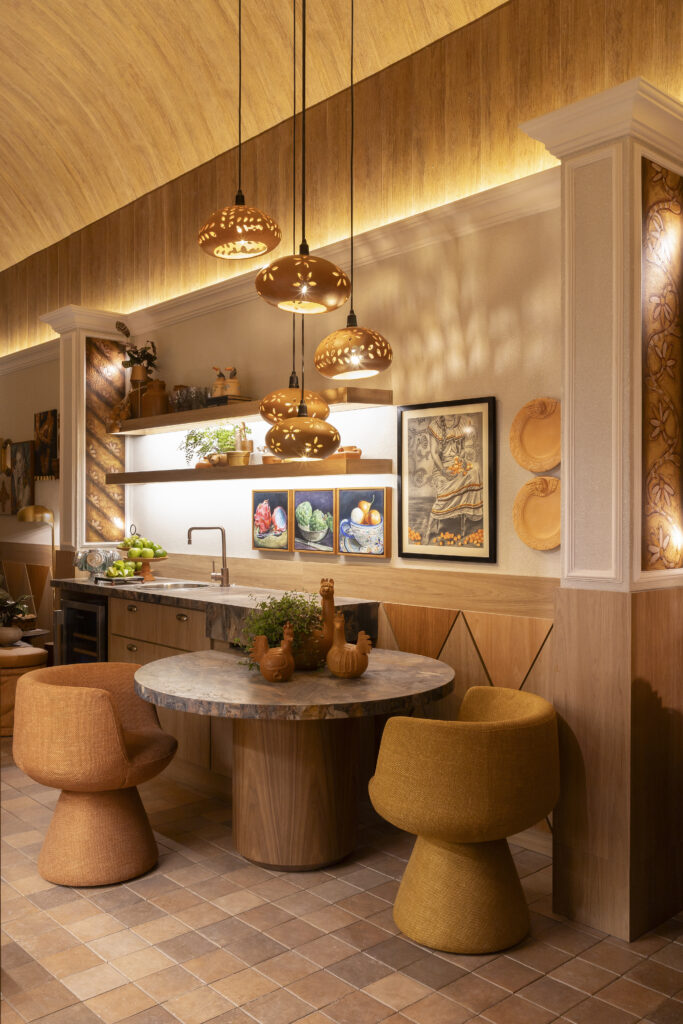
The gourmet kitchen area features a natural-stone countertop from northeastern Brazil. The space is conceived as an extension of the social area, with open shelving displaying Bolivian ceramics and artisan objects. Photo: Carolina Mossin
Despite its commitment to memory and ancestry, the Co-Living Chiquitano proposes a contemporary reading of dwelling. Designed to encourage lingering, observation and deceleration, the space combines curved furniture, natural materials and indirect lighting that create an immersive atmosphere from the entrance. A countertop in natural stone from northeastern Brazil anchors the gourmet kitchen, conceived as an extension of the social space. At the back, a large shelving unit brings together books, sculptures and objects the architect collected on his travels through Bolivia.
Honoring natural materials and local artisan production is also part of the project’s sustainability commitment, drawing on the region’s traditional techniques to strengthen cultural supply chains and contribute to the preservation of ancestral knowledge.
“Architecture has the power to convey and develop very deep emotional connections. I wanted to build a space where every piece helped tell who we are, where we come from and how our culture continues to live through the people who keep these traditions alive today,” Baldelomar said.
Bolivia Beyond the Altiplano
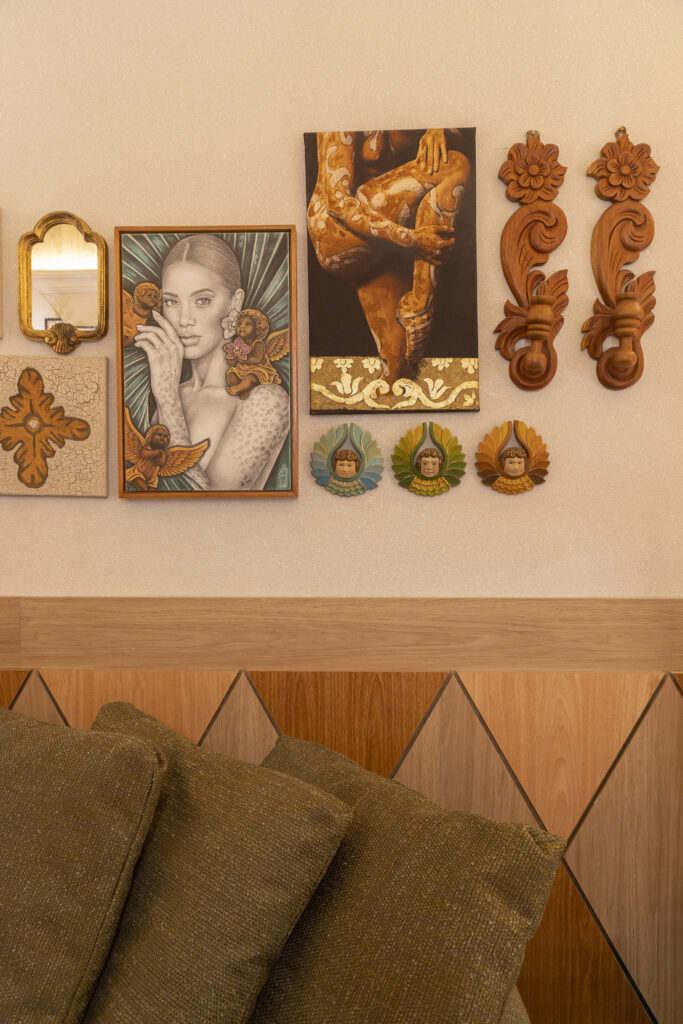
Wall detail showing wood-carved angels, paintings and decorative panels — all produced by Bolivian artisans from the Chiquitania region for the exhibition. Photo: Carolina Mossin
Bringing Chiquitano culture to the country’s largest architecture and design show is, for Baldelomar, an opportunity to broaden the perception of Bolivian identity. Originating in eastern Bolivia, Chiquitano culture was born from the encounter between the indigenous peoples who inhabited the plains and dry forests of the region and the Jesuit missionaries who arrived there in the 17th century. That contact gave rise to one of Latin America’s richest cultural experiences: a mestizo civilization that preserved its ancestral roots while absorbing European influences, creating a unique synthesis of art, architecture, music and craftsmanship that survives to this day.
Architecture is one of the most visible expressions of this legacy. The baroque churches built by the Jesuits in partnership with local indigenous communities became a World Heritage Site and still stand in cities such as Concepcion, San Jose de Chiquitos, San Rafael and Santa Ana. Built with wood, stone and adobe, they combine European floor plans with ornaments, sculptures and paintings from indigenous tradition, forming the so-called mestizo baroque of the jungle, an architectural style that exists nowhere else in the world.
Music plays an equally central role in that identity. Bolivia is the only country on the planet that preserves more than 3,000 baroque sheet music pieces written by indigenous peoples during the missionary period, a collection rediscovered during church restoration work in the second half of the 20th century. This repertoire is celebrated every two years at the International Festival of Baroque Music of Chiquitos, considered one of the largest events of its kind in the world, drawing musicians from many countries to perform works composed more than three centuries ago on the Bolivian plains.
Chiquitano craftsmanship is another pillar of this living heritage. Wood sculptures, ceramics, hand-loomed textiles, embroideries and carved masks are passed down through generations by the region’s communities. Each piece carries graphic patterns, symbols and millennial techniques that speak to the flora, fauna and spirituality of the Chiquitano people, keeping alive a tradition that survived colonization and historical erasure.
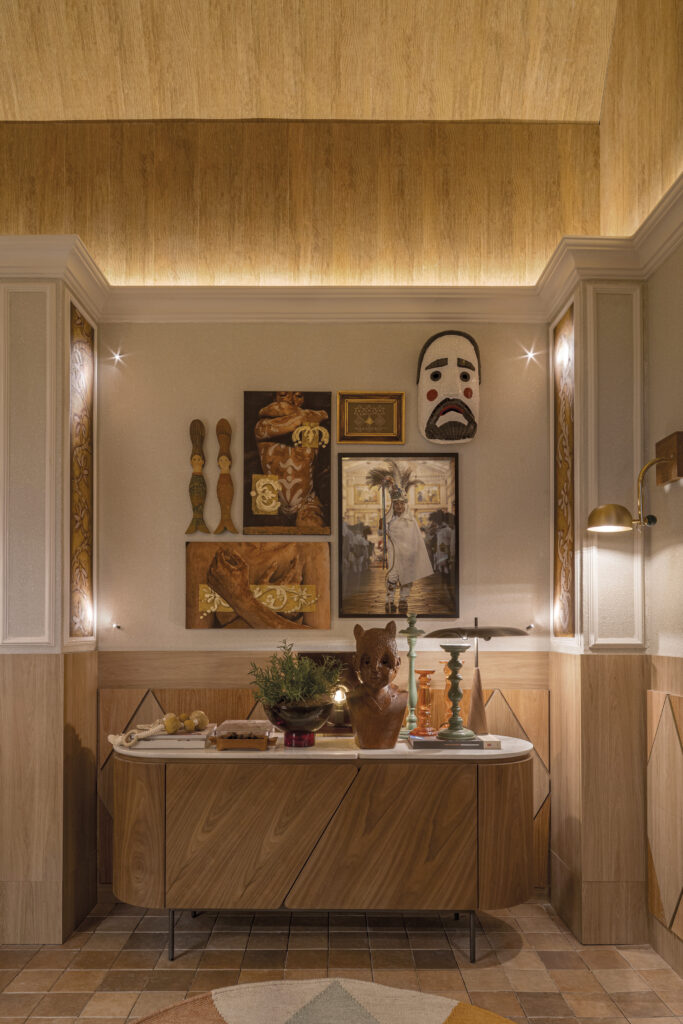
The entrance wall of the Co-Living Chiquitano, with a carved wooden sideboard, photographs of indigenous communities and a traditional Chiquitano mask — the first layer of cultural narrative the visitor encounters. Photo: Carolina Mossin
In Baldelomar’s view, external perceptions of Bolivia tend to be limited to images of cold, mountains and the altiplano. “That represents only a part of the country. We have valleys, forests, the Amazon and an enormous cultural diversity that is still little known outside Bolivia. I wanted to show a different Bolivia, one with traditions that are still alive today,” he said.
A veteran with 12 participations in CASACOR Bolivia and an office established in Sao Paulo since 2023, the architect has 19 years of professional experience. The Co-Living Chiquitano is his third signature at the Sao Paulo edition of the show, following participations in 2023 and 2024.
CASACOR Sao Paulo 2026:Parque da Água Branca, Rua Dona Ana Pimentel, Barra Funda, São Paulo, Brazil
June 2 through Aug. 9. Tuesdays through Sundays and holidays, 11 a.m. to 9 p.m.