 Serpa
Serpa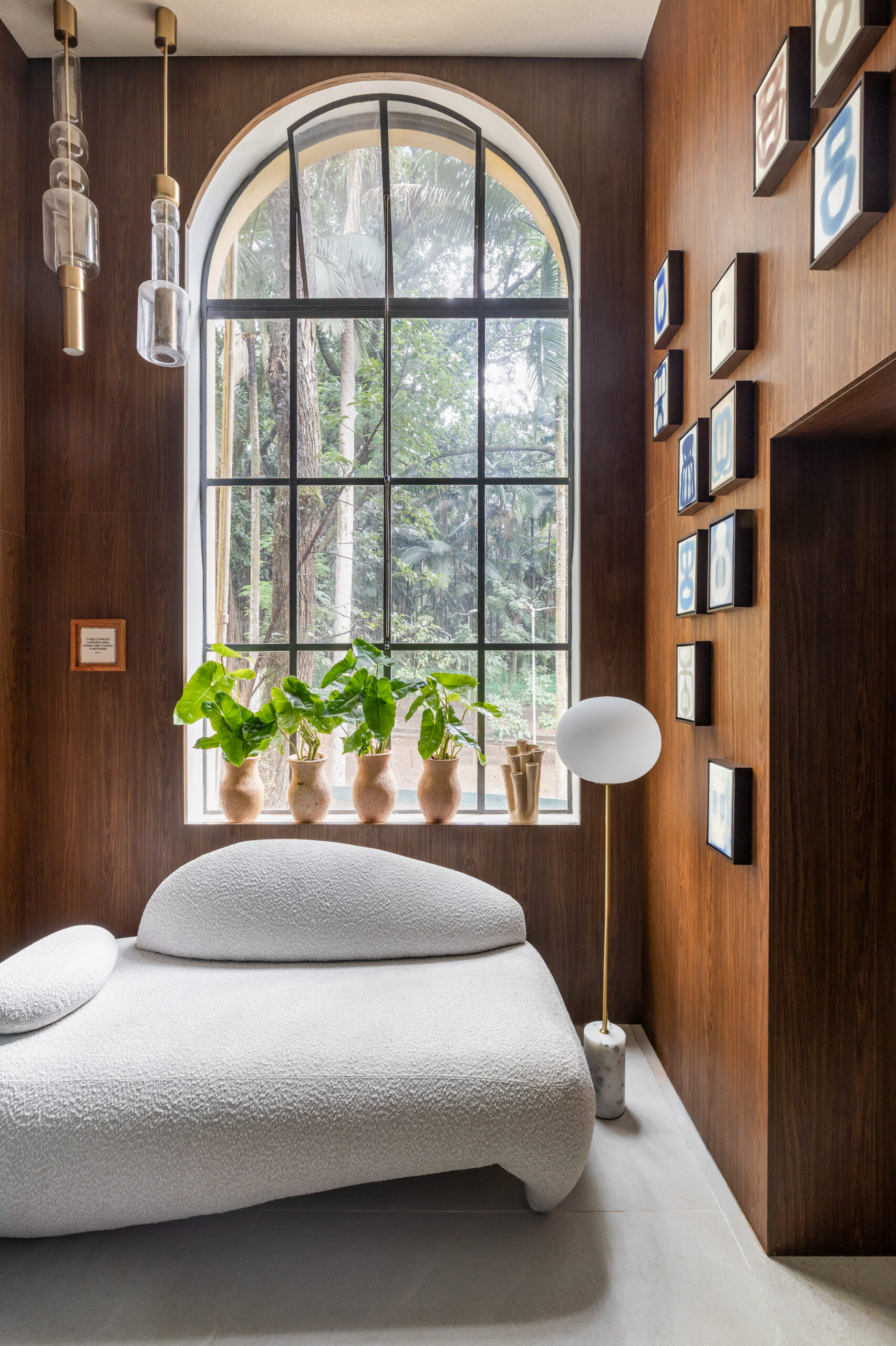
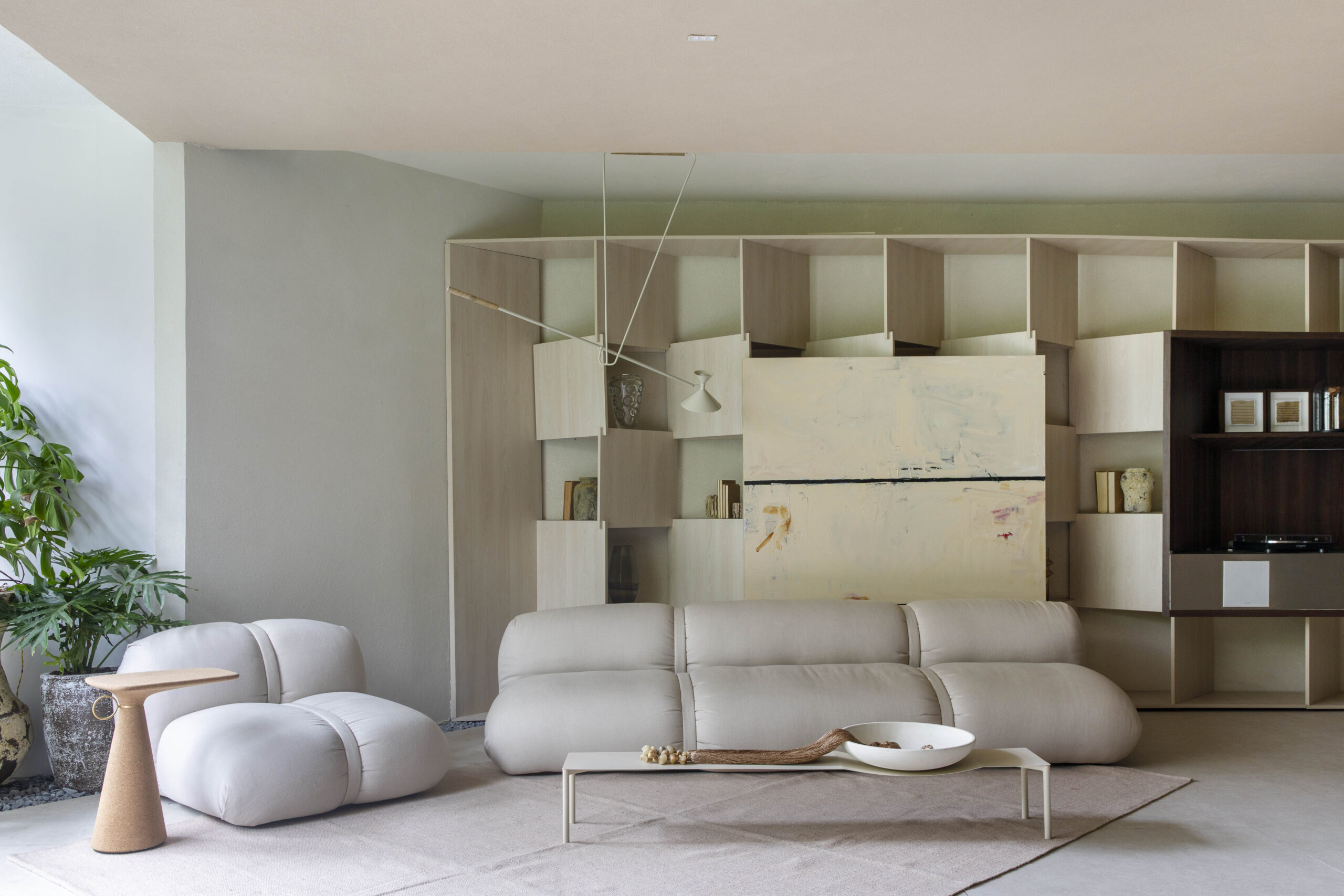
The comfort island of Espaço Gênese centers on an organic chaise longue in bouclé fabric, framed by an arched window overlooking Parque da Água Branca and a series of small framed works on the wood-paneled wall. Photo by Daniela Magario/CASACOR SP 2026.
Espaço Gênese brings together exotic stone, stainless steel and a four-artist curatorial program to map, across 269 square feet, the evolutionary arc from cave to skyscraper
SÃO PAULO — At 29, with three years of professional practice, architect Camilo Jr. makes his CASACOR São Paulo 2026 debut with Espaço Gênese, a 269-square-foot space that investigates the origins of human consciousness through a dialogue with materials. The project is a bathroom with a comfort and accessibility island. It is on view at Parque da Água Branca, in the city’s west side, through Aug. 9, as part of Latin America’s largest architecture and interior design exhibition. Among this edition’s first-time participants, Camilo Jr. is one of the youngest professionals and one of the most unambiguous in his commitment to concept as the primary driver of design.
Conceived as a memorial to the human journey, Espaço Gênese departs from a philosophical premise that runs through every design decision: architecture is not the consequence of thought but the very place where thought is born. In the architect’s framing, human intelligence did not emerge first and then begin to build. It built itself in the act of transforming stone, wood and earth into shelter and meaning. Moving through the space, visitors are invited to recognize their own reflection in the long evolutionary arc from cave to skyscraper and to understand that the history of humanity resides not only in books but is embedded in every material the species learned to master.
From Stone to Steel: A Chronology in Matter
Each material in Espaço Gênese was chosen with precision and sensitivity to function as a character in a chronological narrative of civilization. This is not decorative composition. It is an argument built in layers, in which the order of elements within the space mirrors the order of human history itself, from the raw roughness of the planet to the cold, reflective brilliance of technological reason.
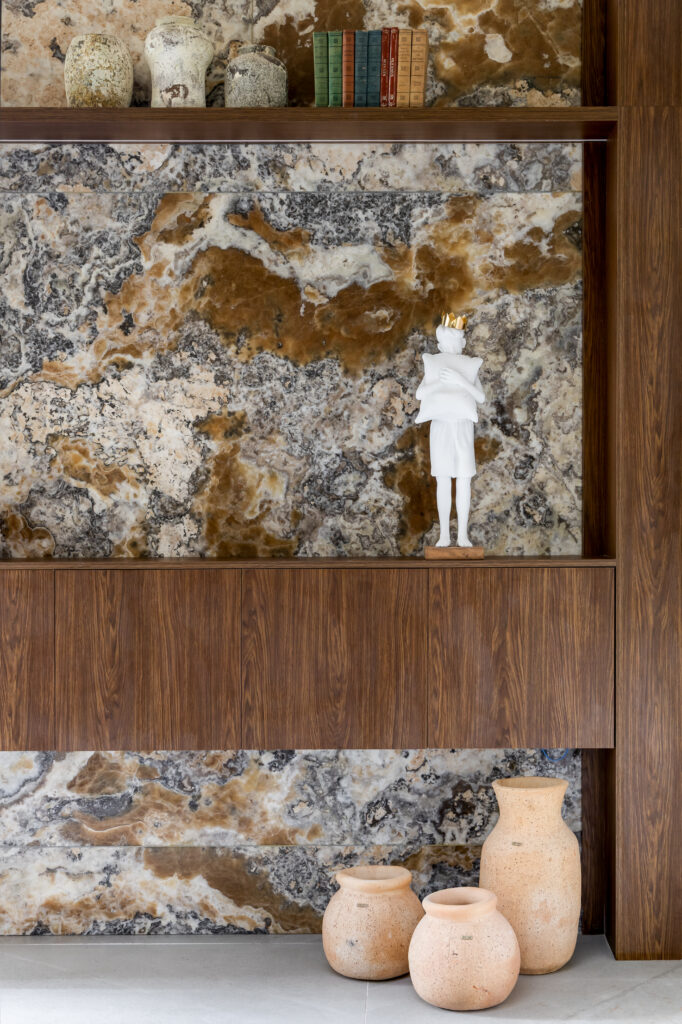
The exotic Kappadokya stone, which combines travertine formation with the translucency of onyx, covers the main wall of the space. Its shades of gray, blue, beige and brown record geological eras onto a single surface. Photo by Daniela Magario/CASACOR SP 2026.
Opening this timeline, the exotic Kappadokya stone combines travertine formation with the translucency of onyx in a single sedimentary block. Its shades of gray, blue, beige and brown gather the records of geological eras onto a single surface. For Camilo Jr., the choice is not aesthetic but narrative: Kappadokya represents the primordial foundation, the ground on which humanity rose, the memory of a planet that witnessed the first forms of consciousness. Its veins are, in the project, the rivers of time that cross the surface of the space in silence and weight.
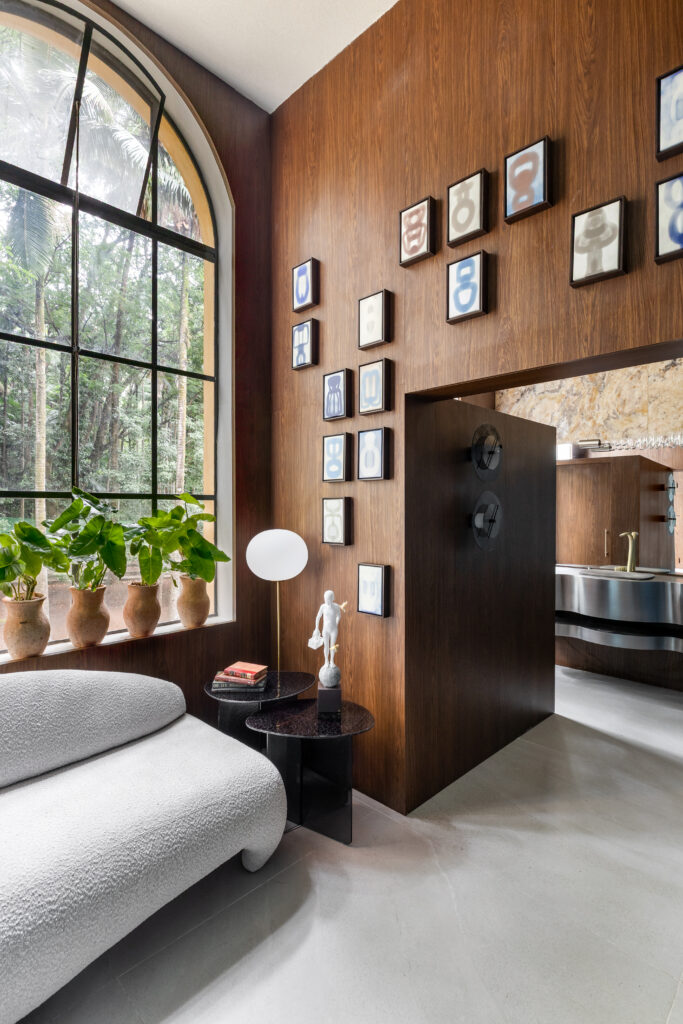
The comfort island of Espaço Gênese, with its arched window overlooking Parque da Água Branca, anchors a seating area that leads visitors from the gallery wall into the bathroom core. Photo by Daniela Magario/CASACOR SP 2026.
Continuing that chronology, MDF Carvalho Brun Thera, a new release from Duratex, occupies the space in dark-toned panels with rich texture and organic presence. Produced from eucalyptus reforestation timber and certified internationally by the Forest Stewardship Council, the material represents, within the project’s framework, humanity’s first mastery of the natural environment. It is the element that translates the transformation of wood into shelter, warmth and beauty, connecting the space to the forest as the species’ first collective home. Rich in texture, the dark wood speaks of ancestry, of the fire that warmed the first nights and of the ability to turn what nature offers into comfort and meaning.
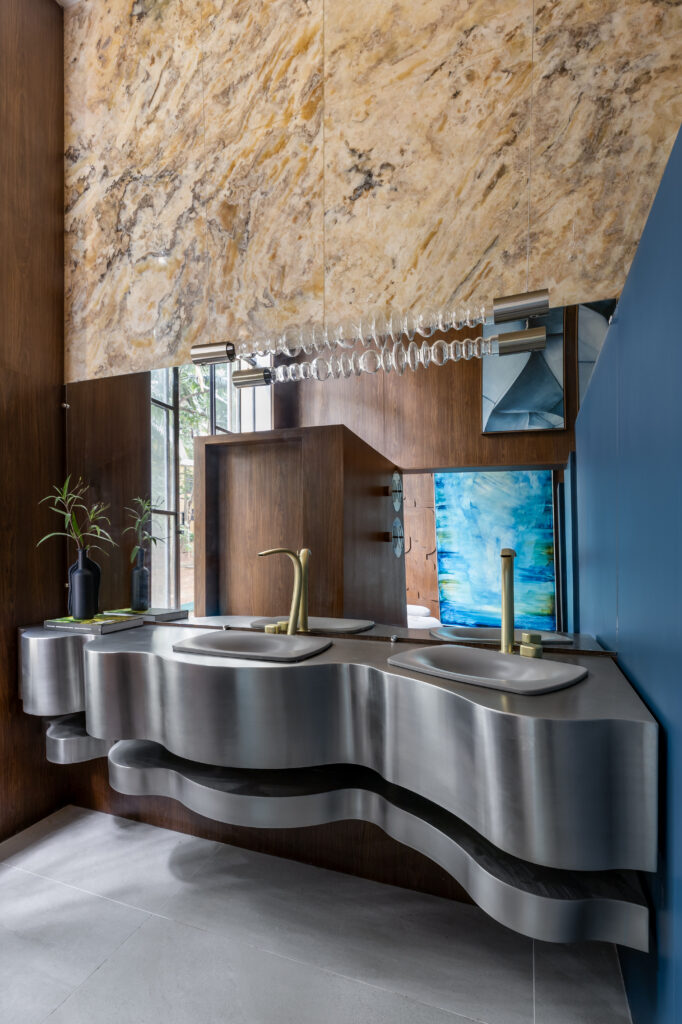
The sculptural stainless steel countertop by Studio304 dominates the bathroom core of Espaço Gênese. Its undulating form sits beneath the Kappadokya stone wall and a crystal pendant fixture. Photo by Daniela Magario/CASACOR SP 2026.
Positioned at the furthest point of the chronology, 304 stainless steel supplied by Studio304 closes the material triad with a countertop whose surface is cold, lucid and mirror-like. For the architect, stainless steel is the metaphor of pure reason: logic, precision, thought turning back on itself. By returning the reflection of whoever looks at it, the material transforms the everyday act of using a bathroom into a direct invitation to self-reflection. Stainless steel is also recognized by the industry as one of the most sustainable materials in modern construction, with a high recyclability rate across its entire life cycle. With it, Espaço Gênese closes its material argument: from the stone that sheltered us to the surface that gives us back our own image.
Sustainability as Commitment, Not Rhetoric
Two of the three central materials in the project carry verifiable environmental certifications and practices. Duratex’s MDF Carvalho Brun Thera is produced from eucalyptus timber grown in reforestation areas and certified by the Forest Stewardship Council, the international seal that attests to responsible wood sourcing. Stainless steel, meanwhile, is widely recognized by the construction industry as one of the most environmentally sound materials available in the contemporary market. Highly recyclable and durable, it reduces the need for replacement over time and presents low environmental impact across its life cycle. In Espaço Gênese, sustainability is not conceptual rhetoric. It is inscribed in the materials selected and in the certifications that back them.
Art as an Extension of Concept
Built in direct dialogue with the project’s philosophical premise, the curatorial program at Espaço Gênese brings together four artists whose works address matter, movement, time and silence. Each piece was selected not for superficial aesthetic affinity but for its resonance with the space’s central argument: the idea that human intelligence is constituted through contact with matter, and that art, like architecture, is one of the places where that process becomes visible.
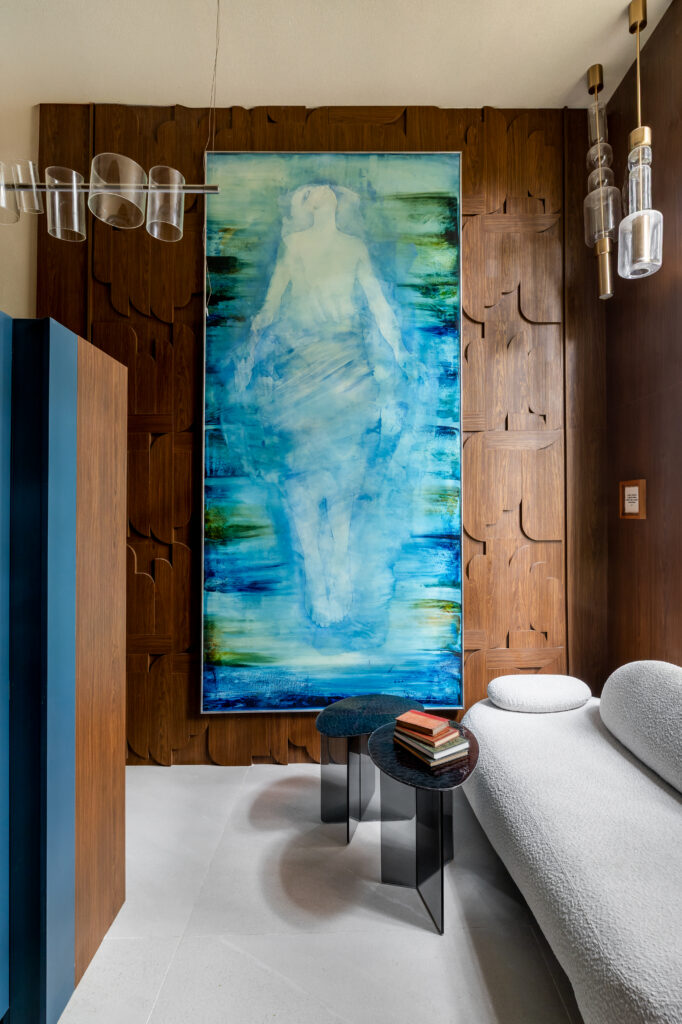
Carlos Araújo’s “A Crucificação” (The Crucifixion), from the exhibition “O Olhar como Origem” (The Gaze as Origin), occupies a full-height position on the carved wood-panel wall, carrying the dimension of the sacred that runs through the space’s concept. Photo by Daniela Magario/CASACOR SP 2026.
Carlos Araújo contributes “A Crucificação” (The Crucifixion), from the exhibition “O Olhar como Origem” (The Gaze as Origin). Known for developing work that engages with biblical imagery without adhering to a literal narrative, Araújo positions his painting at the boundary between figuration and abstraction, transforming traditional references into compositions defined by color fields, contrast and formal synthesis. In Espaço Gênese, the work carries the dimension of the sacred and the mythic that runs through the human relationship with stone and with origins.
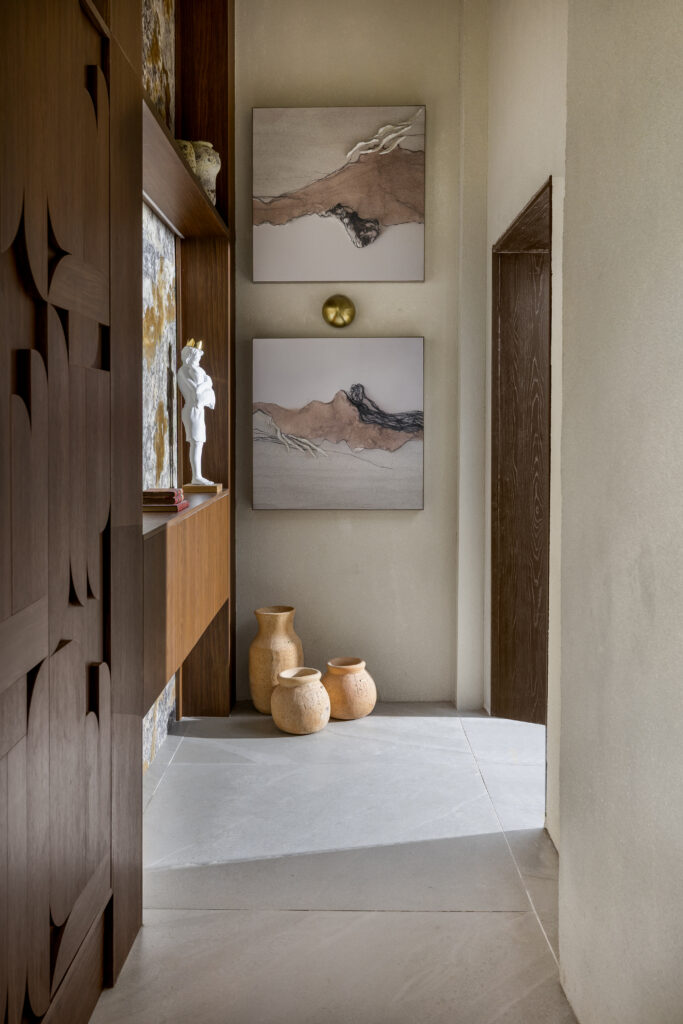
Works from Annike Limborço’s series “Mares e Morros” (Seas and Hills) line a corridor in Espaço Gênese. Built in subtle layers of delicate tonalities, the pieces evoke mountains and natural flows as metaphors for interior silence. Photo by Daniela Magario/CASACOR SP 2026.
Annike Limborço contributes pieces from the series “Mares e Morros” (Seas and Hills), an artistic investigation into the forms, textures and sensations of the mineral world. Built in subtle layers of delicate tonalities, the works evoke mountains, reliefs and natural flows as metaphors for what inhabits interior silence. Organic lines and sensitive surfaces compose deconstructed worlds, fragments of seas, hills and inner horizons that resonate with the space’s phenomenological proposition. Each piece presents a fluid territory in which what appears static reveals, upon sustained attention, layers of movement and depth.
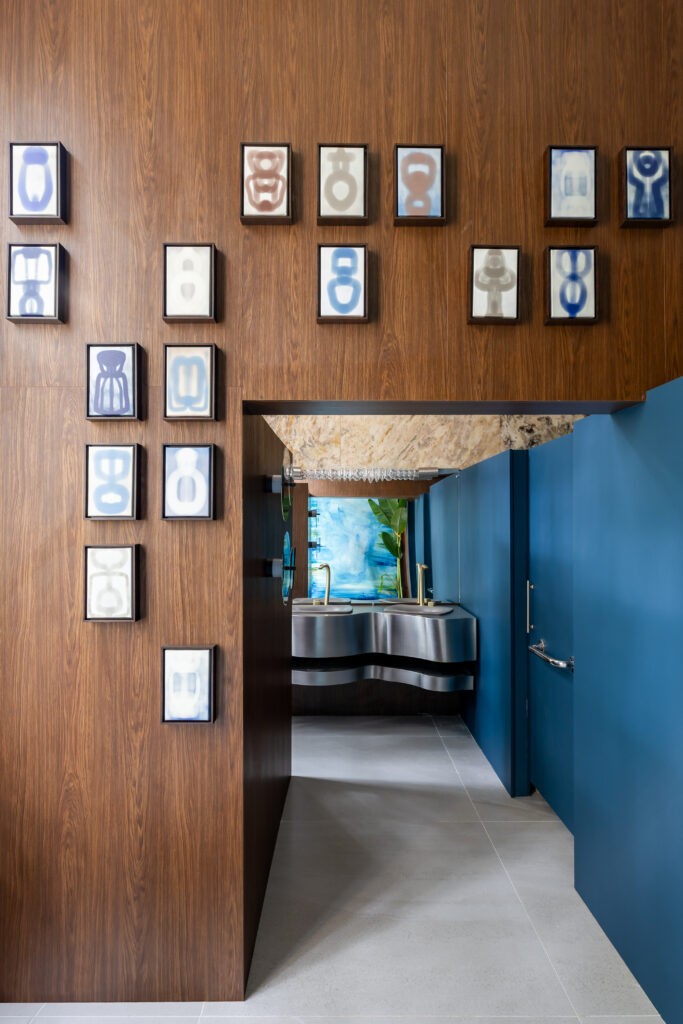
The entrance of Espaço Gênese frames the stainless steel countertop at the far end of the space, while a series of small framed works covers the surrounding wood-paneled wall, guiding visitors through the space’s material and artistic narrative. Photo by Daniela Magario/CASACOR SP 2026.
Hanna Dank presents works from the series “Forjados no Mar” (Forged at Sea), a study of movement and form inspired by natural forces and the fluidity of the tides. Blues and neutrals interweave in compositions of gentle presence and silent expression, with contours that appear shaped by water and time. According to Camilo Jr., the series was one of the first elements to inform the project’s concept, serving as a visual starting point for the narrative the space would go on to construct. “Forjados no Mar” introduces into the space a serene and contemporary elegance that engages with the contemplative coolness of the steel and the ancestral solidity of the stone.
Closing the curatorial program, photographer Adriano Pacelli presents “Silêncio Concreto” (Concrete Silence), a fine art series drawn from photographs of the structural forms at Little Island, the suspended park on the Hudson River in New York. Removed from their original context, the forms cease to be merely structural and begin to suggest movement, tension and fluidity. The rigid curves of concrete meet, in an almost silent manner, the constant presence of the Hudson’s waters, creating a dialogue between matter and flow, permanence and transformation. Within Espaço Gênese as a whole, Pacelli’s work connects the primordial scale of raw stone to the contemporary scale of the built city, closing the space’s narrative arc with precision and without excess.
The Architect: A Career Built Outside Convention
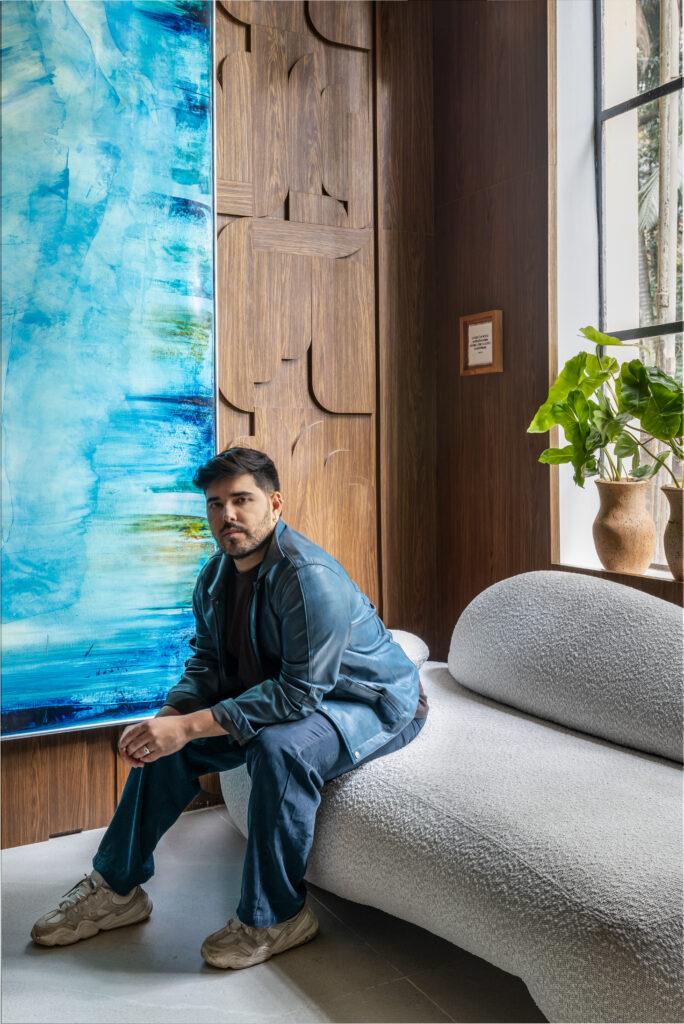
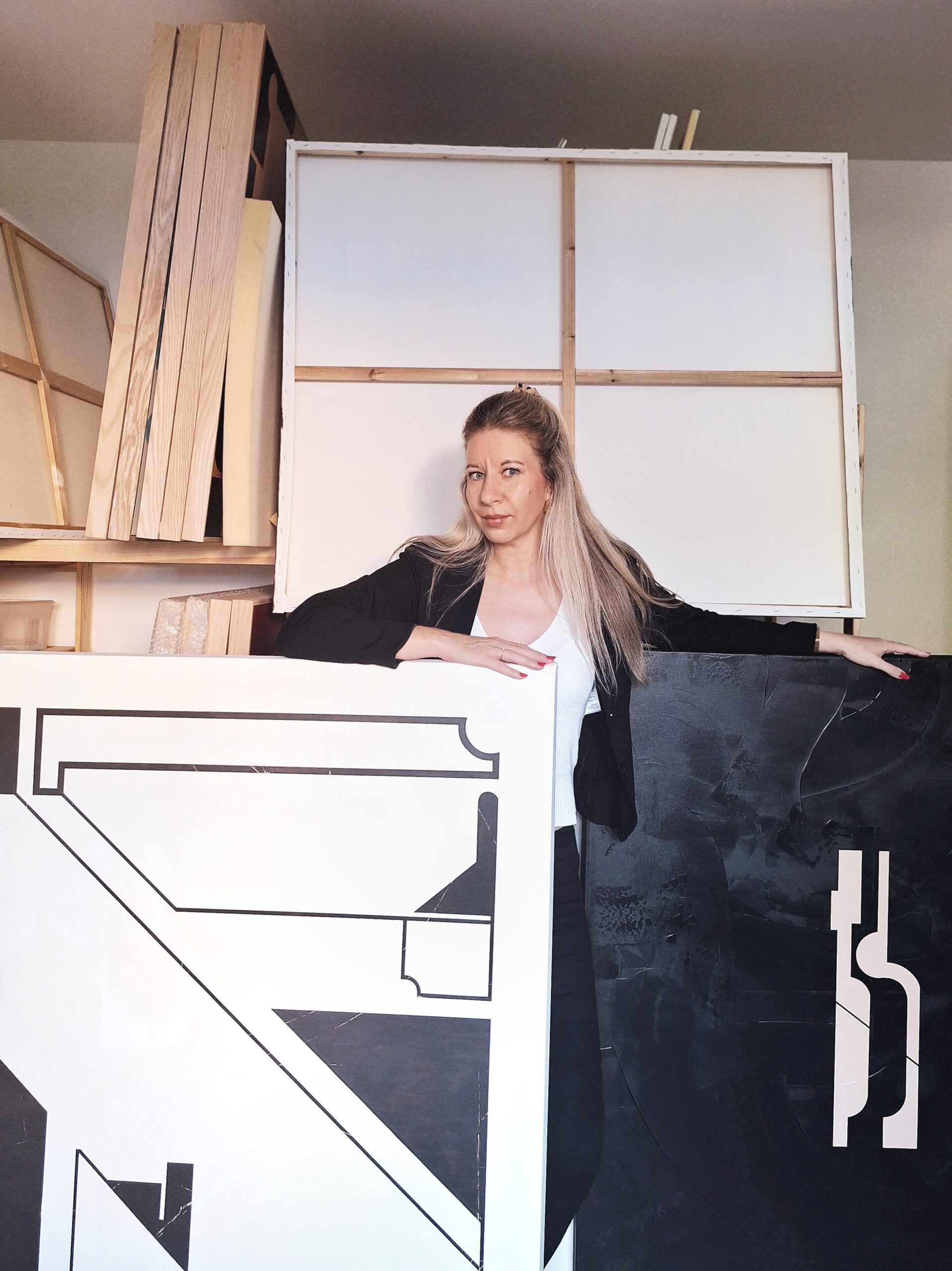
Architect Camilo Jr. at Espaço Gênese, his debut environment at CASACOR São Paulo 2026. Photo: Daniela Magario
A Rio de Janeiro native and the first architect in his family, Camilo Jr. built his professional trajectory in a way that runs counter to the sector’s typical patterns. Before founding his studio, Camilo Arquiteto, in 2022, he accumulated experience at startups across different industries, absorbing concepts of innovation, agile methodologies and a management perspective that today directly influences his design practice. From that hybrid formation, between the startup world and architecture, emerged an approach that values clear processes, efficient methods and the ability to identify and create opportunities where none yet exist.
Beyond projects with singular design and a distinctive voice, the architect has championed multidisciplinary thinking and become a reference for young professionals seeking to build careers from scratch. With three years of practice, Camilo Jr. is now part of the CASACOR SP program, a milestone that reflects an accelerated and consistent trajectory in a market historically demanding of newcomers.
From Studio to Book: Method as Philosophy
In February 2026, Camilo Jr. released the book “Método Arquiteto 360: A Visão Tech” (Architect Method 360: The Tech Vision), a theoretical and practical guide to management, marketing and sales aimed at architects and creative professionals who want to structure their careers using concepts tested in the startup world. The book draws on the author’s own trajectory and organizes, in a direct and accessible way, the processes that allowed him to build a studio with identity and market presence in a short time. Clear processes and efficient methods, Camilo Jr. argues, are not exclusive attributes of the technology sector. They are tools any creative professional can and should adopt to grow with consistency.
For the architect, the book and Espaço Gênese are expressions of the same principle. Understanding origins, whether those of humanity or of the creative market itself, is the surest path to designing the future. In the book, that principle takes the form of management and method. In the CASACOR space, it takes the form of stone, wood, stainless steel and art.
A Generation That Bets on Concept
At 29, with a CASACOR SP debut that combines conceptual depth, rigorous materiality, verifiable sustainability and a high-caliber curatorial program, Camilo Jr. establishes himself as one of the most consistent voices of the new generation of Brazilian design and architecture. Espaço Gênese is not simply a visitable, photographable space. It is an immersive and timeless experience that, in its material quietude, celebrates human intelligence and asserts, with conviction, that understanding where we come from is the most sophisticated exercise in thinking about where we can go.
In that sense, Camilo Jr.’s debut at Latin America’s largest design exhibition represents more than a personal achievement. It is a signal that a new generation of Brazilian architects understands that the market is changing and that projects with layers, with argument, with coherence between concept and execution carry growing relevance both in Brazil and on the international stage. With Espaço Gênese, Camilo Jr. did not merely keep pace with CASACOR SP 2026. He anticipated it.
CASACOR São Paulo 2026 is on view at Parque da Água Branca, 455 Avenida Francisco Matarazzo, Água Branca, São Paulo.