 Serpa
Serpa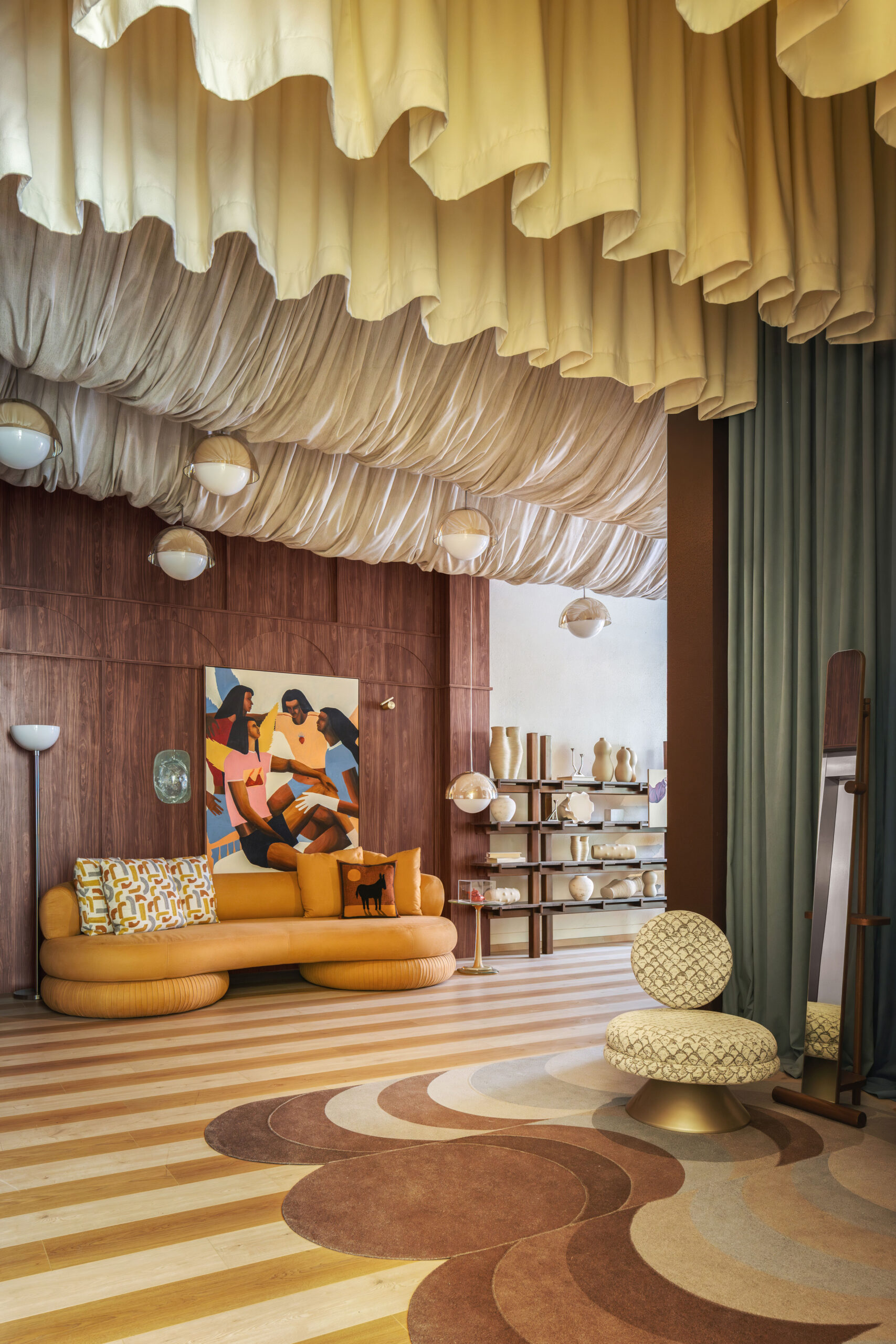
General view of the passageway installation, with its draped ceiling and wood-paneled walls setting the tone for “Ilha da Alma.” CASACOR São Paulo 2026 / Nicholas Oher. Photo: Maura Mello
Passageway installation at the São Paulo show invites reflection on identity after nine years of collaborative work.
SÃO PAULO – Designer Nicholas Oher is unveiling his first authored project as an independent architect at CASACOR São Paulo 2026. Named “Ilha da Alma,” or “Island of the Soul,” the installation occupies a passageway within the exhibition and engages directly with this year’s overarching theme, “Mind and Heart.” The debut arrives after nearly a decade of work built entirely around collective creation.
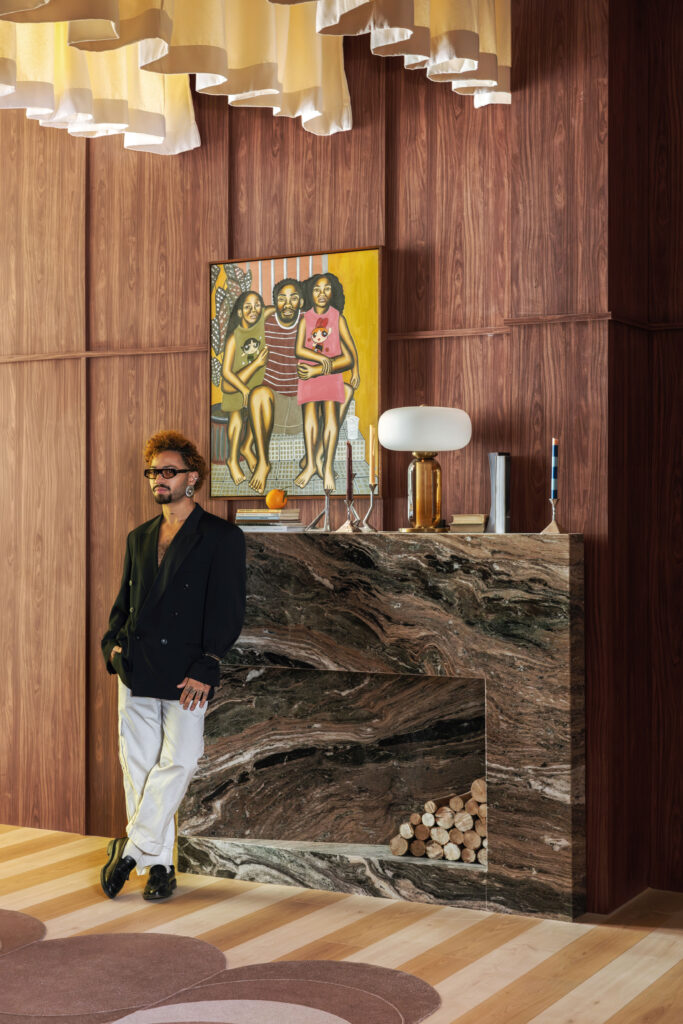
Architect Nicholas Oher, photographed within his debut solo installation, “Ilha da Alma,” at CASACOR São Paulo 2026. CASACOR São Paulo 2026 / Nicholas Oher. Photo: Maura Mello
A Personal Manifesto
Rather than functioning as a simply decorated space, the project reads as an intimate manifesto. Born from an exercise in self-examination, the installation invites visitors to revisit memories, attachments and references that shape their own sense of identity. The name itself distills that conceptual proposition.
For the architect, the word “ilha,” or island, represents a rare and deeply personal territory, one accessible only to the individual who holds it. “Alma,” or soul, refers to the essence a person carries quietly across a lifetime. Together, the two ideas form a symbolic space where memory and presence coexist.
“Ilha da Alma is the materialization of my inner universe. It is a place where I share my references, my memories and the paths that brought me here. I wanted to create an environment that spoke about me, while still allowing every visitor to find a piece of themselves,” Oher said.
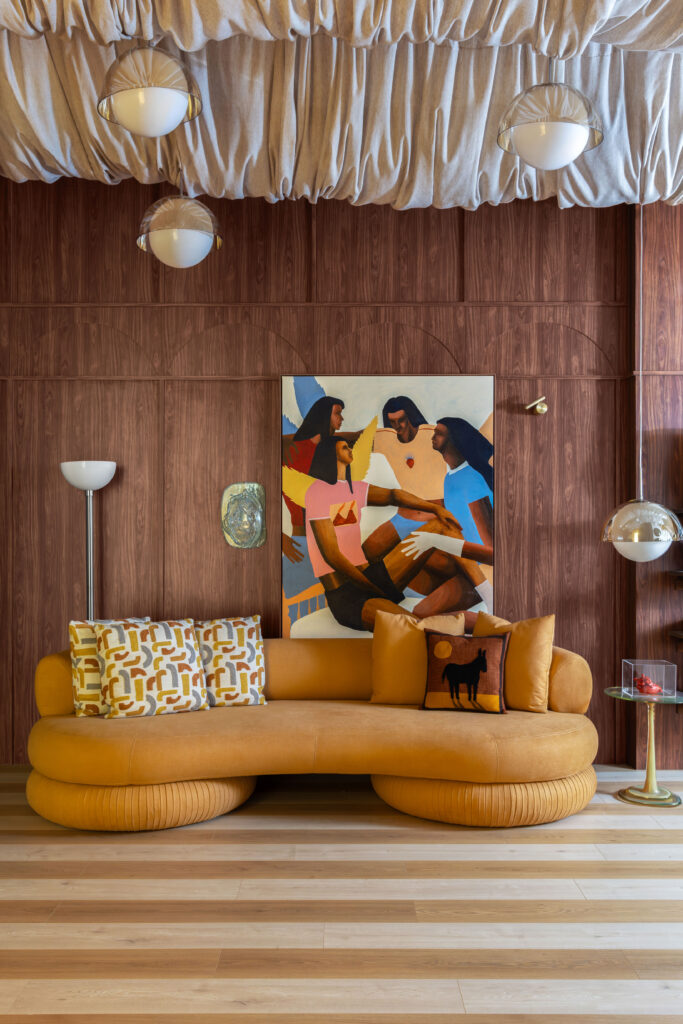
The living area beneath the sculpted fabric ceiling, anchored by a curved mustard-toned sofa and an original portrait painting. CASACOR São Paulo 2026 / Nicholas Oher. Photo: Maura Mello
Sanctuary in a Corridor
Installed within a passage of the exhibition, an area typically treated as pure circulation space, the intervention turns transit into sensory experience. The design recalls a contemporary cabin, suspended from daily life and conceived to slow visitors down, to let them sit, observe, read and reflect.
That choice of location carries its own meaning. Corridors are usually seen as spaces for quick transition inside architecture exhibitions, but the project reverses that logic by proposing pause over continuous flow, reinforcing the invitation toward introspection that runs through the installation’s entire narrative.
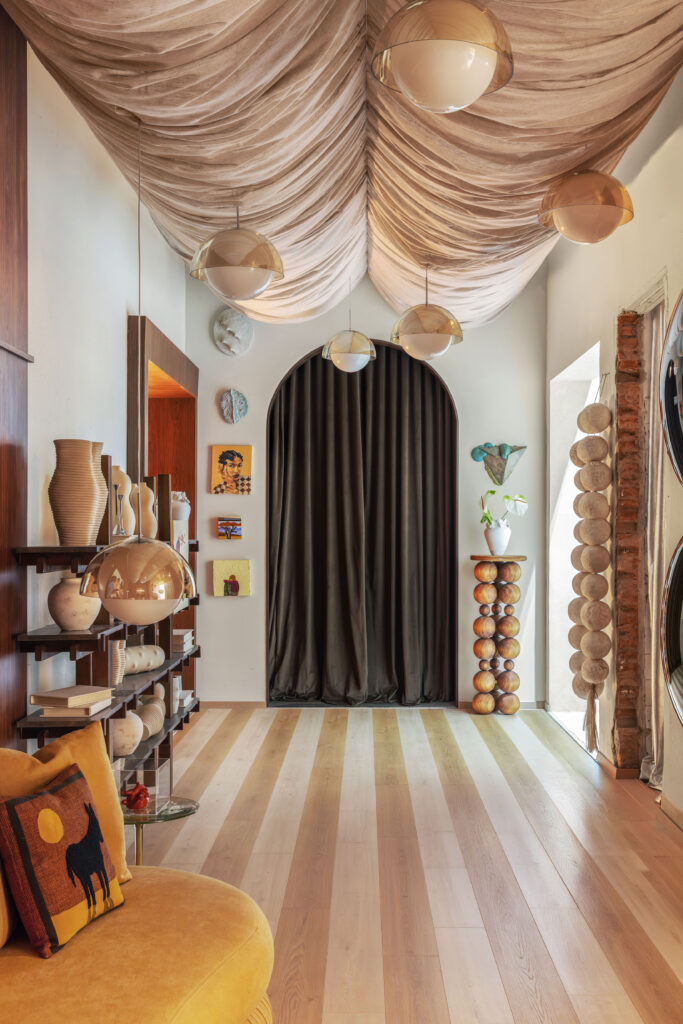
Vista da entrada de “Ilha da Alma”, com tecido drapeado no teto e iluminação âmbar conduzindo os visitantes em direção ao arco de veludo ao fundo. À esquerda, uma estante reúne referências pessoais de Nicholas Oher. Foto: Maura Mello
Light, Color and Material With Meaning
From a construction standpoint, the architecture was conceived as an embrace, according to its creator. Warm lighting, carrying an almost nostalgic atmosphere, creates a sense of welcome the moment a visitor climbs the entry staircase and crosses the threshold between corridor and refuge.
Warm wood tones dominate much of the interior palette, representing, in the project’s conceptual reading, whatever is solid, mature and permanent within a person. Deep blues appear at strategic points by contrast, evoking the vastness of thought, somewhere between the immensity of the sky and the depths of the sea.
No element was placed at random. Books scattered through the space reveal titles the architect has returned to throughout his life. Artworks placed around the room celebrate everyday Brazilian culture. Textures applied to finishes and fabrics carry specific emotional memories, each tied to a personal recollection.
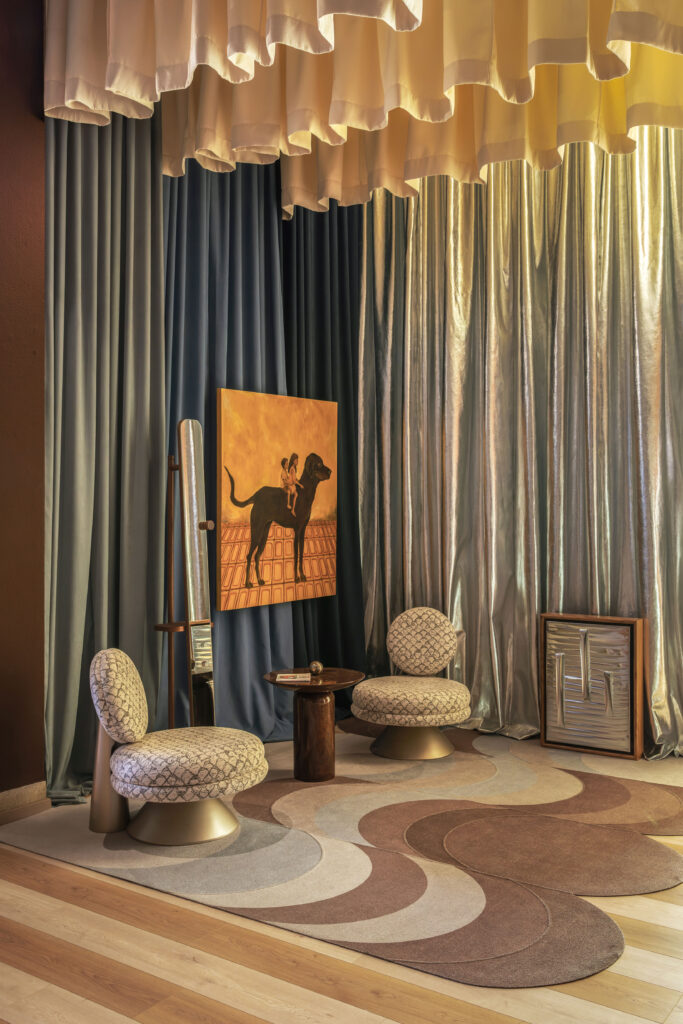
Detalhe de “Ilha da Alma”: cortinas em camadas nas cores azul, dourado e prateado emolduram um quadro e um espelho de pé, enquanto o padrão orgânico do piso — uma marca recorrente na obra de Nicholas Oher — percorre todo o espaço. Foto: Maura Mello
A Signature Line Running Through the Work
One of the most recurring elements in Oher’s creative language appears in the floor pattern, a signature present in nearly all of his previous projects. In “Ilha da Alma,” that same pattern returns to stitch together the spatial narrative, connecting past, present and future within a single design.
This visual signature acts as a throughline between the architect’s collective career and his first solo experience. Though the project marks a break in his working method, moving from group creation to individual authorship, the persistence of familiar elements underscores aesthetic continuity amid professional transition.
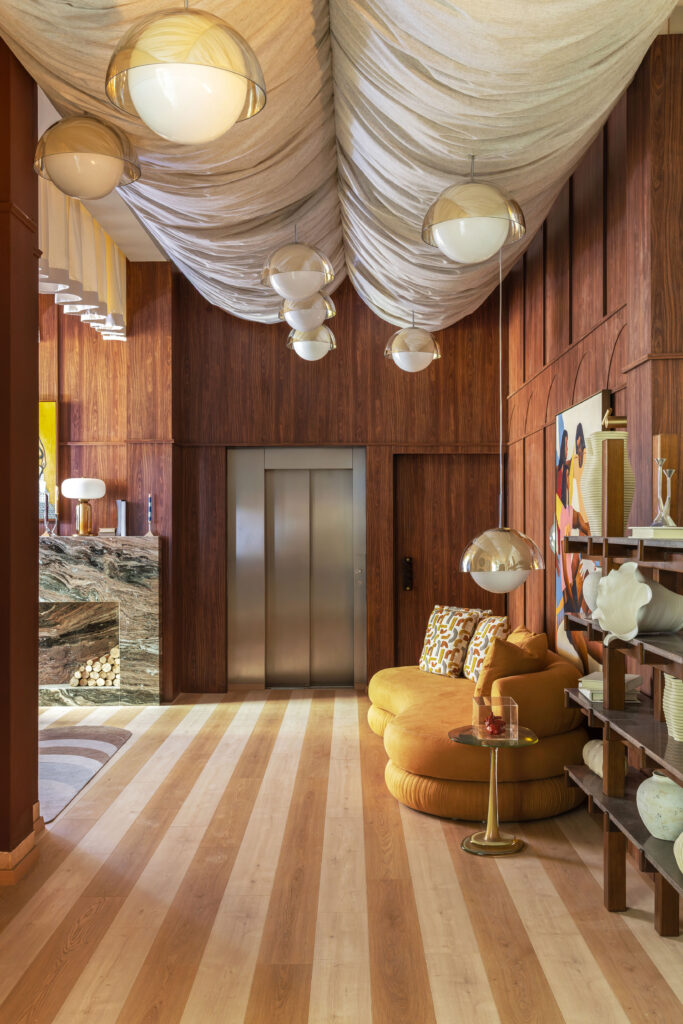
The striped oak floor, one of Oher’s recurring signatures, runs beneath the mustard sofa toward the wood-paneled backdrop. CASACOR São Paulo 2026 / Nicholas Oher. Photo: Maura Mello
Design as an Emotional Tool
The proposal arrives at a moment when interior architecture is increasingly discussed as a tool for emotional connection rather than purely functional or aesthetic solutions. “Ilha da Alma” enters that conversation by proposing a space centered on internal experience, in contrast to environments traditionally designed for display.
Contemporary discussions around slowing down and seeking quiet within increasingly connected urban environments speak directly to the proposal. At a moment when the world seems to accelerate constantly, the architect notes, the space suggests the opposite movement: turning inward.
Visitors who climb the stairs and cross into the sensory refuge are invited to access, symbolically, their own inner island, a quiet place that nonetheless remains ever-present, home to memories, dreams and the essence of each individual.
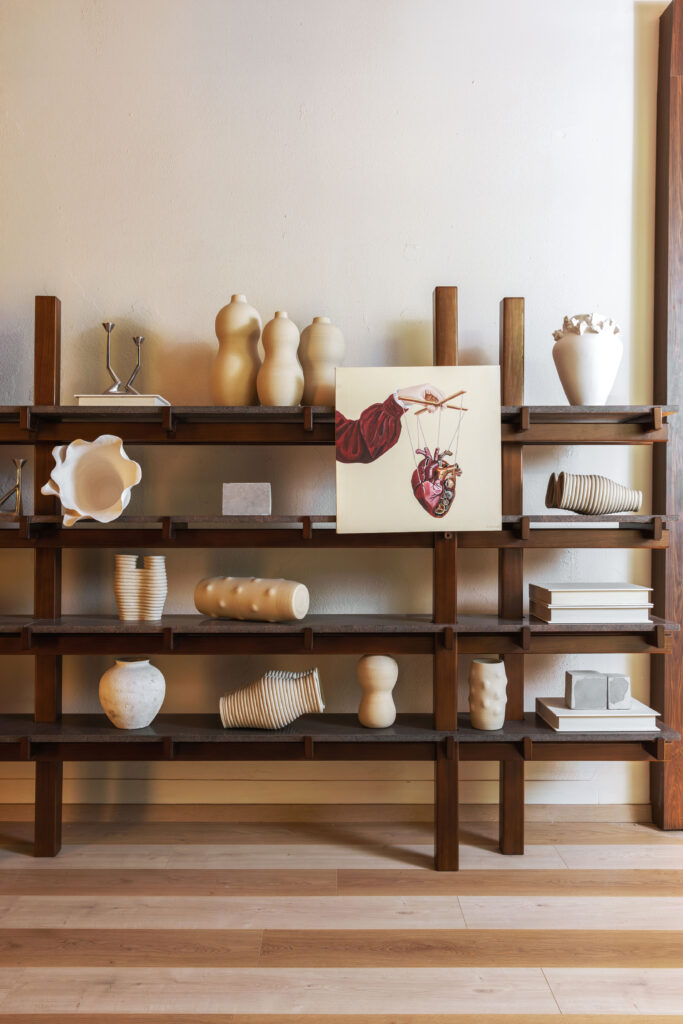
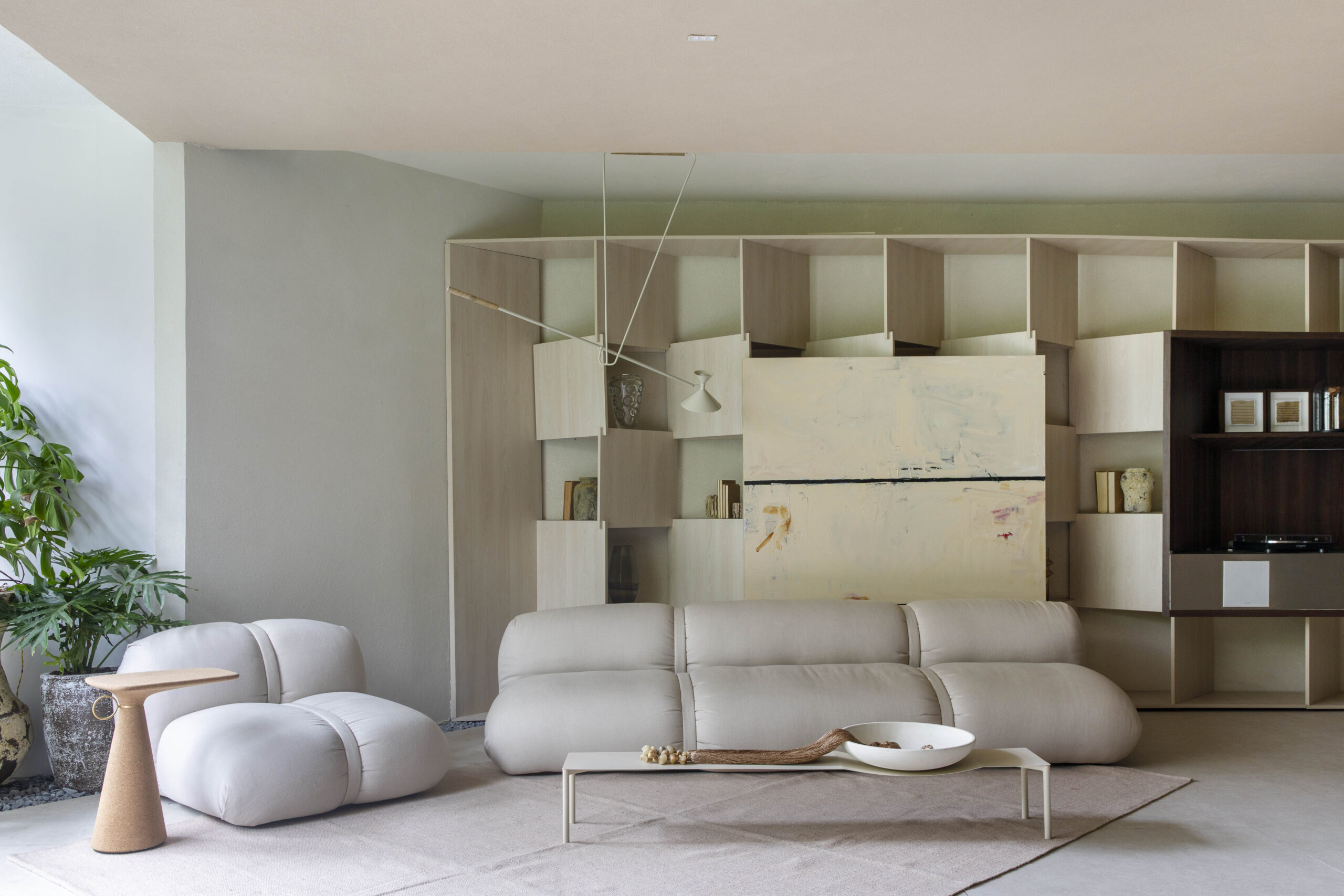
A hand-jointed wooden shelving unit displays a rotating still life of ceramics, books and small original paintings. CASACOR São Paulo 2026 / Nicholas Oher. Photo: Maura Mello
A Showcase for Emerging Names
It is worth noting that CASACOR, Brazil’s largest architecture, design and landscaping exhibition, traditionally brings established professionals together alongside emerging names, functioning as a significant launchpad for authored careers within the industry. Oher’s solo debut takes place in precisely that setting, closely watched by professionals, brands and specialized audiences alike.
After nearly a decade building a body of work through partnerships and collective projects, this moment marks a symbolic turning point in the architect’s career. Debuting individually with a project centered on introspection reinforces the coherence between conceptual discourse and career decision.
According to Oher, debuting solo at a show of CASACOR’s scale carries meaning that extends beyond showcasing technical work. It also represents, in his own words, a personal statement about professional identity, built across nine years of joint work and now reaffirmed on his own terms.
By turning architecture into narrative and space into feeling, “Ilha da Alma” sums up, in its creator’s own words, a crossing. The phrase captures both the physical experience offered to visitors, who climb a staircase and cross into a sensory environment, and the symbolic journey back to oneself suggested throughout the project’s design.
Details
CASACOR São Paulo 2026
Dates: June 2 to Aug. 9, 2026
Location: Parque da Água Branca, Rua Dona Ana Pimentel, São Paulo
Information: www.casacor.com
Instagram: @casacor_oficial